

Introduction
Customer acquisition costs on traditional channels like Facebook and Google Ads have reached unprecedented highs in 2027, forcing e-commerce and marketing managers to scrutinize cloud communications software pricing more closely than ever. While WhatsApp boasts open rates upward of 90% and has become the definitive arena for automated marketing campaigns, achieving true ROI requires balancing your Business Solution Provider (BSP) subscription costs against Meta's per-conversation fees.
Streamline your software evaluation process
The 2027 landscape is defined by a massive shift toward Hyper-Personalized AI Agents and the prioritization of Zero-Party Data. Enter Wati. Originally known for its straightforward customer support inbox, Wati has aggressively pivoted to capture the e-commerce marketing sector.
With the integration of Generative AI for automated replies, advanced drag-and-drop workflow builders, and native headless commerce sync, Wati positions itself as a highly competitive tool for D2C brands. It aims to bypass technical bottlenecks and scale revenue rapidly while keeping cloud communications software pricing predictable and manageable for growing teams.
But is it truly the optimal WhatsApp Business API platform for your specific marketing needs, or just another tool in an increasingly crowded market? In this comprehensive 2027 review, we will dissect Wati’s core capabilities, analyze its pricing structure against Meta’s latest per-message billing updates, and compare it head-to-head with top alternatives like Treble.ai, ManyChat, SleekFlow, Bird, Twilio, MessageBird, and Respond.io.
Tool | Best For | Implementation Time | Pricing (USD $) | Key Features | Use Cases |
Wati | E-commerce marketing & pure WhatsApp automation | 1-3 days | Starts at $39/mo + Meta fees | Gen AI replies, drag-and-drop workflows, native Shopify/WooCommerce sync | Abandoned cart recovery, automated D2C broadcasts, Click-to-WhatsApp ad funnels |
ManyChat | Social commerce across multiple platforms | 1-3 days | Starts at $15/mo + Meta fees | Omnichannel visual flow builder, IG/FB/WA integration | Cross-platform social media giveaways, influencer campaign automation |
Treble.ai | Enterprise-grade AI automation | 2-4 weeks | Custom Pricing | Advanced AI routing, complex CRM integrations, high-volume handling | Complex lead qualification, enterprise B2B marketing workflows |
SleekFlow | Omnichannel retail support | 1-2 weeks | Starts at $79/mo + Meta fees | Unified inbox (WeChat, Line, WA), in-chat payment links | O2O (Online-to-Offline) retail tracking, VIP customer clienteling |
Respond.io | Multi-agent customer support | 1-2 weeks | Starts at $79/mo + Meta fees | Advanced routing logic, multi-channel inbox, team performance analytics | High-volume inbound query management, support-to-sales handoffs |
Bird / Twilio / MessageBird | Developer-led custom integrations | 2-4 weeks | Pay-as-you-go (Volume based) | Raw API access, global telecom infrastructure, high scalability | Custom-built proprietary CRMs, massive-scale transactional alerts |
*Note: All prices shown reflect typical monthly billing. Vendors often offer lower pricing for annual commitments, but those discounts are excluded here for easier comparison. Actual costs may vary depending on your requirements, usage volumes, and negotiated terms.
Key Takeaways
Wati stands out in 2027 as a powerhouse WhatsApp API designed specifically for e-commerce brands prioritizing marketing ROI. It delivers immediate value for teams focused purely on WhatsApp, though omnichannel brands may need to look elsewhere.
Pricing and Value: Wati combines a flat monthly subscription with Meta's per-conversation billing. It is highly cost-effective for scaling broadcast campaigns, but smaller teams should monitor their Meta costs closely.
Core Capabilities: Users get immediate access to a drag-and-drop workflow builder, native CRM and Shopify sync, and granular analytics that accurately measure broadcast performance and conversion rates.
The Verdict: Choose Wati if WhatsApp is your primary revenue channel. If you need to manage SMS, Instagram, and WhatsApp from a single inbox, alternatives like Respond.io or SleekFlow are better equipped for your 2027 strategy.
Evaluating Wati for your WhatsApp marketing? Use AuthenCIO's free engine to compare top APIs.
Software Covered in this Article
The following articles break down the key aspects of Cloud Communications Software, featuring a carefully curated set of key players:






Core Capabilities: Why Marketing Managers Choose Wati in 2027
Finding the right WhatsApp CRM for marketing managers requires a platform that seamlessly bridges the gap between complex automation and user-friendly interfaces. Wati has made significant strides in this area, focusing on features that directly impact e-commerce ROI by empowering marketing teams to execute campaigns without relying on IT or engineering departments.
1. Advanced Automation and Workflow Builders
The most significant barrier to entry for automated WhatsApp campaigns has historically been the technical complexity of setting up multi-step flows. Wati’s 2027 iteration features a highly intuitive, drag-and-drop workflow builder specifically designed for non-technical marketing teams. You do not need developer resources to map out intricate customer journeys. This visual approach saves countless hours compared to manual coding and allows for rapid iteration of marketing funnels.
A standout feature is the integration of Generative AI for automated replies. Instead of relying on rigid, keyword-based decision trees that frustrate users, Wati’s Gen AI can interpret customer intent and handle dynamic responses within the boundaries of your brand voice.
For example, setting up a Meta-compliant abandoned cart recovery campaign is remarkably straightforward. You can deploy specific message templates that comply with 2027 Meta policies:
"Hi {{1}}, we noticed you left some great items in your cart! Complete your purchase in the next 2 hours using code {{2}} to get 10% off. [Button: Checkout Now] [Button: Need Help?]"
If the user clicks "Need Help?", Wati's Gen AI seamlessly takes over, answering product-specific questions by pulling data from your synced e-commerce catalog before routing them back to the checkout link.
Furthermore, Wati excels in top-of-funnel acquisition through Step-by-Step Automated 'Click-to-WhatsApp' Ad Funnels:
Connect Meta Business Manager: Link your Wati account directly to your Facebook Ads manager.
Create the Ad: Launch an ad on Facebook or Instagram with a "Send WhatsApp Message" call-to-action.
Configure Keyword Triggers: Set up a specific pre-filled message (e.g., "I want the VIP discount") that triggers a dedicated Wati workflow.
Build the Gen AI Qualification Flow: Use Wati to automatically ask qualifying questions (size, preference, location) based on the user's initial click.
Route to Conversion: Automatically send a personalized checkout link or route high-value leads to a human sales agent via the multi-agent dashboard.
2. Risk Mitigation: Managing Gen AI Hallucinations
While Generative AI offers incredible efficiency, marketing managers rightly worry about "hallucinations"—instances where the AI invents policies, offers unauthorized discounts, or misrepresents products. Wati addresses this critical 2027 concern by implementing strict brand-voice guardrails and knowledge-base constraints.
The AI is sandboxed to only pull answers from your approved documentation, synced product catalogs, and predefined FAQs. If a customer query falls outside these strict parameters, the system is programmed to execute a seamless fallback, immediately routing the conversation to a human agent rather than guessing an answer and risking brand reputation.
Native E-commerce Integrations and CRM Sync
Fragmented customer data caused by silos between the WhatsApp tool and the primary CRM is a major pain point that destroys personalization efforts. Wati addresses this by offering deep, native integration capabilities with modern headless commerce stacks, mid-market CRMs (like HubSpot and Salesforce), and standard platforms like Shopify and WooCommerce.
This native sync ensures that your WhatsApp marketing isn't operating in a vacuum. When a customer's order status changes in Shopify, Wati instantly triggers the corresponding WhatsApp template.
When a lead is qualified via a WhatsApp chat, the zero-party data they provide (like sizing preferences or product interests) is automatically enriched in your CRM, allowing for better cross-channel personalization in the future.
If you are currently locked into a restrictive BSP and want to leverage Wati's e-commerce focus, the transition is easier than ever. Here is a 5-step migration guide for moving from other Business Solution Providers to Wati:
Audit Existing Templates: Export all currently approved Meta templates and identify which ones are actively driving ROI to avoid migrating dead assets.
Export Contact Lists: Download your opt-in lists, ensuring you retain the exact timestamps of customer opt-ins to maintain compliance with stringent 2027 data privacy laws.
Disable 2FA on the Old BSP: Turn off Two-Factor Authentication on your existing WhatsApp Business API number to release it from the current provider.
Migrate via Embedded Signup: Use Wati’s Meta-embedded signup flow to instantly port your existing phone number without experiencing any significant downtime.
Re-sync Webhooks and CRMs: Reconnect your Shopify, WooCommerce, or custom CRM webhooks within Wati’s integration dashboard to resume automated flows immediately.
3. Broadcast Performance and Granular Analytics
Sending bulk campaigns is easy; ensuring they actually deliver and convert without getting your number banned is the real challenge. The risk of phone number blocking due to accidental non-compliant broadcast practices is a nightmare for marketing managers that can halt revenue overnight.
Wati provides robust broadcast performance tools that prioritize delivery rates and account health. To avoid bans during bulk broadcasts, marketing managers should follow this Checklist for verifying Meta compliance within Wati:
Verify Opt-in Health: Ensure your broadcast list only contains users who have explicitly opted in via compliant channels (website pop-ups, checkout checkboxes).
Segment by Engagement Tier: Use Wati's analytics to segment audiences based on past interaction. Send high-volume broadcasts only to users who have replied within the last 90 days to maintain high engagement scores.
Monitor Quality Rating: Keep a real-time eye on your WhatsApp phone number quality rating (Green, Yellow, Red) directly within the Wati dashboard.
A/B Test Small Batches: Before blasting 50,000 users, use Wati to send two variations of a template to 500 users each, monitoring block rates and reply rates before scaling to protect your sender reputation.
Wati's granular analytics allow you to track not just open rates, but the impact of rich media and interactive buttons on customer engagement levels, giving you the precise data needed to continually refine your messaging strategy.
Find Perfect Software for Your Business
Wati Pricing in 2027: Does the Value Match the Cost?
Evaluating cloud communications software pricing requires separating the vendor's subscription fees from Meta's underlying infrastructure costs. In 2027, Wati's pricing model reflects broader industry standards by charging a flat platform fee alongside usage-based message rates. Analyzing these tiers against your actual message volume is critical for assessing true ROI and avoiding budget overruns.
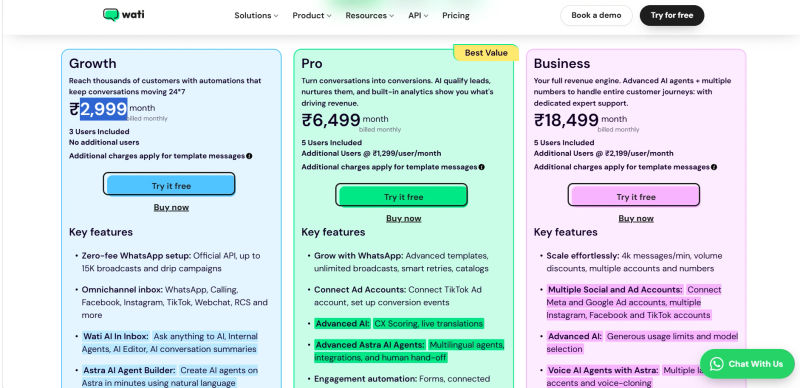
Meta Per-Message Billing vs. Wati Subscription
In 2027, understanding your WhatsApp API costs requires strictly separating software access from network delivery fees. Wati acts as the software interface, while Meta acts as the carrier.
Wati charges a flat monthly subscription fee (starting around $39/month for the Standard tier and $89/month for Advanced) which grants access to the platform, the workflow builder, and a set number of user seats. However, customers are fully subject to Meta’s per-delivered-message pricing model on top of this subscription. Wati either passes these Meta fees through or requires a prepaid Meta balance, depending on your exact billing configuration.
Meta's billing categorizes templates into Marketing, Utility, Authentication, and Service. Marketing messages carry the highest per-message cost, while utility and authentication are cheaper. Crucially, service messages sent within an open 24-hour customer-initiated window remain free.
To make this concrete, let's look at a hypothetical 2027 scenario: For a brand sending 50,000 marketing messages to a US-based audience, Meta's delivery fees would be approximately $1,250 (assuming roughly $0.025 per marketing message in North America). Adding the Wati Advanced subscription ($89) brings the total monthly bill to roughly $1,339.
To determine if Wati offers good value, marketing managers should use this updated ROI estimation framework to calculate the cost-per-conversion on WhatsApp vs. Email:
Calculate Total Campaign Cost: (Number of Marketing Messages Sent x Meta's Per-Message Rate for your Country) + (Pro-rated Wati Monthly Subscription Cost).
Isolate Paid Conversions: Deduct any conversions generated entirely within free 24-hour user-initiated service windows to accurately measure paid marketing ROI.
Calculate Conversion Value: Number of Paid Conversions x Average Order Value (AOV).
Determine WhatsApp CPA: Total Campaign Cost / Number of Paid Conversions.
Factor in LTV & Compare: Compare the repeat purchase rate of customers acquired via WhatsApp versus Email, then benchmark the final WhatsApp CPA against your current Email Marketing CPA.
While the upfront cost of sending a WhatsApp broadcast is undeniably higher than sending an email blast, real-world metrics consistently show that WhatsApp's CTR and conversion rate improvements (often 5x to 10x higher than email) result in a significantly lower overall Cost Per Acquisition (CPA). Wati's value lies in its ability to maximize those conversion rates through its advanced automation and native e-commerce integrations, justifying the higher per-message network cost.
Skip the sales pressure. Get an unbiased look at Wati's messaging automation on AuthenCIO.
Wati vs. The Competition: A Head-to-Head Comparison
While Wati is powerful, it is not the only player in the market. Depending on your specific business model, alternatives might offer a better fit. Let's compare Wati against the 2027 market leaders using a highly scannable breakdown.
1. Wati vs. ManyChat: Best for Social Commerce?
ManyChat built its reputation on Facebook Messenger and Instagram automation before expanding into WhatsApp.
ManyChat Strengths: Superior, unified visual flow builder for the entire Meta ecosystem. Ideal for cross-platform social commerce, such as running Instagram giveaways that funnel users into WhatsApp, or managing influencers across multiple Meta platforms.
Wati Strengths: Deep native integrations with Shopify and WooCommerce. Specialized focus on WhatsApp-specific compliance and template management.
The Verdict: If your primary goal is pure WhatsApp e-commerce automation, Wati takes the lead. It is a more robust choice for D2C brands that view WhatsApp as their primary retention channel rather than just an extension of social media.
2. Wati vs. Treble.ai: The Battle for Automation Efficiency
Treble.ai is a powerhouse when it comes to complex, enterprise-grade AI automation.
Treble.ai Strengths: Intricate routing logic, deep integrations with proprietary enterprise CRMs, and highly advanced lead qualification workflows. Unmatched customization for massive operations.
Wati Strengths: Accessibility, time-to-value, out-of-the-box functionality, and an intuitive drag-and-drop builder.
The Verdict: Treble.ai often requires a steeper learning curve and a more involved implementation process (2-4 weeks). For mid-market e-commerce marketing managers who need to launch abandoned cart flows and promotional broadcasts quickly (1-3 days) without relying on a dedicated technical team, Wati is optimized for rapid deployment and far more efficient.
3. Wati vs. SleekFlow: Which Offers Better Omnichannel Support?
SleekFlow is designed for omnichannel retail.
SleekFlow Strengths: Unified inbox across WhatsApp, WeChat, Line, and SMS. Exceptional Online-to-Offline (O2O) retail tracking and VIP clienteling features for in-store staff.
Wati Strengths: Unapologetically WhatsApp-first, offering deeper, more specialized WhatsApp features and e-commerce syncs.
The Verdict: If your business operates heavily across multiple chat apps, SleekFlow is superior. However, if your marketing budget is heavily concentrated on WhatsApp and you don't need to manage WeChat or Line, paying for SleekFlow's omnichannel capabilities might result in unnecessary bloat. Wati provides a more focused, streamlined experience.
Critical Pros and Cons for E-commerce Decision Makers
To make an informed decision, you must look beyond the marketing material and understand the platform's practical limitations and strengths based on aggregated user sentiment analysis from 2027 reviews.
The Pros:
Rapid Deployment: The platform is genuinely no-code, allowing marketing teams to launch complex automated campaigns in days, not weeks.
E-commerce Centric: Native integrations with Shopify, WooCommerce, and headless stacks mean your product catalogs and customer data sync flawlessly.
High-Traffic Resilience: Evaluation of the platform's scalability shows excellent uptime during high-traffic events like Black Friday, ensuring you don't lose revenue during critical sales periods.
Compliance Safeguards: Built-in tools help monitor template quality and opt-in health, significantly reducing the risk of Meta account bans.
Enterprise-Grade Data Security: Wati maintains strict 2027 data residency and GDPR compliance standards, ensuring that European and global enterprise-level decision-makers can securely manage zero-party data without regulatory friction.
The Cons:
Single-Channel Focus: If your audience expects support on Telegram, Line, or native webchat, Wati's WhatsApp-only focus will force you to use multiple disparate tools.
Support Bottlenecks: Expert insights into technical support responsiveness indicate that while Wati's platform is stable, getting complex technical issues resolved via their account managers can sometimes be slow for lower-tier subscribers.
Scaling Costs: Because Meta charges per delivered message, high-volume broadcast strategies can become expensive quickly if not carefully targeted and segmented. Wati does not mark up these fees, but the sheer volume enabled by their easy automation can lead to budget overruns if left unchecked.
Top 2027 Alternatives: When Bird, Twilio, or Respond.io Make More Sense
If Wati’s profile doesn't perfectly align with your needs, several other platforms warrant serious consideration.
4. Bird & Twilio
Bird (formerly MessageBird) and Twilio are titans of the API-first world, offering raw API access and unmatched scalability. However, they are built for developers, not marketing managers.
When evaluating cloud communications software pricing, the difference between these platforms and Wati is stark. Bird and Twilio utilize a pay-as-you-go, volume-based pricing model. You pay per message sent, which is highly cost-effective at a massive enterprise scale. In contrast, Wati relies on a fixed monthly subscription model bundled with a ready-to-use interface.
While Bird WhatsApp API pricing and Twilio's usage-based fees look cheaper on paper, they require significant engineering overhead. If you have an in-house engineering team to build a proprietary WhatsApp CRM from scratch, choose Bird or Twilio. If you want a ready-to-use software interface without development costs, stick with Wati.
5. Respond.io
Respond.io is a formidable alternative if your primary pain point is managing high volumes of incoming customer queries without significantly increasing headcount. While Wati has a multi-agent dashboard, Respond.io's routing logic, team performance analytics, and multi-channel inbox are arguably superior for heavy customer support operations.
If your WhatsApp strategy is 80% inbound support and 20% outbound marketing, Respond.io might be the better fit. If the ratio is reversed, stick with Wati.
Try AuthenCIO
Move to faster, smarter software evaluation with AI
Final Verdict: Should You Implement Wati for Your 2027 Strategy?
For e-commerce and marketing managers focused on driving measurable ROI through automated WhatsApp campaigns, Wati is a highly competitive tool in the 2027 market. It successfully abstracts the technical complexities of the WhatsApp Business API, replacing them with intuitive workflow builders, Generative AI integrations, and native e-commerce syncs that directly impact the bottom line.
Who is this not for? If you are an enterprise requiring deep, custom-coded integrations via Twilio, a brand relying heavily on omnichannel support across WeChat and Line (look to SleekFlow), or a business primarily focused on cross-platform social media giveaways (look to ManyChat), Wati may not be your optimal choice.
However, if your goal is to seamlessly connect your Shopify or headless commerce stack to WhatsApp, recover abandoned carts automatically, and launch highly targeted, Meta-compliant broadcast campaigns without writing a single line of code, Wati provides the exact infrastructure you need to succeed.
Next Steps for Marketing Managers:
If you are ready to move forward and start a trial, follow this implementation checklist to ensure a smooth launch:
Audit Current Templates: Review your existing messaging assets for compliance and performance.
Verify Meta Business Manager Status: Ensure your business is fully verified in Meta to avoid API throttling.
Map Your Core Workflows: Document your abandoned cart and welcome series logic before touching the software.
Prepare Your Product Catalog: Ensure your Shopify or WooCommerce data is clean for seamless syncing.