
Introduction
The year 2027 has solidified WhatsApp as the primary engine for conversational commerce, customer support, and direct-to-consumer marketing. For marketing managers and support leads, the challenge is no longer deciding whether to use the WhatsApp Business API, but determining which automation platform offers the best return on investment without spiraling costs.
Streamline your software evaluation process
Maximizing your whatsapp automation roi requires choosing the right platform from the start. You are evaluating Treble.ai because your brand needs a scalable conversational AI solution, but you cannot afford hidden fees, misaligned features, or unexpected API markups.
This guide breaks down Treble.ai's 2027 pricing structure, Meta's mandatory conversation-based charges, and how Treble.ai stacks up against top competitors like Wati.io, CallHippo, ManyChat, Twilio, Bird, SleekFlow, and MessageBird. Let us analyze the exact tool that fits your specific use case, team size, and financial budget.
Plan | Best For | Pricing ($) | Limitations | Setup/Onboarding Fee |
Treble.ai (Pro) | AI-driven conversational commerce | $99/mo + Meta fees | Limited custom CRM integrations on base tiers | $0 to $500 (Depending on CRM) |
Wati.io (Growth) | SMB Customer Support Teams | $49/mo + Meta fees | Lacks advanced omnichannel marketing flows | $0 (Self-serve) |
ManyChat (Pro) | Marketing-Led Conversational Flows | $15/mo + Meta fees | Focused heavily on social, weak on support ticketing | $0 (Self-serve) |
Twilio (Pay-as-you-go) | High-Volume Developer-First Brands | $0.005/msg + Meta fees | Requires heavy developer resources to build UI/UX | Custom Developer Costs |
Bird (CRM) | Marketing Automation Scale | Custom + Meta fees | Steep learning curve for non-technical marketing users | Custom Enterprise Fee |
SleekFlow (Pro) | Omnichannel Sales Integration | $79/mo + Meta fees | Advanced automation requires higher enterprise tiers | $300+ (Guided setup) |
MessageBird (Omnichannel) | Global Communication Infrastructure | Custom + Meta fees | Enterprise-focused pricing can alienate smaller SMBs | Custom Enterprise Fee |
CallHippo (Business) | Voice-First Global Communications | $40/user/mo | Primarily voice-first; WhatsApp is an add-on channel | $0 (Self-serve) |
*Note: All prices shown reflect typical monthly billing. Vendors often offer lower pricing for annual commitments, but those discounts are excluded here for easier comparison. Actual costs may vary depending on your requirements, usage volumes, and negotiated terms.
Software Covered in this Article
The following articles break down the key aspects of Cloud Communications Software, featuring a carefully curated set of key players:







2027 WhatsApp Automation Pricing Comparison
Evaluating WhatsApp automation pricing in 2027 requires looking far beyond the monthly software subscription fee. The market has shifted dramatically from simple broadcast tools to complex conversational commerce engines that handle discovery, qualification, checkout assistance, and post-purchase support within a single messaging workflow.
As a decision-maker, you must analyze the Total Cost of Ownership (TCO), which includes the platform fee, per-user seat costs, AI-agent consumption rates, and the mandatory Meta API fees.
Treble.ai positions itself as a robust mid-market to enterprise solution, heavily focused on integrating AI agents to deflect support tickets and drive automated sales. However, comparing it directly to a tool like ManyChat or Wati.io requires understanding that these platforms serve fundamentally different primary use cases.
A low monthly software fee from a basic provider can still produce a higher total cost if the platform has expensive usage markups, limited automation capabilities that force human handoffs, or weak integrations that require custom developer work.
When comparing these platforms, you must evaluate the unit economics at the message level. A single automated journey may contain several billable templates, making your category mix—marketing versus utility—a critical variable.
The comparison table above highlights the baseline entry points, but the true financial impact of your choice will depend entirely on your monthly conversation volume, your ratio of human agents to AI agents, and your geographic market.
Treble.ai Pricing Plans Breakdown: What Do You Actually Get?
Treble.ai’s 2027 pricing architecture is designed to scale with your conversation volume and your reliance on artificial intelligence. Unlike legacy platforms that charge strictly by human seats, Treble.ai monetizes the efficiency of its AI agents.
Understanding these tiers is essential to prevent overpaying for features you do not need or under-provisioning your support team.
1. Starter vs. Professional: Finding the Sweet Spot for Growth
The Essential Plan: Best for Low-Volume Pilots
Starting at approximately $49 per month, the Essential tier is built for brands just transitioning from the free WhatsApp Business App to the official API. It includes basic chatbot functionality, up to 2 human-agent seats, and standard automated replies.
Value for Money: High for small teams, but the limitations become apparent quickly. You do not get access to advanced AI resolution capabilities or deep CRM integrations.
Limitations: If your ticket volume spikes, the lack of AI deflection means you will need to hire more human agents, driving up your operational overhead.
The Professional Plan: Best for Mid-Market Growth
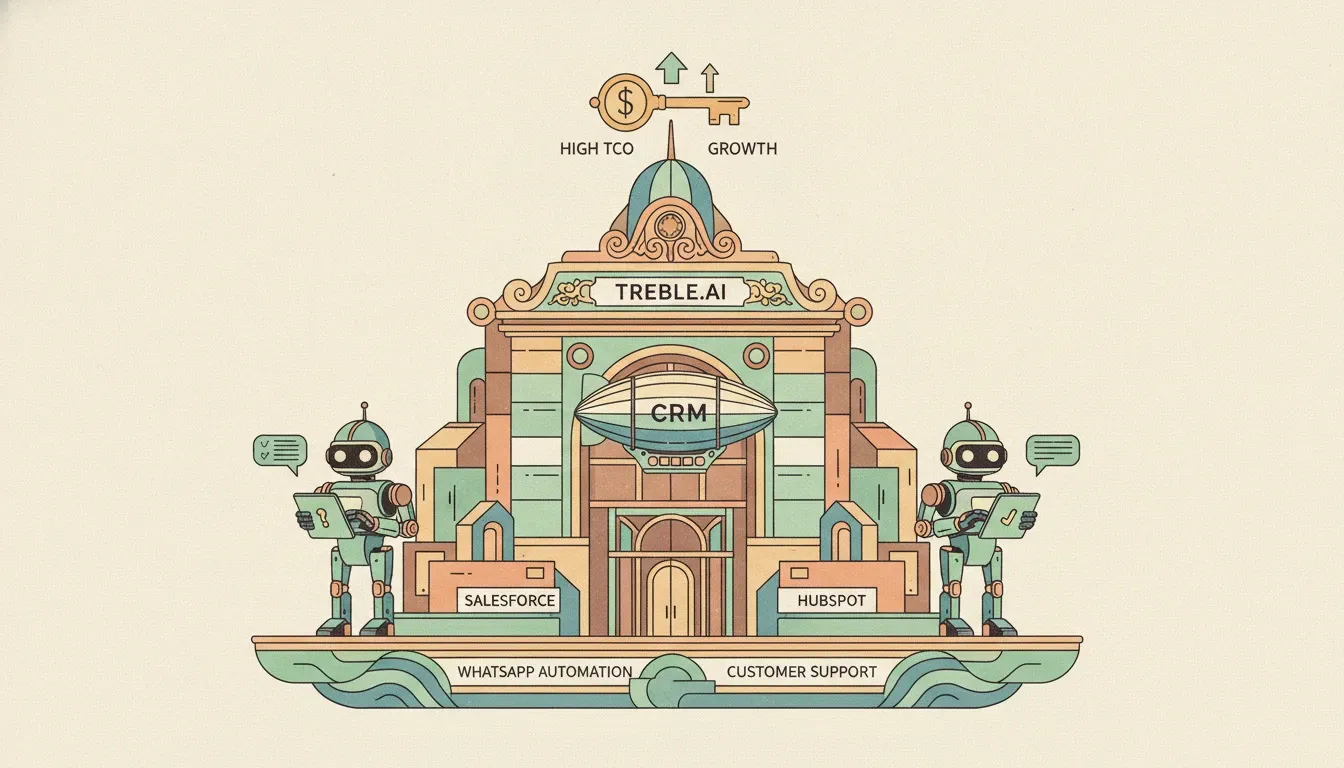
At roughly $99 per month, this is the sweet spot for most growing brands. The Pro tier unlocks Treble.ai’s core value proposition: up to 5 dedicated AI-agent seats and advanced integrations with CRMs like HubSpot and Salesforce.
Value for Money: This plan offers the best balance. By utilizing AI to handle routine inquiries, you significantly reduce the cost per resolved interaction.
Limitations: There are still caps on the number of complex automated workflows you can run simultaneously, and you are subject to standard API rate limits (which can cause potential message delays during peak traffic if not managed properly).
2. Enterprise Solutions: Custom API Limits and Dedicated Support
For large-scale operations, Treble.ai offers custom pricing that typically starts in the thousands per month. This tier provides unlimited AI-agent seats, volume-based discounts on platform usage, custom API rate limits, dedicated account management, and bespoke technical onboarding.
Value for Money: For brands processing hundreds of thousands of messages monthly, the volume discounts on AI interactions offset the high subscription cost.
Limitations: The financial commitment is substantial, requiring rigorous internal business cases and CFO approval before implementation.
Time-to-Value and Integration Depth
A critical factor in software evaluation is onboarding speed. Treble.ai offers a realistic time-to-value of 2 to 4 weeks for the Professional tier.
The platform provides out-of-the-box, bi-directional sync for HubSpot and Salesforce, meaning marketing managers can trigger WhatsApp templates based on CRM deal stages without writing custom code. However, highly customized CRM objects will require the Enterprise tier's dedicated technical support to map correctly.
Hidden Costs and WhatsApp Business API Costs 2027
The most common reason marketing managers experience "bill shock" is a fundamental misunderstanding of Meta's pricing model. Your Treble.ai subscription does not cover the cost of sending messages through the WhatsApp network.
Meta charges businesses on a per-message basis for each message delivered, and these rates vary drastically based on the recipient's country and the message category. Accurately forecasting your whatsapp business api costs 2027 is non-negotiable.
1. Understanding the Four Message Categories
In 2027, Meta strictly enforces four template categories, each with its own pricing structure:
Marketing Messages: These are promotional messages, offers, and cart abandonment reminders. They are the most expensive category. A poorly targeted marketing campaign can drain your budget rapidly.
Utility Messages: These include order updates, shipping notifications, and appointment reminders. They are significantly cheaper than marketing messages and often qualify for volume-based pricing tiers, creating economies of scale for brands with recurring transactional messaging.
Authentication Messages: Used for one-time passwords (OTPs) and account recovery. These are priced similarly to utility messages.
Service Messages: These are user-initiated conversations. When a customer messages you, a 24-hour customer service window opens. Non-template replies sent during this window incur a specific service fee, which Meta updated in late 2026.
2. Regional Pricing Variations and Free Entry Points
Country-level segmentation is essential for global brands. You must calculate a blended cost per delivered message by country rather than applying one average global rate.
Additionally, you must account for Meta's free entry points. Messages triggered by a user clicking a "Click-to-WhatsApp" ad on Facebook or Instagram initiate a 72-hour period where messages are not charged under Meta's published API rates. Maximizing these entry points is a critical strategy for minimizing your overall marketing category fees.
3. Hypothetical Billing Scenario: India vs. UK
To illustrate the impact of regional and category variance, consider a brand sending 10,000 messages in a single month.
Scenario A (Marketing in India): Sending 10,000 marketing templates to users in India will cost approximately $118 in Meta fees (based on typical 2027 USD card rates).
Scenario B (Utility in the UK): Sending 10,000 utility templates to users in the United Kingdom will cost roughly $380 in Meta fees.
Even though utility messages are inherently cheaper than marketing messages, the geographic location of the recipient dramatically shifts the final invoice.
Your Treble.ai subscription cost remains flat, but your API consumption costs will fluctuate wildly based on these two variables.
4. The Risk of Misclassification
Pricing transparency and message categorization matter more than ever. Brands must audit whether each template is genuinely marketing, utility, or authentication.
Misclassifying a promotional message as a utility message to save money will result in template rejection, account penalties, and distorted financial forecasts. Treble.ai mitigates this risk by offering an AI-driven pre-flight template checker that analyzes your copy and accurately predicts Meta's category classification before you submit it for approval.
Find Perfect Software for Your Business
The Competitor Landscape: Pricing and Use Cases
To make an informed decision, you must compare Treble.ai against the broader market. Every tool has a distinct primary use case.
Choosing the wrong platform will result in paying for unused features or struggling with technical limitations.
1. Wati.io: Best for SMB Customer Support Teams
Wati.io is designed for small to medium businesses that need a shared team inbox and basic automation. It excels at collaborative customer support.
Pricing Differences: Analyzing treble.ai vs wati pricing reveals that Wati.io is generally more affordable at the entry level, starting at $49/month.
Value for Money: Excellent for straightforward support, but it lacks the sophisticated AI-driven commerce flows and deep marketing attribution models that Treble.ai offers. It is a tool built for human agents first, bots second.
2. ManyChat: Best for Marketing-Led Conversational Flows
ManyChat dominates the social media to WhatsApp pipeline. If your primary goal is building visual flows to capture leads from Instagram and route them to WhatsApp, ManyChat is unparalleled.
Pricing Differences: Highly accessible, starting at very low monthly rates (around $15/month).
Value for Money: Incredible for top-of-funnel marketing. However, it is fundamentally weak when it comes to complex, multi-tiered support ticketing, making it a poor choice for support leads looking to deflect complex customer queries.
3. SleekFlow: Best for Omnichannel Sales Integration
SleekFlow focuses heavily on social selling, integrating seamlessly with platforms like Shopify and Stripe to enable in-chat checkouts.
Pricing Differences: Comparable to Treble.ai's mid-tiers at $79/month, but advanced automation requires upgrading to their premium plans.
Value for Money: If your entire business model is built on direct conversational sales and immediate payment collection, SleekFlow is a strong contender. Treble.ai, however, offers more robust AI deflection for post-purchase support and complex CRM routing.
Skip the sales pressure and compare Treble.ai rates side-by-side with top competitors on AuthenCIO.
4. Twilio & Bird: Best for High-Volume Developer-First Brands
Twilio is not an out-of-the-box software; it is a raw communications API. It is built for engineering teams that want to construct their own bespoke WhatsApp interfaces.
Pricing Differences: Twilio operates on a pure pay-as-you-go model with a tiny markup on Meta's fees.
Value for Money: The software cost is minimal, but the hidden cost lies in the expensive developer resources required to build, maintain, and update the UI/UX. It is not suitable for marketing managers looking for a plug-and-play solution.
Bird (formerly part of the broader MessageBird ecosystem but heavily rebranded for CRM and marketing) focuses on massive scale marketing automation for enterprise brands.
Data Residency and Security Compliance: For enterprise brands, Bird offers rigorous compliance standards, including GDPR adherence, ISO 27001 certification, and strict EU/US data residency options.
Value for Money: Highly powerful for data-heavy marketing teams, but it presents a steep learning curve for non-technical users compared to Treble.ai's more intuitive interface.
5. CallHippo: Best for Global Communication Infrastructure
CallHippo is primarily a virtual phone system and call center software that has added WhatsApp as an omnichannel feature.
Pricing Differences: Priced per user/seat, focusing heavily on voice capabilities.
Value for Money: If your support team is primarily voice-based and WhatsApp is a secondary channel, CallHippo makes sense. If WhatsApp is your primary growth engine, Treble.ai is vastly superior.
Calculating Your WhatsApp Automation ROI
To justify the cost of Treble.ai or any of its competitors to executive leadership, you must build a defensible ROI calculation. A simple comparison of monthly subscription fees is insufficient.
You must implement a Total Cost of Ownership framework and measure it against incremental gross profit.
Step 1: Estimate Monthly Conversation Volume
Begin by analyzing your current website traffic, social media engagement, and existing support ticket volume. Project how much of this traffic will be routed to WhatsApp via Click-to-WhatsApp ads, website widgets, and QR codes.
Accurate volume forecasting prevents unexpected overages.
Step 2: Map the Category Mix
Determine the ratio of your messages. Will your volume be 70% utility (cheap, transactional) and 30% marketing (expensive, promotional)?
This mix dictates your foundational Meta API costs and informs how much you should allocate to your software subscription.
Step 3: Calculate the Total Cost of Ownership (TCO)
Your TCO formula is:
(Meta Platform Fees) + (Treble.ai Subscription & Usage Fees) + (Internal Implementation Costs) + (Human Escalation Costs).
Do not ignore the cost of human agents. A platform with a cheap subscription but a poor bot builder will result in high human escalation costs, ruining your ROI.
Step 4: Measure Support Deflection Savings
For support leads, ROI is found in deflection. If Treble.ai’s AI agents can resolve 40% of tier-1 inquiries without human intervention, calculate the hourly wage savings of your support staff.
Track the cost per resolved interaction rather than just the cost per message. This is where Treble.ai's AI-agent pricing model proves its worth.
Step 5: Attribute Incremental Revenue
For marketing managers, the strongest measurement approach is incremental. Compare an automated WhatsApp journey with a control group or your previous email/SMS baseline.
Track delivered messages, opt-in rates, response rates, qualified-lead rates, conversion rates, and Average Order Value (AOV).
Customer Lifetime Value (CLV) Impact
Beyond immediate conversions, you must factor in Customer Lifetime Value. WhatsApp automation excels at post-purchase engagement.
By using utility messages for seamless order tracking and AI agents for instant troubleshooting, you increase customer satisfaction and repeat purchase rates. A 5% increase in retention driven by a superior WhatsApp experience can mathematically justify the entire annual cost of a platform like Treble.ai.
Your break-even point is reached when your incremental gross profit (driven by WhatsApp marketing conversions and CLV growth) plus your verified support savings (driven by AI deflection) exceeds your TCO.
Try AuthenCIO
Move to faster, smarter software evaluation with AI
Final Verdict: Is Treble.ai the Right Investment for Your Brand?
Choosing the right WhatsApp automation tool in 2027 comes down to aligning the platform's primary strength with your most pressing business bottleneck.
If your brand is a small business focused entirely on collaborative human support, Wati.io offers a more cost-effective entry point. If you are a developer-heavy enterprise looking for raw infrastructure, Twilio or MessageBird are the logical choices. If your sole focus is top-of-funnel social media lead generation, ManyChat is the undisputed leader.
However, if you are a growing mid-market brand that requires a sophisticated blend of AI-driven customer support deflection and targeted conversational commerce, Treble.ai justifies its price point.
The platform's ability to integrate deeply with enterprise CRMs and utilize AI to lower the cost per resolved interaction makes it a financially sound investment, provided you accurately forecast your Meta API fees and maintain high-quality, segmented message flows.
30-Day Evaluation Checklist
To ensure you make a data-driven financial decision, use this checklist over the next 30 days:
Audit Current Channels: Document your current SMS and Email spend, alongside human support hours dedicated to tier-1 tickets.
Map 3 Core Workflows: Identify the top three journeys you want to automate (e.g., abandoned cart, order tracking, FAQ resolution).
Forecast Volume: Estimate your monthly message volume and categorize it strictly into Marketing, Utility, Authentication, or Service.
Run a TCO Calculation: Use the formula provided above to estimate your total monthly spend with Treble.ai versus a competitor like Wati.io or ManyChat.
Test CRM Sync: During your demo, specifically ask to see the bi-directional sync capabilities with your exact CRM setup (HubSpot, Salesforce, etc.).