
Introduction
Evaluating cloud communications software pricing in 2027 requires looking beyond basic monthly subscriptions, particularly when integrating WhatsApp Business APIs like Wati. For e-commerce store owners and digital marketing decision-makers, the true cost of scaling sales on WhatsApp involves a complex matrix of platform fees, user seat limits, and Meta’s conversation-based pricing model. You are here to make a financial decision about your cloud communications stack, not just to learn about features. We will expose the hidden costs, highlight the strict limitations of each platform, and position every tool with its primary use case so you can choose the most cost-effective solution for your specific operational needs.
Key Takeaways for Decision-Makers:
Streamline your software evaluation process
Total Cost of Ownership (TCO) matters most: Base subscriptions are just the start; you must factor in Meta’s conversation fees, per-seat markups, and AI surcharges to accurately project your cloud communications software pricing.
Align the tool with your bottleneck: Choose Wati for shared support inboxes, Treble.ai for sales automation, and ManyChat for budget-friendly marketing.
Watch for hidden 2027 fees: Migration costs, data residency compliance, and Meta fee markups can drastically alter your expected ROI.
How Cloud Communications Software Pricing Works in 2027
Cloud communications software pricing in 2027 is divided into two primary models: Communications Platform as a Service (CPaaS) and Software as a Service (SaaS). Understanding this distinction is critical before comparing tools like Wati, Twilio, or SleekFlow, as it dictates whether you pay for raw infrastructure or a ready-to-use interface.
CPaaS (Pay-As-You-Go): Providers like Twilio charge micro-fractions of a cent per API call or message sent. You pay only for what you use, but your team must build and maintain the software interface.
SaaS (Seat-Based & Tiered): Platforms like Wati and ManyChat charge a flat monthly subscription based on user seats, contact limits, or feature access. These tools provide a visual inbox and no-code automation builders out of the box.
Regardless of the software model you choose, WhatsApp API pricing includes Meta's mandatory conversation-based fees. Your total cloud communications software pricing will always equal your platform fee (SaaS subscription or CPaaS usage) plus Meta's per-conversation charges for marketing, utility, authentication, or service messages.
WhatsApp API Cost Comparison 2027: Wati vs. The Field
Before comparing platforms, it is crucial to understand that these WhatsApp Business Solution Providers (BSPs) operate as distinct cloud communications software solutions. The market is divided into two primary models: out-of-the-box SaaS pricing (monthly subscriptions for ready-to-use interfaces like Wati) and API infrastructure pricing (pay-as-you-go models for developer-centric platforms like Twilio). While Wati has traditionally dominated the mid-market e-commerce space with its straightforward shared inbox, specialized tools now offer better value depending on whether you need a turnkey application or raw infrastructure.
Plan | Best For | Pricing (USD $) | Meta Fee Markup | Limitations |
Wati (Pro) | Growing e-commerce teams needing shared inboxes | $99/month | None (Direct Pass-through) | Steep costs for extra seats; basic chatbot builder |
Treble.ai | High-conversion sales automation & CRM sync | $99/month | None (Direct Pass-through) | Overkill for simple support; requires setup time |
ManyChat (Pro) | Budget-friendly marketing flows & social synergy | $15/month | None (Direct Pass-through) | Limited complex routing for enterprise support |
SleekFlow (Pro) | Multi-channel social selling (O2O) | $79/month | Varies by tier | WhatsApp API costs are separate; seat limits apply |
Respond.io (Team) | Complex customer support workflows & SLAs | $99/month | None (Direct Pass-through) | Primarily support-focused; marketing features are secondary |
Bird (CRM) | Enterprise-grade global messaging campaigns | Custom / Volume-based | Custom markup applied | High barrier to entry for small businesses |
Twilio | Technical teams & scalable API infrastructure | Pay-as-you-go | ~$0.005 per message | Requires developer resources; no native UI |
Whether you need an out-of-the-box SaaS platform to automate abandoned cart recovery or scalable API infrastructure to build custom integrations, selecting the wrong cloud communications software can lead to thousands of dollars in wasted subscription fees and development costs.
Software Covered in this Article
The following articles break down the key aspects of Cloud Communications Software, featuring a carefully curated set of key players:







Wati Pricing Breakdown 2027: Plans, Limits, and Hidden Costs
Wati has positioned itself as a go-to WhatsApp Business API for small to medium e-commerce brands. However, as your transaction volume grows, Wati’s pricing structure requires careful scrutiny to ensure you are getting true value for money.
Wati's Core Pricing Tiers
Wati divides its offerings into distinct tiers, each designed for a different stage of business growth:
Growth Plan (Approx. $49/month): Designed for small teams starting with WhatsApp marketing. It includes a basic shared team inbox, standard chatbot features, and a limited number of user seats (usually 5). This plan is strictly for businesses with low conversation volumes.
Pro Plan (Approx. $99/month): Built for scaling e-commerce stores. This tier unlocks advanced integrations (like Shopify and HubSpot), granular reporting, and more complex automated routing. It is the most popular choice for established online retailers.
Business Plan (Approx. $299/month): Geared toward high-volume senders needing priority support, dedicated account management, and higher API rate limits for massive broadcast campaigns.
Hidden Costs and Value for Money
The headline subscription price is only the beginning. Decision-makers must account for the dual-layered pricing model. Wati charges its software fee, but you are also responsible for Meta’s conversation fees.
Seat Limitations: Wati’s base plans come with a fixed number of users. If your customer support team expands during peak seasons (like Black Friday), you will pay a premium (often $15 to $20 per additional user per month). This can rapidly inflate your fixed costs.
Green Tick Verification: Acquiring the Official Business Account (Green Tick) is a major trust factor for e-commerce brands. While Wati assists with the application process within its platform, the stringent approval process requires time and brand readiness. Ensure you account for the operational delay this might cause.
Migration Note: Porting an existing WhatsApp number to Wati is a standard procedure, but it requires careful planning to avoid downtime. You must ensure your previous BSP releases the number promptly.
Who is Wati Best For?
Wati is best for mid-sized e-commerce brands that need a plug-and-play shared inbox and basic automation without hiring a developer. If your primary goal is to get multiple support agents answering WhatsApp messages quickly, Wati offers solid value.

Treble.ai and ManyChat: Best for Marketing Automation and Chatbots
If Wati’s feature set does not align with your aggressive marketing goals, Treble.ai and ManyChat offer specialized alternatives focused heavily on automation, lead generation, and conversion.
1. Treble.ai: Best for High-Conversion Sales Automation
Treble.ai is engineered specifically for revenue teams that want to turn WhatsApp into a primary sales channel rather than just a support inbox.
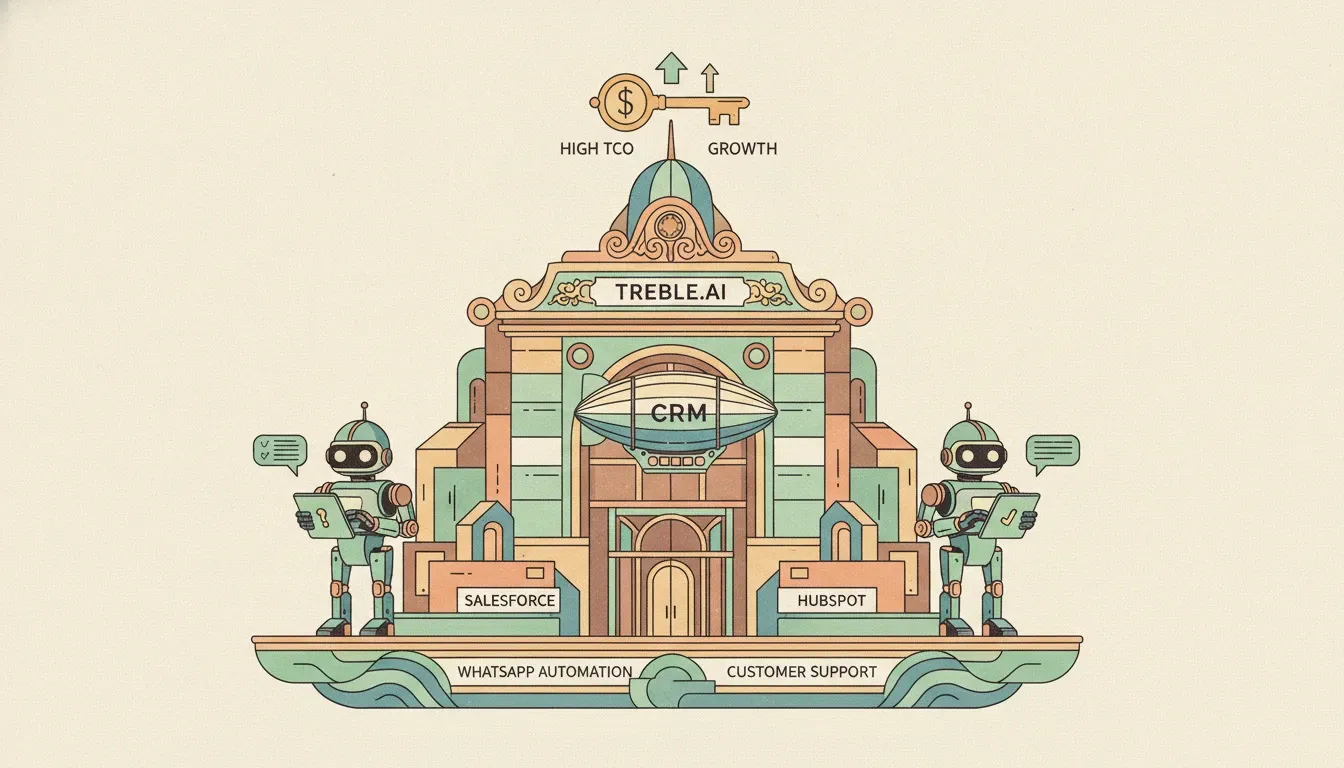
Pricing Differences: Treble.ai generally starts at a higher price point (around $99/month base) but justifies this through deep native integrations with CRMs like HubSpot and Salesforce.
Value for Money: The ROI comes from its ability to automate lead qualification. Instead of paying human agents to ask qualifying questions, Treble.ai’s automated flows handle the top of the funnel, significantly reducing your Customer Acquisition Cost (CAC).
Hidden Costs: The complexity of setup means you might need to invest internal hours or hire an agency to build the initial flows.
Plan Limitations: It is not designed to be a traditional customer service helpdesk. If you need complex ticketing and SLA tracking, Treble.ai will fall short.
Migration Note: Moving to Treble.ai requires mapping your existing CRM fields to their platform, which can be an intensive initial project.
2. ManyChat: Best for Budget-Friendly Marketing Flows
ManyChat remains the undisputed leader for budget-conscious digital marketers who want to leverage social media synergy.
Pricing Differences: Starting at just $15/month for the Pro plan, ManyChat is significantly cheaper than Wati’s entry-level tier.
Value for Money: It offers an unparalleled visual flow builder that works seamlessly across Instagram, Messenger, and WhatsApp. For e-commerce stores driving traffic from Instagram Reels to WhatsApp, ManyChat provides the highest ROI.
Hidden Costs: Pricing scales based on the number of contacts in your database. If you have a massive list of inactive subscribers, your monthly software bill will increase unnecessarily unless you actively prune your list.
Plan Limitations: ManyChat’s shared inbox capabilities are rudimentary compared to Wati. It is a marketing tool first and a support tool second.
Migration Note: Porting numbers to ManyChat is relatively straightforward, but importing complex external contact lists requires strict formatting to maintain opt-in compliance.
SleekFlow and Respond.io: Best for Omnichannel E-commerce and Support
For brands that operate across multiple channels (WhatsApp, Instagram, Webchat, and physical retail), a WhatsApp-only tool like Wati might create data silos.
3. SleekFlow: Best for Multi-Channel Social Selling
SleekFlow bridges the gap between online interactions and offline conversions, making it ideal for omnichannel e-commerce.
Pricing Differences: Plans typically start around $79/month. SleekFlow positions itself as a premium social commerce platform.
Value for Money: The true value lies in its payment link generation and catalog integrations. Agents can share product catalogs and accept payments directly within the WhatsApp chat, drastically reducing cart abandonment.
Hidden Costs: Similar to Wati, adding extra team members can be costly. Additionally, advanced analytics and custom reporting are often locked behind their more expensive enterprise tiers.
Plan Limitations: The learning curve is steeper than Wati’s, and smaller teams might find the interface overwhelming if they only intend to use WhatsApp.
Migration Note: SleekFlow handles multi-channel migrations well, but syncing your e-commerce product catalog requires dedicated setup time.
4. Respond.io: Best for Complex Customer Support Workflows
When your e-commerce store scales to the point where customer support requires strict routing rules and performance tracking, Respond.io is the superior choice.
Pricing Differences: Starting around $99/month, Respond.io is priced similarly to Wati’s Pro plan but delivers vastly superior support features.
Value for Money: You are paying for advanced workflow automation. Respond.io can intelligently route VIP customers to specific agents, escalate unresolved tickets, and provide granular metrics on agent response times.
Hidden Costs: Respond.io charges based on Monthly Active Contacts (MAC). If you send a massive marketing broadcast, your MAC count will spike, potentially pushing you into a higher, more expensive subscription tier for that month.
Plan Limitations: While exceptional for support, its marketing broadcast tools are less intuitive than ManyChat’s or Treble.ai’s.
Migration Note: Respond.io offers robust support for porting numbers, but recreating your complex routing logic from a legacy system will require significant operational bandwidth.
Find Perfect Software for Your Business
Bird and Twilio: Best for Enterprise and Developer-Heavy Teams
Bypassing out-of-the-box SaaS for foundational cloud communications software is the most scalable route for developer-heavy teams in 2027. Cloud communications software pricing for Bird and Twilio relies on a pure pay-as-you-go API model. Instead of monthly SaaS subscription tiers and seat licenses, you pay only per-message API costs alongside Meta's standard conversation fees. This eliminates software markups but requires custom engineering to build your own interfaces.
5. Bird: Best for Enterprise-Grade Global Messaging
Bird (formerly MessageBird CRM) has evolved into a comprehensive CRM and marketing automation platform tailored for large-scale operations.
Pricing Differences: Bird often utilizes custom pricing for enterprise clients, combining a hefty platform fee with volume-based messaging discounts.
Value for Money: For global e-commerce brands sending millions of messages, Bird’s direct carrier relationships ensure high deliverability and lower latency.
Hidden Costs: The platform requires significant onboarding, and dedicated account management fees are often baked into the enterprise contracts.
Plan Limitations: It is entirely unsuitable for small to mid-sized businesses due to high minimum monthly commitments and complex deployment cycles.
Migration Note: Enterprise migrations are handled by dedicated success managers, but the process can take weeks to finalize.
6. Twilio: Best for Technical Teams and Scalable API Infrastructure
Twilio is the raw engine of communications. It is not a ready-to-use software but an API that developers use to build custom WhatsApp solutions.
Pricing Differences: Twilio uses a strict pay-as-you-go model. You pay Meta’s conversation fee plus a tiny markup to Twilio (often around $0.005 per message). There are no monthly user seat fees.
Value for Money: If you have developers, Twilio is the cheapest way to scale. You only pay for what you use, and you can build a custom interface tailored exactly to your e-commerce workflows.
Hidden Costs: The hidden cost is developer time. You must build, host, and maintain your own inbox, routing rules, and chatbot logic.
Plan Limitations: There is no native user interface for non-technical marketing or support teams.
Migration Note: Porting a number to Twilio requires technical API configuration and adjusting your webhook endpoints.
Join 10,000+ businesses who bypass the billing guesswork and select software on AuthenCIO.
Crucial 2027 Considerations: AI Surcharges, Migration, and Data Residency
To make a fully informed decision, modern e-commerce leaders must look beyond basic messaging limits and evaluate the operational infrastructure of their chosen platform.
1. AI & LLM Integration Costs
As AI-driven customer service becomes the standard, you must evaluate how platforms charge for these capabilities. Some tools require you to use their proprietary AI agents, charging a surcharge per automated conversation. Others allow a "Bring Your Own Key" (BYOK) model, where you plug in your own OpenAI or Anthropic API key, allowing you to pay raw token costs directly to the LLM provider. BYOK is significantly cheaper at scale, so clarify this capability before signing an annual contract.
2. Migration Complexity and Porting Numbers
The hidden cost of switching WhatsApp Business Solution Providers is operational downtime. Porting a live WhatsApp number requires disabling two-step verification on the old platform, acquiring a migration PIN, and verifying the number on the new platform. If your team lacks technical expertise, choose a platform that offers free, managed migration support to prevent losing your chat history or verification status.
3. Data Residency and Global Compliance
For global e-commerce brands, data privacy is a major financial risk. If you sell to European customers, GDPR compliance dictates where your customer data is stored. Ensure your chosen platform offers local data residency options (e.g., servers hosted in the EU) rather than defaulting to US-based servers. Non-compliance can result in fines that dwarf your software savings.
How to Calculate Your True WhatsApp Marketing Costs
Understanding your WhatsApp marketing automation costs is the most critical step in forecasting your 2027 budget. To make an informed decision, you must stop looking solely at the monthly software subscription. The true cost of your WhatsApp Business API plan is calculated by combining your fixed platform costs with your variable Meta conversation costs.
Understanding Meta’s Conversation Pricing
Meta charges based on 24-hour conversation windows, categorized by the type of template used to initiate the chat. Understanding these four categories is essential for accurate budgeting:
Marketing Conversations: These include promotional messages, abandoned cart reminders, and upselling campaigns. They are the most expensive category because they drive direct revenue.
Utility Conversations: These facilitate a specific, agreed-upon request or transaction, such as order confirmations, shipping updates, or billing statements. These are significantly cheaper than marketing messages.
Authentication Conversations: Used for one-time passcodes (OTPs) and account recovery.
Service Conversations: These are user-initiated. If a customer messages you and you reply within 24 hours, you are charged a lower service rate.
The 72-Hour Free Window Strategy
One of the most effective ways to lower your Customer Acquisition Cost (CAC) is leveraging Meta's 72-hour free window. If a user enters a conversation through a Click-to-WhatsApp ad on Facebook or Instagram, the conversation is completely free for 72 hours. For example, if you spend $500 on ads driving users to WhatsApp, you can send them promotional materials, qualify the lead, and close the sale over three days without paying a single cent in Meta conversation fees.
The ROI Calculation Formula
To evaluate whether Wati or a competitor is worth the investment, use this framework:
Total Monthly Cost = (Software Subscription) + (Extra Seat Fees) + (Marketing Conversations x Meta Rate) + (Utility Conversations x Meta Rate)
Cost Per Acquisition (CPA) = Total Monthly Cost / Total Conversions Driven by WhatsApp
For example, if you use Treble.ai for $99/month and spend $200 on Meta marketing conversation fees to recover abandoned carts, your total cost is $299. If that campaign recovers 50 carts with an average order value of $100 (Total Revenue: $5,000), your WhatsApp CPA is roughly $6. This proves the value of the tool far beyond its base subscription price.
Try AuthenCIO
Move to faster, smarter software evaluation with AI
Final Verdict: Which WhatsApp API Plan Wins in 2027?
Selecting the right WhatsApp Business API requires aligning your cloud communications software investment with your most pressing business bottleneck. To maximize ROI, calculate the Total Cost of Ownership (TCO)—including base subscriptions, per-message fees, and AI surcharges—rather than just comparing entry-level pricing.
Decision Flowchart for E-commerce Leaders:
If your bottleneck is basic team collaboration: Choose Wati. It provides the fastest setup for a shared inbox, provided you monitor seat counts to prevent fixed costs from spiraling.
If your bottleneck is top-of-funnel lead qualification: Choose Treble.ai. It justifies a higher initial investment through aggressive revenue generation and deep CRM integration.
If your bottleneck is marketing budget: Choose ManyChat. For budget-conscious marketers focused on social media funnels, it offers an unbeatable price-to-performance ratio.
If your bottleneck is multi-channel sales (O2O): Choose SleekFlow. It delivers the catalog integrations necessary to drive seamless social commerce.
If your bottleneck is complex support routing: Choose Respond.io. It provides the advanced routing and SLA tracking required for large-scale customer service teams.
If your bottleneck is technical scale and margins: Choose Twilio or Bird. Bypassing SaaS platforms entirely yields the lowest per-message costs, assuming you have the developer resources to build and maintain the API infrastructure.