
Introduction
Heading into 2027, cloud communications software pricing for solo entrepreneurs typically ranges from $9.99 to $30 per month per user. While many founders bootstrap with free tools like Google Voice, upgrading to a paid virtual phone system is now a baseline requirement for survival due to strict A2P 10DLC compliance and the need for a professional image.
Streamline your software evaluation process
While free platforms were the standard back in 2024, the 2027 landscape of AI-driven call routing makes a dedicated business number a necessity. Using a personal cell phone or an outdated free tool screams "amateur" to potential clients and blurs the critical boundary between your personal and professional life.
However, navigating cloud communications software pricing can feel like a full-time job. Pricing models are deliberately confusing, hidden regulatory fees run rampant, and paying for enterprise-grade features you do not need can quickly drain a bootstrapped budget.
This guide cuts through the marketing fluff to provide a granular, decision-focused breakdown of Unitel Voice pricing and its top competitors for 2027. We will evaluate minute caps, hidden regulatory fees, mobile app user experiences, and scalability. Our goal is to help you choose the right virtual phone tool based on your specific use case, ensuring you get the best value for your money without falling victim to unpredictable monthly bills.
Plan | Best For | Pricing ($) | Limitations | Contract Type |
Unitel Voice Start-Up | Ultra-low volume solopreneurs | $9.99 / month | 500-minute cap, basic mobile app | Month-to-Month |
800.com Personal | Toll-Free Number Branding | $29.00 / month | 1,000-minute cap, higher entry cost | Month-to-Month |
Quo Solo | Integrated CRM Functionality | $15.00 / month | Limited legacy third-party integrations | Month-to-Month |
Grasshopper Solo | Simple Mobile-First Setups | $28.00 / month | No physical desk phone support | Annual (Billed Monthly) |
Phone.com Basic | Low-Volume Users on a Budget | $12.99 / month | 500 pooled minutes, paid SMS | Month-to-Month |
Ooma Office | Hybrid Home-Office Hardware | $19.95 / user / month | High hardware costs, heavy taxes | Month-to-Month |
Nextiva Essential | Scalable All-In-One Comms | $23.95 / user / month | Annual contract required for best rate | Annual |
RingCentral Core | Advanced AI-Driven Analytics | $20.00 / user / month | Complex setup, overkill for solo users | Annual |
*Note: All prices shown reflect typical monthly billing. Vendors often offer lower pricing for annual commitments, but those discounts are excluded here for easier comparison. Actual costs may vary depending on your requirements, usage volumes, and negotiated terms.
Key Takeaways
Unitel Voice is the budget champion: At $9.99/month for the Start-Up Plan and $24.99/month for the Unlimited Plan, Unitel Voice offers the most competitive entry-level pricing for solo startups in 2027.
Top alternatives by use case: Choose 800.com for toll-free branding, Grasshopper for mobile-first simplicity, or Nextiva if you need scalable cloud communications software pricing tiers.
Watch for hidden fees: Base rates are highly competitive this year, but solopreneurs must watch out for minute overages on basic plans, premium CRM integration fees, and data porting costs.
Hardware is optional: Most modern plans are optimized for mobile apps and softphones, though Ooma remains the best choice if your home office requires physical desk phones.
Software Covered in this Article
This guide breaks down the pricing and key features of cloud communications software, covering a curated set of providers:







Unitel Voice Pricing Breakdown: Is It Worth It?
Unitel Voice has built its reputation on being one of the most budget-friendly virtual phone systems for startups. However, in the 2027 market, the definition of "budget-friendly" requires a closer look at what features are locked behind higher paywalls and how overage charges can inflate your monthly bill.
1. The Start-Up Plan ($9.99/month)
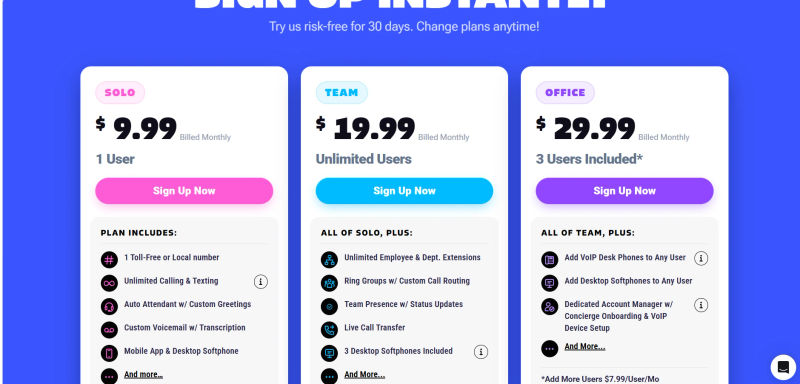
At just under ten dollars, the Start-Up plan is the entry-level offering. It includes one business number (local or toll-free), unlimited users, and standard features like custom greetings, voicemail-to-email, and call forwarding.
Who is this best for? This plan is strictly for solo entrepreneurs with very low call volumes who primarily need a professional auto-attendant to route calls to their personal cell phone.
The Limitations and Break-Even Point
The catch is the 500-minute monthly cap, which applies to both inbound and outbound calls. In 2027, Unitel Voice charges approximately 3.4 cents per additional minute. If your startup begins to gain traction and you consume 1,000 minutes in a month, your bill jumps from $9.99 to $19.99.
2. The Unlimited Plan ($19.99/month)
Once you cross the 950-minute mark consistently, you hit the break-even point where upgrading to the Unlimited plan makes financial sense. This tier removes the minute anxiety entirely. It includes unlimited calling and SMS text messaging, making it the safer choice for sales-heavy founders who cannot afford to monitor their daily talk time.
The Mobile App Experience in 2027
Most solo founders work primarily from their smartphones. Unitel Voice’s mobile app allows you to make and receive calls showing your business caller ID.
While functional, the 2027 user experience remains somewhat utilitarian compared to sleeker modern apps. It lacks advanced AI-driven call transcription natively within the base app, meaning you will need to rely on third-party tools if you want automated meeting notes.
Porting Your Number
If you are currently using a personal number for business and want to migrate it to Unitel Voice, the porting process is free but requires careful execution to avoid downtime:
Verify Eligibility: Check if your current number can be ported (most US/Canada numbers can).
Submit a Letter of Agency (LOA): Provide Unitel Voice with a signed LOA and a recent phone bill.
Maintain Existing Service: Do not cancel your old personal plan until Unitel confirms the port is complete (usually 5-7 business days).
Configure Routing: Set up your auto-attendant rules in Unitel before the port date to ensure zero missed calls.
Find Perfect Software for Your Business
1. 800.com and Quo: Best Alternatives for Toll-Free and Simplicity
If Unitel Voice’s feature set does not align with your growth strategy, 800.com and Quo offer highly specialized alternatives for solo founders.
800.com: Best for Toll-Free Number Branding
For startups that need to project a "big company" image nationwide, 800.com specializes in vanity toll-free numbers (e.g., 1-800-STARTUP).
Personal Plan ($29.00/month): Includes 1 toll-free number and 1,000 minutes.
Unlimited Plan ($59.00/month): Unlimited minutes and advanced routing.
Who is this best for? E-commerce founders, national consultants, or any solo entrepreneur whose primary marketing strategy relies on a memorable, brandable 1-800 number.
Limitations: 800.com has a significantly higher entry price than Unitel Voice. Furthermore, vanity numbers often come with a one-time setup fee depending on the desirability of the number. If you are a local business targeting a specific city, a toll-free number may actually hurt your local SEO and trust, making this the wrong tool for you.
Quo: Best for Integrated CRM Functionality
Quo has emerged in 2027 as a favorite for solo founders who want a modern, frictionless user interface that integrates seamlessly with lightweight CRMs.
Solo Plan ($15.00/month): Includes unlimited calling, SMS, and basic CRM integrations.
Who is this best for? Solo founders who live in their CRM and need automated SMS follow-ups. If you want a system that automatically texts a client back if you miss their call, Quo handles this beautifully out of the box.
Limitations: Quo is a newer platform. While its UI is gorgeous, its integration ecosystem outside of major enterprise CRMs is limited. However, it offers excellent compatibility with lightweight databases like Notion, Airtable, or Pipedrive, which fits the modern solo founder's stack perfectly.
2. Grasshopper vs. Phone.com: The Solopreneur Standbys
Grasshopper and Phone.com have been targeting small businesses for over a decade. In 2027, they represent two completely different pricing philosophies: unlimited convenience versus granular pay-as-you-go.
Grasshopper: Best for Simple Mobile-First Setups
Grasshopper is designed specifically to add a business line to your existing personal smartphone.
Solo Plan ($28.00/month): Includes 1 number, 3 extensions, and unlimited minutes/SMS.
Partner Plan ($46.00/month): 3 numbers, 6 extensions.
Who is this best for? The busy solo founder who wants absolute budget predictability. At $28 a month, you never have to worry about minute caps, overage fees, or fluctuating bills.
The inclusion of three extensions is perfect for a solo founder who wants to use the classic "fake it till you make it" tactic (e.g., "Press 1 for Sales, Press 2 for Support," both routing to the founder's cell phone). Grasshopper also fully supports MMS (picture messaging), which is a specific pain point solved for service-based founders who need to send or receive photos for quotes and proof of work.
Limitations: Grasshopper is strictly a virtual routing system. It does not support physical VoIP desk phones. If you ever plan to open a physical office with hardware, Grasshopper cannot scale with you.
Phone.com: Best for Low-Volume Users on a Budget
Phone.com offers a highly modular pricing system that allows you to mix and match user types.
Basic Plan ($12.99/month): Includes 500 pooled minutes, 1 phone number, and video conferencing.
Plus Plan ($19.99/month): Unlimited minutes and text messaging.
Who is this best for? The ultra-lean startup that wants a cheaper entry point than Grasshopper but wants the option to add physical desk phones later.
Limitations: The "pooled minutes" trap. The $12.99 Basic plan caps you at 500 minutes. Furthermore, SMS is often treated as an add-on or consumes your minute pool in complex ways on the base tier. If you text clients frequently, the Basic plan will result in overage charges, forcing you to upgrade to the $19.99 Plus plan anyway.
3. Ooma: Best for Home Office and Hardware Needs
Not every solo entrepreneur works exclusively from a smartphone. For consultants, lawyers, or accountants operating out of a dedicated home office, a physical desk phone provides superior call quality and ergonomics.
Ooma Office Pricing
Ooma Office ($19.95/user/month): Includes over 50 features, a virtual receptionist, and unlimited calling in the US/Canada.
Ooma Office Pro ($24.95/user/month): Adds call recording, voicemail transcription, and desktop app integration.
Who is this best for? The hybrid home-office founder who requires physical hardware. Ooma excels at providing pre-configured VoIP desk phones that work perfectly out of the box. It is also one of the few platforms in 2027 that still reliably supports analog fax machines via an adapter, which is crucial for legal and medical solopreneurs.
Limitations and Hidden Costs: Ooma's advertised price of $19.95 is rarely what you actually pay. Ooma is notorious for passing heavy local and state telecom taxes directly to the consumer. Depending on your zip code, a $19.95 plan can easily cost $25 to $28 per month after taxes and regulatory fees. Additionally, you must factor in the upfront capital expenditure of purchasing the physical IP phones, which range from $60 to $150 each.
To ensure high call quality with hardware like Ooma, solo founders must meet basic technical requirements, primarily a reliable high-speed fiber or 5G connection and proper router prioritization settings to ensure voice traffic is not interrupted by heavy downloads.
4. Nextiva and RingCentral: When to Upgrade for Scalability
While Unitel Voice and Grasshopper are excellent for parties of one, they crumble if your 2027 roadmap includes hiring a team of five to ten employees, establishing a call center, or needing deep analytics.
Nextiva: Best for Scalable All-In-One Communications
Nextiva positions itself as a complete all-in-one communications platform, bypassing heavy enterprise jargon for a streamlined experience.
Essential Plan ($23.95/user/month): Unlimited voice, video, and basic integrations.
Professional Plan ($27.95/user/month): Adds advanced integrations (Salesforce, HubSpot) and multi-level auto-attendants.
Who is this best for? The funded startup founder who is solo today but plans to hire a sales team within the next six months. Nextiva provides seamless internal team chat, video meetings, and robust call routing that scales effortlessly.
Limitations: To get the $23.95 rate, you are usually locked into an annual contract. Month-to-month pricing is significantly higher. The platform is also incredibly feature-dense, which can lead to a steep learning curve for a solo founder who just wants to make a simple phone call.
RingCentral: Best for Advanced AI-Driven Analytics
RingCentral remains the enterprise heavyweight, but their entry-level plans are accessible to ambitious startups.
Core Plan ($20.00/user/month): Unlimited domestic calling, SMS, and basic AI features.
Advanced Plan ($25.00/user/month): Adds advanced call monitoring, automatic call recording, and deep CRM integrations.
Who is this best for? Data-driven founders who need 2027-specific AI features. RingCentral’s integrated AI can automatically transcribe calls, generate post-call summaries, and highlight action items. If your solo business relies on high-ticket B2B sales, this AI assistance acts like a virtual secretary.
Data Portability and Exit Costs
If you choose Nextiva or RingCentral, be aware of the exit costs. Because these platforms deeply integrate with your contacts and call logs, moving your data out if your startup pivots or downsizes can be technically cumbersome. Always export your call logs and CRM data monthly to avoid vendor lock-in.
Security and Reliability in 2027
When evaluating budget virtual phone providers, solo founders often overlook security until a breach happens. In 2027, basic password protection is insufficient for business communications.
Always ensure the provider you choose offers mandatory Two-Factor Authentication (2FA) for account access to protect your client data and call logs. Furthermore, review the provider's historical uptime guarantees. While enterprise tools like RingCentral boast 99.999% uptime SLAs, budget options may experience occasional routing hiccups during peak hours. Finally, beware of cancellation traps. Ensure the provider allows you to cancel your subscription or port your number out directly through the web dashboard, rather than forcing you to call a retention specialist during limited business hours.
Hidden Costs to Watch Out for in 2027 Virtual Phone Plans
The most frustrating aspect of evaluating cloud communications software pricing in 2027 is the disparity between the advertised price and the final invoice. When budgeting for your startup, you must calculate the true cost of ownership by watching out for these four hidden fees:
Taxes and Regulatory Fees: Unlike standard software subscriptions, cloud communications software is subject to federal, state, and local telecommunications taxes. The Federal Universal Service Fund (USF) fee alone fluctuates quarterly. Depending on your provider and location, taxes can inflate your advertised monthly bill by 15% to 30%. Providers like Unitel Voice and Phone.com pass these fees onto the user, while some premium tiers of other tools absorb them.
Minute Overage Charges: As discussed with Unitel Voice and Phone.com, base plans often come with a 500-minute cap. If you run a marketing campaign that drives unexpected call volume, a 3-cent per minute overage fee can turn a $10 bill into a $50 bill overnight. Always calculate your break-even point before choosing a metered plan for your cloud communications software.
Activation and Porting Fees: While porting your existing number into a new service is legally required to be allowed, some budget providers charge a one-time porting fee or an account activation fee. Always read the checkout page carefully. Furthermore, if you decide to leave a provider, check their Terms of Service for "port-out" fees, which penalize you for taking your number to a competitor.
International SMS and Global Rates: "Unlimited calling and texting" almost universally means unlimited strictly within the United States and Canada. If your startup sources materials from overseas or has international clients, you will be billed per minute at international rates. Crucially, International SMS is rarely included in base cloud communications plans, and automated SMS campaigns are strictly regulated by 2027 A2P 10DLC compliance rules, which often carry their own registration fees.
Value for Money: How to Choose Your 2027 Phone Provider
Choosing the right cloud communications software requires aligning the platform's primary strengths with your startup's immediate operational needs. Avoid paying for enterprise-level scalability you do not need today, but ensure the provider can support your daily workflow and integration requirements.
To maximize your value for money, use this simple framework:
1. Audit Your Call Volume
Look at your personal cell phone bill from the last three months. How many minutes did you spend on business calls? If it is consistently under 400 minutes, a metered plan is safe. If it fluctuates wildly, you need an unlimited plan to protect your budget.
2. Define Your Hardware Needs
Will you only ever use a smartphone and a laptop? Or do you need a physical desk phone? This single question eliminates half the providers on the market. If you need hardware, prioritize Ooma or Nextiva. If you only need a mobile app, Grasshopper or Quo are superior.
3. Assess Integration Requirements
Do you manually log calls in a CRM? If so, paying an extra $10 a month for a system like Quo or Nextiva that automates this data entry will save you hours of administrative work, easily justifying the higher price tag.
Try AuthenCIO
Move to faster, smarter software evaluation with AI
Final Verdict: Which Plan Wins for Solo Entrepreneurs?
Navigating cloud communications software pricing in 2027 requires matching your immediate budget with your daily workflow. There is no universal "best" virtual phone plan, only the most cost-effective solution for your specific operational style.
If you are an ultra-lean solo entrepreneur bootstrapping your way to your first few clients, Unitel Voice’s $9.99 Start-Up plan is incredibly difficult to beat. It provides the essential professional veneer—a dedicated number and an auto-attendant—at the absolute lowest entry price, provided you strictly manage your minute usage. (Runner Up: Phone.com Basic for modular scaling).
If you demand budget predictability and refuse to worry about minute caps, Grasshopper’s $28 Solo plan remains the most reliable mobile-first solution. It offers unlimited usage, MMS support, and a dead-simple setup without complex cloud communication fees. (Runner Up: Quo Solo for founders needing automated SMS replies).
If your startup is built on high-ticket sales where call transcription and CRM logging are critical to closing deals, bypass the budget tools entirely. Investing in the higher-tier cloud communications software pricing of RingCentral or Nextiva will provide the 2027 AI tools necessary to operate like a massive enterprise, even if you are just an army of one. (Runner Up: 800.com for national branding without full AI).
Stop letting confusing pricing models dictate your operational efficiency. Audit your call volume, check for hidden fees, and choose the platform that empowers your startup to grow.