

Introduction
Cloud communications software pricing typically ranges from $10 to $40 per user per month, depending on whether you need a basic toll-free routing service or a comprehensive unified communications platform. When evaluating toll-free number providers, you must look far beyond the advertised monthly rate. Because cloud communications serve as the default infrastructure for modern businesses, providers increasingly hide their true costs behind complex tiers, per-user minimums, metered minute caps, and regulatory surcharges. Small business owners and freelancers must evaluate pricing as a total-cost equation rather than a simple monthly subscription.
Streamline your software evaluation process
Before diving into the detailed breakdowns of features and hidden fees, use the comparison table below to quickly benchmark 800.com against the top cloud communication alternatives on the market today.
Plan | Best For | Pricing (USD $) | Setup/Activation Fees | Limitations |
800.com | Straightforward toll-free routing | $19 - $109 / month | $0 (Vanity numbers require a one-time fee) | Strict minute caps on lower tiers; lacks advanced team collaboration tools. |
Unitel Voice | Simple, affordable startup growth | $9.99 - $29.99 / month | $0 | Basic features; heavily metered minutes on entry-level plans. |
Quo | Integrated marketing analytics | $25 - $45 / month | $0 | Steeper learning curve; SMS marketing limits on base tiers. |
Nextiva | Scalable unified communications | $21 - $35 / user / month | $0 (Requires minimum user count) | Minimum user requirements; complex setup for solo operators. |
Weave | Client-facing service businesses | $399 / month (flat rate) | $99 - $299 depending on hardware | High entry cost; primarily focused on local presence over toll-free. |
RingCentral | Global enterprise features | $20 - $35 / user / month | $0 | Complex compliance fees; add-on costs for advanced AI tools. |
Grasshopper | Mobile-only entrepreneurs | $14 - $80 / month | $0 | Legacy interface; lacks modern AI and advanced CRM integrations. |
Phone.com | Low-volume users on a budget | $12.74 - $29.99 / user / month | $0 | Base plan is strictly metered (300 minutes); overage fees apply quickly. |
*Note: All prices shown reflect typical monthly billing. Vendors often offer lower pricing for annual commitments, but those discounts are excluded here for easier comparison. Actual costs may vary depending on your requirements, usage volumes, and negotiated terms.
Key Takeaways
800.com hits the sweet spot for standard toll-free needs: It remains a top mid-tier choice in 2027 for small businesses that need dedicated 800 numbers, SMS capabilities, and straightforward call routing without paying for bloated features.
Solopreneurs can find cheaper entry points: If budget is your primary concern, Unitel Voice and Quo offer the most cost-effective starter plans for freelancers and micro-businesses.
Growing teams should invest in UCaaS: Nextiva and RingCentral provide superior scalability and enterprise-grade features for businesses that need more than just a toll-free number, such as advanced analytics and CRM integrations.
Niche tools win for local shops: Appointment-based businesses will get better ROI from Weave's specialized scheduling and client communication tools than a traditional toll-free service.
Software Covered in this Article
The following articles break down the key aspects of Cloud Communications Software, featuring a carefully curated set of key players:







Introduction and Toll-Free Pricing Comparison
The global cloud communications software market is projected to exceed $20 billion by 2027, driven largely by the shift toward unified, cloud-based deployments. For highly price-conscious decision-makers, this means there are more options than ever, but also more opportunities to overpay for features you do not need.
Navigating cloud communications software pricing requires understanding two primary models: per-user licensing and usage-based billing. Toll-free numbers are no longer just standalone voice lines; they are integrated components of these omnichannel customer service stacks. When you compare 800.com to competitors like Unitel Voice, Quo, Nextiva, Weave, RingCentral, Grasshopper, and Phone.com, you are not just comparing minute rates. You are evaluating the total cost of routing capabilities, SMS functionality, CRM integrations, and compliance support.
The strongest affordability test for any toll-free plan is usage transparency. You should be able to calculate your exact monthly bill based on your expected call volume, text message output, and team size without encountering surprise charges.
800.com Pricing Breakdown: Is It Worth the Cost?
800.com has built its reputation on providing memorable toll-free and vanity numbers with straightforward call routing. Their pricing structure is divided into three main tiers designed to scale with your call volume, but the true value depends heavily on your specific usage patterns.
Who is this best for? 800.com is best for straightforward toll-free routing. It is ideal for businesses that need a memorable 1-800 number to route directly to existing cell phones or landlines without the bloat of a massive software ecosystem.
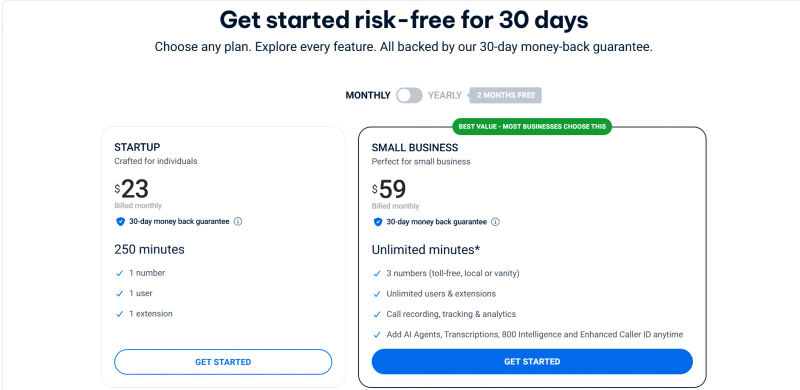
Pricing Differences: 800.com offers a Personal plan starting at $19 per month, an Unlimited plan at $49 per month, and a Pro plan at $109 per month. The Personal plan includes 1,000 minutes and basic routing features, making it accessible for low-volume users. The Unlimited plan removes the minute cap and adds SMS capabilities, while the Pro plan increases the monthly SMS limits and includes advanced analytics.
Value for Money: For a business handling exactly 900 minutes of inbound calls per month, the $19 Personal plan offers excellent value. When calculating the toll-free number ROI for small biz, you must factor in how many of those minutes convert into paying customers. Because 800.com charges a flat account fee rather than a per-user fee, it scales incredibly well for small teams sharing a single customer service line compared to per-user platforms.
Hidden Costs: If you exceed your 1,000-minute allowance on the Personal plan, you will pay a per-minute overage fee that can quickly bloat your bill. Additionally, acquiring a specific vanity number (e.g., 1-800-FLOWERS) requires a one-time premium acquisition fee that typically ranges from $30 to $40.
This is not a recurring monthly charge, but it must be factored into your upfront budget. You must also account for regulatory recovery fees and taxes, which can add 10% to 15% to your final invoice.
Plan Limitations: The Unlimited plan is subject to standard fair use policies—typically acting as a soft cap around 3,000 to 5,000 minutes per month to prevent abuse by high-volume call centers.
Furthermore, 800.com lacks advanced team collaboration tools like internal chat or video conferencing. SMS messaging is also restricted on the lowest tier, meaning you will need to upgrade to send outbound text marketing.
Unitel Voice and Quo: Best Budget Options for Solopreneurs
For freelancers and solopreneurs who find 800.com's $19 starting price too high for their current volume, Unitel Voice and Quo offer compelling, budget-friendly alternatives with distinct primary use cases.
1. Unitel Voice: Cheapest Toll-Free Numbers for Freelancers
Who is this best for? Unitel Voice is best for simple, affordable startup growth. It is designed for the bootstrapped founder who needs a professional image immediately but has very low incoming call volume.

Pricing Differences: Unitel Voice starts at an ultra-low $9.99 per month for its entry-level plan, significantly undercutting 800.com. However, this base plan is heavily metered, capping out at just 500 minutes.
Value for Money: If you receive only a handful of client calls a week, Unitel Voice is the most cost-effective way to secure a toll-free number. You get professional greetings, extensions, and a mobile app for half the base price of 800.com.
Risk-averse solopreneurs will also appreciate that Unitel Voice frequently offers a 30-day free trial, allowing you to test the service without financial commitment.
Hidden Costs and Limitations: The low monthly fee is a double-edged sword. Overage fees on Unitel Voice can be punishing, often costing between $0.03 and $0.05 per additional minute.
If a marketing campaign suddenly drives 2,000 minutes of inbound calls, your $9.99 bill will skyrocket, making 800.com's $49 Unlimited plan a much safer financial bet for growing businesses.
2. Quo: Best for Integrated Marketing Analytics
Who is this best for? Quo is best for integrated marketing analytics. It is built for solo marketers and boutique agencies that need to tie every incoming call directly to a specific advertising campaign.
Pricing Differences: Quo's pricing sits slightly higher than 800.com's entry tier, typically ranging from $25 to $45 per month.
Value for Money: Quo justifies its price tag by acting as a marketing attribution tool. Instead of just routing calls, Quo provides dynamic number insertion and detailed ROI reporting.
If you are spending money on Google Ads, the data Quo provides makes it far more valuable than a standard 800.com routing number. Like Unitel Voice, Quo often provides short free trials to test their analytics dashboard.
Hidden Costs and Limitations: Quo limits the number of tracking numbers and SMS marketing messages you can send on its base tiers. If you run multiple concurrent campaigns, you will be forced into their higher-priced tiers quickly.
Furthermore, its interface has a steeper learning curve compared to 800.com's straightforward dashboard.
Nextiva and RingCentral: Enterprise Features on a Small Business Budget?
When a small business scales, communication needs shift from simple call routing to team collaboration. Nextiva and RingCentral provide comprehensive cloud communications software solutions that combine voice, video, and messaging.
Cloud communications software pricing for these platforms uses a per-user, per-month model. Nextiva starts at $21 per user/month for unlimited calling and toll-free numbers. RingCentral begins at $20 per user/month, offering robust integrations. Both deliver enterprise-grade features on a small business budget, scaling costs based on your team size and advanced feature needs.
3. Nextiva
Who is this best for? Nextiva is best for scalable unified communications. It is the ideal choice for growing sales and support teams that need voice, video, and CRM tools in one application.
Pricing Differences: Unlike 800.com's flat account pricing, Nextiva charges per user. Plans range from $21 to $35 per user, per month. For a solo operator, Nextiva is comparable to 800.com. For a team of ten, Nextiva costs over $200 per month, while 800.com remains $49 on its Unlimited plan.
Value for Money: You are paying for a comprehensive ecosystem. Nextiva includes advanced call routing, video conferencing, team messaging, and deep integrations with tools like Salesforce and HubSpot.
Nextiva also boasts highly rated, reliable mobile applications for iOS and Android, ensuring small business owners can manage operations on the go without dropped calls.
Hidden Costs and Limitations: Nextiva requires minimum user counts (often 3 to 5 users) to unlock its lowest advertised pricing. Additionally, toll-free minutes are often pooled across the account but are still capped based on your tier, meaning high-volume toll-free inbound calls might still incur overage fees on top of the hefty per-user subscription.
4. RingCentral
Who is this best for? RingCentral is best for global enterprise features. It is built for distributed, remote-first teams that require international numbers, advanced AI analytics, and maximum uptime reliability.
Pricing Differences: RingCentral's pricing mirrors Nextiva, starting around $20 per user, per month for the Core plan and scaling up to $35 or more for Advanced plans.
Value for Money: RingCentral offers cutting-edge AI-driven call sentiment analysis, automated meeting transcriptions, and unparalleled global routing capabilities. If you have employees and clients spread across different continents, RingCentral provides infrastructure that 800.com simply cannot match, complete with a robust mobile app that rarely suffers from downtime.
Hidden Costs and Limitations: RingCentral is notorious for complex billing. You will encounter compliance fees, regulatory recovery charges, and additional costs for vanity numbers and international toll-free routing.
The platform is also feature-heavy, making it overly complicated and frustrating for a simple retail business that just wants the phone to ring.
Find Perfect Software for Your Business
Weave: The Best Choice for Appointment-Based Local Businesses
If you are a solo digital freelancer, you can skip this section entirely: Weave is massive overkill for your needs. However, for brick-and-mortar service providers, telephony requirements are vastly different, making standard toll-free routing less relevant than client engagement tools.
Who is this best for? Weave is best for client-facing service businesses. Dental offices, optometry clinics, veterinary practices, and local home service agencies are the primary target audience for this platform.
Pricing Differences: Weave completely abandons the low-cost, per-user, or tiered minute models. Instead, it charges a flat platform fee that typically hovers around $399 per month for the entire office, which often includes the physical desk phones.
Value for Money: Comparing Weave's $399 price tag to 800.com's $19 plan is an apples-to-oranges comparison. Weave integrates directly with practice management software. When a patient calls, Weave pulls up their appointment history, outstanding balances, and family members on the receptionist's screen.
It also handles automated appointment reminders, review generation, and two-way SMS. For a local clinic, this automation replaces the need for a dedicated administrative assistant, offering massive ROI.
Hidden Costs and Limitations: The primary limitation is the high barrier to entry, including setup and hardware fees that can range from $99 to $299.
Furthermore, Weave focuses heavily on local area codes to build community trust; while you can port or add a toll-free number, it is not the platform's core competency. You are also locked into their proprietary hardware ecosystem in many cases, making switching away from Weave difficult.
Grasshopper and Phone.com: Legacy vs Modern Flexibility
For businesses that want to stick to virtual phone numbers without the heavy UCaaS features of Nextiva or the high price of Weave, Grasshopper and Phone.com remain popular alternatives to 800.com.
6. Grasshopper
Who is this best for? Grasshopper is best for mobile-only entrepreneurs. It is designed for the plumber, landscaper, or consultant who runs their entire business from their personal smartphone and needs to keep personal and business calls separate.
Pricing Differences: Grasshopper offers a True Solo plan for $14 per month (one number, one extension) and scales up to a Small Business plan for $80 per month (five numbers, unlimited extensions).
Value for Money: Grasshopper's value lies in its simplicity and flat-rate pricing for domestic calls. The True Solo plan is cheaper than 800.com's Personal plan and offers a highly reliable mobile app that turns your cell phone into a business line.
Hidden Costs and Limitations: Grasshopper is a legacy platform. This means that while its user interface feels dated and it lacks the AI-driven SMS automation of newer competitors, its core routing infrastructure is incredibly stable and reliable.
However, it charges extra for professional voice studio greetings, which are often included or easily AI-generated in competing software.
Join over 10,000+ businesses that made smarter software choices using AuthenCIO
7. Phone.com
Who is this best for? Phone.com is best for low-volume users on a budget who want the flexibility to mix and match user types.
Pricing Differences: Phone.com starts at $12.74 per user, per month for its Basic plan, moving up to $29.99 for the Pro plan.
Value for Money: Phone.com's unique selling proposition is its mix-and-match billing. You can have one user on the expensive Pro plan (with unlimited minutes) and three part-time employees on the cheap Basic plan. This flexibility allows you to tailor your bill precisely to your team's usage, a feature 800.com does not offer.
Hidden Costs and Limitations: The $12.74 Basic plan is strictly metered, providing only 300 pooled minutes per month. Once you exceed that limit, the overage fees will quickly make the plan more expensive than 800.com's Unlimited tier.
Additionally, advanced features like call recording and voicemail transcription are locked behind the higher-priced tiers, and SMS is heavily metered on the lowest plan.
Toll-Free Decision Matrix
To simplify your choice, use this quick-reference matrix to map your specific business type to the ideal provider based on 2027 pricing and feature sets:
The Solo Digital Freelancer: Choose Unitel Voice if you are strictly on a budget and receive fewer than 500 minutes of calls per month. Choose 800.com if you want a flat $19 rate with double the minute allowance.
The Mobile-Only Entrepreneur: Choose Grasshopper. If you run a landscaping or consulting business entirely from your smartphone, its legacy reliability and $14 True Solo plan are unbeatable.
The Scaling Sales Team (5-20 Employees): Choose Nextiva or RingCentral. You need a UCaaS platform that charges per user but provides internal chat, video conferencing, and deep CRM integrations to keep your team aligned.
The Local Brick-and-Mortar Clinic: Choose Weave. The $399 flat rate pays for itself by automating appointment reminders and patient data retrieval, completely replacing manual administrative work.
The Marketing Agency: Choose Quo. The dynamic number insertion and campaign attribution tools are essential for proving ad ROI to your clients.
Try AuthenCIO
Move to faster, smarter software evaluation with AI
How to Choose the Right Toll-Free Plan
Selecting the right provider requires balancing your immediate budget constraints with your long-term operational needs. When evaluating cloud communications software pricing, look beyond the basic toll-free number. With more than 48 million toll-free numbers active in the North American registry, differentiation between providers has shifted away from simply obtaining an 800 number toward call quality, routing flexibility, and compliance support.
Evaluate the Effective Cost Per Conversation: Do not compare plans based solely on the advertised monthly rate. Instead, calculate the effective cost per productive conversation. A plan like 800.com's $19 tier might seem cheap, but if you consistently pay $40 in overage fees and lack the SMS tools needed to close deals, it is more expensive than a $49 unlimited plan. Factor in your expected inbound minutes, outbound minutes, and SMS volume (checking whether texts are bundled or cost $0.02+ per message) before making a decision.
Understand Regulatory and Compliance Costs: Caller authentication and messaging compliance are now critical operational costs in cloud communications software pricing. With strict FCC regulations, STIR/SHAKEN protocols, and A2P 10DLC registration requirements for business SMS, you must ensure your provider actively manages number reputation. If you choose a cut-rate provider that fails to authenticate your calls, your toll-free number will show up as "Scam Likely" on your customers' caller ID, destroying your conversion rates. Evaluate whether providers include compliance, 10DLC registration, and reputation monitoring in their base fees or if they charge extra for it.
Consider International Calling and AI Add-ons: If you are a freelancer with global clients, domestic toll-free plans will not cover your needs. International calling rates can range from $0.03 to $0.15 per minute depending on the country, and receiving international calls on a US toll-free number often incurs additional surcharges. Providers like RingCentral are better equipped for global routing than flat-rate domestic tools. Additionally, check if modern features like AI call transcription or sentiment analysis are included or billed as premium add-ons.
Verify Portability and Contract Terms: Finally, never lock yourself into a provider without verifying number portability. You must own your toll-free number. Ensure that the provider allows you to port your number away for free if you outgrow their service.
Additionally, watch out for annual contract traps. Many providers advertise a low monthly rate that requires a 12-month upfront commitment. If you have seasonal call volume, month-to-month flexibility is often the smarter financial choice.
Banish the guesswork from your telephony budget and evaluate 800.com pricing on AuthenCIO today.