

Introduction
When evaluating cloud communications software pricing for 2027, IT leaders need immediate clarity on base costs, add-ons, and total cost of ownership (TCO). KrispCall positions itself as a cost-effective, AI-driven cloud phone solution designed to bridge the gap between basic calling and advanced CRM workflows.
Streamline your software evaluation process
KrispCall's 2027 pricing ranges from $15 to $40 per user/month, depending on the tier and required AI capabilities. However, calculating the exact TCO for your communications infrastructure requires looking past the base subscription price to account for usage limits, international rates, and premium integrations.
To help you navigate the complexities of modern VoIP deployments, this breakdown analyzes KrispCall’s pricing tiers, uncovers hidden costs, and compares the platform directly against top industry competitors.
Key Takeaways:
Cloud Communications Software Pricing: KrispCall plans range from $15 to $40 per user/month. The higher end of this range accounts for premium AI processing credits, advanced administrative controls, and 24/7 priority support SLAs.
CRM Integration Value: The Standard Plan is the optimal choice for mid-market teams, offering bi-directional syncing that significantly lowers VoIP CRM integration costs and automates manual data entry.
Hidden Costs to Watch: IT managers must budget for number porting fees, premium CRM connector surcharges, and potential AI processing overages.
Competitor Positioning: While KrispCall excels in affordable CRM connectivity, massive global enterprises needing 99.999% SLAs might prefer RingCentral, and highly regulated industries should evaluate Quo.
Plan | Best For | Pricing (USD $) | Limitations |
KrispCall | Cost-effective AI telephony & CRM logging | $15 - $40 /user/month | Advanced AI features restricted to top tiers; international rates vary. |
Calilio | Local presence management | $12 - $35 /user/month | Limited native integrations compared to enterprise platforms. |
CallHippo | High-volume outbound sales | $16 - $45 /user/month | Heavy reliance on usage-based billing for international calls. |
CloudTalk | Advanced call center analytics | $25 - $50 /user/month | Steeper learning curve; higher base cost for small teams. |
Nextiva | Unified communications ROI | $20 - $55 /user/month | Complex contract terms; AI features require premium add-ons. |
Quo | Niche industry compliance | $18 - $40 /user/month | Smaller app ecosystem; limited global number availability. |
RingCentral | Large-scale enterprise stability | $20 - $60 /user/month | High total cost of ownership; complex deployment process. |
Dialpad | Native AI transcription & coaching | $15 - $45 /user/month | Strict user minimums on enterprise plans; premium support costs extra. |
*Note: All prices shown reflect typical monthly billing. Vendors often offer lower pricing for annual commitments, but those discounts are excluded here for easier comparison. Actual costs may vary depending on your requirements, usage volumes, and negotiated terms.
Software Covered in this Article
The following articles break down the key aspects of Cloud Communications Software, featuring a carefully curated set of key players:







How Much Does Cloud Communications Software Cost in 2027?
In 2027, standard cloud communications software pricing ranges from $20 to $50 per user per month, while advanced enterprise plans with integrated AI capabilities typically cost between $60 and $120+ per user per month. The exact cost depends heavily on your required feature set, integration needs, and international calling volume.
Across the current VoIP and Unified Communications as a Service (UCaaS) market, pricing generally falls into three distinct tiers:
Basic/Essential Tiers ($15 - $25/user/month): Designed for startups and small teams, these plans cover core VoIP functionality, local numbers, SMS, and basic call routing.
Professional Tiers ($25 - $50/user/month): The industry standard for growing businesses. These plans unlock essential CRM integrations (like Salesforce and HubSpot), advanced analytics, multi-level IVR, and basic AI call summaries.
Enterprise & AI Tiers ($60 - $120+/user/month): Built for global operations, these premium packages include advanced AI agent coaching, custom API access, dedicated account management, and strict compliance tools (HIPAA, SOC2).
While base subscription rates have remained relatively stable over the last few years, the widespread adoption of AI in 2027 has introduced new variable costs. Buyers should carefully evaluate usage-based billing for AI transcription minutes, premium international routing, and advanced data storage before committing to a platform.
Choose your cloud phone platform without overpaying. Evaluate KrispCall on AuthenCIO today.
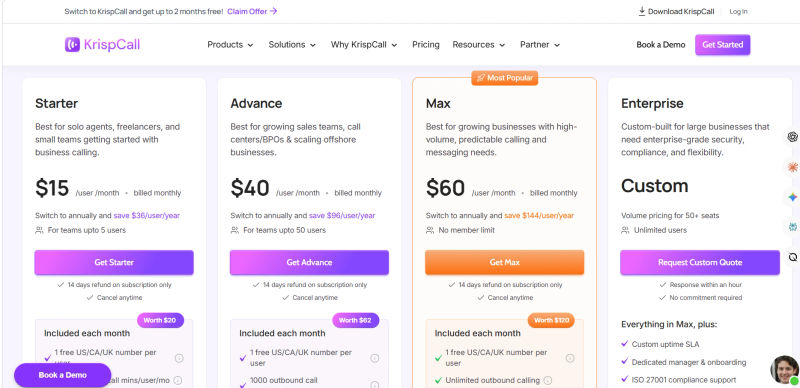
KrispCall Pricing Plans: Detailed Breakdown for 2027
In 2027, artificial intelligence is no longer a premium novelty; it is a baseline expectation for business communications. KrispCall has structured its AI cloud phone plans to reflect this reality, offering tiered subscriptions that cater to different operational scales.
For IT managers, understanding the exact feature-to-value mapping of these tiers is critical for cost-efficiency. The pricing ranges reflect the inclusion of advanced features, where the higher end accounts for premium AI credits and dedicated support SLAs.
1. Essential Plan: Best for Small Teams and Startups
Priced competitively around $15 per user/month for entry-level operations, the Essential tier is designed for lean teams that need reliable VoIP functionality without enterprise overhead. This plan includes local numbers, basic call routing, standard voicemail, and SMS capabilities.
However, this tier lacks the advanced AI transcription and deep CRM integrations that define modern cloud telephony. It is a highly functional entry point, but it may create data silos if your team relies heavily on automated workflows.
IT managers should view this tier as a replacement for legacy hardware rather than a fully integrated operational tool. Support response times at this tier are typically standard business hours (8x5 SLA).
2. Standard Plan: The Sweet Spot for CRM Integration
Hovering around $25 to $30 per user/month, the Standard plan unlocks the core value proposition of KrispCall. This tier includes native, bi-directional integrations with major CRMs like Salesforce, HubSpot, and Zoho.
For operations leaders, this is where the business phone system ROI becomes apparent.
Feature-to-Value Mapping:
Automated Call Logging: Eliminates manual data entry, saving agents an average of two minutes per call.
Click-to-Dial Functionality: Streamlines outbound workflows directly from the CRM interface.
Basic AI Call Summaries: Provides quick, searchable text summaries of conversations, reducing the need to listen to full call recordings.
The cost per minute of agent productivity decreases significantly when CRM data entry is automated, making the Standard plan the most popular choice for mid-market sales and support teams.
3. Enterprise Plan: Scalable AI Solutions for Global Ops
Targeting distributed enterprises at approximately $40 per user/month, this tier provides unrestricted access to KrispCall’s comprehensive AI suite and advanced administrative controls.
Note that Enterprise tiers in the 2027 SaaS market typically require a minimum seat count—often starting at 50 users—which must be factored into budget planning.
Enterprise-Grade Capabilities:
Real-Time Sentiment Analysis: AI evaluates caller tone and agent responses live, allowing managers to intervene in escalating situations.
Custom API Access: Enables IT teams to build bespoke integrations with proprietary ERPs or niche industry software.
Dedicated Account Management: Ensures 24/7 priority support and stringent uptime SLAs, which are crucial for organizations migrating from legacy PBX systems.
Administrative Dashboard and User Provisioning
A critical factor for IT managers is the ease of managing the platform post-deployment. KrispCall’s administrative dashboard is designed for streamlined user provisioning.
In the Standard and Enterprise tiers, IT teams can utilize Role-Based Access Control (RBAC) to define granular permissions for agents, managers, and system admins.
Furthermore, the platform supports bulk user uploads and automated provisioning via SCIM (System for Cross-domain Identity Management), drastically reducing the IT hours required to onboard new hires or manage organizational restructuring.
Does KrispCall Offer a Free Trial in 2027?
Yes, there is a KrispCall free trial, but IT managers must approach it strategically.
Industry benchmarks for 2027 indicate that B2B SaaS trial-to-paid conversions average 18.2% for opt-in trials (no credit card required) and 48.8% for opt-out trials (credit card required upfront).
Operations leaders should use the trial window not just to test basic calling, but to conduct a rigorous Proof of Concept (PoC) that validates technical requirements.
Step-by-Step PoC Deployment Checklist:
Network Readiness Assessment: Validate QoS (Quality of Service) and bandwidth requirements under peak load to ensure no packet loss during concurrent calls.
CRM Sandbox Integration: Test API calls and ensure custom fields map correctly from KrispCall to your CRM environment.
Latency Benchmarking: Test call quality across different geographic regions to prove reliability for globally distributed teams.
AI Accuracy Audit: Evaluate the AI's ability to transcribe industry-specific jargon without hallucination or data omission.
Single Sign-On (SSO) and Security Integration: Verify SAML 2.0 or OAuth integrations with your identity provider (e.g., Okta, Azure AD) to ensure compliance with internal security policies.
KrispCall Hidden Costs and Plan Limitations
When evaluating cloud communications software pricing, the advertised per-user rate is rarely the final price. Vendors frequently keep base licenses low while shifting revenue to usage-based billing, add-ons, and administrative fees.
KrispCall’s pricing structure exemplifies these industry-wide pitfalls. IT managers must account for the following hidden costs and plan limitations to avoid unpredictable billing and accurately calculate Total Cost of Ownership (TCO).
The Total Cost of Ownership (TCO) Formula for Cloud Communications:Annual TCO = (Base License Cost × Users × 12) + (Average Monthly Usage Fees × 12) + Premium Integration Surcharges + Implementation/Setup Fees + Number Porting Fees + Cost of Internal IT Management
1. Premium CRM Connector Surcharges
While basic integrations might be included in the Standard plan, bi-directional syncing with custom Salesforce objects or enterprise-grade ERPs often requires a premium connector fee.
Always verify if your specific CRM workflow is supported out-of-the-box or if it requires an API add-on that inflates your VoIP CRM integration costs.
2. International Calling and Number Provisioning
KrispCall offers extensive global coverage, but local number availability in emerging markets can incur separate monthly fees. Unpredictable monthly billing is a common pain point due to complex international calling zones.
IT managers must audit their historical call data to estimate these usage-based costs accurately before signing a contract.
3. Number Porting Fees
Migrating away from a legacy system means bringing your existing phone numbers with you. While some platforms offer free porting for the first batch of numbers, porting large blocks of DIDs (Direct Inward Dialing) or toll-free numbers can incur fees ranging from $2 to $5 per number.
This is a one-time hidden cost that must be accounted for in the initial migration budget.
4. Implementation and Professional Services Surcharges
For small teams, self-service onboarding is standard. However, for mid-market or enterprise deployments requiring custom API configurations, complex call routing trees, or dedicated training sessions, vendors often charge a one-time professional services fee.
Check if your deployment scale triggers mandatory implementation surcharges.
5. AI Processing Limits
AI features such as real-time transcription and sentiment analysis require significant computational power. While KrispCall includes these in higher tiers, there are often fair-use limits on the number of hours or minutes processed per month.
Exceeding these limits can result in metered overage charges, which can quickly inflate your monthly invoice if your team handles high call volumes.
6. Data Residency and Compliance
For healthcare, legal, or financial services, compliance with HIPAA or GDPR regarding AI-processed voice data is non-negotiable.
Upgrading to compliant storage solutions, securing third-party security audits, or requesting localized data residency often adds a significant percentage to the annual contract value.
Find Perfect Software for Your Business
Quick Comparison: KrispCall vs. Top 2027 VoIP Alternatives
To truly understand KrispCall's market position, it must be evaluated against the broader ecosystem.
Each of these platforms serves a distinct primary use case, and understanding these distinctions is key to maximizing your business phone system ROI.
1. KrispCall vs. The Heavyweights: RingCentral, Nextiva, and Dialpad
These platforms are the established giants of the UCaaS (Unified Communications as a Service) world. They offer massive feature sets, but often at a premium price point with complex deployment cycles.
RingCentral: Best for Large-Scale Enterprise Stability
RingCentral remains a dominant force in the unified communications market. It is best for massive, globally distributed enterprises that require 99.999% uptime SLAs, extensive hardware compatibility, and deep legacy system integrations.
Pricing & Value: The KrispCall vs RingCentral pricing debate comes down to scale. RingCentral's pricing is notoriously complex, and the TCO is generally higher. For a 500-user deployment, RingCentral's base cost and implementation fees will significantly outpace KrispCall. KrispCall is the more affordable option for mid-market companies that require agile software deployments rather than legacy PBX hardware support.
Security & Compliance: RingCentral excels here, offering out-of-the-box SOC2 Type II, HIPAA, and GDPR compliance, alongside end-to-end encryption (E2EE) for voice and video, making it a fortress for enterprise data.
Nextiva: Best for Unified Communications ROI
Nextiva excels in bundling voice, video, and customer experience tools into a single, cohesive platform. It is best for organizations looking to consolidate their entire communications stack with one vendor.
Pricing & Value: Looking at Nextiva vs KrispCall 2027 trends, Gartner research highlights that enterprise spending on traditional telephony platforms is falling as companies leverage existing collaboration tools like Microsoft Teams or Google Workspace. If your team already pays for these suites, paying for Nextiva's bundled video and messaging features may be redundant. KrispCall offers a more focused, lightweight telephony solution that integrates alongside existing tools without forcing you to pay for overlapping functionalities.
Security & Compliance: Nextiva maintains strict ISO/IEC 27001 certifications and offers robust PCI compliance for contact centers handling payment information over the phone.
Dialpad: Best for Native AI Transcription and Coaching
Dialpad built its architecture around artificial intelligence from day one. It is best for high-performance sales and support teams that require highly accurate, real-time coaching, automated QA, and deep conversational intelligence.
Pricing & Value: In a direct Dialpad AI pricing comparison, Dialpad's proprietary AI engine is arguably more mature in handling complex sentiment analysis than KrispCall's. The trade-off is pricing flexibility; Dialpad's enterprise plans come with strict user minimums and higher base costs. KrispCall provides a more accessible entry point for AI telephony without rigid contract requirements, making it ideal for scaling teams.
Security & Compliance: Dialpad provides comprehensive SSO options, custom data retention policies, and SOC2 Type II compliance, ensuring that AI transcripts are securely stored and easily auditable.
Join thousands of operations leaders who trust AuthenCIO for their communications evaluations.
2. KrispCall vs. Specialized Challengers: Calilio, CallHippo, CloudTalk, and Quo
Beyond the heavyweights, several specialized challengers offer compelling alternatives to KrispCall.
Choosing between them depends entirely on your operational priorities, whether that be global presence, sales velocity, or strict regulatory adherence.
Calilio: Best for Local Presence Management
Calilio is a strong contender for businesses that prioritize establishing a local presence in multiple international markets quickly. It excels at rapid number provisioning and simple, intuitive call routing.
Pricing & Value: When evaluating Calilio vs CallHippo pricing or comparing it to KrispCall, Calilio is highly competitive for basic international footprint expansion. However, Calilio lacks the depth of native CRM integrations and advanced AI workflows found in KrispCall. IT managers should choose Calilio for simple global reach, but KrispCall is superior for data-driven sales teams that need their phone system to communicate seamlessly with their CRM.
Security & Compliance: Calilio offers standard TLS/SRTP encryption for calls but lacks the advanced compliance certifications (like HIPAA) required for highly regulated industries.
CallHippo: Best for High-Volume Outbound Sales
CallHippo is purpose-built for call centers and outbound sales development representatives (SDRs). It features aggressive power dialers, global connect features, and gamification metrics designed to maximize agent output.
Pricing & Value: While KrispCall handles outbound calling efficiently, CallHippo's interface is optimized purely for high-velocity volume. The downside of CallHippo is its heavy reliance on usage-based billing for international calls, which can lead to unpredictable invoices. KrispCall offers more predictable pricing structures for blended inbound and outbound environments.
Security & Compliance: CallHippo provides standard data encryption and GDPR compliance, but IT managers must configure user access controls carefully to protect large lists of outbound lead data.
CloudTalk: Best for Advanced Call Center Analytics
CloudTalk targets the modern contact center with deep analytics, custom reporting, and complex skill-based routing. It is best for support teams that need granular visibility into agent performance, call queues, and customer satisfaction metrics.
Pricing & Value: CloudTalk enterprise features are robust, but its base cost is higher for small teams, and its interface presents a steeper learning curve for non-technical users. KrispCall offers a more balanced, user-friendly solution for general business operations that do not require enterprise-grade contact center metrics but still want actionable data insights.
Security & Compliance: CloudTalk boasts strong security credentials, including ISO 27001 and SOC2 Type II, making it a secure choice for customer support teams handling sensitive user data.
Quo: Best for Niche Industry Compliance
Quo has carved out a space in highly regulated industries by focusing on secure, compliant communications. It is best for legal, medical, or financial firms where data sovereignty, end-to-end encryption, and strict regulatory adherence are the primary concerns.
Pricing & Value: Quo VoIP plans are priced to reflect their specialized architecture. While KrispCall adheres to standard security protocols, Quo's entire infrastructure is built around compliance. The trade-off is a smaller app ecosystem and fewer out-of-the-box CRM integrations compared to KrispCall. If compliance is your absolute top priority, Quo is the safer choice; if operational efficiency and CRM connectivity are paramount, KrispCall wins.
Security & Compliance: Quo is the gold standard here, offering military-grade encryption, guaranteed data residency options, and strict adherence to HIPAA, FINRA, and GDPR regulations.
Try AuthenCIO
Move to faster, smarter software evaluation with AI
Conclusion: Is KrispCall the Right Investment for Your 2027 Tech Stack?
Evaluating cloud communications software pricing in 2027 requires balancing base subscription costs with the operational ROI of AI and CRM integrations. KrispCall stands out as a highly affordable, AI-capable solution for mid-market teams that need seamless CRM logging without the bloat of legacy enterprise systems.
To maximize your ROI and simplify your procurement choice, use this Decision Matrix to align your primary business need with the most cost-effective platform:
Primary Need: Seamless CRM Syncing & Affordability → Choose KrispCall. It offers the best balance of AI features and bi-directional CRM integration for mid-market teams, keeping base costs low.
Primary Need: 99.999% Uptime & Global Enterprise Scale → Choose RingCentral. It justifies its higher total cost of ownership (TCO) with unmatched stability and legacy hardware support.
Primary Need: Advanced AI Sales Coaching → Choose Dialpad. Its proprietary AI engine drives high ROI for real-time sentiment analysis and agent QA.
Primary Need: Strict Legal/Medical Compliance → Choose Quo. Its architecture is purpose-built to handle sensitive, regulated data, avoiding costly compliance penalties.
Primary Need: High-Velocity Outbound Dialing → Choose CallHippo. Its power dialers are optimized for SDR productivity, maximizing outbound sales ROI.
Ultimately, navigating cloud communications software pricing requires IT managers to conduct a thorough TCO analysis. Factor in hidden costs like international usage, AI processing limits, number porting fees, and premium integration surcharges before making a final decision.
Utilize free trial periods not just to test call quality, but to validate your specific CRM workflows, audit security protocols like SSO, and ensure the platform delivers measurable ROI for your long-term operational goals.