

Introduction
Evaluating cloud communications software pricing in 2027 requires factoring in the massive expense of international roaming for distributed workforces. Roaming data management is now a core component of enterprise cloud communications software, shifting from individual physical SIMs to centralized eSIM shared data pools. For operations and logistics heads, Voye Global offers a predictable financial model: its primary shared mobile data pool costs $2,450 per month for 1TB of global data (requiring a minimum of 50 active seats).
Streamline your software evaluation process
This transition to shared data pools minimizes international roaming expenses while maintaining reliable connectivity via Tier-1 carrier prioritization. When analyzing cloud communications software pricing, decision-makers must look beyond the lowest cost-per-gigabyte. A true evaluation requires a granular understanding of how data is allocated across the software platform, the hidden limitations of regional coverage, and the administrative overhead of reconciling telecom invoices.
Voye Global has positioned itself as a major player in this space, designing its 2027 shared mobile data pool plans specifically to eliminate individual data caps and pool resources across an entire remote workforce via a unified cloud communications dashboard.
To help you choose the right tool for your logistics and operations teams, we provide a direct, unbiased pricing evaluation. Below is a comprehensive comparison of Voye Global against the top enterprise eSIM and cloud communications roaming providers in the 2027 market.
Plan | Best For | Pricing (USD $) | Limitations |
Voye Global Shared Pool | Mid-to-large logistics teams needing predictable global data overhead | $2,450/month for 1TB Global Pool | Requires minimum 50 active seats; premium routing incurs overage fees |
GigSky Enterprise | Mission-critical field operations and offshore logistics | $45/user for 10GB (Global) | High per-user cost at scale; no true shared data pooling |
Airalo Business | Occasional executive travel and short-term deployments | $30/user for 10GB (Regional) | Managed individually; data expires after 30 days; no centralized MDM integration |
Keepgo Corporate | Long-term data persistence for seasonal or intermittent travel | $50/GB (Pay-as-you-go Pool) | Highest upfront cost-per-GB; limited high-speed 6G coverage in Tier 3 zones |
Flexiroam Fleet | Global fleet scalability and IoT tracking integration | $3,100/month for 1TB Pool | App management friction; requires complex initial provisioning for large fleets |
Truphone Enterprise | Enterprise-grade security, MDM integration, and private APNs | $65/user/month (Unlimited) | Complex deployment cycle; strict throttling after 20GB of high-speed usage |
Holafly Business | Fixed-cost unlimited regional data for heavy individual users | $69/user/month (Unlimited) | Strict no-tethering/hotspot policies; not viable for multi-device fleet operations |
*Note: All prices shown reflect typical monthly billing. Vendors often offer lower pricing for annual commitments, but those discounts are excluded here for easier comparison. Actual costs may vary depending on your requirements, usage volumes, and negotiated terms.
Software Covered in this Article
The following articles break down the key aspects of Cloud Communications Software, featuring a carefully curated set of key players:







Key Takeaways: Cloud Communications Software Pricing & Roaming
Cloud communications software pricing for global roaming in 2027 heavily favors shared data pools and scalable enterprise tiers. For remote teams, consolidating mobile data usage through centralized platforms reduces per-gigabyte costs and simplifies billing compared to managing individual consumer eSIMs.
Voye Global: Leads the market for shared mobile data pools, allowing IT administrators to dynamically allocate resources across a distributed workforce.
Short-Term Deployments: GigSky offers mission-critical reliability for field operations, while Airalo provides cost-effective regional plans for occasional executive travel.
Long-Term & Fleet Scalability: Keepgo ensures data persistence with non-expiring plans, whereas Flexiroam excels in managing large-scale global fleets.
Unlimited vs. Pooled: Holafly is ideal for fixed-cost unlimited regional data, while Truphone delivers enterprise-grade security and seamless integration.
When evaluating cloud communications software pricing, always factor in hidden costs such as tethering restrictions, hardware compatibility, and premium support fees. Selecting the optimal provider requires balancing data validity, regional coverage, and your team's specific deployment timeline.
2027 Voye Global Pricing Breakdown: Shared Mobile Data Pools
In 2027, Voye Global has refined its enterprise offering to align closely with modern cloud communications software pricing models. Rather than charging per individual line, Voye focuses heavily on a shared mobile data pool model integrated directly into your cloud telecom stack. This structure is fundamentally designed to solve the problem of data waste and drive international roaming cost reduction for logistics.
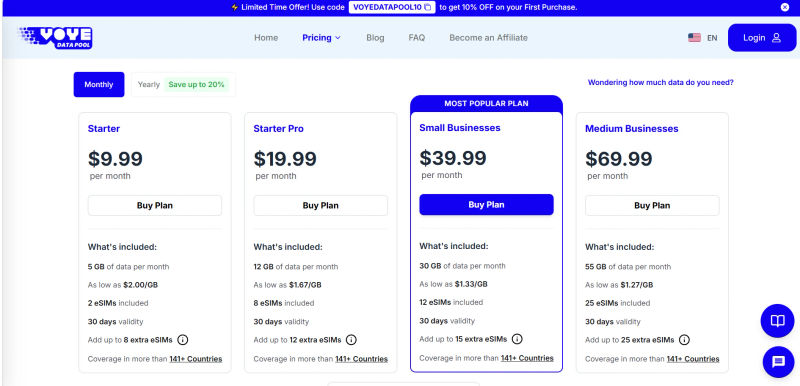
In a traditional individual corporate SIM model, some employees consume only 10% of their allocated data while others exceed their limits, resulting in expensive overage charges. Voye Global's shared pool aggregates the data allowance into a single, centralized reservoir that dynamically allocates bandwidth to users based on real-time consumption across different time zones and regions.
When evaluating enterprise eSIM pricing 2027 within your broader cloud communications software pricing strategy, Voye Global’s tiers start at a baseline of $2,450 per month for a 1 Terabyte (TB) global data pool. This base cost covers up to 100 active eSIM profiles, bringing the effective cost to roughly $2.45 per gigabyte.
For larger enterprise deployments, a 5TB pool is available at $10,500 per month, reducing the cost-per-GB to $2.10. Notably, this 5TB pool can be shared across different regional subsidiaries, allowing multinational logistics firms to consolidate their telecom spend globally. Overage rates are strictly capped at $3.50 per GB, providing a predictable ceiling for annual telecom budgets.
Who is this best for? Voye Global is best for mid-to-large logistics teams and remote operations that require predictable global data overhead without the micromanagement of individual data caps.
If you have a fleet of 50 to 500+ members moving unpredictably across borders, the pooling model ensures that high-usage field engineers are subsidized by low-usage transit coordinators.
However, decision-makers must account for plan limitations. Voye Global requires a minimum commitment of 50 active seats to access the pooled pricing tiers. Because it is billed similarly to SaaS seat licenses, it is crucial to understand that a seat is considered "active" and billed as long as the profile is assigned within your Mobile Device Management (MDM) portal, regardless of whether the employee travels or consumes data during that specific billing cycle.
Furthermore, while the pool is marketed as "global," data consumed in certain high-cost maritime or remote satellite zones—often critical for shipping logistics—is deducted at a 3x multiplier from the shared pool. Operations heads must audit their team's primary travel routes against Voye Global's 2027 zone classification list to accurately forecast consumption.
1. GigSky and Airalo: Best Alternatives for Short-Term Deployments in 2027?
While Voye Global excels in long-term, large-scale data pooling, logistics teams often face scenarios requiring agile, short-term connectivity solutions. GigSky and Airalo offer distinct pricing models that cater to specific operational niches where a massive shared pool might be overkill or financially inefficient.
GigSky: Best for Mission-Critical Field Operations
GigSky has built its 2027 enterprise reputation on network reliability and robust coverage in challenging environments, including offshore, maritime, and aviation sectors. Unlike Voye Global's pooled approach, GigSky relies on high-tier individual data packages. Enterprise pricing averages $45 per user for a 10GB global plan valid for 30 days.
Who is this best for? GigSky is best for mission-critical field operations where network uptime is more important than cost-per-GB. If you are deploying a specialized engineering team to a remote port for a three-week infrastructure project, GigSky provides superior Tier-1 carrier prioritization.
The primary limitation is scalability; deploying GigSky across a 500-person logistics fleet will result in significantly higher annual costs compared to a shared pool, and unused data does not roll over. However, for logistics firms with high-frequency short-term deployments, GigSky does offer volume discounts, typically reducing costs by 15% to 20% for deployments exceeding 200 users per quarter.
Airalo: Best for Occasional Executive Travel
Airalo has expanded its consumer dominance into the B2B sector with a streamlined corporate management portal. Airalo Business focuses on regional and local eSIMs rather than global pools. A typical 30-day, 10GB regional plan (e.g., covering all of Europe or Southeast Asia) costs approximately $30 per user.
Who is this best for? Airalo is best for occasional executive travel and short-term regional deployments. If your operations head or regional managers travel internationally a few times a quarter, provisioning an Airalo eSIM on demand is highly cost-effective.
The limitation lies in its management architecture. Airalo does not offer true shared data pooling. Each eSIM is a siloed asset, meaning operations managers must manually top up individual accounts when data runs low, creating administrative friction for large-scale logistics fleets.
Find Perfect software for Your Business
2. Keepgo and Flexiroam: Evaluating Long-Term Data Validity Plans
For logistics companies, data expiration is a massive source of wasted capital. Traditional 30-day billing cycles force companies to pay for data that simply vanishes if unused. Keepgo and Flexiroam address this pain point through long-term validity models, offering a different financial structure than Voye Global's monthly recurring pools.
Keepgo: Best for Long-Term Data Persistence
Keepgo's 2027 corporate offering is built entirely around data persistence. Their shared data pools feature a 365-day validity period, meaning any unused gigabytes automatically roll over as long as the account remains active. The pricing structure is pay-as-you-go, with enterprise pools costing roughly $50 per GB upfront.
Who is this best for? Keepgo is best for long-term data persistence for seasonal or intermittent travel. If your logistics team experiences massive spikes in travel during the holiday supply chain rush but remains stationary for the rest of the year, Keepgo prevents you from paying high monthly subscriptions during the off-season.
The primary limitation is the high initial cost-per-GB. While the data lasts a year, the upfront capital expenditure is significantly higher than Voye Global's $2.45/GB monthly rate, making Keepgo inefficient for consistent, high-volume daily users.
Flexiroam: Best for Global Fleet Scalability
Flexiroam offers a hybrid approach, combining bulk data pooling with extensive IoT and fleet tracking integrations. In 2027, Flexiroam's enterprise pricing sits at approximately $3,100 per month for a 1TB shared pool. While slightly more expensive than Voye Global, Flexiroam includes advanced API access for integrating connectivity data directly into existing supply chain management software.
Who is this best for? Flexiroam is best for global fleet scalability where human personnel and IoT tracking devices (like shipping container monitors) share the same data ecosystem. Operations heads can manage both employee smartphones and hardware trackers from a single pool.
The limitation is the initial provisioning complexity; deploying Flexiroam across mixed hardware environments requires dedicated IT support. Operations heads should expect a 4-to-6 week development cycle to fully integrate the Flexiroam API with proprietary logistics software, which can cause initial deployment friction.
3. Truphone and Holafly: Unlimited Data vs Pooled Resources
When evaluating Voye Global's shared pool, decision-makers must also consider the alternative: unlimited data models. Truphone and Holafly offer fixed-cost structures that eliminate the need to monitor gigabyte consumption, but they introduce entirely different operational constraints.
Truphone: Best for Enterprise-Grade Security and Integration
Truphone focuses on the high end of the corporate market, offering unlimited global data plans priced around $65 per user, per month. This premium pricing includes deep Mobile Device Management (MDM) integration, private APNs, and built-in VPN tunneling, ensuring that all remote data traffic complies with strict enterprise security protocols.
Who is this best for? Truphone is best for enterprise-grade security and integration. If your logistics team handles highly sensitive customs data, proprietary routing algorithms, or government contracts, Truphone's built-in security infrastructure justifies the higher cost.
The limitation is the strict fair usage policy (FUP). While marketed as "unlimited," Truphone heavily throttles 5G/6G speeds down to 3G after 20GB of usage per billing cycle. In practical terms, a throttled 3G connection means a field engineer cannot reliably run a basic cloud-based inventory management app, causing severe operational delays at critical checkpoints.
Holafly: Best for Fixed-Cost Unlimited Regional Data
Holafly has disrupted the B2B market by offering unlimited data eSIMs at a flat rate, typically around $69 per user for a 30-day global pass. There are no overage fees, no shared pools to monitor, and no complex dynamic allocation formulas to calculate.
Who is this best for? Holafly is best for fixed-cost unlimited regional data for heavy individual users. If you have a specific subset of employees who consume massive amounts of data (e.g., video conferencing from remote warehouses daily), Holafly provides absolute budget predictability.
However, the limitations are severe for logistics teams. Holafly strictly prohibits tethering and hotspotting. A remote worker cannot use their phone to provide internet to a laptop or a barcode scanner, rendering the service virtually useless for multi-device field operations.
Operational Readiness: Hardware, Support, and Deployment in 2027
Evaluating pricing is only one part of the equation; operations heads must also assess the operational readiness of these platforms. As telecom standards evolve, three critical non-pricing factors must influence your decision:
Hardware Compatibility: Ensure your existing fleet of devices supports 2027 connectivity standards. While most 2025 and 2026 enterprise smartphones support standard eSIM profiles, taking full advantage of the high-speed 6G networks offered by premium tiers (like Truphone or GigSky) requires 6G-ready hardware. Deploying a high-tier plan on older 5G devices results in wasted bandwidth potential.
Customer Support SLAs: When a logistics driver is stuck at a border crossing at 3 AM with no data to load customs documents, standard email support is insufficient. Enterprise SLAs must guarantee 24/7 technical support with 15-minute response times. Providers like Voye Global and Truphone offer dedicated account managers, whereas consumer-first brands like Airalo may lack the rapid response infrastructure required for mission-critical logistics.
Bulk Provisioning Timelines: The speed of deployment directly impacts operational agility. Transitioning a fleet of 500+ users should not take weeks. Top-tier providers offer zero-touch provisioning via MDM integrations (such as Microsoft Intune or Jamf), allowing IT departments to push eSIM profiles to hundreds of devices in a matter of hours.
Hidden Costs and Plan Limitations to Watch Out For in 2027
The most critical phase of evaluating 2027 corporate telecom pricing is identifying the hidden costs that can destroy your projected ROI. While Voye Global and its competitors advertise transparent top-line pricing, operations heads must audit the fine print of their Service Level Agreements (SLAs).
Zone Classification Multipliers: Scrutinize the definition of "Global Coverage." In 2027, many providers have restructured their zone classifications. Tier 1 countries are always included, but critical logistics hubs in Tier 2 or Tier 3 countries often incur premium routing fees. With Voye Global, consuming data in a Tier 3 zone depletes your pool at an accelerated rate (e.g., 1GB used equals 3GB deducted).
Data Throttling and Deprioritization: Unlimited plans rely on aggressive Fair Usage Policies. Once a user hits a hidden threshold, their connection speed is throttled from high-speed 6G down to 2G/3G speeds, paralyzing cloud-based supply chain software. Always negotiate hard caps and guaranteed minimum speeds.
MDM Integration and API Fees: Transitioning to a global eSIM pool requires robust MDM software. Providers may charge API access fees to integrate with your existing systems or setup fees for establishing private APNs. These "hidden value-adds" can increase your first-year deployment costs by 10% to 15%.
Tax and Compliance Liabilities: Global data pooling creates complex tax liabilities depending on where the data is consumed versus where your company is headquartered. Providers that offer legally compliant consumption reports by jurisdiction save accounting departments hundreds of hours.
To prepare for the transition, operations heads should use the following 2026 Roaming Spend Audit Checklist:
Audit total 2026 individual roaming spend and identify the top 10% of high-usage employees.
Map your team’s most frequent travel routes against the 2027 Tier 1, 2, and 3 zone classifications of your prospective provider.
Evaluate your current MDM infrastructure to determine if API integration fees will apply.
Review potential cross-border tax liabilities with your accounting department based on expected data consumption regions.
Try AuthenCIO
Move to faster, smarter software evaluation with AI
Final Verdict: Choosing the Right Data Plan for Your Remote Team
Minimizing international roaming expenses in 2027 requires aligning your connectivity platform with your specific operational behavior and broader cloud communications software pricing strategy. There is no single "best" provider; there is only the best provider for your unique use case.
If your primary goal is to eliminate the administrative nightmare of individual data caps and you manage a large, highly mobile logistics workforce, Voye Global's shared mobile data pool offers the most compelling balance of cost-efficiency and predictability. The $2,450 monthly baseline for 1TB of dynamically allocated data effectively neutralizes the risk of isolated bill shock, a common pitfall when evaluating cloud communications software pricing.
However, if your operations require specialized, mission-critical uptime in remote areas, GigSky remains the premium standard. For fleets that require long-term data validity without monthly expirations, Keepgo's 365-day rollover model is unmatched. Conversely, if security and deep MDM integration are non-negotiable requirements for your enterprise, Truphone's managed unlimited plans provide the necessary infrastructure, provided you can navigate their throttling limitations.
Before making a final purchasing decision, we highly recommend initiating a pilot program. Request a trial eSIM deployment for a small control group of 10 to 15 high-frequency travelers.
This allows your IT department to test bulk provisioning speeds, evaluate the reality of Tier-3 zone coverage, and measure actual 6G hardware compatibility before committing to an annual enterprise contract. By taking a data-driven, phased approach, you can successfully transition your organization to a connectivity plan that optimizes your cloud communications software pricing and drives genuine bottom-line savings.
Find predictable travel data rates. Run a side-by-side pricing comparison of Voye Global on AuthenCIO.