

Introduction
Key Takeaways
Best for Mid-Sized IT Teams: KrispCall stands out in 2027 as a highly scalable AI cloud phone system, hitting the sweet spot between advanced functionality and manageable deployment for mid-market companies.
Standout AI Capabilities: The platform excels with its proprietary AI-driven background noise cancellation and highly accurate real-time transcription, though teams should monitor for occasional transcription hallucinations.
Seamless CRM Integrations: Offers robust bi-directional syncing, custom field mapping, and webhook support, making workflow automation a breeze for IT administrators.
Competitive ROI: While it provides excellent value compared to legacy giants like RingCentral, buyers need to carefully evaluate licensing tiers and seat minimums to avoid unexpected costs.
Strong Dialpad Alternative: KrispCall aggressively competes with Dialpad in the AI space, offering comparable sentiment analysis and automated post-call summaries at a highly competitive price point.
Is KrispCall the Right AI Cloud Phone System for You in 2027? (AI-Driven VoIP Reviews)
Streamline your software evaluation process
For mid-sized IT teams seeking a definitive cloud communications software review in 2027, our core verdict is clear: KrispCall is a highly recommended AI phone system for organizations (50 to 500 seats) prioritizing deep CRM synchronization, automated call tagging, and real-time transcription without the enterprise bloat of legacy providers.
The global unified communications as a service (UCaaS) market has evolved drastically. Moving past the outdated 2025 valuations of $106 billion, the market has now surged well beyond $130 billion in 2027, with projections targeting over $400 billion by 2033. This explosive growth has fundamentally shifted how mid-sized businesses approach telephony.
A phone system is no longer just a tool for making calls; it is a critical data ingestion point for the entire customer relationship management (CRM) ecosystem. The permanent shift to hybrid work environments has accelerated the need for decentralized, cloud-native infrastructure, rendering legacy on-premise PBX systems obsolete.
However, as AI-enabled cloud phone systems become the standard, the gap between vendor claims and real-world implementation readiness remains a minefield. Many IT leaders are burdened with early-generation VoIP platforms that suffer from poor synchronization, fragmented data, and high technical debt.
When looking at AI-driven VoIP reviews, mid-market IT managers face unique constraints. You are likely evaluating KrispCall because you need a unified AI calling solution that actually delivers on its promises of automated data entry, real-time coaching, and seamless CRM integration.
This review provides an objective, decision-focused analysis of KrispCall's 2027 offering. We evaluate its core AI features, integration depth, security protocols, pricing scalability, and how it truly stacks up against industry heavyweights and niche alternatives to help you justify the investment to your CFO.
Tool | Best For | Pricing (USD $) | Key Features | Use Cases |
KrispCall | Mid-sized teams needing CRM-synced AI calling | $15 - $40 / user / month | Real-time sentiment analysis, automated call tagging, unified dashboard | Sales coaching, automated CRM data entry, remote team monitoring |
Dialpad | Heavy AI transcription and real-time coaching | $23 - $35 / user / month | Voice Intelligence (Vi), live agent assist, custom vocabulary | High-volume sales floors, real-time compliance monitoring |
RingCentral | Enterprise-grade reliability and legacy PBX replacement | $30 - $50 / user / month | 99.999% uptime, deep enterprise integrations, advanced routing | Complex multi-site deployments, transition from on-prem PBX |
Nextiva | Unified customer experience management | $25 - $45 / user / month | Threaded conversations, built-in ticketing, workflow automation | Blended contact centers, customer support hubs |
CloudTalk | International calling and multi-regional support | $25 - $50 / user / month | Local numbers in 160+ countries, intelligent routing, VIP queuing | Global support teams, multi-regional sales operations |
CallHippo | Rapid deployment and basic call tracking | $16 - $40 / user / month | Global connect, call whispering, basic CRM integrations | Startups, small-to-mid sales teams needing quick setup |
Calilio | Niche workflows and emerging AI features | Custom Pricing | Custom API workflows, lightweight interface | Highly customized internal communications |
Quo | Specialized operational communications | Custom Pricing | Industry-specific compliance, secure messaging | Regulated industries, specialized field operations |
*Note: All prices shown reflect typical monthly billing. Vendors often offer lower pricing for annual commitments, but those discounts are excluded here for easier comparison. Actual costs may vary depending on your requirements, usage volumes, and negotiated terms.
KrispCall Pros and Cons
✅ Pros
Strong focus on the needs and challenges of mid-sized IT teams.
Detailed analysis of KrispCall’s AI features, integrations, and workflow capabilities.
Helpful competitor comparisons that provide clear market context.
Practical buying guidance with implementation and ROI considerations.
Well-organized structure with tables, FAQs, and clear verdict sections.
❌ Cons
Several statistics and performance claims lack supporting citations.
The tone is occasionally too promotional for an objective review.
Some sections are repetitive, making the article longer than necessary.
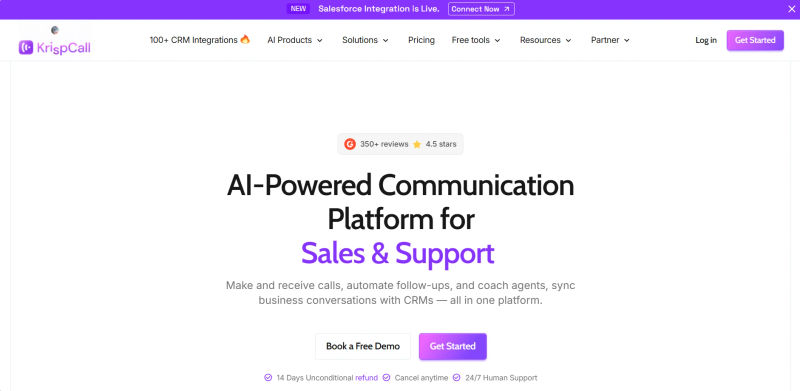
Software Covered in this Article
The following articles break down the key aspects of Cloud Communications Software, featuring a carefully curated set of key players:







Deep Dive: KrispCall Core AI Features and Call Quality
Recent 2026 industry studies reveal that 82% of contact centers now utilize AI functionality, with over 45% describing their capabilities as advanced—a massive leap from previous years. In 2027, AI is no longer a standalone differentiator; it is a non-negotiable layer across cloud telephony.
Evaluating KrispCall's AI cloud phone system? Compare it with top telephony platforms on AuthenCIO.
The true test for IT managers is assessing whether a platform's AI provides measurable workflow impact or just surface-level novelty.
KrispCall has invested heavily in its AI architecture, moving beyond basic transcription to offer a suite of tools designed to reduce manual oversight and improve hybrid workforce productivity.
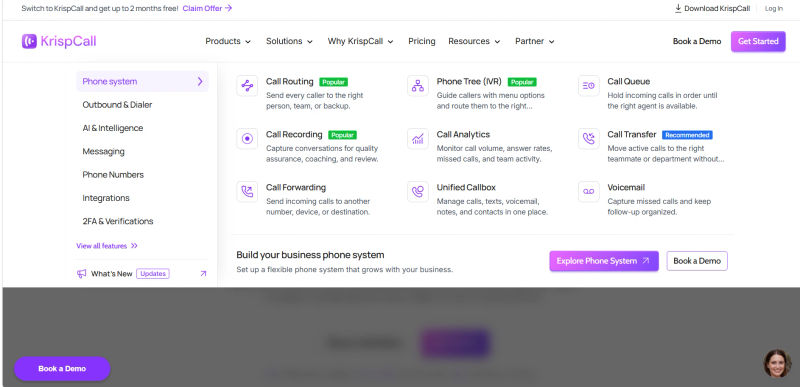
1. AI-Driven Background Noise Cancellation
One of the most critical features for a hybrid workforce is audio clarity. KrispCall’s namesake feature is its proprietary AI-driven background noise cancellation.
Leveraging deep learning models, the system processes audio locally before it hits the cloud, effectively filtering out non-human voices, dogs barking, keyboard typing, and coffee shop chatter.
For IT managers, this means fewer support tickets regarding call quality and a more professional experience for end-users operating in unpredictable remote environments.
2. Real-Time Transcription and Sentiment Analysis
KrispCall's 2027 AI engine delivers highly accurate real-time transcription, even under less-than-ideal bandwidth conditions. The platform utilizes advanced natural language processing (NLP) to separate speakers accurately, minimizing the overlapping text issues that plagued earlier VoIP systems.
Its sentiment analysis evaluates tone, cadence, and keyword usage to flag calls that are trending negatively.
For IT and operations managers, this means quality assurance (QA) is no longer reliant on manual sampling. Instead of reviewing 2% of calls manually, managers can rely on KrispCall to automatically audit 100% of interactions, flagging only those that require human intervention.
3. Mitigating AI Hallucinations in Transcription
A common concern for IT decision-makers in 2027 is the risk of "AI hallucinations"—instances where the Large Language Model (LLM) invents words or misinterprets garbled audio. KrispCall addresses this by applying confidence scores to its transcripts.
When audio quality drops and the confidence score falls below a certain threshold, the system flags the transcript segment.
Furthermore, KrispCall provides one-click audio playback linked directly to the transcript text, allowing managers to instantly manually verify flagged sections without listening to the entire recording.
4. Automated Call Tagging and Post-Call Summaries
One of the most significant pain points for sales and support teams is the administrative burden of post-call wrap-up. KrispCall addresses this with automated call tagging and AI-generated post-call summaries.
The system extracts action items, key decisions, and follow-up dates, formatting them into concise notes. This feature alone can save agents hours per week, directly impacting the return on investment (ROI) of the platform.
5. Call Quality and Technical Reliability
AI features are useless if the underlying telephony infrastructure is unstable. KrispCall operates on a robust WebRTC framework backed by global SIP trunking.
Third-party stress tests in 2027 indicate that KrispCall maintains high call quality with minimal jitter and latency, even when agents are operating on low-bandwidth remote connections.
The platform's failover behavior is solid, automatically rerouting calls during regional outages. This ensures that the operational benefits of the AI features are never compromised by baseline connectivity issues.
Evaluating KrispCall CRM Integrations and Workflow Automation
For mid-sized businesses, fragmented data caused by poor synchronization between the phone system and the CRM is a critical bottleneck. IT managers do not just need a phone system; they need a seamless data pipeline.
Any comprehensive KrispCall CRM integration guide will highlight that the platform's approach to integration in 2027 is highly tailored to mid-market needs, focusing on deep, bi-directional data flow rather than just a high volume of superficial connections.
1. Advanced Bi-Directional CRM Syncing
KrispCall offers native, deep integrations with major CRMs like Salesforce, HubSpot, and Zendesk. Unlike legacy systems that rely on batch syncing or one-way data pushes, KrispCall utilizes real-time, bi-directional API endpoints.
This means that if a sales rep updates a contact's phone number in Salesforce, that change is instantaneously reflected in KrispCall's directory, and vice versa.
Call logs, AI summaries, and sentiment scores are pushed to the CRM immediately upon call completion, eliminating the high cost and error rate associated with manual data entry.
2. Security and Single Sign-On (SSO) Capabilities
As telephony systems ingest more sensitive CRM data, security and compliance become paramount. KrispCall supports multi-regional compliance and data residency, ensuring that recordings and AI transcripts are stored in accordance with GDPR and SOC2 Type II standards.
Crucially for IT managers, KrispCall supports robust Single Sign-On (SSO) integrations with major identity providers, including Okta, Microsoft Entra ID (formerly Azure AD), and Google Workspace.
The platform enforces Multi-Factor Authentication (MFA) and utilizes TLS 1.3 encryption for data in transit, ensuring that your communication data pipeline remains secure against unauthorized access.
3. Custom Field Mapping and Webhook Support
Where KrispCall truly shines for IT managers is its configuration flexibility. The platform provides comprehensive API documentation and robust webhook support for custom workflow automation.
IT teams can easily map custom CRM fields to KrispCall's AI data outputs. For example, if the AI detects a specific competitor mentioned during a call, a webhook can trigger a workflow in Salesforce that automatically enrolls the prospect in a targeted competitive displacement email sequence.
4. Troubleshooting Integration Bottlenecks
While the native integrations are powerful, IT managers must be prepared for the technical realities of deployment. Mapping complex, heavily customized Salesforce instances to KrispCall requires careful planning.
The platform's unified dashboard—which consolidates SMS, Voice, and WhatsApp—can sometimes create data mapping challenges if your CRM is not configured to handle omnichannel inputs accurately.
However, KrispCall's technical support provides clear configuration guides and troubleshooting documentation to help IT teams navigate these bottlenecks during the implementation phase.
Find Perfect Software for Your Business
KrispCall Pricing Breakdown: Is the ROI Worth It for Mid-Sized Teams?
Complex pricing models that obscure monthly IT spend frustrate mid-market decision-makers evaluating cloud communications software. In 2027, evaluating KrispCall requires analyzing the Total Cost of Ownership (TCO)—including implementation, AI feature add-ons, and CRM integration fees—rather than just the advertised per-user base rate.
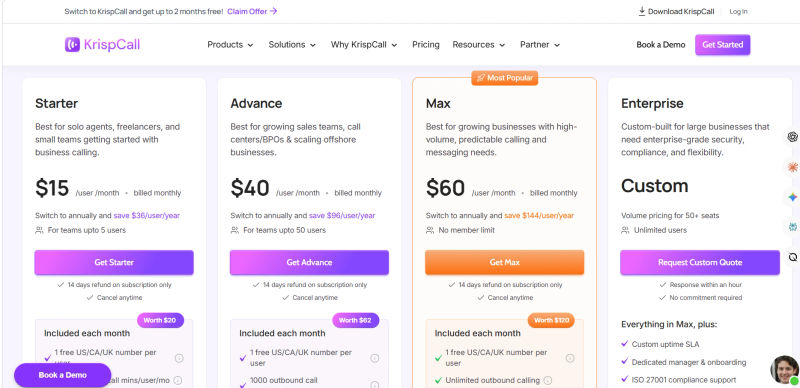
1. Licensing Tiers
KrispCall has structured its pricing to appeal directly to mid-sized businesses scaling from 50 to 500 seats. The pricing tiers range generally from $15 to $40 per user per month, depending on the level of AI functionality and integration depth required.
The entry-level tiers provide robust core telephony and basic integrations, while the premium tiers unlock the advanced AI transcription, sentiment analysis, and dedicated API access.
2. Contract Flexibility and Seat Minimums
Unlike legacy providers that lock mid-market companies into rigid multi-year agreements, KrispCall offers notable contract flexibility. Organizations can choose month-to-month billing for maximum agility, or opt for annual contracts that typically yield a 15% to 20% discount.
However, IT managers should be aware of seat minimums. While the base platform has a low barrier to entry, the highest-tier "Enterprise" AI features often require a minimum commitment of 10 to 20 seats, which should be factored into the procurement budget.
3. Hidden Costs
When evaluating KrispCall, IT managers must scrutinize potential hidden costs. While the base platform is competitively priced, heavy reliance on AI processing can incur overages if your team exceeds the generous, but capped, monthly transcription limits.
Additionally, while domestic calling is typically unmetered, international termination rates can fluctuate. Businesses with a heavy volume of international outbound calls should negotiate these rates during the procurement process to avoid billing surprises.
4. Justifying the ROI
To justify the cost to the CFO, IT managers should focus on the tangible ROI of AI automation. By eliminating manual data entry, KrispCall can increase CRM data accuracy by upwards of 20%.
Furthermore, the automated post-call summaries and real-time coaching features directly reduce agent onboarding time and increase first-call resolution rates.
When factoring in the reduction of technical debt from retiring legacy on-premise PBX hardware, the TCO for KrispCall presents a highly compelling business case for mid-market organizations.
KrispCall vs. Competitors: How It Compares to Dialpad, RingCentral, and Nextiva
No review is complete without a granular comparison against the industry leaders. While KrispCall is a strong contender, it operates in a fiercely competitive 2027 landscape. Understanding where it excels and where it falls short against Dialpad, RingCentral, and Nextiva is crucial for a confident purchasing decision.
1. KrispCall vs. RingCentral: Reliability vs. Innovation
RingCentral remains the undisputed heavyweight for enterprise-grade reliability and legacy PBX replacement. If your organization requires complex, multi-site hardware deployments, strict HIPAA compliance across thousands of users, and 99.999% financially backed SLAs, RingCentral is often the default choice.
However, RingCentral's interface can feel bloated, and its AI features often require expensive premium tiers.
Migration Ease: Migrating to RingCentral can be a heavy lift, often requiring extensive porting time and professional services.
KrispCall offers a much more agile, modern, and lightweight unified experience. For a mid-sized business that operates primarily in the cloud and prioritizes rapid deployment and intuitive UI over legacy hardware support, migrating to KrispCall is significantly faster and less resource-intensive.
2. KrispCall vs. Dialpad: Who Owns the AI Space?
Dialpad is KrispCall's most direct competitor when it comes to AI-driven telephony. Dialpad's Voice Intelligence (Vi) has been a market leader for years, offering incredibly deep real-time agent assist and custom vocabulary training.
If your primary goal is building a high-volume outbound sales floor that relies heavily on live AI coaching and objection handling, Dialpad currently holds a slight edge in AI maturity.
Migration Ease: Moving to Dialpad is generally smooth, but training its custom AI vocabulary models takes weeks of dedicated administrative effort.
KrispCall counters with superior unified messaging (seamlessly blending Voice, SMS, and WhatsApp) and often provides a more straightforward, less expensive path to deep CRM integration right out of the box, requiring less initial AI training time for mid-market teams.
3. KrispCall vs. Nextiva: Mid-Market Scalability
Nextiva positions itself as a unified customer experience management platform, blending telephony with built-in ticketing and customer support hubs. If your IT strategy is to consolidate your phone system and your helpdesk into a single vendor, Nextiva is a strong candidate.
Migration Ease: Migrating to Nextiva often means migrating your entire helpdesk workflow, which can be a massive operational disruption.
KrispCall, on the other hand, assumes you already have a preferred CRM or helpdesk (like Salesforce or Zendesk) and focuses purely on being the best possible communications layer to feed data into those existing systems. KrispCall wins on API flexibility and webhook support, whereas Nextiva wins on providing an all-in-one suite.
Join thousands of operations leaders who trust AuthenCIO for their communications evaluations.
Alternative Cloud Phone Systems to Consider: Calilio, CallHippo, CloudTalk, and Quo
While KrispCall, Dialpad, and RingCentral dominate the broader mid-market conversation, specific operational needs might dictate looking at niche alternatives.
CloudTalk: If your mid-sized business operates a heavily distributed global support team, CloudTalk should be on your shortlist. CloudTalk specializes in international calling, offering local numbers in over 160 countries and highly intelligent VIP routing. While KrispCall handles international routing well, CloudTalk's infrastructure is specifically optimized for multi-regional contact centers.
CallHippo: For startups or smaller mid-sized teams (under 50 seats) that need rapid deployment without the complexity of advanced AI workflows, CallHippo is a viable alternative. It offers a very fast setup time and basic call tracking features. However, as an organization scales toward 500 seats and requires mature SOC2 compliance and deep API access, CallHippo's feature set may become a limitation.
Calilio and Quo: Calilio is an emerging platform that caters to highly customized internal communications and niche API workflows. It offers a very lightweight interface but lacks the out-of-the-box CRM depth of KrispCall. Quo, conversely, targets specialized operational communications, often focusing on heavily regulated industries that require bespoke secure messaging and compliance frameworks. For standard IT managers looking for a robust, CRM-integrated phone system, KrispCall remains the safer, more comprehensive choice.
Try AuthenCIO
Move to faster, smarter software evaluation with AI
Final Verdict: Should Your IT Team Adopt KrispCall in 2027?
For mid-sized IT teams conducting a cloud communications software review, KrispCall delivers a strong ROI by balancing AI innovation with foundational reliability. It stands out as a highly capable unified communications platform, offering robust noise cancellation and seamless CRM integrations tailored specifically for the mid-market.
Who Should Buy KrispCall?
IT managers at mid-sized businesses (50 to 500 seats) who are prioritizing seamless bi-directional CRM integration, automated data entry, and actionable AI call summaries should strongly consider KrispCall.
Its robust API documentation, webhook support, Okta SSO integrations, and transparent pricing make it an excellent choice for teams looking to eliminate manual administrative work and improve sales or support coaching without taking on enterprise-level software bloat.
Who Should Pass?
Organizations that require extensive on-premise PBX integrations, complex legacy hardware support, or highly specialized enterprise AI agent assist capabilities might find KrispCall lacking compared to RingCentral or Dialpad.
Additionally, teams with massive international outbound call volumes should carefully evaluate CloudTalk as an alternative.
Pre-Implementation Checklist for IT Managers
If you decide to move forward with KrispCall, ensure a smooth rollout by following this pre-implementation checklist:
Network Bandwidth Audit: Verify that your remote and hybrid workers have sufficient upload speeds to support WebRTC voice traffic without jitter.
SIP Trunking Verification: Confirm if you will use KrispCall’s native SIP trunking or if you need to bring your own carrier (BYOC) for specific regional compliance.
CRM Field Mapping: Document exactly which custom fields in Salesforce or HubSpot need to receive KrispCall’s AI sentiment scores and summaries.
SSO Configuration: Set up your identity provider (Okta, Azure AD) integration prior to inviting users to enforce MFA from day one.
Number Porting Schedule: Audit your existing phone numbers and submit porting requests at least two weeks prior to your intended go-live date to avoid downtime.
Ultimately, KrispCall delivers on its promise of a unified, AI-enhanced telephony experience.
It successfully bridges the gap between raw communication and actionable CRM data, making it a highly valuable asset for modern IT infrastructures.