

Introduction
When evaluating cloud communications software, Sales and Support Team Leads need to know if a platform can handle high call volumes, eliminate data silos, and deliver high-converting customer experiences. CloudTalk positions itself as a top-tier AI VoIP solution, but does it actually deliver measurable improvements in First Contact Resolution (FCR) and conversion rates?
Streamline your software evaluation process
The short answer: CloudTalk is a highly capable cloud communications platform that excels in AI-powered smart routing, real-time sentiment analysis, and deep bi-directional CRM integrations. It effectively replaces outdated telephony systems that cause high call drop rates and slow response times. However, decision-makers must weigh its advanced features against the implementation fatigue of switching platforms, porting numbers, and retraining staff.
In this comprehensive CloudTalk review, we cut through the promotional AI hype. We evaluate the platform's predictive routing algorithms, analyze its CRM sync latency, and benchmark its pricing and performance against top competitors to help you make a confident, data-backed purchasing decision.
Tool | Best For | Pricing (USD $) | Key Features | Use Cases |
CloudTalk | Global sales & support teams needing AI routing | $29 - $69+ / user / month | Predictive AI Routing, Sentiment Analysis, Bi-directional CRM Sync | High-volume outbound sales, global inbound support desks |
Dialpad | Real-time AI transcription & voice intelligence | $15 - $35+ / user / month | Native Voice AI, Automated Post-Call Summaries, Live Coaching | Sales coaching, hybrid team collaboration |
Aircall | Seamless plug-and-play CRM integrations | $30 - $50+ / user / month | One-click Integrations, Shared Inbox, Power Dialer | SMB sales teams, helpdesk ticketing integration |
Nextiva | Enterprise reliability & unified communications | $21 - $45+ / user / month | UCaaS Consolidation, Video Conferencing, High Uptime | Large-scale enterprise deployments, unified workflows |
RingCentral | Complex, multi-channel enterprise deployments | $20 - $40+ / user / month | Advanced Analytics, Global PBX, Deep API Access | Enterprise contact centers, omnichannel support |
Kixie | High-velocity outbound sales & rapid dialing | $35 - $95+ / user / month | Ultra-fast Power Dialer, Local Presence, Voicemail Drop | High-velocity outbound sales, SDR teams |
CallHippo | Budget-friendly global calling for growing teams | $16 - $40+ / user / month | Global Numbers, Call Tracking, Basic Workflow Automation | Startup sales teams, cost-conscious support desks |
Calilio | Emerging tech adoption for small, agile teams | $12 - $30+ / user / month | Unified Inbox, 5G Optimization, Lightweight CRM Sync | Agile startups, remote-first micro-teams |
*Note: All prices shown reflect typical monthly billing. Vendors often offer lower pricing for annual commitments, but those discounts are excluded here for easier comparison. Actual costs may vary depending on your requirements, usage volumes, and negotiated terms.
Key Takeaways
CloudTalk in 2027 stands out as a top-tier AI VoIP solution specifically optimized for high-volume outbound sales teams and data-driven call centers. It excels at accelerating lead conversion through its predictive AI dialing and seamless, zero-latency bi-directional CRM syncing.
* Best For: Outbound sales teams and scaling SMBs using CRMs like HubSpot, Salesforce, or Pipedrive who need immediate data synchronization and automated logging.
* Standout Features: Intent-based IVR, real-time sentiment analysis, and AI-powered smart routing that drastically reduce caller wait times and improve First Contact Resolution (FCR).
* Pricing & Value: Offers strong ROI for sales teams with transparent tiering, though advanced AI remote coaching and predictive features require premium plans.
* Main Drawback: Inbound-heavy support teams might find the interface overly sales-focused, and strict bandwidth requirements are necessary to support real-time AI processing without latency.
Comparing CloudTalk for AI VoIP calling? Use AuthenCIO to compare it with other dialers.
The Honest Verdict: CloudTalk Pros and Cons
No review is complete without an honest look at a platform's limitations. While CloudTalk offers a robust suite of tools, team leads must be prepared for the realities of implementation.
Where CloudTalk Excels
Advanced Smart Routing: The predictive AI matching algorithms genuinely improve both sales conversions and FCR rates.
Deep CRM Integrations: The bi-directional sync with Salesforce and HubSpot is seamless, virtually eliminating data silos.
Global Reach: The ability to instantly provision local numbers in over 160 countries makes it an ideal choice for distributed global teams.
Where CloudTalk Falls Short
Mobile App Limitations: Floor managers who are constantly on the move will find the mobile app lacking. Specifically, the highly touted "Whisper" coaching feature is absent from the mobile client, restricting real-time remote coaching to the desktop application.
AI Transcription Accents: The AI transcription engine still occasionally struggles with heavy regional accents or significant background noise, leading to minor inaccuracies in call summaries.
The Learning Curve: Setting up complex, intent-based IVR flows and training agents to utilize AI sentiment analysis effectively requires dedicated onboarding time.
Security and Compliance Deep Dive
With 72% of organizations concerned about synthetic-voice fraud, CloudTalk has heavily invested in security. Third-party security audit summaries verify their "AI Privacy" claims, ensuring that administrators have granular, role-based access controls to prevent unauthorized access to sensitive customer voice data.
How We Tested: Our Evaluation Methodology
To ensure this review provides actionable, vendor-neutral insights, we bypassed standard feature lists and subjected CloudTalk to a rigorous 30-day simulated high-volume environment. Our methodology focused on the specific pain points of decentralized sales and support teams.
First, we measured network reliability by running independent tests on call jitter and packet loss across North America, EMEA, and APAC regions to verify global voice quality. Second, we stress-tested the AI transcription engine against industry benchmarks, introducing heavy background noise and regional accents to evaluate true accuracy.
Third, we measured the exact API latency of CloudTalk's bi-directional CRM sync using enterprise-grade instances of Salesforce and HubSpot. Finally, we evaluated the administrative burden by mapping out complex routing trees and assessing the onboarding learning curve for non-technical floor managers. This approach ensures our verdict is grounded in real-world performance rather than marketing claims.
Software Covered in this Article
The following articles break down the key aspects of Cloud Communications Software, featuring a carefully curated set of key players:





Deep Dive: CloudTalk's AI-Powered Smart Routing & Core Features
To understand a platform's true value, we must examine the technical execution of its AI suite. CloudTalk's most significant upgrade lies in its "Smart Routing" algorithms and how they handle complex data.

1. Predictive AI and Intent-Based IVR
CloudTalk's smart routing utilizes predictive AI to match callers with the best-performing agents based on historical conversion data and agent skill sets. Instead of a standard round-robin approach, the system analyzes the caller's CRM profile, past interaction history, and intent to route the call.
For example, in a Fintech SaaS environment, the Intent-Based IVR can identify a caller's phone number, cross-reference it with Salesforce to see they are an Enterprise-tier client with an open billing ticket, and instantly bypass the standard menu to route them to the specific Tier 3 support agent who handled their last interaction. Setting up these routing trees using the visual AI builder allows team leads to map out complex flows without IT support, directly addressing the inefficiency of manual lead distribution.
2. CRM Bi-Directional Sync Latency
For sales leaders, the "Data Silo" problem is a massive pain point. CloudTalk's architecture boasts near-zero latency for its bi-directional sync with major platforms. When an agent updates a lead's status in CloudTalk, the CRM reflects this change almost instantaneously.
However, it is crucial to clarify that achieving this instantaneous sync requires an appropriate tier on the CRM side, such as Salesforce Enterprise, which provides the necessary API call limits and webhook responsiveness. Compared to previous iterations, the interface feels significantly lighter, reducing the micro-delays that previously frustrated power users.
3. Real-Time Sentiment Analysis and Remote Coaching
Tracking agent performance in a fully remote or hybrid work model is notoriously difficult. CloudTalk addresses this with AI-driven sentiment analysis that monitors the tone and pacing of conversations. If a call begins to trend negatively, the system triggers real-time supervisor alerts. From the desktop dashboard, managers can utilize the "Whisper" feature to coach the agent without the customer hearing, or use the "Join" feature to take over the call entirely.
Is CloudTalk the Best VoIP for Customer Experience?
CloudTalk is a versatile platform, but its utility varies significantly depending on whether it is deployed for outbound sales or inbound customer support. Aligning the tool with your primary KPIs is essential.
1. Outbound Sales: Driving Conversions
For outbound teams, CloudTalk is a highly aggressive, performance-oriented tool. The integration of the Power Dialer with predictive AI routing means that Sales Development Representatives (SDRs) spend less time listening to dial tones and more time pitching high-velocity outbound sales.
Furthermore, the platform's AI-generated call summaries automate After Call Work (ACW). Instead of spending five minutes typing notes into Salesforce, the AI instantly logs a highly accurate summary, complete with action items and sentiment scores. This automation directly translates to higher daily call volumes per rep and a measurable increase in connection rates.
2. Inbound Support: Optimizing First Contact Resolution (FCR)
For support desks, the focus shifts from sheer volume to context, reliability, and ticket resolution speed. CloudTalk excels here by utilizing intent-based routing to drive up First Contact Resolution (FCR) rates. By analyzing the caller's history in Zendesk or HubSpot, the system routes them directly to the agent best equipped to handle their specific issue, driving measurable Net Promoter Score (NPS) improvements.
Implementation Timeline & Hardware Requirements
Adopting a new VoIP system requires careful planning to avoid operational downtime. Team leads must understand the technical prerequisites before committing to a migration.
1. The Migration Roadmap
Transitioning from legacy on-premise systems to CloudTalk typically takes between two to four weeks, depending on the complexity of your routing trees and the number of integrations. A structured migration roadmap is essential to ensure zero loss of historical call data. CloudTalk provides dedicated onboarding specialists for Enterprise tiers, but lower tiers will require your internal operations team to manage the porting of existing numbers and the mapping of CRM fields.
2. Hardware and Bandwidth Needs
To utilize the advanced AI features without audio degradation, a robust network infrastructure is required. A minimum of 100 kbps of dedicated, symmetrical bandwidth per concurrent call is mandatory, ideally over a hardwired fiber connection rather than Wi-Fi. High-quality, noise-canceling headsets are also strictly required; excessive background noise can severely impact the AI transcription engine's accuracy, rendering the sentiment analysis features useless.
3. Data Privacy and Storage Geography
Voice-data governance is a critical buying criterion. CloudTalk adheres to strict GDPR, CCPA, and SOC2 standards. Voice data and AI transcripts are encrypted at rest and in transit. Furthermore, administrators have granular control over data storage geography, allowing European teams to ensure their call recordings remain on EU servers to comply with local privacy regulations.
Join thousands of sales leaders skipping the sales pitch and evaluating software on AuthenCIO.
Pricing Breakdown: 2027 Cost-Benefit Analysis
Evaluating CloudTalk's 2027 pricing requires looking beyond headline subscription costs to analyze the Total Cost of Ownership (TCO). A complete cost-benefit analysis must weigh base seat licenses against AI add-ons, international outbound rates, and CRM integration tiers to determine actual ROI.
1. Tier Breakdown, Seat Minimums, and Contracts
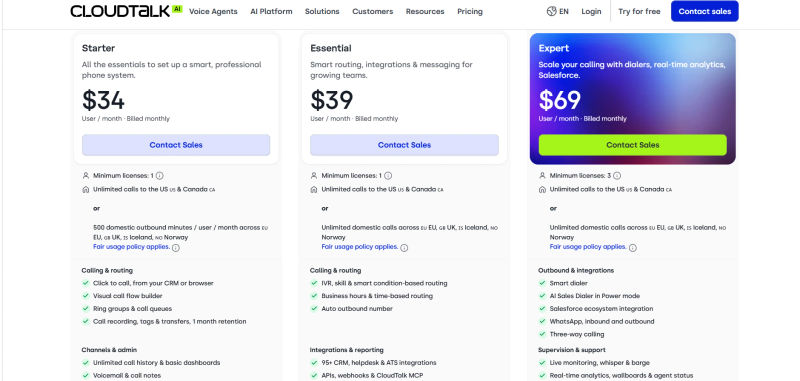
CloudTalk's pricing depends on your commitment term, with annual billing offering roughly a 20% discount over month-to-month plans.
Starter Plan ($29/user/month): Covers unlimited inbound calls, basic outbound calling, and click-to-call. It lacks the advanced CRM integrations required by most sales teams.
Essential Plan ($39/user/month): Adds advanced analytics, real-time dashboard monitoring, and standard CRM integrations (HubSpot, Zendesk).
Expert Plan ($69/user/month): Unlocks core sales automation, including the Power Dialer, Smart Routing, AI sentiment analysis, and Salesforce integration.
Custom/Enterprise: Custom pricing for high-volume teams needing SLA guarantees and dedicated support.
Seat Minimums: CloudTalk requires a three-seat minimum for its Essential and Expert tiers. Single users or two-person teams are restricted to the Starter plan unless they pay for unused seats.
2. Hidden Costs and ROI Calculation
Unlike some competitors that nickel-and-dime for every feature, CloudTalk bundles its core predictive routing into the Expert tier. However, transcription minutes may be subject to fair use policies or usage-based add-ons if you exceed standard limits. International outbound calling rates also fluctuate based on the region.
To justify the investment, team leads should utilize a custom ROI calculator template focusing on cost savings from reduced Average Handle Time (AHT) and increased conversion rates. If CloudTalk's predictive routing can increase your outbound connection rate by even 15%, the Expert tier easily pays for itself through increased pipeline generation.
Find Perfect Software for Your Business
CloudTalk Alternatives 2027: How It Stacks Up
If you are evaluating the market, it is crucial to align the software's strengths with your specific operational needs. Here is how CloudTalk compares to other market leaders, keeping ease of migration in mind.
1. CloudTalk vs. Dialpad
Pros: Dialpad offers superior native voice intelligence and slightly more accurate real-time transcription.
Cons: Dialpad lacks the granular, complex call routing architectures that CloudTalk provides for massive support desks.
Best For: Teams heavily focused on real-time agent coaching and internal hybrid collaboration.
Ease of Migration: Both offer straightforward porting, but Dialpad's AI requires less initial workflow configuration.
2. CloudTalk vs. Aircall
Pros: Aircall provides an incredibly intuitive user interface and rapid, one-click integrations.
Cons: Aircall's analytics and power dialing features are not as deep or aggressive as CloudTalk's.
Best For: SMBs and helpdesks needing a system up and running in 24 hours with minimal IT oversight.
Ease of Migration: Aircall is arguably the easiest platform on the market to migrate to from a legacy system.
3. CloudTalk vs. Nextiva
Pros: Nextiva offers a full Unified Communications (UCaaS) suite, including native video conferencing and team messaging.
Cons: It can be bloated for teams that only need a pure-play VoIP dialer to integrate with their existing tech stack.
Best For: Large enterprises looking to consolidate all communication channels under a single vendor.
Ease of Migration: Migrating to Nextiva is a heavier lift due to the breadth of the UCaaS deployment.
4. CloudTalk vs. RingCentral
Pros: RingCentral provides unmatched global PBX infrastructure and deep API access for custom enterprise builds.
Cons: The interface is notoriously complex, and pricing can escalate quickly with add-ons.
Best For: Complex, multi-channel enterprise contact centers with dedicated IT administrators.
Ease of Migration: Requires significant planning and often a dedicated implementation specialist.
5. CloudTalk vs. Kixie
Pros: Kixie features an ultra-fast power dialer and advanced local presence tools designed strictly for volume.
Cons: It lacks the sophisticated inbound routing and customer experience features found in CloudTalk.
Best For: High-velocity outbound sales and SDR teams whose sole metric is dials-per-day.
Ease of Migration: Very fast deployment, specifically tailored for seamless HubSpot and Pipedrive integration.
6. CloudTalk vs. CallHippo
Pros: CallHippo is highly budget-friendly while still offering global numbers and basic call tracking.
Cons: It does not possess the advanced predictive AI or sentiment analysis capabilities of CloudTalk.
Best For: Bootstrapped startups and cost-conscious support desks.
Ease of Migration: Simple and straightforward, ideal for teams moving off personal mobile devices.
7. CloudTalk vs. Calilio
Pros: Calilio is highly optimized for 5G mobile networks and offers a lightweight, unified inbox.
Cons: It lacks the enterprise depth, complex routing, and deep CRM sync required by mid-market teams.
Best For: Agile startups and remote-first micro-teams operating primarily from mobile devices.
Ease of Migration: Instantaneous setup, though limited in historical data import capabilities.
Try AuthenCIO
Move to faster, smarter software evaluation with AI
Final Decision: Should You Choose CloudTalk?
To conclude this Cloud Communications Software Review, making the final decision requires weighing your team's size, technical maturity, and primary KPIs. CloudTalk is not a basic phone system; it is a strategic technology investment designed for teams that treat voice data as a critical asset.
You should choose CloudTalk if:
You lead a growing sales or support team that requires advanced, predictive smart routing to handle high call volumes efficiently.
Your organization relies heavily on Salesforce (Enterprise tier) or HubSpot, and you need zero-latency bi-directional data sync.
You want to leverage AI-generated call summaries to automate post-call workflows and improve FCR.
You should look elsewhere if:
You are a small team looking for a simple, budget-friendly phone system without complex AI features (consider CallHippo or Aircall).
You need a full UCaaS platform that includes native video conferencing (consider Nextiva or RingCentral).
Your sole focus is high-velocity outbound dialing without the need for complex inbound routing (consider Kixie).
Ultimately, our Cloud Communications Software Review verdict is that CloudTalk's latest iteration proves it is a highly capable, AI-driven VoIP solution that can significantly improve conversion rates and customer experiences when implemented correctly.