
Introduction
Selecting the right AI-powered VoIP dialer in 2027 requires looking far beyond basic per-minute calling rates. For customer service directors and sales leaders, evaluating AI call center software cost is now a complex exercise in measuring Total Cost of Ownership (TCO), the tangible ROI of artificial intelligence capabilities, and the seamless integration of these tools into existing workflows.
Streamline your software evaluation process
As the global Contact Center as a Service (CCaaS) market rapidly expands—projected to reach $30.15 billion by 2034—vendors are fundamentally shifting their pricing models. Today, you are not just paying for a phone line; you are investing in real-time agent coaching, automated wrap-ups, and predictive call routing.
CloudTalk has positioned itself as a highly capable contender in this AI-driven landscape, offering tiered plans designed to scale with growing sales and support teams. However, navigating its pricing structure requires a careful analysis of base subscription costs versus usage-based fees, especially when comparing it to industry heavyweights like Aircall, Dialpad, and RingCentral.
This comprehensive guide breaks down CloudTalk's 2027 pricing plans, exposes potential hidden costs, and compares its value directly against top competitors to help you make an informed, data-backed decision.
Key Takeaways for Decision-Makers
Evaluate TCO Over Sticker Price: The true cost of CloudTalk and its competitors in 2027 includes telecom taxes, API usage overages, and integration fees, not just the monthly per-user subscription.
AI Features Are Tiered: Advanced capabilities like generative-AI call summaries and real-time sentiment analysis are typically gated behind higher-tier plans (e.g., CloudTalk's Expert plan) or billed on a usage basis.
Competitor Positioning Matters: While CloudTalk offers a balanced omnichannel approach, competitors like Kixie may offer better velocity for outbound sales, and Dialpad remains the benchmark for native AI coaching.
Contract Flexibility is Critical: Beware of annual lock-ins and minimum seat requirements that can hinder your ability to scale down operations efficiently.
Plan | Best For | Pricing (USD $) | Limitations | Primary CRM Integration | AI Inclusion |
CloudTalk | Scaling sales and support teams needing advanced routing | $25 - $69+ / user / month | Advanced AI features restricted to higher tiers; extra costs for premium integrations. | Salesforce, HubSpot, Pipedrive | Add-on in lower tiers; Included in Expert |
CallHippo | Budget-conscious international sales teams | $20 - $45 / user / month | Basic AI capabilities compared to modern competitors; reporting can be limited on lower tiers. | Zoho, HubSpot | Basic transcription only |
Calilio | Small businesses needing basic unified communications | $15 - $35 / user / month | Lacks enterprise-grade AI coaching and deep CRM workflow automations. | Basic Webhooks | None natively |
Kixie | High-velocity outbound sales using HubSpot/Pipedrive | $35 - $95+ / user / month | Higher entry price; primarily focused on outbound dialing rather than omnichannel support. | HubSpot, Pipedrive | Included in premium tiers |
Nextiva | Enterprise CRM and VoIP bundling | $25 - $75+ / user / month | Complex setup process; AI features are often bundled into expensive enterprise packages. | Native Nextiva CRM, Salesforce | Bundled in enterprise packages |
Aircall | Seamless helpdesk integrations (Zendesk/Intercom) | $30 - $70+ / user / month | No native video conferencing; AI transcription and analytics require premium add-ons. | Zendesk, Intercom, HubSpot | Premium add-on required |
Dialpad | Real-time AI transcription and live agent coaching | $20 - $40+ / user / month | Advanced AI features require minimum seat counts; international coverage is less robust than RingCentral. | Salesforce, Zendesk | Natively included across most tiers |
RingCentral | Global enterprises requiring strict compliance | $30 - $60+ / user / month | Heavy, complex interface; can be overkill for small teams; hidden fees for API usage. | Salesforce, Microsoft Dynamics | Included in premium tiers |
*Note: All prices shown reflect typical monthly billing. Vendors often offer lower pricing for annual commitments, but those discounts are excluded here for easier comparison. Actual costs may vary depending on your requirements, usage volumes, and negotiated terms.
Software Covered in this Article
The following articles break down the key aspects of Cloud Communications Software, featuring a carefully curated set of key players:





CloudTalk Pricing Plans Breakdown
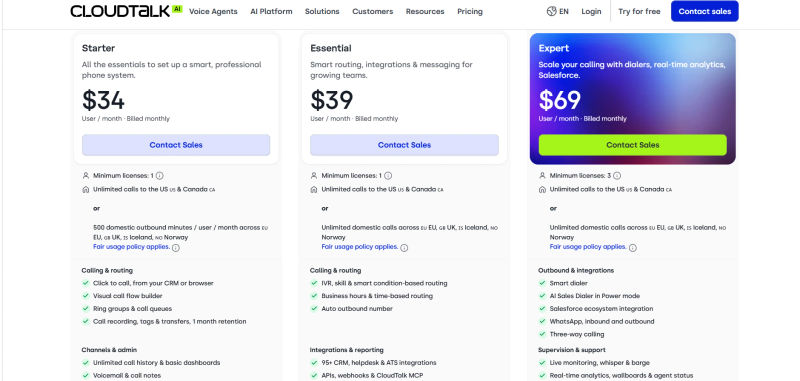
CloudTalk's 2027 pricing structure is divided into four main tiers, each designed to cater to specific operational needs and team sizes. Understanding the nuances of each tier is essential for maximizing ROI and avoiding overpayment for unused features.
1. Starter Plan: The Gateway Tier
The Starter plan is typically priced around $25 to $30 per user per month (billed annually). It is designed as a gateway tier for boutique teams of 5 to 10 agents that need reliable cloud telephony without the complexity of advanced AI routing.
What you get: This tier includes unlimited inbound calls (in select regions), basic call queuing, voicemail, and access to CloudTalk's standard desktop and mobile apps.
The limitations: It severely lacks the AI-driven features that define the 2027 CCaaS landscape. You will not find real-time sentiment analysis, automated call summaries, or advanced CRM integrations at this level. While it serves as a cost-effective entry point, it is rarely a viable long-term option for scaling operations, as growing teams will quickly hit integration bottlenecks.
2. Essential Plan: Built for Growth-Stage Operations
Priced roughly between $35 and $40 per user per month, the Essential plan is where CloudTalk begins to unlock its true value for growth-stage sales and support operations.
What you get: This tier introduces advanced analytics, real-time client dashboards, and crucial integrations with CRMs like Salesforce, HubSpot, and Pipedrive. It includes skill-based routing, which is vital for directing high-value leads to your most experienced sales representatives.
The limitations: It introduces basic AI-assisted features, such as automated post-call workflows that reduce manual data entry, but still lacks the deep generative-AI capabilities found in the higher tiers. For a sales leader managing a team of 20 to 50 representatives, the Essential plan provides the necessary tools to monitor performance without breaking the budget.
3. Expert Plan: High-Volume AI-Driven Dialing
The Expert plan, hovering around $55 to $69 per user per month, is tailored for high-volume call centers and outbound sales teams that rely heavily on automation. This is the tier where CloudTalk's 2027 AI capabilities truly shine.
What you get: Users gain access to the Smart Dialer and Power Dialer, drastically reducing idle time between calls. More importantly, the Expert plan includes AI-powered call transcription, sentiment analysis, and real-time coaching prompts.
A 2025 study cited by NBER research tracked 5,179 customer support agents and found that a generative-AI assistant increased issues resolved per hour by 34% for novice agents. Investing in the Expert plan allows directors to leverage these exact productivity gains, justifying the higher per-user cost through measurable improvements in agent utilization.
4. Custom Plan: Enterprise-Grade Scale and Security
For large organizations with complex requirements, CloudTalk offers a Custom plan with bespoke pricing.
What you get: This tier is built for enterprise-grade security, offering custom SLA guarantees, dedicated account management, and advanced API access for proprietary software integrations. It explicitly involves volume-based discounts for hundreds of seats and provides a dedicated support manager to ensure uptime.
The limitations: The Custom plan is necessary for businesses that require strict data residency controls and custom AI model training policies. However, the onboarding process is extensive, and the final price tag requires direct negotiation with CloudTalk's enterprise sales team.
The Hidden Costs of CloudTalk
When evaluating CloudTalk—or any VoIP provider in 2027—the headline subscription price is rarely the final number on your invoice. Decision-makers must calculate the Total Cost of Ownership (TCO) to avoid unpredictable monthly billing.
1. Telecom Taxes and Local Number Fees
North America represents approximately 39% of the global CCaaS market, and regional telecom regulations can materially affect quoted VoIP prices. Purchasing local numbers, toll-free numbers, and international numbers often incurs separate monthly charges outside the base seat cost.
Furthermore, international termination rates fluctuate, meaning heavy outbound dialing to specific regions can quickly inflate your monthly bill.
2. Usage-Based AI Billing and API Limits
Usage-based AI pricing is becoming a standard industry practice. While CloudTalk includes certain AI features in its Expert tier, intensive use of AI transcription, sentiment analysis, or generative-AI call summaries may be subject to fair-use policies.
If your team exceeds the allotted transcription minutes or hits API call limits when syncing data to Salesforce, you will face metered overage charges that can disrupt budget forecasts.
3. Ease of Migration and Implementation
Implementation and integration costs are frequently overlooked. A 2025 ICMI survey noted that 33% of organizations were only taking initial steps with AI, suggesting that buyers need implementation, training, and workflow-integration support.
Integrating CloudTalk deeply into a customized CRM instance may require external consulting fees. If migrating from a legacy on-premise PBX, you must account for number porting fees, data migration costs, and the temporary expense of running parallel systems during the transition to avoid downtime.
4. Contract Flexibility and Lock-in
Directors need to know the financial implications of scaling down or switching providers. CloudTalk, like many vendors, offers its best pricing on annual contracts. However, this creates vendor lock-in.
If your seasonal call volume drops, you may be stuck paying for unused seats. Always review the terms regarding minimum seat requirements and the penalties associated with early contract termination or mid-year seat reductions.
Find Perfect software for Your Business
CloudTalk vs. Competitors: 2027 Value for Money Analysis
To determine if CloudTalk is the highest-ROI dialer for your team, you must benchmark it against the broader market. Below is a detailed analysis of how CloudTalk stacks up against seven leading competitors, highlighting their primary use cases, pricing dynamics, and support quality.
1. CloudTalk vs. CallHippo
Who is this best for? CallHippo is best for budget-conscious international sales teams needing rapid deployment.
CallHippo aggressively targets the lower end of the pricing spectrum. Its global connect feature allows teams to purchase local numbers in over 50 countries instantly. However, when compared to CloudTalk's Expert plan, CallHippo's AI capabilities in 2027 are relatively basic, lacking deep generative-AI coaching.
Support Quality: CallHippo relies heavily on standard ticketing for lower tiers, which can result in slower response times during critical outages compared to CloudTalk's priority support.
2. CloudTalk vs. Calilio
Who is this best for? Calilio is best for small to mid-sized businesses requiring basic, cost-effective unified communications.
Calilio is designed for simplicity, offering a unified inbox for voice, SMS, and basic team chat. Its pricing is highly competitive, often undercutting CloudTalk's Starter plan. However, it is not built for high-volume contact centers and lacks the sophisticated Power Dialer found in CloudTalk.
Support Quality: Calilio's support is largely community and email-driven, making it less ideal for enterprise directors who require strict SLAs.
3. CloudTalk vs. Kixie
Who is this best for? Kixie is best for high-velocity outbound sales teams relying heavily on HubSpot or Pipedrive automations.
Kixie is a powerhouse for outbound dialing, featuring a highly reliable multi-line Power Dialer and exceptionally deep, bi-directional CRM integrations. Kixie's pricing tends to be higher than CloudTalk's mid-tiers. While CloudTalk offers a more balanced omnichannel approach, Kixie is laser-focused on sales velocity.
Support Quality: Kixie excels here, offering excellent dedicated onboarding and highly responsive technical support tailored for sales workflows.
4. CloudTalk vs. Nextiva
Who is this best for? Nextiva is best for enterprise operations looking to bundle VoIP with native CRM and customer experience tools.
Nextiva has evolved into a comprehensive customer experience platform. Its pricing can be complex, often requiring custom quotes. CloudTalk, by contrast, is a pure-play VoIP dialer that integrates into your existing tech stack rather than trying to replace it.
Support Quality: Nextiva offers 24/7 enterprise-grade support, though navigating their large support infrastructure can sometimes be complex and bureaucratic.
Is CloudTalk the highest-ROI dialer plan for your growing sales team? Find out on AuthenCIO.
5. CloudTalk vs. Aircall
Who is this best for? Aircall is best for customer support teams prioritizing seamless helpdesk integrations like Zendesk and Intercom.
Aircall is CloudTalk's most direct competitor, offering a very similar user interface and pricing structure. Aircall's standout strength is its massive app marketplace. In 2027, both platforms offer AI call summaries, but CloudTalk sometimes edges out Aircall in complex, multi-tiered IVR routing.
Support Quality: Aircall provides highly responsive chat and email support, making it a favorite among agile customer service directors.
6. CloudTalk vs. Dialpad
Who is this best for? Dialpad is best for sales and support teams requiring advanced, native real-time AI transcription and live coaching.
Dialpad was built with AI at its core, and in 2027, it remains the industry leader in real-time voice intelligence. It instantly transcribes calls and pushes live coaching cards to agents. While CloudTalk has introduced similar features, Dialpad's AI engine is generally considered more mature.
Support Quality: Dialpad offers strong technical support specifically trained to help organizations tune and optimize their AI coaching models.
7. CloudTalk vs. RingCentral
Who is this best for? RingCentral is best for global enterprises demanding strict regulatory compliance, extensive geographic coverage, and legacy PBX replacement.
RingCentral is the legacy giant of the VoIP space, offering unparalleled global coverage and exhaustive compliance certifications (HIPAA, GDPR, SOC 2). Its pricing is premium, and its interface can feel bloated compared to CloudTalk's modern design. For a 500-seat multinational bank, RingCentral is a necessity; for a 100-seat agile startup, CloudTalk provides a better TCO.
Support Quality: RingCentral offers multi-tiered global support, though smaller accounts may experience slower resolution times.
Decision Checklist: Choosing the Right AI-Powered VoIP Plan
Choosing the right VoIP plan in 2027 requires a structured evaluation process. Do not rely solely on vendor marketing materials; instead, use this checklist to focus on operational metrics and technical readiness.
Conduct a Technical Readiness Audit: Assess your current internet bandwidth, evaluate the API call limits of your existing CRM (e.g., Salesforce, HubSpot), and document your strict data residency and compliance requirements (SOC 2, GDPR).
Model Your Total Cost of Ownership (TCO): Build a spreadsheet comparing base seat costs, estimated outbound minutes, international termination rates, and anticipated AI usage (e.g., monthly transcription volume). Factor in the cost of parallel systems during migration.
Ask Hard Questions During the Demo: Empower your procurement team to ask sales reps specific questions:
Are AI call summaries billed per interaction, per minute, or included in the base seat price?
What are the exact overage charges for API calls if we exceed the monthly limit?
What are the financial penalties for reducing our seat count mid-contract?
What are your guaranteed SLA response times for critical system outages?
Demand a Pilot Program: Before committing to a multi-year enterprise contract, run a 30-day pilot with a small cohort of agents. Measure specific operational metrics such as Average Handle Time (AHT), First Contact Resolution (FCR), and AI containment rates using your own data.
Try AuthenCIO
Move to faster, smarter software evaluation with AI
Final Verdict
In the 2027 CCaaS market, CloudTalk stands out as a highly capable, flexible VoIP solution that successfully bridges the gap between basic cloud telephony and advanced AI-driven contact center platforms. Its tiered pricing structure allows growing businesses to scale their capabilities without absorbing massive upfront costs, provided they carefully monitor usage-based AI fees and telecom taxes.
However, CloudTalk is not a one-size-fits-all solution. If you are running a high-velocity outbound sales floor, Kixie offers superior CRM automations. If real-time AI coaching is your primary driver for agent retention, Dialpad remains the industry benchmark. Conversely, if you need a balanced, cost-effective platform with strong international routing and robust integrations, CloudTalk's Essential and Expert plans deliver exceptional value for money.
Ultimately, the best VoIP plan aligns with your specific operational bottlenecks and budget constraints. Look beyond the sticker price, evaluate the hidden costs of implementation, and prioritize the AI features that will actually drive measurable productivity gains for your team.