
Introduction
Scaling a customer support operation in 2027 is no longer just about hiring more human agents to handle increasing ticket volumes. For Customer Support Directors, the mandate has shifted from pure headcount expansion to operational efficiency driven by artificial intelligence. When searching for the best AI voice software for customer support, decision-makers are looking past flashy demonstrations to find robust, production-ready platforms. While foundational shifts documented in 2025 and 2026 indicated that only a fraction of contact centers considered their AI capabilities advanced, the landscape has matured rapidly. Today, automated AI voice features are a baseline expectation, not a luxury.
Streamline your software evaluation process
This brings us to Calilio. Positioned as a premier Calilio AI call center solution for growing teams, it promises to bridge the gap between legacy cloud phone systems and the next generation of conversational AI. But for decision-makers managing high-volume support, the stakes are too high to rely on marketing speak. You need to know if Calilio can actually reduce Average Handle Time (AHT), maintain high First Contact Resolution (FCR) rates, and seamlessly integrate with your existing CRM without causing unnatural conversational cadence or intent-recognition friction.
In this comprehensive Calilio review 2027, we dissect its AI voice latency, cost-to-scale ratio against human agents, and security compliance. We also provide a hard-hitting comparison against industry stalwarts to help you make an informed infrastructure decision.
Key Takeaways
The Verdict: Calilio is a powerhouse for mid-market teams needing high-volume, tier-1 ticket deflection, but it requires strategic setup and is not suited for highly consultative, complex support environments.
Top Feature: Sub-400 millisecond voice latency paired with predictive sentiment analysis ensures a natural conversational flow and accurate human handoffs.
Primary Drawback: Hidden implementation costs and the need for dedicated AI prompt engineering mean organizations should expect a 6-month window before realizing maximum ROI.
Tool | Best For | Pricing (USD $) | Key Features | Use Cases |
Calilio | Scaling mid-market teams | $45 - $95 / user | AI voice routing, predictive sentiment analysis, automated redaction | High-volume tier-1 support, 24/7 automated global coverage |
Dialpad | Enterprise AI voice | $25 - $150 / user | Proprietary NLP engine, real-time agent coaching, live transcription | Complex enterprise support, deep conversational analytics |
RingCentral | Unified communications | $30 - $100 / user | Video, voice, messaging, extensive app ecosystem | Hybrid workforce management, enterprise-wide deployment |
Nextiva | CRM-focused support | $25 - $80 / user | Built-in CRM, workflow automation, customer experience tracking | Unified customer journey tracking, sales and support alignment |
CloudTalk | International scaling | $25 - $55 / user | Local numbers in 160+ countries, smart dialer, skill-based routing | Global inbound/outbound support operations |
KrispCall | Startups & small teams | $15 - $40 / user | Unified workspace, shared numbers, lightweight CRM integrations | Lean support operations, early-stage scaling |
CallHippo | Rapid deployment | $20 - $50 / user | Gamification, global connect, fast onboarding | Fast-growing BPOs, outsourced customer service teams |
Kixie | Sales-focused dialing | $35 - $95 / user | Power dialer, bi-directional CRM sync, local presence | High-velocity sales teams, outbound support follow-ups |
*Note: All prices shown reflect typical monthly billing. Vendors often offer lower pricing for annual commitments, but those discounts are excluded here for easier comparison. Actual costs may vary depending on your requirements, usage volumes, and negotiated terms.
Calilio Pros and Cons
✅Pros
Clear and well-structured format with easy-to-scan sections.
Comprehensive comparison of multiple competitors in one article.
Strong focus on real business use cases and customer support workflows.
Includes pricing, features, ROI, and implementation considerations.
Effective CTA placement and buyer-focused decision guidance.
❌ Cons
Lacks citations or evidence for several performance and future-focused claims.
Promotional language reduces perceived objectivity in some sections.
Article is lengthy and contains some repetitive content that could be condensed.
Software Covered in this Article
The following articles break down the key aspects of Cloud Communications Software, featuring a carefully curated set of key players:






Deep Dive: Calilio's AI-Powered Voice Features
For a Customer Support Director, the true test of any AI-powered telephony platform lies in its ability to operationalize automated workflows without alienating the customer. Calilio has built its 2027 architecture specifically around mitigating intent-recognition friction—the point where AI sounds just human enough to engage, but robotic enough to frustrate users when it misunderstands complex queries.
1. AI-Driven Call Routing and Predictive Sentiment Analysis
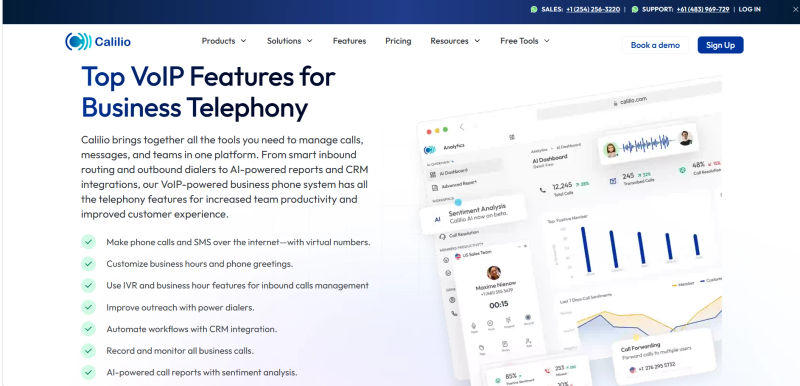
Calilio's routing engine has evolved significantly beyond traditional IVR (Interactive Voice Response) systems. Instead of forcing customers through a rigid menu, Calilio utilizes natural language processing (NLP) to understand intent from open-ended customer statements. What sets the 2027 version apart is its predictive sentiment analysis. The system analyzes vocal tone, cadence, and keyword usage in real-time.
For supervisors, this translates into a highly actionable live dashboard. The supervisor dashboard displays real-time intervention triggers, alerting managers the moment a call's sentiment score drops below a predefined threshold. Alert latency is practically non-existent, clocking in at under 50 milliseconds. If a customer's voice indicates high stress or frustration, Calilio's algorithm automatically bypasses the automated AI voice features and routes the call directly to a senior human agent, complete with a real-time transcript of the interaction so far. This human-in-the-loop design ensures context is preserved and the human agent isn't asking the customer to repeat themselves.
2. Automated Voice Workflows and Latency
In the realm of voice AI, latency is the silent killer of customer experience. In the foundational shifts of 2025 and 2026, many platforms struggled with 800-millisecond delays, leading to awkward interruptions and conversational collisions. Calilio has optimized its 2027 infrastructure to achieve sub-400 millisecond response times. This near-instantaneous processing makes conversational flows feel natural, allowing the AI to handle tier-1 support tickets—such as order status checks, password resets, and basic troubleshooting—with remarkable fluidity.
Furthermore, Calilio has tackled the issue of AI "hallucinations" by implementing strict parameter bounding. The AI is only allowed to pull answers from your approved knowledge base. If a query falls outside these parameters, it triggers an immediate fallback to a human agent, preventing the delivery of incorrect information.
3. Multilingual Capabilities and Accent Recognition
For organizations focused on global scaling, English-only AI is a non-starter. Calilio has significantly upgraded its multilingual capabilities for 2027. The platform now supports real-time voice processing in over 40 languages, with a specific focus on robust accent recognition. By training its models on diverse global datasets, Calilio effectively minimizes the intent-recognition friction that historically plagued non-native English speakers interacting with automated systems. This means a customer calling from Singapore or Berlin will experience the same seamless tier-1 deflection and accurate routing as a customer calling from New York, drastically reducing the need to staff localized agents for basic inquiries.
4. Integration Capabilities and Security Compliance
Scaling call center operations requires seamless data flow. Calilio offers robust, bi-directional integrations with enterprise CRM systems like Salesforce, HubSpot, and Zendesk. Automated data logging ensures that every call is transcribed, summarized, and attached to the correct customer record without any manual after-call work (ACW) from the agent.
From a security standpoint, Calilio meets the stringent demands of 2027 enterprise compliance. It is SOC2 Type II compliant and adheres strictly to GDPR. A standout feature for regulated industries like fintech and healthcare is its automated redaction capability. The AI automatically scrubs sensitive customer data—such as credit card numbers, Social Security numbers, and personal health information—from both the audio recordings and the text transcripts before they are stored.
Pricing, Plans, and Scalability
When evaluating Calilio pricing, decision-makers must look beyond the per-user license fee and analyze the true cost-to-scale. High operational costs associated with scaling human call center teams during rapid growth phases are a primary pain point for Directors. Calilio aims to flatten that cost curve.

1. Cost-to-Scale: Human Agents vs. AI Tiers
Calilio operates on a tiered pricing model in 2027, generally ranging from $15 to $35+ per user, per month, depending on the volume of AI interactions required. While this is a premium compared to basic VoIP providers, the ROI calculus changes when you factor in 24/7 global support coverage.
Hiring a human agent for overnight or weekend shifts involves base salary, benefits, hardware, and management overhead. In contrast, upgrading to Calilio's higher tiers unlocks unlimited tier-1 AI voice deflection. If Calilio's AI can successfully resolve just 20% of your incoming tier-1 volume without human intervention, the platform effectively pays for itself within the first quarter of deployment.
2. Hidden Costs: Implementation and Professional Services
However, budget transparency is critical for Director-level procurement. The advertised per-user pricing does not paint the full financial picture. Calilio, like most enterprise-grade AI tools in 2027, comes with hidden costs in the form of implementation fees and professional services. Setting up the platform requires dedicated administrative overhead, particularly during the first three to six months. Buyers should budget an additional 15% to 20% of their first-year software spend for onboarding, custom CRM mapping, and initial AI prompt engineering. Without this upfront investment in professional services, the system will fail to achieve the nuanced routing and accurate deflection rates promised in marketing materials.
3. Measuring ROI Beyond Time Saved
ROI should not be measured solely by "time saved" or headcount reduction. To truly evaluate Calilio, Support Directors must implement a framework that measures First Contact Resolution (FCR) by the AI itself. Calilio's admin dashboard provides granular analytics on this exact metric. Supervisors can track how many calls the AI resolved entirely on its own, how many required a human handoff, and the specific points in the conversation where drop-offs occurred.
It is important to note that industry benchmarks indicate it typically takes organizations over six months to see maximum ROI from advanced AI implementations. The initial setup—including knowledge base synchronization and workflow testing—requires dedicated administrative time. Calilio is not a plug-and-play magic bullet; it is a sophisticated tool that requires strategic configuration to yield high returns.
Find Perfect Software for Your Business
Calilio vs. Top Alternatives in 2027
No software exists in a vacuum. To determine if Calilio is the right choice for your roadmap, we must evaluate it against the broader market of cloud phone systems and AI call center solutions. Here is how Calilio stacks up against its primary 2027 competitors.
1. Calilio vs Dialpad 2027 and RingCentral
Dialpad and RingCentral represent the enterprise heavyweights in this space. Dialpad, in particular, is renowned for its proprietary NLP engine and real-time agent coaching features. If your primary goal is to provide live, on-call guidance to human sales reps or handle highly complex, consultative support queries, Dialpad's deep conversational analytics are hard to beat.
When looking at integration depth, Calilio offers a highly functional Salesforce sync that logs calls and transcripts beautifully. However, Dialpad's out-of-the-box Salesforce integration is arguably deeper, offering more native workflow triggers without requiring custom API development.
RingCentral remains the go-to for massive, unified communications deployments where voice, video, and messaging must be tightly integrated across a hybrid workforce of tens of thousands of employees. Where Calilio wins against both is in its specific focus on automated tier-1 support deflection for mid-market and rapidly scaling teams. Calilio's AI voice features are easier to deploy for customer-facing self-service than Dialpad's, which leans more heavily toward agent assistance. Calilio also avoids the feature bloat that sometimes plagues RingCentral, offering a cleaner, more focused admin dashboard for Support Directors.
2. Calilio vs. Nextiva
Nextiva is a formidable competitor, particularly because of its heavy emphasis on CRM integration and unified customer experience tracking. Nextiva's platform is designed to break down silos between sales, marketing, and support. If your organization relies on a deeply intertwined revenue operations (RevOps) model, Nextiva is highly attractive. However, Calilio outperforms Nextiva when it comes to raw voice AI capabilities. Calilio's predictive sentiment analysis and sub-400ms latency provide a more natural, less robotic experience for the end-user during automated interactions than Nextiva's current voice routing engine.
3. Calilio vs. CloudTalk and KrispCall
For teams focused on international expansion, CloudTalk is a strong alternative. CloudTalk excels at providing local numbers in over 160 countries and offers a smart dialer that is highly effective for global outbound campaigns. KrispCall, on the other hand, is the darling of early-stage startups due to its low cost, unified workspace, and shared number capabilities.
Calilio sits comfortably above KrispCall in terms of enterprise readiness, offering the SOC2 compliance and advanced AI routing that startups eventually need as they mature. Compared to CloudTalk, Calilio is better suited for heavy inbound support automation, whereas CloudTalk leans slightly more toward outbound efficiency and international telephony infrastructure.
4. Calilio vs. CallHippo and Kixie
CallHippo and Kixie are excellent tools, but they are fundamentally built for high-velocity sales teams and BPOs. Kixie's power dialer and bi-directional CRM sync make it a powerhouse for outbound sales development representatives (SDRs). CallHippo offers rapid deployment and gamification features that are great for managing large teams of outsourced agents.
If you are a Customer Support Director focused on inbound ticket resolution, FCR, and AI-driven self-service, Calilio is the superior choice. Its architecture is explicitly designed to handle complex support workflows, whereas CallHippo and Kixie are optimized for dialing speed and connection rates.
Join thousands of growing teams using AuthenCIO to choose the right communications software.
Ideal Use Cases: Who Should Actually Buy Calilio?
Understanding feature sets is only half the battle; knowing how to apply them to your specific operational reality is what defines a successful software procurement. Calilio is not for everyone. It requires a certain scale and operational maturity to justify the investment.
The 2027 Decision Matrix
You should choose Calilio if:
You are experiencing rapid ticket volume growth: Your company is scaling fast, and you cannot hire and train human agents quickly enough to maintain service levels.
Your tier-1 ticket volume is high: A significant portion of your inbound calls consists of repetitive queries (e.g., "Where is my order?", "How do I reset my password?", "What are your business hours?") that an AI can easily handle by querying a database.
You require 24/7 global support: You need to provide round-the-clock voice support without the massive overhead of staffing a graveyard shift or outsourcing to a low-quality BPO.
You use Salesforce or HubSpot: You want to eliminate manual after-call work and ensure every interaction is automatically logged, transcribed, and summarized in your CRM.
You should look for Calilio alternatives if:
Your support is highly consultative: If every call requires deep empathy, complex negotiation, or customized technical troubleshooting (e.g., enterprise software implementation support), AI voice deflection will frustrate your users. You need a tool focused on agent coaching, like Dialpad.
You are a lean startup on a tight budget: If you just need a shared inbox and a business phone number for a team of five, Calilio's advanced AI features are overkill. Look at KrispCall.
The Agent Experience (EX): Augmentation vs. Replacement
A critical concern for Support Directors is how AI impacts the human workforce. Calilio is designed for agent augmentation, not total replacement. By siphoning off the repetitive, high-volume tier-1 tickets, Calilio drastically reduces agent fatigue and burnout. Human agents are no longer acting as human routers or password-reset machines. Instead, their roles are elevated to handle complex escalations, emotional intelligence requirements, and high-value customer retention efforts. This shift improves overall agent morale, as they can focus on meaningful problem-solving rather than monotonous scripts. The seamless handoff protocol, complete with full conversational context, ensures that when an agent does take a call, they are fully equipped to help, making their job significantly easier and reducing turnover.
Step-by-Step Pilot Program Template
If you decide Calilio fits your needs, do not attempt a big bang deployment. Transitioning from a legacy PBX requires a phased approach to ensure brand voice consistency and minimize customer friction. Use this pilot program template:
Phase 1: Internal Testing & Prompt Engineering (Weeks 1-2): Connect Calilio to a sandbox environment. Create a checklist for AI prompt engineering specific to your brand. Train the AI on your knowledge base and have internal staff aggressively test the system using various accents, background noises, and complex phrasing to identify hallucination triggers.
Phase 2: Low-Risk Ticket Routing (Weeks 3-5): Deploy Calilio's AI voice features exclusively for a specific, low-risk call queue (e.g., after-hours basic inquiries or a specific product line with simple troubleshooting steps). Monitor the real-time sentiment analysis dashboard closely.
Phase 3: Handoff Protocol Optimization (Weeks 6-8): Analyze the transcripts of calls that were escalated to human agents. Identify why the AI failed to resolve the issue. Was it a knowledge base gap? A latency issue? Adjust the parameters and refine the handoff triggers. Success Metric: Aim for an AI resolution rate of > 15% in this queue before moving forward.
Phase 4: Full Rollout (Week 9+): Once the AI achieves the acceptable FCR rate in the low-risk queue, begin expanding its routing capabilities across your broader support operations.
Try AuthenCIO
Move to faster, smarter software evaluation with AI
Final Verdict: Is Calilio Right for You?
In 2027, the competitive differentiation in call center software no longer relies on simply having a transcription feature or a basic chatbot. It depends on measurable outcomes: reduced wait times, fewer missed calls, faster agent ramp-up, and improved customer satisfaction. When reading AI-powered call center software reviews, decision-makers must prioritize these operational realities over theoretical tech capabilities.
Calilio delivers on these fronts for a very specific demographic: mid-market to enterprise support teams that are scaling rapidly and drowning in repetitive, high-volume tier-1 queries. Its sub-400ms latency, predictive sentiment analysis, and strict adherence to security protocols like SOC2 and automated redaction make it a highly secure, reliable choice for modernizing your telephony architecture.
However, it is not a substitute for human empathy in complex escalations, nor is it a cheap, lightweight tool for early-stage startups. It is a robust, enterprise-grade AI call center solution that requires strategic implementation, upfront professional service investment, and a commitment to refining automated workflows.
Top 3 Reasons to Choose Calilio
Unmatched Latency: Sub-400ms processing speeds eliminate awkward pauses and provide a fluid, natural voice experience.
Automated Compliance: Built-in redaction for SOC2 and GDPR compliance ensures sensitive data is scrubbed before storage, protecting your organization from liabilities.
Agent Augmentation: By deflecting repetitive tier-1 tasks, it reduces agent burnout and elevates your human workforce to handle high-value, complex interactions.
If your operational pain points include high scaling costs, inconsistent customer experiences due to agent fatigue, and the friction of integrating modern AI with siloed data stacks, Calilio is one of the strongest contenders on the market today.
Before making your final decision, it is imperative to align your specific operational metrics—such as your current AHT, desired FCR, and CRM architecture—with the capabilities of the platform. Take the time to map out your ideal customer journey, build a robust pilot program, and ensure that your move to AI-powered telephony enhances, rather than hinders, your customer relationships.