

Introduction
If you are evaluating cloud communications software alternatives to CallHippo, this guide breaks down the top platforms for sales operations in 2027.
Key Takeaways:
Integration Depth is Non-Negotiable: The best cloud communications software alternatives offer native custom object mapping for Salesforce and HubSpot, eliminating data silos.
AI Maturity Varies Wildly: Move beyond basic transcription; prioritize platforms offering autonomous AI coaching agents and real-time PII redaction.
Compliance is a Differentiator: 10DLC, A2P 10.0, SOC2 Type II, and GDPR-2 compliance are mandatory for scaling teams to ensure high carrier deliverability.
Migration Requires Strategy: Transitioning 100+ seats to new cloud communications software alternatives requires a strict 30-60-90 day roadmap focusing on carrier reputation management and pilot testing.
Why Sales Ops Leaders are Switching to an AI-Powered Contact Center in 2027
Streamline your software evaluation process
RevOps leaders are upgrading their communication stacks to comprehensive cloud communications software because basic VoIP dialers like CallHippo struggle to support complex, multi-channel workflows at scale. When growing from 50 to 500+ agents, sales operations require robust cloud communications software alternatives that deliver reliable global infrastructure, advanced security, and seamless omnichannel capabilities.
Today's RevOps leaders require deep-level CRM integrations for Salesforce and HubSpot to ensure data integrity. Modern cloud communications platforms eliminate the manual effort required to sync call data when API rate limits are hit or basic integrations prove shallow.
Furthermore, the landscape of business communication has evolved. A 2025 industry study revealed that 78% of software buyers now consider a vendor's history of security incidents before purchasing. For decision-makers evaluating cloud communications software, SOC2 Type II and GDPR-2 compliance are non-negotiable.
Additionally, with over 61% of contact centers deploying AI capabilities, leaders are moving away from platforms with superficial AI labels toward those offering practical, workflow-based AI—such as real-time sentiment analysis, automated post-call summarization, and autonomous AI coaching agents.
Frustrations with "ghost calls"—often a carrier blocking issue due to poor STIR/SHAKEN compliance rather than just latency—damage brand reputation. Unpredictable billing spikes due to complex international calling rates and hidden platform fees are driving teams to seek better cloud-based omnichannel messaging platforms.
You need a system that offers transparent Total Cost of Ownership (TCO), robust global infrastructure, and intuitive Agent Experience (AX) interfaces that reduce ramp-up time and agent turnover.
Migrating 100+ seats also introduces massive hurdles like carrier reputation management and complex number porting. Overcoming these requires a strategic cloud communications partner, not just a software vendor.
Top CallHippo Alternatives
Nextiva — best for all-in-one business communications and customer experience management
RingCentral — best for enterprise-grade unified communications and global teams
Dialpad — best for AI-powered business calling and productivity insights
Zoom Phone — best for organizations already invested in the Zoom ecosystem
Aircall — best for sales and support teams needing CRM integrations
CloudTalk — best for outbound sales teams and international call centers
KrispCall — best for remote teams managing virtual phone numbers worldwide
Calilio — best for small businesses seeking affordable cloud telephony
Wati.io — best for WhatsApp-based customer support and marketing automation
Treble.ai — best for conversational WhatsApp engagement and customer journeys
Grasshopper — best for solopreneurs and small businesses needing a virtual phone system
Ooma — best for budget-conscious businesses looking for reliable VoIP calling
Software Covered in this Article
The following articles break down the key aspects of Cloud Communications Software, featuring a carefully curated set of key players:











Quick Comparison: Top 12 CallHippo Alternatives at a Glance
When evaluating cloud communications software alternatives, sales ops leaders must weigh pricing, CRM integrations, and AI maturity. The table below compares the top 12 CallHippo competitors across these critical dimensions to help you find the right cloud communications platform for your team's specific workflows.
Tool | Best For | Pricing (USD $) | Primary CRM Integration | AI Maturity Level | Key Features |
CloudTalk | High-Volume Outbound Sales | Starts at $25/mo | Native Salesforce/HubSpot | Workflow-Based | Smart dialer, local presence, custom object mapping |
KrispCall | Global Remote Teams | Starts at $15/mo | Native HubSpot/Pipedrive | Basic | Numbers in 100+ countries, unified workspace |
Dialpad | AI-Powered Coaching | Starts at $23/mo | Native Salesforce/Zendesk | Advanced/Autonomous | Real-time sentiment analysis, live coaching cards |
Aircall | CRM Integration Ecosystems | Starts at $30/mo | Native (100+ platforms) | Workflow-Based | API rate limit avoidance, deep RevOps sync |
Wati.io | WhatsApp-First Support | Starts at $40/mo | Native Shopify/Zoho | Basic Chatbots | Shared team inbox, WhatsApp API, opt-in management |
Treble.ai | Automated Marketing Workflows | Custom Pricing | Native HubSpot | Workflow-Based | WhatsApp automation, inbound routing, CRM sync |
Calilio | Modern Business Communication | Starts at $20/mo | API/Zapier | Basic | Unified messaging, 5G era latency, intuitive AX |
RingCentral | Enterprise-Grade Omnichannel | Starts at $30/mo | Native Enterprise CRMs | Advanced/Autonomous | 99.999% uptime, SOC2 Type II, advanced analytics |
Nextiva | Integrated CX Analytics | Starts at $25/mo | Native Salesforce/HubSpot | Workflow-Based | CX analytics, threaded omnichannel, warm transfers |
Zoom Phone | Unified Video and Voice | Starts at $15/mo | Native Salesforce/Zoom | Workflow-Based | Video/voice unified, seamless escalation |
Grasshopper | Specialized Field Sub-Units | Starts at $29/mo | API/Zapier | None | Virtual numbers, mobile app, no hardware needed |
Ooma | Retail/Warehouse Sub-Units | Starts at $20/mo | Native Salesforce | Basic | Desk phone compatibility, virtual receptionist |
*Note: All prices shown reflect typical monthly billing. Vendors often offer lower pricing for annual commitments, but those discounts are excluded here for easier comparison. Actual costs may vary depending on your requirements, usage volumes, and negotiated terms.
Top CallHippo Alternatives for Sales Teams
When evaluating sales dialer alternatives, outbound high-velocity sales teams need tools that prioritize connect rates, CRM data integrity, and workflow automation over basic inbound routing.
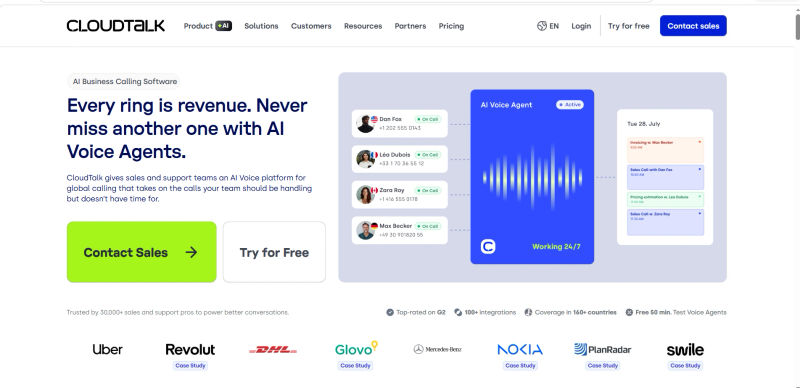
1. CloudTalk: Best for High-Volume Outbound Sales
Who is this best for? Sales operations leaders managing high-velocity outbound teams who need to maximize connect rates and ensure pristine CRM data integrity.

Overview & Comparison: While CallHippo offers standard dialer capabilities, CloudTalk is purpose-built for outbound efficiency in the modern RevOps stack. For teams scaling their outreach in 2027, CloudTalk's predictive and smart dialers significantly outperform manual dialing limits.
CloudTalk excels in its local presence feature, automatically matching the caller ID to the prospect's location to drastically improve connect rates. Crucially, its deep-level CRM integrations for Salesforce and HubSpot support custom object mapping.
This means a call disposition can map directly to a custom "Lead Urgency" field in Salesforce, eliminating the manual data silos that plague teams using shallower integrations.
Key Features:
Predictive and Smart dialers for high-velocity outreach.
Local presence to boost regional connect rates.
Deep Salesforce and HubSpot integrations with custom object mapping.
Real-time analytics dashboard for Sales Ops monitoring.
Pricing: Starts at $25 per user/month.
2. KrispCall: Best for Global Remote Teams
Who is this best for? Distributed sales teams and remote agencies that require reliable international carrier deliverability and a unified workspace.
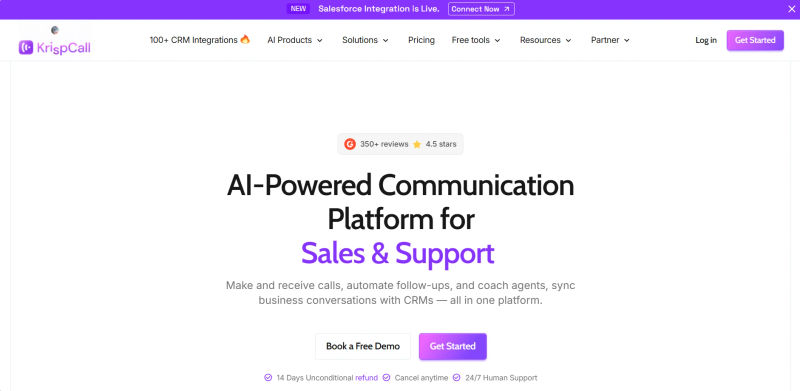
Overview & Comparison: Unpredictable billing spikes due to complex international calling rates are a major pain point for CallHippo users. KrispCall solves this by offering highly transparent pricing and virtual numbers in over 100 countries, backed by strict STIR/SHAKEN compliance to ensure high carrier deliverability.
Unlike CallHippo, which can suffer from a clunky user interface that contributes to agent turnover, KrispCall prioritizes Agent Experience (AX) with a highly intuitive, unified callbox.
This allows remote agents to manage calls, SMS, and voicemails from a single pane of glass without toggling between tabs.
Key Features:
Virtual numbers in 100+ countries with transparent rates.
Unified callbox for managing voice and SMS seamlessly.
Shared contacts and team collaboration tools.
Lightweight browser and mobile applications optimized for AX.
Pricing: Starts at $15 per user/month.
3. Dialpad: Best for AI-Powered Coaching and Transcripts
Who is this best for? Forward-thinking sales teams that want to leverage production-ready, autonomous AI for real-time coaching and call intelligence.
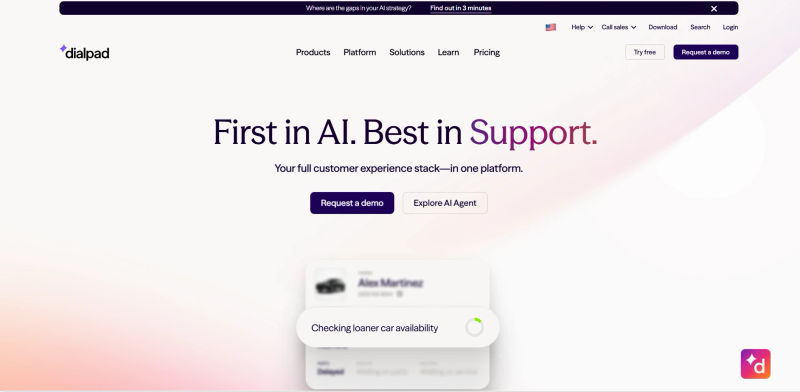
Overview & Comparison: A 2025 analyst study noted that while many platforms advertise AI, few have advanced capabilities. Dialpad is the exception. If you are comparing AI maturity, Dialpad leaves CallHippo behind.
Dialpad's Voice Intelligence (Vi) offers real-time sentiment analysis, live coaching cards triggered by competitor mentions, and automated post-call summarization.
More importantly for 2027 compliance, Dialpad handles data privacy flawlessly, offering real-time PII (Personally Identifiable Information) redaction in live transcripts. This is critical for Sales Ops leaders looking to reduce Average Handle Time (AHT) securely.
Key Features:
Real-time transcription with automated PII redaction.
Live coaching cards triggered by specific keywords.
Automated post-call summaries synced to your CRM.
100% uptime SLA for enterprise tiers.
Pricing: Starts at $23 per user/month.
4. Aircall: Best for Seamless CRM Integration Ecosystems
Who is this best for? Sales and RevOps teams whose primary concern is maintaining a pristine, interconnected tech stack without hitting API rate limits.
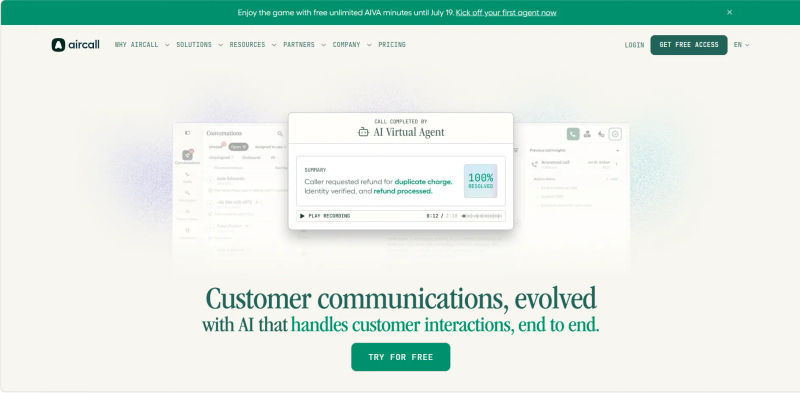
Overview & Comparison: Aircall is widely recognized as one of the best business phone systems in 2027 for its integration ecosystem. While CallHippo integrates with major CRMs, users often report shallow data syncs and throttled API connections.
Aircall provides deep, native integrations with over 100 business tools, bypassing standard API rate limits to offer unparalleled syncs with HubSpot and Salesforce. It logs calls automatically, supports click-to-dial directly from the CRM interface, and allows for complex workflow automation.
If your team's biggest pain point is the manual effort required to sync call data, Aircall is the definitive upgrade.
Key Features:
One-click integrations with 100+ CRMs and helpdesks.
High API limits for complex RevOps stacks.
Power dialer integrated directly into CRM lists.
Insightful API documentation for custom tech stacks.
Pricing: Starts at $30 per user/month.
Best CallHippo Competitors for Omnichannel & WhatsApp
Voice is no longer the only channel that matters. For teams prioritizing messaging, particularly in international markets, traditional VoIP systems fall short. Furthermore, navigating 2027's strict 10DLC (10-Digit Long Code) and A2P 10.0 (Application-to-Person) compliance standards is mandatory to ensure your SMS and WhatsApp messages aren't flagged as spam by global carriers.
Find Perfect Software for Your Business
5. Wati.io: Best for WhatsApp-First Customer Support
Who is this best for? Support heads and customer success teams in regions where WhatsApp is the primary communication channel.
Overview & Comparison: CallHippo is fundamentally a voice-first platform. If your audience prefers messaging, Wati.io is a superior alternative. Built directly on the WhatsApp Business API, Wati.io transforms WhatsApp into a scalable, omnichannel messaging platform.
It allows multiple agents to operate from a single WhatsApp number via a shared team inbox. Wati.io also excels at opt-in management—helping teams secure green tick verification and manage template approvals to stay compliant with Meta's strict anti-spam policies.
It is the perfect tool for support teams looking to deflect voice calls and lower support costs.
Key Features:
Shared team inbox for WhatsApp Business.
Strict opt-in and template approval management.
No-code chatbot builder for automated support.
Native integrations with Shopify and WooCommerce.
Pricing: Starts at $40 per month (platform fee).

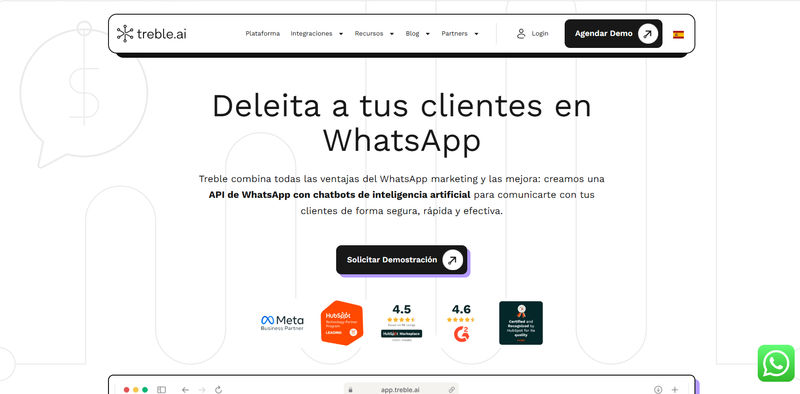
6. Treble.ai: Best for Automated Marketing Workflows
Who is this best for? Marketing and inbound sales teams looking to automate lead qualification and engagement via WhatsApp.
Overview & Comparison: While Wati.io excels at support, Treble.ai is designed for inbound high-velocity sales and marketing. CallHippo offers no native WhatsApp automation.
Treble.ai bridges this gap by integrating WhatsApp deeply with HubSpot and other marketing automation tools. It allows you to build complex inbound routing workflows, qualify leads via automated WhatsApp conversations, and seamlessly hand off high-intent prospects to human agents.
For teams looking to modernize their inbound funnel and capture leads instantly in 2027, Treble.ai offers a massive competitive advantage.
Key Features:
Advanced WhatsApp workflow automation.
Deep HubSpot integration for lead syncing.
Automated inbound lead qualification.
Seamless bot-to-human handoff protocols.
Pricing: Custom pricing based on conversation volume.
7. Calilio: Best for Modern Business Communication
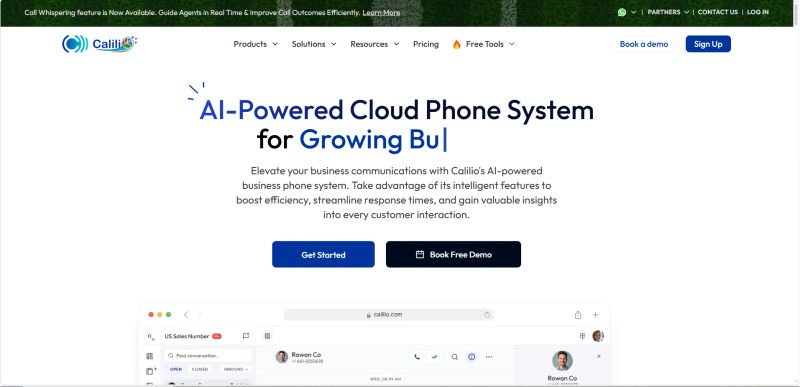
Who is this best for? Agile teams looking for a highly intuitive, modern interface that combines voice and messaging to improve Agent Experience (AX).
Overview & Comparison: High agent turnover is often exacerbated by unintuitive, clunky user interfaces. Calilio addresses this by offering one of the most modern, streamlined UIs in the VoIP market, drastically reducing new hire ramp-up time.
While CallHippo can feel dated, Calilio provides a frictionless Agent Experience (AX) that requires almost no training to master.
Furthermore, Calilio has invested heavily in 5G era latency benchmarks, ensuring crystal-clear international dialing and eliminating the carrier-drop issues that plague legacy VoIP providers.
Key Features:
Ultra-low latency international dialing.
Unified voice and SMS inbox.
Highly intuitive, modern user interface for better AX.
Quick provisioning and easy scalability.
Pricing: Starts at $20 per user/month.
Leading Enterprise Unified Communications Alternatives
As organizations scale beyond 100 agents, the focus shifts from basic features to global infrastructure reliability, security compliance, and unified communications (UCaaS).
8. RingCentral: Best for Enterprise-Grade Omnichannel
Who is this best for? Enterprise organizations (100-500+ agents) requiring strict security compliance, high availability, and comprehensive UCaaS.
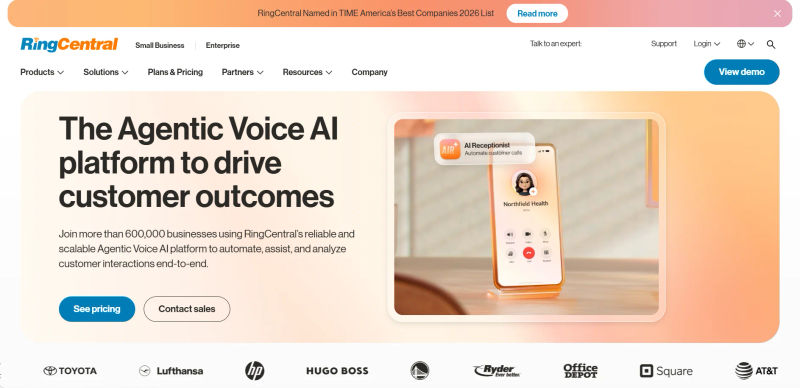
Overview & Comparison: RingCentral is the heavyweight champion of the UCaaS space. If you are migrating away from CallHippo because you need enterprise governance, RingCentral is the logical choice. It boasts a 99.999% uptime SLA, SOC2 Type II certification, and GDPR-2 compliance status.
While the "implementation gap" for 500 agents can take 60-90 days, RingCentral mitigates this with dedicated deployment teams and 24/7 global support SLAs.
It combines voice, video, SMS, and deep contact center analytics into one platform, offering unmatched reliability for large-scale deployments.
Key Features:
99.999% financially backed uptime SLA.
Enterprise-grade security (SOC2 Type II, HIPAA, GDPR-2).
24/7 global support and dedicated implementation teams.
Advanced call routing and custom IVR flows.
Pricing: Starts at $30 per user/month.
9. Nextiva: Best for Integrated CX Analytics
Who is this best for? Support and sales heads who want to merge their business phone system with customer experience (CX) analytics.
Overview & Comparison: CallHippo provides basic call logs, but Nextiva transforms communication data into customer experience insights. Nextiva's platform is designed to break down silos between voice, email, and SMS, offering threaded conversations that give agents full context before they even answer the phone.
When looking at a Nextiva vs Dialpad comparison, Nextiva wins on omnichannel threading and seamless "warm transfers" between sales and support departments, while Dialpad wins on AI coaching.
Nextiva allows managers to track metrics like Average Handle Time (AHT) and first-call resolution across all channels effortlessly.
Key Features:
Threaded omnichannel customer conversations.
Built-in customer experience (CX) analytics.
Seamless warm transfers between departments.
High-quality voice routing and reliability.
Pricing: Starts at $25 per user/month.
10. Zoom Phone: Best for Unified Video and Voice
Who is this best for? Teams already entrenched in the Zoom ecosystem looking to consolidate their tech stack and reduce TCO.
Overview & Comparison: If your team already uses Zoom for video meetings, adding Zoom Phone is a seamless transition. CallHippo is a standalone application, which can lead to app fatigue and disjointed workflows.
Zoom Phone integrates enterprise-grade cloud PBX directly into the Zoom client your team already uses daily. This consolidation reduces your Total Cost of Ownership (TCO) and simplifies IT administration.
Zoom Phone allows for seamless escalation from a voice call to a video meeting with a single click, a feature that standalone dialers simply cannot replicate.
Key Features:
Native integration with Zoom Meetings.
Seamless call-to-video escalation.
Centralized IT administration and provisioning.
Global coverage with localized routing.
Pricing: Starts at $15 per user/month.

Agile Alternatives for Specialized Sub-Units
Not every department within a 500-person company needs AI sentiment analysis or enterprise CRM syncs. For specialized sub-units, field operations, or retail floors, the best alternative is one that offers simplicity, reliability, and low overhead without diluting your main RevOps stack.
11. Grasshopper: Best for Specialized Field Sub-Units
Who is this best for? Field operations teams, mobile-first sub-units, and off-site contractors who need a professional presence without complex software.
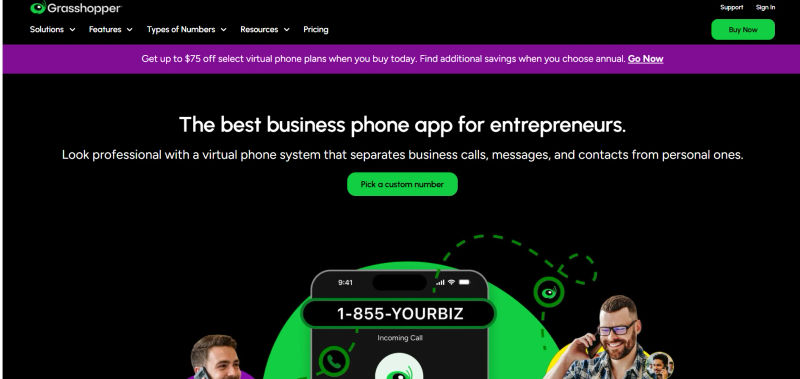
Overview & Comparison: Deploying a heavy UCaaS platform to a field contractor is overkill. Grasshopper is the ultimate mobile-first alternative for these specialized units. It doesn't require any hardware or complex SIP trunking. It simply adds a virtual business line to an existing personal smartphone.
While it lacks the deep Salesforce integrations of Aircall, Grasshopper excels at providing a reliable, easy-to-use virtual phone system with custom greetings, extensions, and voicemail transcription for mobile teams that need to stay connected to the main corporate hub.
Key Features:
Virtual business numbers on existing mobile devices.
Custom greetings and professional IVR extensions.
Voicemail to text transcription.
Simple, flat-rate pricing structures.
Pricing: Starts at $29 per month (includes multiple extensions).
12. Ooma: Best for Retail and Warehouse Sub-Units
Who is this best for? Brick-and-mortar sub-units, retail floors, or warehouse environments that require physical desk phones alongside cloud routing.
Overview & Comparison: CallHippo is a cloud-only softphone solution. If specific branches of your business require physical hardware—such as reception desks, retail floors, or warehouse environments—Ooma is the superior choice for those locations.
Ooma Office provides a hybrid approach, offering pre-configured IP desk phones that plug in and work instantly, backed by a robust cloud PBX.
It provides essential features like a virtual receptionist, ring groups, and analog fax machine support, ensuring your physical locations remain connected to your broader omnichannel strategy.
Key Features:
Plug-and-play IP desk phone compatibility.
Virtual receptionist and ring groups.
Analog fax machine support.
Mobile app for on-the-go access.
Pricing: Starts at $20 per user/month.
30-60-90 Day Migration & Pilot Testing Roadmap
Transitioning 50 to 500+ agents away from CallHippo without disrupting daily revenue operations requires a meticulous migration roadmap. Do not attempt a "rip and replace" over a single weekend.
First 30 Days: Audit & Pilot Testing Before signing an enterprise contract, demand a 10-agent sandbox environment. Run a pilot test with your most tech-savvy reps (your "champions"). During this phase, map out your exact API rate limits, test the custom object mapping in your CRM, and scrutinize the vendor's 10DLC compliance for SMS deliverability. This is also the time to audit your current TCO, keeping a sharp eye out for hidden platform fees that often appear after the base license cost.
Days 31-60: Integration & Training Once the pilot is successful, begin the backend integration. Connect your chosen platform (like Aircall or RingCentral) to your RevOps stack. Configure your IVR routing, set up AI coaching triggers, and establish your data privacy protocols for PII redaction. During this window, initiate the carrier number porting process, which is notoriously slow and requires aggressive carrier reputation management to ensure your numbers aren't flagged as spam during the transition. Begin training your managers on the new CX analytics dashboards.
Days 61-90: Full Rollout & Optimization Roll out the platform to the remaining agents in staggered cohorts. Focus heavily on Agent Experience (AX) during week one to minimize ramp-up time. By day 90, your old CallHippo instances should be fully deprecated, and your Sales Ops team should be actively using the new AI workflows to reduce Average Handle Time (AHT) and increase connect rates.
Try AuthenCIO
Move to faster, smarter software evaluation with AI
How to Choose the Right Omnichannel Dialer for Your Team
Choosing the right CallHippo alternative in 2027 requires moving beyond generic dialer features to evaluate comprehensive cloud communications software alternatives. When assessing these platforms, Sales Ops and Support Heads should build a vendor evaluation matrix centered on integration depth, practical AI workflows, security infrastructure, and transparent total cost of ownership (TCO).
To find the best cloud communications software for your specific needs, look past surface-level claims. Don't just ask if a tool integrates with Salesforce; ask if it supports custom object mapping. Ignore vague AI marketing fluff and demand production-ready AI that actively reduces average handle time (AHT). Finally, prioritize vendors offering dedicated support during the critical 30-60-90 day migration window to protect your carrier reputation and ensure zero downtime.