Introduction
For Marketing Directors in 2026, the days of relying on fragmented data and siloed attribution are officially over. As the lead management software market surges—valued at $12.07 billion in 2025 and projected to reach a staggering $22.02 billion by 2033—the technology driving lead generation has fundamentally evolved. Yet, many marketing teams still struggle to justify their spend to the board because their web, phone, and form submission data live in completely different ecosystems.
Streamline your software evaluation process
When a prospect clicks a Google Ad, browses your website, leaves to consult a colleague via an untrackable channel, and then calls your sales team three days later, traditional tracking methods break. This creates a severe data silo where marketing data does not match sales data, leading to inaccurate lead source reporting and wasted budget on low-performing channels.
Furthermore, traditional contact forms and sign-ups convert at a maximum of just 2% of website visitors. If you are only tracking form fills, you are missing 98% of the picture.
The 2026 digital landscape introduces even more complexity. With the shift toward a post-cookie environment and the rise of "Dark Social"—where prospects share links in private messaging apps like Slack or WhatsApp—first-party data collection is more vital than ever.
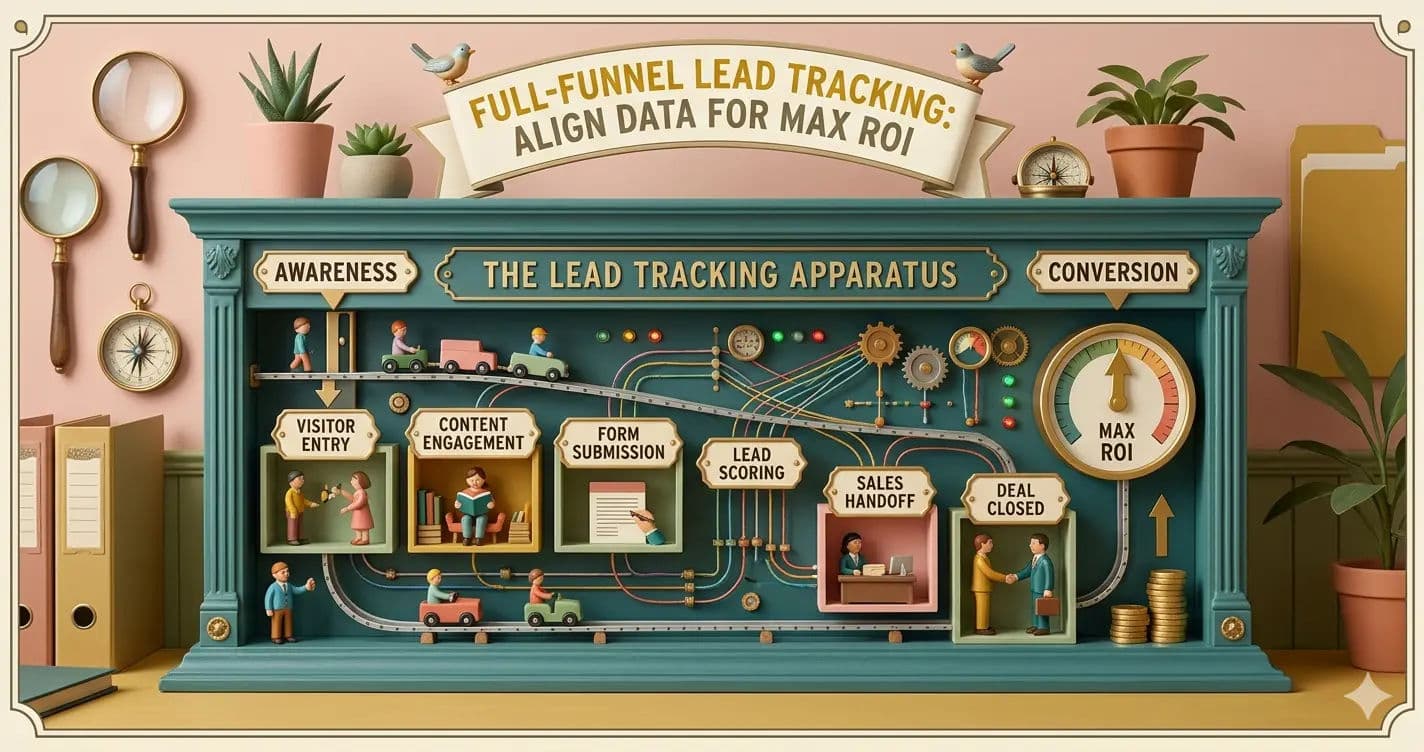
Unified lead tracking solves this by bridging the gap between online interactions, private shares, and offline conversions. By implementing a unified lead tracking platform, Marketing Directors can map a lead's entire journey from the first anonymous touchpoint to the final sale.
This multi-channel lead attribution software allows you to accurately credit search, social, and offline touchpoints, proving the exact ROI of every marketing dollar spent.
Furthermore, with the chance of lead conversion dropping by 80% if follow-up takes longer than five minutes, having a unified system that instantly routes enriched data to your CRM is no longer a luxury; it is a baseline requirement for competitive organizations in 2026.
Key Takeaways:
Unified lead tracking eliminates data silos across web, phone, and form submissions, providing a single source of truth.
Multi-channel attribution is essential for proving marketing ROI to the board and justifying ad spend.
Navigating the 2026 post-cookie landscape requires robust first-party data strategies and tools capable of tracking "Dark Social" interactions.
Enterprise lead management solutions offer predictive AI scoring and deep CRM integrations to accelerate the sales pipeline.
Top 11 Lead Tracking Software at a Glance
Before diving into the granular details of each platform, it is crucial to understand how these tools stack up in terms of pricing, core capabilities, and resource requirements. The table below outlines the 2026 pricing, feature breakdown, and best for for the top unified lead tracking platforms available to marketing decision-makers.
Plan | Price | Best For | Features |
CallRail Call Tracking | $55.00 / month | Granular Call Attribution | • Dynamic number insertion |
WhatConverts Plus | $60.00 / month | Full-Spectrum Lead Management | • Web, phone, and form capture |
Ruler Analytics Pro | $400.00 / month | Multi-Touch Attribution | • Closed-loop revenue tracking |
HubSpot Marketing Hub Starter | $10.00 / month | Integrated CRM and Marketing | • Form and email tracking |
Invoca Performance | Custom Pricing | AI Conversation Intelligence | • AI-powered call scoring |
Ringba Pro | $297.00 / month | High-Volume Pay-Per-Call | • Real-time call routing |
ActiveCampaign Plus | $49.00 / month | Customer Experience Automation | • Site and event tracking |
Salesforce Sales Cloud Pro | $100.00 / month | Complex Sales Pipelines | • Lead registration and scoring |
Phonexa Premium | Custom Pricing | All-in-One Performance Marketing | • Call logic routing |
Infinity Business | $249.00 / month | Call Intelligence & Journeys | • Visitor-level call tracking |
Marchex Essentials | Custom Pricing | Conversational Analytics | • Sales edge insights |
*Note: All prices shown reflect typical monthly billing. Vendors often offer lower pricing for annual commitments, but those discounts are excluded here for easier comparison. Actual costs may vary depending on your requirements, usage volumes, and negotiated terms.
Software Covered in this Article
To help you understand Lead Tracking Software in the right context, this article refers to a carefully curated set of key players:











In-Depth Reviews: The 11 Best Lead Tracking Software
Choosing the right marketing lead source tracking tool requires a deep understanding of how each platform handles multi-touch attribution, data silos, and CRM integrations. Here is an in-depth analysis of the 11 best lead tracking software options for 2026.
1. CallRail: Best for Granular Call Attribution
CallRail has long been a staple for marketers needing to bridge the gap between digital campaigns and offline phone calls. In 2026, it remains a powerhouse for unified lead tracking, particularly for businesses where phone calls are the primary driver of high-value sales. As an offline conversion tracking software, it excels in bringing offline data into the digital realm.
Unified Tracking Capabilities: CallRail seamlessly tracks web visitors, form submissions, and phone calls, tying them all back to the specific marketing channel, campaign, and keyword that drove the interaction. Its Dynamic Number Insertion (DNI) technology ensures that every website visitor sees a unique phone number, allowing for precise session-level tracking.
ROI Impact: By utilizing CallRail, Marketing Directors can finally prove the ROI of their PPC and SEO efforts that result in offline conversions. The platform's integration with Google Ads and Facebook Ads allows for offline conversion data to be fed back into ad algorithms, optimizing future ad spend automatically. This closed-loop system is vital for accurate ROI of lead tracking systems.
Integration & Security: CallRail offers robust integrations with Salesforce, HubSpot, and other major CRMs without data loss. It also maintains strict security standards, including HIPAA compliance for healthcare marketers, ensuring that sensitive caller data is protected at all times.
2. WhatConverts: Best for Full-Spectrum Lead Management
WhatConverts is built on a simple premise: show marketers exactly what is converting. It is an ideal platform for agencies and in-house teams that need a straightforward, all-in-one view of their lead generation efforts across every conceivable channel without complex technical setups.
Unified Tracking Capabilities: Unlike tools that bolt on form tracking as an afterthought, WhatConverts treats web chats, phone calls, e-commerce transactions, and form submissions with equal importance. Every lead is captured and categorized in a centralized dashboard, completely eliminating data silos and providing a holistic view of the customer journey.
ROI Impact: The platform automatically calculates the value of each lead based on predefined criteria or integrated sales data. This allows Marketing Directors to generate instant ROI reports that clearly demonstrate which campaigns are driving revenue, not just traffic. It simplifies the process of justifying marketing spend to executive boards.
Integration & Security: WhatConverts features seamless API connectivity and native integrations with over 1,000 apps via Zapier, alongside direct syncs with major CRMs as top-tier CRM lead integration tools. Its reporting is highly customizable, making it easy to share clean, deduplicated data with stakeholders.
3. Ruler Analytics: Best for Multi-Touch Attribution
Ruler Analytics is a robust B2B lead tracking analytics platform designed specifically to solve the complex, multi-touch attribution challenges faced by modern marketing teams. It is the go-to choice for organizations with long, convoluted sales cycles.
Unified Tracking Capabilities: Ruler Analytics excels at mapping a lead's journey from the very first anonymous touchpoint to the final closed-won deal. It tracks users across multiple sessions, devices, and channels, storing this first-party data securely until the user finally identifies themselves via a form fill or phone call.
ROI Impact: The true value of Ruler Analytics lies in its closed-loop revenue tracking. By integrating directly with your CRM, it pulls revenue data back into your marketing dashboard. This allows directors to move away from vanity metrics and justify marketing spend based on actual generated pipeline and closed revenue, significantly enhancing financial reporting.
Integration & Security: Ruler boasts deep, two-way integrations with Salesforce, HubSpot, and Pipedrive. It is fully GDPR compliant, ensuring that European data privacy standards are strictly met in a cookieless 2026 landscape where data governance is paramount.
4. HubSpot: Best for Integrated CRM and Marketing Automation
HubSpot is much more than a CRM; its Marketing Hub is a formidable unified lead tracking platform. For teams looking to consolidate their tech stack, HubSpot offers a seamless transition from lead capture to customer retention within a single ecosystem.
Unified Tracking Capabilities: HubSpot natively tracks website activity, form submissions, email interactions, and social media engagement. Every interaction is logged on a unified contact timeline, providing sales teams with complete context before they ever make a call or send an email, smoothing the MQL to SQL handoff.
ROI Impact: HubSpot's custom attribution reports allow Marketing Directors to assign revenue credit using various models (first-touch, last-touch, linear, or U-shaped). This flexibility is crucial for understanding how different channels contribute to the overall ROI and adjusting budgets accordingly.
Integration & Security: As a foundational piece of the marketing tech stack, HubSpot plays well with almost everything. It features SOC2 compliance and enterprise-grade security, making it a safe choice for risk-averse IT departments who require stringent data protection protocols.
Find Perfect Software For Your Business
5. Invoca: Best for AI-Powered Conversation Intelligence
Invoca is tailored for enterprise-level organizations that handle massive volumes of inbound calls and need deep, AI-driven insights into those conversations to drive marketing strategy. It acts as a premier offline conversion tracking software for large-scale operations.
Unified Tracking Capabilities: Invoca connects digital customer journeys to offline phone conversations. It tracks the exact digital touchpoints that led to a call and uses natural language processing to analyze the content of the conversation in real-time, extracting actionable insights from every interaction.
ROI Impact: By automatically scoring leads based on conversation outcomes (e.g., "appointment booked" or "quote requested"), Invoca feeds high-intent conversion data back into Google and Meta ad platforms. This predictive lead scoring drastically reduces cost-per-acquisition and maximizes the ROI of paid media. Typical Time to Value: 30-90 days, depending on integration depth.
Integration & Security: Invoca integrates flawlessly with Adobe Experience Cloud, Salesforce, and Google Analytics 4. Unlike DialogTech, which excels in multi-location brand control, Invoca’s primary strength lies in its predictive AI scoring capabilities. It holds rigorous security certifications, including SOC2 Type 2, GDPR, and PCI DSS compliance.
6. Ringba: Best for High-Volume Pay-Per-Call Tracking
Ringba is the ultimate solution for performance marketers, affiliate networks, and agencies that operate in the pay-per-call space. It is built to handle massive scale and complex routing rules with zero latency.
Unified Tracking Capabilities: Ringba provides real-time tracking and routing for inbound calls. While its primary focus is on telephonic data, it integrates with web properties to track the digital origins of every call, ensuring publishers and affiliates are accurately credited for their lead generation efforts.
ROI Impact: For businesses buying and selling calls, Ringba's granular analytics and custom payout structures are essential for maintaining profitability. It allows directors to identify exactly which traffic sources yield the highest quality calls, optimizing budget allocation instantly and preventing wasted spend.
Integration & Security: Ringba's API is highly flexible, allowing IT departments to build custom integrations with proprietary CRMs and billing systems. It is designed for high availability and minimal latency, ensuring that no call data is ever lost during high-volume spikes.
7. ActiveCampaign: Best for Customer Experience Automation
ActiveCampaign blends email marketing, marketing automation, and CRM functionality into a single platform. It is ideal for mid-market companies that want to track leads through highly personalized, automated journeys.
Unified Tracking Capabilities: ActiveCampaign's site tracking feature links a contact's website behavior to their email engagement and form submissions. This unified view allows marketers to trigger specific automations based on a lead's exact multi-channel behavior, ensuring highly relevant follow-ups.
ROI Impact: By leveraging automated follow-ups based on behavioral tracking, ActiveCampaign helps businesses beat the 5-minute follow-up rule, drastically increasing lead conversion rates. The platform's attribution tools help directors see which automated sequences are driving the most revenue, directly impacting the bottom line.
Integration & Security: ActiveCampaign integrates seamlessly with e-commerce platforms like Shopify and WooCommerce, as well as major landing page builders. It maintains strong data privacy protocols suitable for global operations, ensuring compliance in a strict regulatory environment.
Compare lead tracking vendors without the sales pressure on AuthenCIO today.
8. Salesforce: Best for Complex Sales Pipelines
Salesforce's Sales Cloud, when combined with its marketing automation tools (like Account Engagement/Pardot), offers an unparalleled lead tracking ecosystem for B2B enterprises with highly complex, multi-stage sales pipelines.
Unified Tracking Capabilities: Salesforce acts as the ultimate single source of truth. It tracks every interaction—from the first anonymous web visit to the final contract signature—across web, phone (via CTI integrations), and forms, tying it all to individual contacts and broader accounts for comprehensive visibility.
ROI Impact: For Marketing Directors needing to justify spend to the board, Salesforce provides the most comprehensive B2B lead tracking analytics available. Its customizable dashboards can display multi-touch attribution models that prove exactly how marketing influenced every dollar of pipeline. Typical Time to Value: 90-120 days.
Integration & Security: As the industry standard CRM, Salesforce integrates with virtually every marketing tool on the market. Its security, compliance certifications (SOC2, ISO), and data governance capabilities are best-in-class, making it the safest choice for enterprise data management.
9. Phonexa: Best for All-in-One Performance Marketing
Phonexa is a comprehensive suite designed for performance marketers who need to track leads, calls, clicks, and emails within a single, unified interface. It is particularly strong in the insurance, financial services, and home services sectors.
Unified Tracking Capabilities: Phonexa eliminates the need for multiple disparate tools by combining call tracking (Call Logic), lead distribution (LMS Sync), and click tracking into one platform. This ensures that a lead's journey is tracked seamlessly across all mediums without data loss or fragmentation.
ROI Impact: The platform's automated accounting and predictive routing features ensure that leads are sold or routed to the highest bidder or best-performing sales agent. This directly increases the revenue generated per lead, maximizing overall marketing ROI and operational efficiency.
Integration & Security: Phonexa offers a highly secure environment with advanced fraud detection capabilities, which is critical for performance marketers. Its API connectivity ensures smooth data transfer between publishers, advertisers, and internal systems.
10. Infinity: Best for Call Intelligence and Customer Journeys
Infinity is a premier call tracking and conversation analytics platform that focuses heavily on mapping the entire customer journey, making it a favorite for agencies and enterprise brands seeking deep behavioral insights.
Unified Tracking Capabilities: Infinity provides visitor-level tracking that connects website behavior, form fills, and phone calls. It illuminates the "dark" areas of the customer journey, showing exactly which marketing activities prompted a prospect to pick up the phone, even if they navigated away from the site first.
ROI Impact: By utilizing Infinity's conversation analytics, Marketing Directors can identify the specific keywords and campaigns that drive high-value sales conversations. This data is used to optimize bidding strategies in real-time, significantly improving the ROI of search and social campaigns.
Integration & Security: Infinity integrates deeply with Google Ads, Google Analytics, Salesforce, and HubSpot. It is ISO 27001 certified and fully GDPR compliant, ensuring enterprise-grade data protection for global brands.
11. Marchex: Best for Conversational Analytics and Sales Insights
Marchex focuses on extracting actionable sales insights from omnichannel conversations. It is designed for businesses that want to not only track where leads come from but also understand why they convert or fail to convert.
Unified Tracking Capabilities: Marchex tracks inbound calls, text messages, and web forms, unifying these interactions into a single lead profile. Its AI analyzes these conversations to determine lead intent and outcome automatically, providing a rich context for every interaction.
ROI Impact: By automating lead scoring and outcome categorization, Marchex saves marketing and sales teams thousands of hours in manual data entry. Marketing Directors can use these automated insights to immediately shift budget toward campaigns that generate sales-qualified leads, boosting overall ROI and team productivity.
Integration & Security: Marchex offers robust API support and pre-built integrations with major CRMs and ad platforms. Its compliance monitoring features are particularly valuable for regulated industries like automotive and healthcare, ensuring all communications meet strict legal standards.
Join 10,000+ businesses that found their ideal software stack using AuthenCIO's neutral comparisons.
How to Choose the Right Lead Tracking Tool for Your Team
Selecting the right multi-channel lead attribution software is a critical decision that will impact your marketing strategy for years to come. When evaluating lead tracking for marketing directors, the focus must shift from basic feature lists to operational impact. With the 2026 privacy landscape shifting toward a cookieless environment, you must evaluate tools based on their ability to handle first-party data securely and efficiently. Here is a framework for making the right choice.
Assess Multi-Touch Attribution Capabilities: Surface-level feature lists often promise the world, but you need to dig into how the tool credits social, search, and offline touchpoints. Ensure the software offers flexible attribution models (linear, time-decay, U-shaped) so you can accurately map a lead's journey from the first touchpoint to the final sale. This is essential for justifying marketing spend to the board.
Evaluate CRM Integration Depth: The frustration of data silos—where marketing data doesn't match sales data—is the primary pain point these tools must solve. Provide your IT department with a checklist of technical requirements to ensure seamless API connectivity. The chosen software must sync with major CRMs like Salesforce or HubSpot without data loss. If a tool requires heavy manual effort to clean and deduplicate leads, it is not the right fit for a modern 2026 tech stack.
Analyze the Total Cost of Ownership: Do not just look at the subscription fee. Analyze the total cost of ownership, which includes implementation, API usage limits, and training costs. Vague pricing models can lead to budget overruns. Look for vendors that provide clear pricing tiers for mid-market and enterprise levels, and factor in the average time-to-value for the platform.
Prioritize Security and Compliance: Security and compliance certifications like SOC2, ISO 27001, and GDPR are non-negotiable for directors in 2026. As you build a scalable lead generation system, ensuring that your customer data is handled securely is paramount. Additionally, look for tools that offer insights into how they handle "Dark Social" and non-trackable referral traffic, as this remains a growing challenge for accurate attribution.
User Adoption and Proof of Concept (POC): A tool is only as good as your sales team's willingness to use the enriched data. For enterprise-level transitions, always insist on a Proof of Concept (POC) phase to ensure user adoption and verify that the platform meets your technical requirements before full deployment.
Plan for Data Migration: Finally, ensure the vendor provides a step-by-step migration guide for moving data from legacy tracking systems to their modern platform. A smooth transition is critical to maintaining historical ROI data and ensuring your team can hit the ground running.
Try AuthenCIO
Move to faster, smarter software evaluation with AI
Conclusion: Upgrading Your Lead Tracking Strategy
In 2026, the inability to accurately track leads across web, phone, and form submissions is a competitive disadvantage that no Marketing Director can afford. Fragmented attribution leads to wasted budgets, misaligned sales and marketing teams, and an inability to prove true ROI.
By implementing a unified lead tracking platform—whether it is the granular call attribution of CallRail, the multi-touch modeling of Ruler Analytics, or the enterprise power of Salesforce—you can finally illuminate the entire customer journey.
Accurate data is the foundation of scalable growth. By choosing a software solution that integrates seamlessly with your existing CRM, utilizes AI-driven predictive scoring, and maintains strict security compliance, you empower your team to make data-driven decisions that directly impact the bottom line. Stop guessing which channels are driving revenue and start tracking every touchpoint with precision.
Next Steps Checklist:
Audit current data silos: Identify exactly where your marketing and sales data currently disconnect.
Define 2026 attribution KPIs: Determine which metrics (e.g., cost-per-acquisition, closed-won revenue) matter most to your executive board.
Shortlist 3 vendors for demos: Select platforms that align with your required integrations, budget, and implementation capabilities for a focused evaluation.