
Introduction
As we navigate the highly competitive B2B landscape of 2026, the complexity of the buyer's journey has reached unprecedented levels. Buyers are conducting more independent research, interacting with brands across a multitude of digital and dark social channels, and expecting highly personalized engagements.
Streamline your software evaluation process
Furthermore, the market is currently flooded with AI-generated noise, making it increasingly difficult to distinguish genuine buyer intent from automated interactions. Despite these advancements in buyer behavior and technology, many organizations still rely on fragmented, siloed data systems that fail to capture the complete picture.
When data is siloed, friction between departments is inevitable. Marketing teams often celebrate high volumes of Marketing Qualified Leads (MQLs) generated through top-of-funnel campaigns. However, when these leads are passed over the fence to sales, they frequently fail to convert.
This results in "Lead Fatigue" among sales representatives, who become exhausted and demotivated by chasing unqualified or out-of-context prospects. Sales leadership then complains about poor lead quality, while marketing operations argues that sales is failing to execute proper follow-ups.
This "blame game" is a direct symptom of disconnected data. Without a unified view of the customer journey, neither team can accurately pinpoint where the funnel is leaking or which specific touchpoints are driving actual revenue.
Industry research indicates that poor data quality and fragmented tracking cost companies up to 12% of their annual revenue. In an era where efficiency is paramount, relying on vanity metrics or isolated conversion points is no longer viable.
Transitioning away from fragmented systems requires a fundamental shift in both technology and organizational mindset. It demands the implementation of a full-funnel lead tracking strategy that serves as a single source of truth for both marketing and sales, ensuring every dollar spent can be directly tied to pipeline generation and revenue realization.
Software Covered in this Article
To help you understand Lead Tracking Software in the right context, this article refers to a carefully curated set of key players:








What is Full-Funnel Lead Tracking?
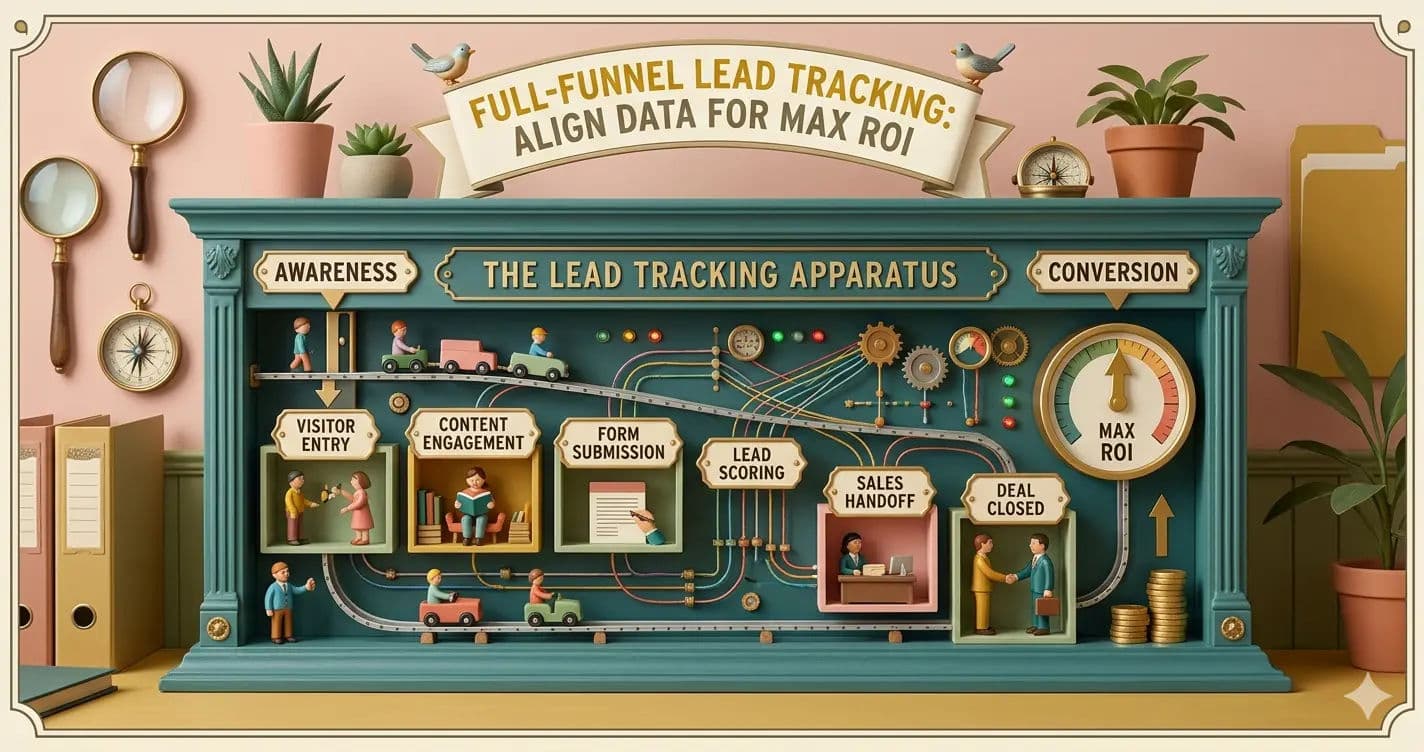
Full-funnel lead tracking is a comprehensive data strategy that monitors and records every interaction a prospect has with your brand, spanning the entirety of the buyer's journey. Unlike basic conversion tracking—which typically only measures isolated events like a form fill or a whitepaper download—full-funnel tracking connects the dots between top-of-funnel awareness, middle-of-funnel consideration, and bottom-of-funnel purchasing decisions.
In 2026, defining what constitutes a "lead" has evolved. A lead is no longer just an email address in a database; it is a dynamic profile of behavioral data, intent signals, and engagement metrics.
Full-funnel tracking captures this continuous customer journey, providing visibility into the "dark funnel"—the hidden, untracked spaces where modern B2B buyers conduct their research, such as private Slack communities, unlinked brand mentions, and third-party review sites.
1. Beyond First and Last Touch
Traditional tracking often relies on first-touch or last-touch attribution, which assigns 100% of the credit to a single interaction. Full-funnel tracking utilizes multi-touch attribution models to distribute credit accurately across all touchpoints that influenced the sale. This ensures that top-of-funnel brand awareness campaigns receive appropriate credit alongside bottom-of-funnel conversion events.
2. Cookieless Tracking and Data Clean Rooms
With the phase-out of third-party cookies, tracking in 2026 relies heavily on first-party data and server-side infrastructure. To maintain compliance with privacy regulations like GDPR and CCPA while preserving data integrity, organizations are increasingly adopting Data Clean Rooms.
These secure environments allow multiple parties (like a brand and an advertising platform) to match first-party data and measure campaign performance without exposing personally identifiable information (PII) or violating privacy laws.
3. Closed-Loop Reporting
This methodology connects marketing automation platforms with Customer Relationship Management (CRM) systems. By doing so, it ensures that when a deal is won, that exact revenue data is fed back into the marketing platform. This feedback loop allows algorithms to optimize future campaigns based on actual revenue generated rather than mere lead volume.
By implementing these methodologies, organizations can move beyond theoretical marketing metrics and establish a concrete B2B lead attribution framework.
Aligning Marketing Operations and Sales Leadership
The most significant benefit of a full-funnel lead tracking strategy is not just technological; it is deeply cultural. Unified data tracking is the ultimate catalyst for aligning marketing operations and sales leadership. When both departments operate from a single source of truth, the traditional silos break down, paving the way for collaborative, revenue-focused strategies.
Achieving marketing operations efficiency requires granular visibility into what happens after a lead is handed off. Marketing needs to know which campaigns are generating leads that actually progress to the proposal stage and which campaigns are generating dead ends.
Conversely, sales leadership requires deep context before their representatives make a call. A sales rep needs to know exactly which web pages a prospect visited, which emails they opened, and what specific pain points they researched before filling out a contact form.
Unified lead tracking provides this bidirectional visibility. It enables the creation of shared dashboards where both teams can monitor the health of the entire revenue engine. This shared visibility fosters accountability and transforms monthly alignment meetings into strategic Unified GTM (Go-To-Market) or Revenue Operations (RevOps) workshops.
Furthermore, this alignment is critical for managing the rise of AI-to-AI sales interactions. As buyers increasingly use AI agents to conduct research and even negotiate, your sales and marketing systems must seamlessly share intent data to respond appropriately to these automated inquiries.
By leveraging marketing and sales alignment data to foster collaboration, AI algorithms can identify the behavioral patterns of prospects most likely to convert. Marketing can focus their budget on acquiring high-intent profiles, while sales can prioritize outreach, drastically improving conversion rates.
Key Components of a Unified Data Strategy
Building a full-funnel lead tracking strategy requires a robust, interconnected architecture. A unified data strategy is composed of several critical technical and strategic elements that work in harmony to capture, process, and analyze lead behavior across all touchpoints.
1. Advanced Multi-Touch Attribution Models
To achieve maximum returns, you must understand the true value of every marketing effort. Multi-touch attribution models are essential for this:
Linear Attribution: Distributes credit equally across all touchpoints.
Time-Decay Attribution: Gives more credit to the touchpoints that occurred closest to the conversion.
U-Shaped Attribution: Assigns 40% credit to the first touch, 40% to the lead creation touch, and distributes the remaining 20% among the middle touches.
W-Shaped Attribution: Ideal for B2B, this assigns 30% to the first touch, 30% to lead creation, 30% to opportunity creation, and 10% to the remaining interactions.
2. Server-Side Tracking Infrastructure
Client-side tracking (using browser cookies) is no longer reliable in 2026 due to ad blockers and strict privacy settings. Server-side tracking moves the data collection process from the user's browser to your own server.
This not only improves website performance but ensures that your lead tracking software captures accurate, uncorrupted data while remaining fully compliant with global privacy standards.
3. Standardized UTM Parameters and Taxonomy
A unified data strategy falls apart without clean data entry. Marketing operations must establish a strict, standardized taxonomy for UTM (Urchin Tracking Module) parameters. Every link shared across social media, email, paid ads, and partner networks must follow this naming convention to ensure that traffic sources, mediums, and campaign names are accurately categorized when they enter the CRM.
4. Seamless API Integrations and Middleware
Data must flow freely between your marketing automation platform, your website analytics, and your CRM. This requires robust API integrations. When native integrations fall short, middleware tools are necessary to translate and sync data fields, ensuring that a lead's behavioral history is instantly available to the sales representative the moment they open the CRM record.
5. Identity Resolution
In a post-cookie landscape, Identity Resolution is the linchpin of full-funnel tracking. This process involves stitching together a user's journey across multiple devices and sessions using first-party identifiers (like hashed emails or login IDs).
Without robust identity resolution, a single prospect interacting with your brand on a mobile phone and later on a desktop will be incorrectly tracked as two separate, disconnected leads.
Find Perfect Software For Your Business
Lead Tracking Software Comparison 2026: CallRail, WhatConverts, and Beyond
Selecting the right lead tracking software for ROI is the most critical step in executing your strategy. In 2026, no single tool does everything perfectly; instead, successful organizations build a customized, integrated tech stack. Let's examine how top-tier platforms solve specific tracking challenges.
1. Capturing Anonymous Intent: Snitcher and Leadfeeder
A significant portion of B2B research happens anonymously. Tools like Snitcher and Leadfeeder are vital for identifying the companies visiting your website before they ever fill out a form.
By utilizing advanced IP tracking, identity resolution, and proprietary databases, these platforms reveal which target accounts are showing intent. This allows marketing to retarget these specific accounts and enables sales to conduct proactive, highly relevant outbound outreach.
2. Tracking Inbound Conversions: CallRail vs WhatConverts 2026
For businesses where phone calls are a primary conversion mechanism, tracking offline interactions is notoriously difficult. When evaluating CallRail vs WhatConverts 2026 capabilities, both bridge this gap by providing dynamic number insertion (DNI).
When a prospect calls your business, these tools trace the call back to the specific keyword, ad, or web page that drove the interaction. CallRail often excels in deep integrations with broader marketing suites, while WhatConverts is frequently favored by agencies for its robust, multi-client reporting dashboards.
3. Bridging the Gap with Data Synchronization: Outfunnel and Tie
Data silos often occur because marketing tools and sales CRMs speak different languages. Outfunnel is designed to tightly sync marketing automation data with CRMs, ensuring that email engagement metrics are instantly visible to sales reps.
Similarly, Tie acts as a powerful integration layer, connecting disparate systems and automating complex data workflows so that lead information flows seamlessly across the entire enterprise stack without manual data entry.
4. Closed-Loop Attribution: Ruler Analytics
Ruler Analytics operates as a premier multi-touch attribution software designed for closed-loop reporting. It captures every touchpoint of a user's journey and, when a deal is marked as "closed-won" in the CRM, Ruler passes that exact revenue data back to the advertising platforms (like Google Ads or LinkedIn).
This allows marketing operations to optimize their bidding strategies based on actual revenue generated rather than just cost-per-lead.
5. The Central Source of Truth: HubSpot
HubSpot remains a powerhouse for executive-level visibility. By serving as both the marketing automation platform and the CRM, HubSpot lead management integration naturally eliminates many data silos. It provides comprehensive dashboards that allow sales leadership and marketing ops to track the entire lifecycle of a lead in one unified interface.
6. Non-Core Feature Comparison of Mentioned Tools
While tracking capabilities are paramount, operational features often dictate the success of software adoption. The table below compares the non-core operational aspects of these platforms to aid your evaluation.
Platform | Target Company Size | Best For | Primary Limitation |
CallRail | SMB to Mid-Market | Deep offline/call tracking | Can be overkill if calls aren't a primary channel |
WhatConverts | SMB & Agencies | Multi-client agency reporting | Less native enterprise CRM integrations |
Snitcher | B2B SMB to Enterprise | Capturing anonymous B2B intent | Relies on B2B IP matching (less effective for B2C) |
Leadfeeder | B2B Mid-Market to Ent. | Account-based marketing (ABM) | Pricing scales rapidly with website traffic volume |
Ruler Analytics | Mid-Market to Enterprise | Closed-loop revenue attribution | Requires complex initial setup and mapping |
Outfunnel | SMB | Simple marketing-to-CRM syncing | Lacks advanced enterprise routing features |
Tie | Enterprise | Complex, custom data workflows | Highly technical; requires developer resources |
HubSpot | All Sizes | Unified RevOps visibility | Can lack the deep offline tracking of specialized tools |
Step-by-Step Implementation for Sustainable Growth
Transitioning from fragmented data to a unified lead tracking 2026 framework requires a methodical approach. Attempting to overhaul your entire system overnight will lead to operational chaos. Instead, follow this structured implementation roadmap to ensure a smooth transition and immediate alignment between marketing and sales.
Phase 1: Stakeholder Buy-in and Budgeting
Before touching any technology, secure buy-in from the C-suite, IT, and legal departments. Present the financial impact of disconnected data and outline the expected ROI of the new stack. Crucially, involve IT early to ensure any proposed software meets strict 2026 security and SOC2 compliance requirements, which are non-negotiable for enterprise data handling.
Phase 2: Audit and Gap Analysis (Days 1-15)
Begin by mapping your existing technology stack. Identify every tool currently used to capture, store, or process lead data. Conduct interviews with both marketing operations and sales leadership to uncover where data gets lost.
Create an audit checklist to identify missing UTM parameters, broken API connections, and inconsistencies in how a "qualified lead" is defined across departments.
Phase 3: Infrastructure and Integration (Days 16-45)
Once gaps are identified, begin connecting your systems. Implement server-side tracking to future-proof your data collection. Use tools like Outfunnel or Tie to establish bidirectional syncing between your marketing platforms and your CRM.
Ensure that offline conversions, managed by tools like CallRail or WhatConverts, are properly feeding into your central database. The goal of this phase is to ensure that a lead's complete history is visible in one place.
Phase 4: Lead Scoring and Attribution Modeling (Days 46-75)
With data flowing correctly, establish your lead scoring logic. Collaborate with sales leadership to assign point values to specific actions (e.g., attending a webinar = 20 points, visiting the pricing page = 15 points). Simultaneously, configure your multi-touch attribution model in a tool like Ruler Analytics to ensure marketing channels are receiving appropriate credit for pipeline generation.
Phase 5: Training and Alignment (Days 76-90)
Technology is only as effective as the people using it. Conduct comprehensive training sessions for the sales team on how to interpret the new behavioral data available in their CRM views. Establish a recurring monthly Unified GTM meeting where both teams review the unified dashboard, analyze lead velocity, and adjust scoring models based on closed-won feedback.
Measuring Success and Optimizing the Funnel
Implementing a full-funnel lead tracking strategy is not a "set it and forget it" endeavor. To guarantee maximum returns, marketing operations and sales leadership must continuously monitor performance using advanced metrics that go beyond superficial engagement statistics.
1. Customer Acquisition Cost (CAC) by Channel
With unified tracking, you can calculate the exact cost of acquiring a customer through specific channels. Instead of knowing your blended CAC, you will know precisely how much it costs to acquire a customer via LinkedIn Ads versus organic search. This allows you to aggressively reallocate budget to the most efficient channels.
2. Lead Velocity Rate (LVR)
LVR measures the month-over-month growth in the number of qualified leads your marketing team is generating. It is a real-time indicator of future revenue growth. By tracking LVR through a full-funnel lens, you can ensure that the leads being generated are actually progressing through the pipeline, rather than just inflating top-of-funnel metrics.
3. Customer Lifetime Value (CLV) to CAC Ratio
The ultimate measure of success is the CLV:CAC ratio. Full-funnel tracking allows you to see not just which campaigns generate the most customers, but which campaigns generate the most profitable customers over time. If a specific lead source consistently yields high-CLV clients, marketing can confidently increase investment in that area.
4. Pipeline Velocity
This metric evaluates how quickly leads move through your sales funnel from initial contact to closed-won. By analyzing pipeline velocity, sales and marketing can identify specific bottlenecks. If leads routinely stall at the proposal stage, marketing can develop targeted middle-of-funnel content to assist sales in overcoming objections.
Try AuthenCIO
Move to faster, smarter software evaluation with AI
Conclusion: Future-Proofing Your Revenue Engine
In 2026, the alignment of marketing operations and sales leadership is no longer a theoretical ideal; it is a strict requirement for survival. Implementing a full-funnel lead tracking strategy eliminates the guesswork, dismantles data silos, and creates a unified revenue engine focused on maximum returns.
By moving away from fragmented, single-touch metrics and embracing comprehensive, closed-loop reporting, organizations can finally understand the true impact of their investments.
The journey to unified data tracking requires careful planning, robust infrastructure, and the right technology partners. To ensure you select the best tools for your organization, use this 2026 RFP Checklist when evaluating vendors:
Server-Side Tracking Capabilities: Does the platform support robust, first-party data collection independent of browser cookies?
AI-Intent Integration: Can the software ingest and process intent signals to facilitate AI-to-AI sales interactions and predictive scoring?
Enterprise-Grade Security: Does the vendor maintain strict SOC2 compliance and offer secure Data Clean Room integrations?
Commit to the implementation roadmap, foster a culture of shared accountability, and watch as your marketing and sales teams transform into a single, unstoppable force for business growth.