
Introduction
Marketing agencies in 2026 face a frustrating paradox. On one hand, 69% of agencies expect their marketing budgets to increase this year, aggressively expanding into full-funnel experimentation with channels like short-form video, organic social, and influencer marketing. On the other hand, the average client relationship lasts a mere 12 to 24 months.
Streamline your software evaluation process
Why the disconnect? The answer lies in the "Attribution Gap." Clients simply do not believe that digital ads—especially top-of-funnel brand awareness campaigns—are driving offline phone sales and tangible revenue.
To bridge this gap, you need the best call tracking software for agencies 2026. With the total phase-out of third-party cookies and advanced iOS tracking restrictions now fully enforced, relying on legacy attribution is a recipe for churn. You need bulletproof call tracking ROI for marketing agencies to prove your value.
CallRail currently commands approximately 45% of the market share among SMBs and mid-market agencies, dominating the local service sector. But as the landscape grows more complex, is it still the right choice? This comprehensive CallRail review 2026 will dissect its features, pricing, and alternatives to help you make a definitive, data-backed decision for your agency's tech stack.
Tool | Best For | Pricing | Key Features |
CallRail | Mid-market agencies needing all-in-one tracking | Starts at $55/month | DNI, Conversation Intelligence, Form Tracking |
WhatConverts | Agencies focused on comprehensive lead capture | Starts at $30/month | Lead reporting, chat tracking, custom fields |
Ruler Analytics | B2B agencies needing deep multi-touch attribution | Starts at $400/month | Revenue attribution, pipeline tracking, GDPR compliance |
HubSpot | Inbound agencies already in the HubSpot ecosystem | Starts at $10 / seat / month | Native CRM integration, campaign tracking |
Invoca | Enterprise agencies with high call volumes | Custom pricing | AI-driven speech analytics, enterprise integrations |
Ringba | Performance marketers and pay-per-call agencies | Starts at $147 /month | Real-time routing, publisher management |
*Note: All prices shown reflect typical monthly billing. Vendors often offer lower pricing for annual commitments, but those discounts are excluded here for easier comparison. Actual costs may vary depending on your requirements, usage volumes, and negotiated terms.
Software Covered in this Article
To help you evaluate CallRail in the right context, this article compares it against a carefully curated set of competitors:





Executive Summary: The 2026 Call Tracking Comparison Matrix
Agencies do not need more channels in 2026; they need clearer proof. The modern agency landscape is shifting rapidly. Paid search, SEO, and organic social are the top channels for agencies winning new clients, surpassing referrals which dominated in 2025. Furthermore, 52% of agencies identify short-form video and 51% identify personalization as the most influential industry approaches for 2026.
However, tracking a phone call generated from a personalized TikTok ad or an organic social post requires robust technology. The days of relying solely on Google Ads forwarding numbers are over.
Agencies need multi-channel attribution software that provides conversation-level insights. Proving ROI through attribution clarity is critical to retaining clients and justifying multi-channel investments.
Without a dedicated platform, agencies face two massive pain points: the high overhead of manually listening to and grading calls for quality assurance, and fragmented data across multiple platforms making it impossible to create a "single source of truth" for clients. Call tracking software solves this by digitizing offline conversions and injecting them directly into your digital reporting dashboards.
Deep Dive: CallRail’s Core Features for High-Growth Agencies
CallRail has evolved significantly from a simple number-forwarding service into a comprehensive lead engagement platform. Let's evaluate its core features through the lens of a multi-channel agency.
1. Multi-Touch Attribution and Dynamic Number Insertion (DNI)
At the heart of CallRail is its Dynamic Number Insertion (DNI) technology. In 2026, privacy regulations and cookieless tracking environments have made attribution incredibly difficult.
CallRail handles this by using first-party data tracking. When a user visits a client's website, CallRail swaps the hardcoded phone number with a unique tracking number tied to that specific user's session, source, or campaign.
Agency Value: This allows you to tell a client, "This $5,000 roofing job came from a customer who first clicked a Facebook ad, then searched organically three days later, and finally called from a Google Search Ad." This dynamic number insertion ROI proves the value of your entire marketing funnel, not just the last click.
2. AI-Powered Conversation Intelligence: Automating Lead Qualification
Manually grading calls is a margin-killer for agencies. CallRail's Premium Conversation Intelligence utilizes AI to transcribe calls, analyze sentiment, and automatically score leads. In 2026, this feature set includes custom vocabularies, allowing agencies to train the AI to listen for specific buying signals.
Agency Value: Setting up custom vocabularies takes a junior account manager roughly 2 to 3 hours of initial configuration and testing per client. Once trained to listen for specific phrases—like "schedule an appointment," "pricing," or "warranty"—the AI operates autonomously.
This upfront investment of time drastically reduces weekly QA hours. You can automate lead qualification, ensuring that if a call is flagged as a "Good Lead" by the AI, it automatically triggers a workflow in your CRM. This conversation intelligence for agencies provides statistical benchmarks showing significant improvements in average cost-per-lead reporting accuracy.
3. Form Tracking: Closing the Loop on Multi-Channel Leads
Call tracking alone only paints half the picture. The synergy between "Form Tracking" and "Call Tracking" is where CallRail provides a holistic multi-channel view. CallRail's form tracking captures the same session-level attribution data for form submissions as it does for phone calls, unifying all leads into a single dashboard.
Agency Value: When presenting client-facing ROI reports, you can highlight "calls-to-revenue" and "forms-to-revenue" side-by-side. This eliminates the need to cross-reference Google Analytics, WordPress database entries, and call logs.
CallRail Pricing for Agencies 2026
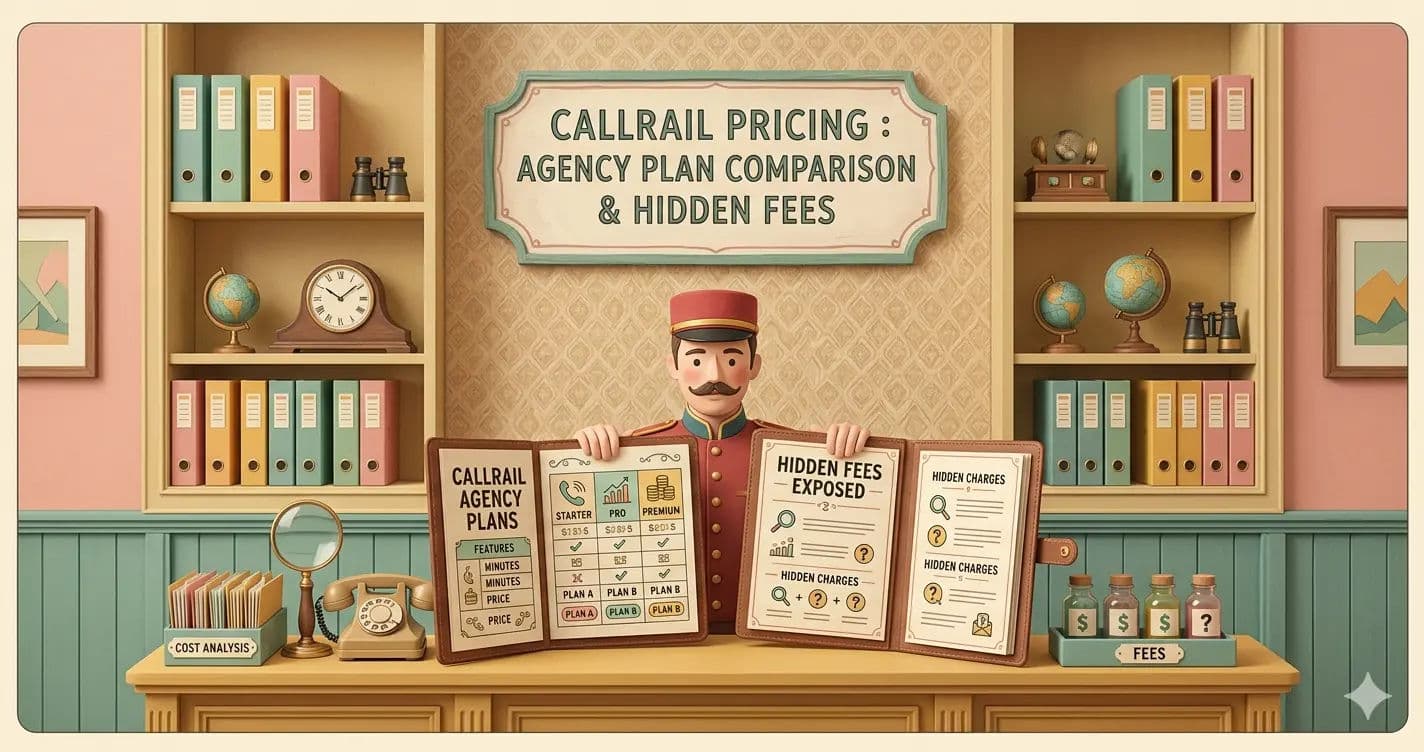
CallRail pricing for agencies is a critical factor. While it is feature-rich, it can become expensive if not managed correctly. CallRail’s base plan starts at $45 per month, which includes 5 local numbers and 250 local minutes. However, most agencies will need the "Call Tracking + Form Tracking" bundle, which starts at $95 per month.
The Value vs. Cost Matrix for Agencies:
Small Agencies (1-10 Clients): CallRail is highly cost-effective. The base plans provide enterprise-level attribution for a fraction of the cost. You can easily absorb the cost or pass a flat fee to clients.
Mid-Market Agencies (11-50 Clients): This is CallRail's sweet spot. The Agency Partner Program offers volume discounts, revenue share opportunities, and a centralized dashboard to manage sub-accounts. You can white-label the reporting dashboard, adding your agency's logo and colors, which increases perceived value.
Large Agencies (50+ Clients): At this scale, per-minute and per-number costs can eat into margins.
The High-Volume Overages Trap (Sticker Shock): Consider a high-traffic home services client generating 10,000 minutes of talk time and requiring 50 tracking numbers. While the base plan is $55, the per-minute overages and extra numbers ($3/number) can quickly inflate the monthly bill to $500 or more. Agencies must vigilantly audit unused DNI pools to prevent margin erosion.
Passing Costs to Clients: Experienced agencies handle CallRail pricing by baking the cost into their monthly retainer as a "Technology & Attribution Fee" (often marked up by 20-30% for management), or they bill the client directly through CallRail's client billing feature.
Find Perfect Software For Your Business
The Competitive Landscape: CallRail vs. The Alternatives
While CallRail is the market leader for SMBs, it is not the only player. Depending on your agency's specific needs, alternative platforms might offer better functionality or pricing.
1. CallRail vs. WhatConverts: The Battle for Mid-Market Attribution
The CallRail vs WhatConverts 2026 debate is common among agency owners. While CallRail started as a call tracking tool that added form tracking, WhatConverts was built from the ground up as a comprehensive lead tracking platform.
WhatConverts focuses heavily on the "Lead Center" concept. It tracks calls, forms, chats, and e-commerce transactions, tying them all back to marketing channels.
For agencies whose primary goal is simply delivering a monthly report that says "We generated X leads from Y channels," WhatConverts is often easier to use and slightly more cost-effective. However, CallRail wins decisively on AI conversation intelligence and deep integrations with ad platforms.
2. CallRail vs. Ruler Analytics: European Compliance and Multi-Channel Depth
Ruler Analytics vs CallRail is a comparison of depth versus breadth. Ruler Analytics is a true multi-touch revenue attribution platform. It excels at tracking long, complex B2B sales cycles.
If your agency works with enterprise B2B clients where a single deal takes six months and involves 15 touchpoints across LinkedIn, Google Ads, and email marketing, Ruler Analytics provides a superior pipeline view.
Furthermore, Ruler Analytics is based in the UK and is built with strict European GDPR compliance in mind, making it a safer bet for agencies with heavy European client bases. CallRail, conversely, is better suited for high-velocity, shorter sales cycle clients like home services, legal, and healthcare.
3. Enterprise Solutions: When to Choose Invoca or Ringba
As your agency scales, you may outgrow CallRail's capabilities.
Invoca vs CallRail for enterprise: Invoca is the heavyweight champion for enterprise brands. If your client has 500+ franchise locations and requires complex, skill-based call routing, real-time agent coaching, and deep integrations with enterprise BI tools, Invoca is the necessary choice. CallRail's routing is sufficient for SMBs but breaks down at the enterprise level.
Ringba: If your agency focuses on performance marketing, affiliate networks, or pay-per-call arbitrage, Ringba is the industry standard. It offers real-time bidding for calls and advanced publisher management that CallRail does not support.
Find out if CallRail is the right fit for your agency by evaluating it on AuthenCIO's vendor-neutral platform.
Integration Ecosystem: Connecting CallRail to HubSpot and Your CRM
A call tracking tool is only as good as the ecosystem it connects to. In 2026, isolated data is useless data.
The CallRail HubSpot integration is widely considered one of the best in the industry. It features a bi-directional sync. When a call comes in, CallRail automatically creates a contact in HubSpot, logs the call activity, and attaches the marketing source data.
If the call results in a closed won deal in HubSpot, that revenue data is pushed back into CallRail, allowing for true closed-loop reporting. This data can then be pushed directly into Google Ads to optimize your bidding algorithms based on actual closed revenue, not just raw call volume.
Local Service Ads (LSA) and CallRail Integration
Google Local Services Ads (LSAs) have become a massive lead driver for SMB agencies in 2026, particularly for plumbers, HVAC technicians, and legal professionals. A common agency pain point is that LSA calls remain siloed in Google's proprietary dashboard, making holistic client reporting nearly impossible.
CallRail solves this with its native integration for Google LSAs. By swapping the default Google forwarding number with a CallRail tracking number, agencies can track these specific, high-intent calls alongside standard PPC, SEO, and social media campaigns. This allows you to unify all lead sources into a single dashboard, providing a complete picture of your agency's impact on the client's bottom line.
Who Owns the Data? Porting and Retention
A major concern for agency owners regarding lead attribution reporting for clients is data ownership. If a client fires your agency or decides to take their marketing in-house, who keeps the tracking numbers?
With CallRail, the data and the numbers belong to the account owner. If an agency holds the master account, the numbers are technically theirs. However, to maintain good relationships and avoid messy offboarding disputes, numbers can be ported out to another provider or transferred directly into the client's own separate CallRail account.
Pro Tip: The porting process can take 2 to 4 weeks depending on the telecom carrier. Always outline data ownership and porting transfer fees in your initial agency Service Level Agreement (SLA) to set clear expectations from day one.
Proving Client ROI: Actionable Frameworks for Agencies
To truly leverage CallRail, agencies must move beyond simply showing a dashboard. You must use the data to prove value actively.
The 30-Day 'Proof of Value' Pilot Program: For skeptical clients who don't believe digital marketing drives phone calls, implement this framework:
Baseline Measurement (Days 1-7): Install CallRail's DNI script but do not change any marketing spend. Establish the baseline organic call volume.
Campaign Launch (Days 8-21): Launch the top-of-funnel campaigns (e.g., Meta Ads, YouTube Ads) using dedicated tracking numbers and DNI.
AI Grading (Continuous): Use CallRail's AI to automatically tag calls over 60 seconds as "Qualified Leads."
The ROI Reveal (Day 30): Present a highly visual report showing exactly how many qualified calls were generated by the new campaigns, complete with audio snippets of actual customers booking services.
The ROI Reveal Report Mockup: Your 2026 reporting template should be designed for instant comprehension. Picture a dashboard where the top widget prominently displays "Cost Per Qualified Lead (CPQL)." Directly below that is a bar chart showing "Channel-Specific Revenue."
On the right sidebar, feature a "Missed Opportunity Cost" ticker. This ticker calculates the potential revenue lost from unanswered calls (e.g., 15 missed calls at an average lifetime value of $1,000 = $15,000 lost). This brilliant metric shifts the blame for poor performance from the agency's marketing efforts to the client's operational bottlenecks.
Pros and Cons: A No-Nonsense Look at CallRail for Agency Owners
While the 30-day pilot program often yields impressive results, maintaining that success requires understanding the platform's limitations. To provide a truly objective review, we must look at where CallRail excels and where it falls short for agency decision-makers.
The Pros:
Unmatched Ease of Use: The UI is intuitive. Junior account managers can set up DNI pools and tracking numbers in minutes without developer assistance.
Agency Partner Program: The white-labeling capabilities, co-marketing resources, and revenue-sharing models are specifically designed to help agencies scale.
Best-in-Class AI: The 2026 updates to Conversation Intelligence make automated lead scoring highly accurate, drastically reducing QA hours.
Seamless Integrations: Native, reliable integrations with Google Ads, Meta Ads, Google Analytics 4, HubSpot, and Salesforce.
The Cons:
Pricing Scalability: High-volume clients can cause costs to skyrocket due to per-minute and per-number overages. It requires vigilant account management.
Complex B2B Limitations: It lacks the deep, multi-year pipeline tracking capabilities found in dedicated B2B tools like Ruler Analytics.
Enterprise Routing: Call routing features are basic compared to enterprise solutions like Invoca, making it unsuitable for massive, multi-national call centers.
Try AuthenCIO
Move to faster, smarter software evaluation with AI
Final Verdict: Should Your Agency Invest in CallRail in 2026?
For the vast majority of multi-channel marketing agencies—specifically those managing SMBs, local services, legal, healthcare, and e-commerce clients—CallRail remains the gold standard in 2026. Its blend of ease-of-use, powerful AI conversation intelligence, and agency-centric features like white-label reporting make it an invaluable tool for proving client ROI and closing the attribution gap.
However, it is not a one-size-fits-all solution. If your agency specializes strictly in enterprise B2B clients with 12-month sales cycles, Ruler Analytics is a better fit. If you are running high-volume pay-per-call affiliate networks, Ringba is the superior choice. And if you are managing complex, multi-national call centers, you will need the power of Invoca.
Ultimately, the decision comes down to your client base, your budget, and your specific reporting needs. Do not let unproven ROI be the reason you lose clients at the dreaded 12-month mark. Invest in the right attribution software, digitize your offline conversions, and prove the undeniable value of your multi-channel campaigns to secure your agency's retention rates and bottom line.