

Introduction
In 2027, video is no longer just a top-of-funnel brand awareness tool; it is the core engine driving B2B demand generation. With 78% of B2B marketers heavily utilizing video to build trust and accelerate pipeline velocity, the industry has rapidly shifted toward video-first lead scoring.
Streamline your software evaluation process
For Demand Generation Heads, this means choosing the right hosting platform is a critical financial and operational decision. You are constantly balancing the need for robust analytics and deep CRM integrations against the risk of unpredictable subscription costs.
Wistia remains a dominant player in the B2B marketing space, but its 2027 hybrid pricing model—combining flat subscription fees with usage-based bandwidth and strict video limits—requires careful evaluation.
If you are assessing enterprise video hosting platforms, you must look beyond the sticker price to calculate the true Total Cost of Ownership (TCO). This guide breaks down Wistia’s pricing tiers, exposes the hidden costs of bandwidth overages, and compares Wistia against top alternatives so you can make an objective, ROI-driven software choice.
Key Takeaways:
Video-First Lead Scoring: Wistia's higher tiers excel at syncing granular engagement data directly into Marketing Automation Platforms (MAPs) like Marketo and HubSpot.
The Threat of Bill Shock: Wistia's 1TB bandwidth limit across all standard tiers can lead to significant overage fees, especially as 4K video becomes the B2B standard.
Strategic Alignment: Selecting a platform requires mapping your specific pipeline requirements—whether that is high-volume hosting, 1:1 sales outreach, or enterprise security—to the right vendor.
Wistia vs. Top Alternatives: Pricing and Best Use Cases
Wistia is a premium choice for B2B demand generation, but its pricing can rise quickly with video limits and bandwidth overages. This comparison shows how Wistia’s cost and capabilities stack up against leading alternatives, so you can choose the platform that best fits your budget and marketing goals.
Tool | Best For | Pricing | Limitations |
Wistia | B2B Marketing & Demand Gen | Starts from $99/mo | Strict video caps, 1TB bandwidth limit across all standard tiers, overage fees. |
Vimeo | High-Volume, Cost-Effective Hosting | Starts from $16/mo | Lacks deep CRM integrations, limited marketing automation sync. |
Vidyard | 1:1 Sales Outreach and Prospecting | Starts from $89/mo | Expensive for mass hosting, primarily built for sales rather than marketing. |
Brightcove | Enterprise-Grade Scalability & Monetization | Custom Pricing | High barrier to entry, complex implementation, overkill for standard B2B marketing. |
Loom | Quick Internal Communications | Starts from $18/user /mo | Not suitable for public-facing website hosting or demand generation campaigns. |
YouTube | Top-of-Funnel Reach and SEO | Free | Ads, suggested competitor videos, zero native B2B lead capture capabilities. |
SproutVideo | Secure, Internal Corporate Video Sharing | Starts from $15/mo | Less brand recognition, fewer native integrations with major marketing automation platforms. |
*Note: All prices shown reflect typical monthly billing. Vendors often offer lower pricing for annual commitments, but those discounts are excluded here for easier comparison. Actual costs may vary depending on your requirements, usage volumes, and negotiated terms.
Software Covered in this Article
To help you understand Wistia in the right context, this article refers to a carefully curated set of leading alternatives:





Wistia Pricing 2027: Quick Comparison
Evaluating video hosting platforms in 2027 requires a highly strategic approach. The SaaS market has shifted heavily toward hybrid pricing models, where vendors combine a predictable platform fee with usage-based metrics like bandwidth, storage, or premium AI capabilities.
For Demand Generation Heads, this means the advertised monthly price is rarely the final invoice amount.
Wistia’s pricing structure is explicitly designed for B2B marketers who want to turn video views into qualified pipeline. Unlike platforms that focus purely on video delivery or internal messaging, Wistia positions itself as a lead generation tool. However, this positioning comes at a premium.
To make an informed decision, you must map your specific pipeline requirements—such as the need for interactive video branching, automated transcription credits, or Marketo integrations—directly to Wistia's tiered offerings.
Before committing to a multi-year contract, it is essential to understand exactly what is included in the base subscription and, more importantly, what triggers a price increase. The following sections provide a detailed breakdown of Wistia's tiers and how they stack up against the broader 2027 video marketing landscape.
Wistia Pricing Tiers Explained: Plus vs. Pro vs. Advanced
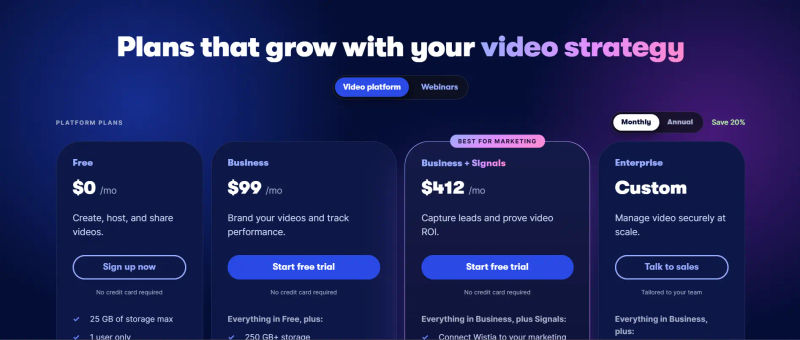
Wistia’s 2027 pricing is segmented into three primary standard tiers: Plus, Pro, and Advanced, alongside a custom Enterprise option. Each tier is gated not only by features but also by the number of videos you can host, making it critical to align your content production volume with your subscription.
1. Wistia Business: The Sweet Spot for Demand Generation
Priced at $99 per month, the Business plan is where Wistia’s marketing capabilities truly unlock. This tier increases your limit to 50 videos and introduces crucial features like video heatmaps, A/B testing, and custom Calls-to-Action (CTAs).
For Demand Gen Heads, the Business plan provides the minimum viable data needed to measure video engagement scores. You can see exactly which parts of a product demonstration a prospect re-watched, allowing sales teams to tailor their follow-up conversations.
Despite these benefits, the Business plan still lacks native, bi-directional syncing with high-end Marketing Automation Platforms (MAPs). You can export CSVs or use basic Zapier connections, but this can create data silos and manual labor overhead for larger organizations.
2. Wistia Advanced: AI Features and Deep MAP Sync
At $329 per month, the Advanced plan is built for mature marketing operations. It expands your library to 250 videos and includes the deep, bi-directional integrations with Marketo, HubSpot, and Pardot that enterprise teams require. By syncing viewing data directly into your CRM, you can trigger automated lead scoring and nurturing workflows based on video consumption.
In 2027, the Advanced tier also heavily incorporates AI-driven features. This includes AI video SEO, automated transcription, and intelligent video branching for interactive experiences. It is important to note how these features are billed.
While AI transcription is included, heavy usage of automated chapter generation and AI content repurposing may consume specific feature credits. Demand Gen Heads must monitor these credits to ensure their content teams are not inadvertently driving up monthly costs. For enterprises focused on proving the direct impact of video views on the sales pipeline, the Advanced plan offers the highest ROI, provided you can justify the steep monthly cost.
3. Wistia Enterprise Pricing: Security, SOC2, and Custom Contracts
For large-scale organizations, Wistia offers a custom Enterprise tier. This tier is not just about increasing video limits past 250; it is triggered by strict IT procurement requirements. If your organization requires Single Sign-On (SSO), SOC2 compliance documentation, custom Service Level Agreements (SLAs), and a dedicated Customer Success Manager, you will be pushed into the Enterprise tier.
Enterprise pricing is entirely custom and requires negotiation. As a Demand Gen Head, your biggest leverage during these negotiations is bandwidth. Because Enterprise contracts are tailored to your usage, you can often negotiate a much higher bandwidth ceiling or a significantly reduced overage rate compared to the standard $0.08 per GB. Securing favorable terms here is critical for protecting your budget against unpredictable viral content or heavy webinar consumption.
Find Perfect Software For Your Business
The Hidden Costs of Wistia: Bandwidth and Overages
When evaluating B2B video hosting costs, the most significant pain point for decision-makers is the fear of unpredictable "bill shock." While Wistia's feature set is incredibly robust for lead generation, its approach to bandwidth and storage can severely inflate your Total Cost of Ownership over a 3-year period if not carefully managed.
In 2027, as 4K and 8K streaming requirements become the standard for B2B product demonstrations and high-end brand storytelling, bandwidth consumption is skyrocketing. Wistia includes 1TB of bandwidth across its Plus, Pro, and Advanced plans. This is a crucial detail: upgrading to the $399/month Advanced plan does not increase your bandwidth allowance compared to the $99/month Plus plan.
To understand the impact, consider the difference between 1080p and 4K video. A standard 10-minute 1080p video might consume roughly 500MB of bandwidth per view. If 1,000 prospects watch that video, you consume 500GB—half of your monthly allowance.
However, a 10-minute 4K video can easily consume 2.5GB per view. If those same 1,000 prospects watch the 4K version, you consume 2.5TB of bandwidth. This instantly blows past your 1TB limit, resulting in 1.5TB of overages. At Wistia's historical rate of $0.08 per extra GB, that single video would add $120 in overage fees to your monthly invoice.
To avoid these budget surprises, Demand Gen Heads must calculate a "Bandwidth Formula" before signing a contract:
(Average Video Length in minutes) x (Average Bitrate/Size per minute) x (Monthly Unique Viewers) = Estimated Bandwidth
If your calculations project consistent overages, you have two choices: aggressively negotiate a custom Enterprise contract with Wistia to secure a higher bandwidth ceiling, or look toward competitors with more generous bandwidth allowances that better fit your content strategy.
Wistia vs. Competitors: Who Offers the Best Value for B2B?
When evaluating Wistia, it is essential to compare it against platforms designed for different primary use cases. While Wistia excels at marketing automation and lead scoring, competitors offer distinct advantages in volume, scale, and specific departmental workflows.
1. Vimeo: Best for High-Volume, Cost-Effective Hosting
Vimeo is the industry standard for high-definition, creative video hosting. For B2B companies, Vimeo Enterprise offers a compelling alternative to Wistia, primarily because it does not strictly meter bandwidth in the same punitive way. If your strategy relies on hosting hundreds of high-res videos, webinars, and product tutorials with massive viewership, Vimeo provides a much more predictable TCO.
However, Vimeo's limitation lies in its B2B marketing depth. While it offers basic lead capture and CRM integrations, it lacks the granular, bi-directional data sync and interactive branching that make Wistia so powerful for demand generation. Vimeo is best if you need a beautiful, cost-effective player for high-volume hosting, but Wistia wins if your primary goal is lead attribution and pipeline velocity.
2. Brightcove: Best for Enterprise-Grade Scalability and Monetization
Brightcove operates on a completely different scale. It is an enterprise-grade platform built for global distribution, massive live streaming events, and complex OTT (Over-The-Top) media delivery. Brightcove offers unparalleled security, server-side ad insertion, and global content delivery network (CDN) optimization.
For a standard B2B software company looking to host website demos and capture leads, Brightcove is heavily over-engineered and significantly more expensive than Wistia. It requires dedicated technical resources to implement and manage.
Brightcove is best for Fortune 500 companies or media brands where video is the actual product being sold. For Demand Gen Heads focused on marketing automation workflows, Wistia provides a much faster time-to-value and a more user-friendly interface.
Wistia vs. Vidyard and Loom: Sales Outreach and Internal Comms
Not all B2B video is created for the marketing website. Much of the 2027 video landscape is dominated by 1:1 sales outreach and asynchronous internal communication. In these arenas, Vidyard and Loom serve very different purposes than Wistia.
3. Vidyard: Best for 1:1 Sales Outreach and Prospecting
While Wistia is built for the marketing department, Vidyard is built for the sales floor. Vidyard’s primary use case is enabling Sales Development Reps (SDRs) and Account Executives to record, send, and track personalized video messages directly from their email clients, Outreach, or Salesloft.
For Demand Gen Heads, the critical consideration here is integration overlap and data governance. Many enterprise organizations attempt to use Wistia for marketing (syncing to Marketo) and Vidyard for sales (syncing to Salesforce). This can create significant data synchronization challenges.
If a prospect watches a marketing video on your website and a sales video in an email, both platforms will attempt to score that lead. Without strict data governance, you risk double-counting engagement and inflating lead scores.
While Wistia has introduced basic screen recording features, it cannot match Vidyard's seamless integration into the daily workflow of a high-volume outbound sales team. If your primary goal is to increase cold outreach conversion rates, Vidyard is the superior choice, but it requires careful CRM mapping if used alongside Wistia.
4. Loom: Best for Quick Internal Communications
Loom has revolutionized asynchronous communication. Priced affordably (starting around $12.50 per user/month), Loom is designed for rapid screen recording and sharing. It is the perfect tool for replacing a 30-minute internal meeting with a 3-minute video update, walking a client through a complex support ticket, or delivering a quick product release note to the engineering team.
Loom’s limitation is that it is not a marketing hosting platform. You would not use Loom to host the hero video on your company homepage, as it lacks the polished, unbranded player, SEO capabilities, and advanced analytics required for demand generation. Loom and Wistia are not mutually exclusive; in a well-optimized 2027 tech stack, a company will use Wistia for external marketing assets and Loom for internal team collaboration.
Wistia vs. YouTube and SproutVideo: Top-of-Funnel and Security
Finally, Demand Gen Heads must consider the extremes of the video hosting spectrum: the massive, free reach of YouTube and the highly secure, controlled environment of niche players like SproutVideo.
5. YouTube: Best for Top-of-Funnel Reach and SEO
YouTube is the second-largest search engine in the world. Its primary use case is top-of-funnel brand awareness and organic discovery. The pricing is unbeatable—it is completely free to host unlimited videos and consume unlimited bandwidth.
However, for a B2B demand generation strategy, relying solely on YouTube for website hosting is a critical mistake. YouTube’s algorithm is designed to keep viewers on YouTube, not to drive them to your landing pages. If you embed a YouTube video on your pricing page, you risk showing your prospects suggested videos from your direct competitors the moment the video ends.
Furthermore, YouTube offers zero native B2B lead capture forms and cannot sync viewing data to your CRM. YouTube should be used strictly as a distribution channel for brand awareness, while Wistia should be used to host conversion-focused videos on your owned properties.
6. SproutVideo: Best for Secure, Internal Corporate Video Sharing
SproutVideo is a highly specialized platform that excels in security and privacy. If your company needs to host sensitive internal training videos, compliance materials, or a gated partner portal, SproutVideo offers granular, role-based access controls, password protection, and login tracking that Wistia’s standard tiers struggle to match.
SproutVideo is highly cost-effective for these specific use cases, but it lacks the brand recognition and robust ecosystem of third-party marketing integrations found in Wistia. It is the best choice when restricting access to video content is more important than maximizing public viewership and lead generation.
Try AuthenCIO
Move to faster, smarter software evaluation with AI
Final Verdict: Choosing the Right Video Platform for Your Pipeline
Selecting the right video hosting platform in 2027 comes down to aligning the software's primary use case with your demand generation goals. Wistia remains one of the most powerful tools available for B2B marketers who need to prove the ROI of their video content. By syncing detailed engagement data directly into platforms like Marketo and HubSpot, Wistia’s Advanced plan allows you to score leads, trigger workflows, and measure exact pipeline contribution.
However, this power comes with strict limitations. The 1TB bandwidth cap across all standard tiers and the rigid limits on video count mean that Wistia can quickly become expensive if not managed correctly. Demand Gen Heads must model their expected viewership and video production volume to accurately forecast the Total Cost of Ownership and avoid end-of-month bill shock.
Decision Matrix: When to Upgrade or Switch
Stay on Wistia Pro: If your team produces fewer than 50 videos, relies on basic heatmaps, and can manage manual CSV exports for lead scoring.
Upgrade to Wistia Advanced: If you require bi-directional MAP syncing (Marketo/HubSpot), AI-driven transcription credits, and interactive video branching to automate your demand gen pipeline.
Negotiate Wistia Enterprise: If your IT department requires SSO and SOC2 compliance, or if your "Bandwidth Formula" projects massive overages that require a custom, negotiated bandwidth ceiling.
Switch to Vimeo: If your strategy relies on high-volume, 4K hosting without the need for deep CRM integration.
Switch to Vidyard: If your primary goal is empowering the sales team with 1:1 outbound outreach, provided you manage the CRM data overlap.
If your objective is to turn your marketing website into a highly measurable, lead-generating machine, Wistia’s Pro or Advanced tiers are worth the investment—provided you keep a close eye on your bandwidth consumption.