

Introduction
Key Takeaways:
Cloud Communications Platform First: Voye Global functions as a robust cloud communications software, replacing fragmented roaming plans with a centralized administrative dashboard to manage a unified, shared mobile data pool.
Cost Predictability & Automated Alerts: By shifting to a pooled model with automated data alerts and hard caps, operations managers eliminate carrier "bill shock" and achieve predictable monthly connectivity expenses.
Enterprise Security & Private APN: As a secure cloud solution, it offers Private APN capabilities and network redundancy (5G/LTE), ensuring corporate data remains secure and off vulnerable public Wi-Fi networks.
Scalable Software Deployment: Seamless API integrations and compatibility with Mobile Device Management (MDM) platforms allow for zero-touch, over-the-air eSIM provisioning across large global fleets.
Strategic Fit for Logistics: It is highly recommended for land-based supply chains, cross-border trucking fleets, and global field technicians. However, highly specialized maritime operations may require alternative satellite-based solutions.
Voye Global Review 2027: At a Glance
Streamline your software evaluation process
For logistics and operations managers in 2027, managing mobile connectivity for a distributed workforce requires robust cloud communications software. The global supply chain moves faster and is more digitized than ever, relying heavily on real-time IoT tracking, electronic logging devices (ELDs), and cloud-based ERPs. Yet, many enterprises still manage connectivity through fragmented carrier portals, bogged down by the high cost and unpredictability of traditional roaming "Day Passes."
When employees cross borders, the administrative burden of managing individual data plans without a centralized cloud platform creates massive inefficiencies and inevitable overage penalties. The modern solution is a software-defined enterprise mobile data pool, powered by cloud-managed eSIM technology.
Voye Global has positioned itself as a leading cloud communications platform in this space, offering a centralized, software-driven shared mobile data pool designed specifically for corporate fleets and logistics teams. Unlike consumer-focused travel eSIMs that cater to leisure travelers, Voye Global emphasizes cloud-based administrative control, API-driven deployment across hundreds of devices, and predictable global mobile data costs. But is its software platform the right choice for your specific operational needs, or should you be looking at competitors like GigSky, Airalo, Keepgo, Flexiroam, Truphone, or Holafly?
Below is a highly scannable decision summary matrix to help you immediately understand where Voye Global's cloud management capabilities fit into the broader 2027 connectivity software landscape.
Tool | Best For | Pricing (USD $) | Key Features | Support Level | Use Cases |
Voye Global | Centralized Logistics Fleets | Custom Pool (e.g., $4-$6/GB pooled) | Central dashboard, hard caps, MDM deployment | 24/7 Enterprise Human Support | Cross-border trucking, global supply chain fleets |
GigSky | Offshore & Maritime Ops | $9-$15/GB (Enterprise) | Offshore network coverage, enterprise API | 24/7 Specialized Maritime Support | Maritime logistics, aviation, offshore rigs |
Airalo | Individual Corporate Travelers | $4.50-$10/GB (Per User) | Consumer-friendly app, regional plans | Standard Ticketing & Bot | Occasional executive travel, single-trip deployments |
Keepgo | Unexpiring Data Needs | $3-$8/GB (Valid 365 days) | Unsteered IP, data valid for 365+ days | Standard Ticketing | Long-term IoT devices, backup connectivity |
Flexiroam | Global Field Technicians | $4-$9/GB (Granular) | Granular data slicing, wide global coverage | 24/7 Enterprise Support | Multi-country field service, remote diagnostics |
Truphone | Corporate Compliance | Custom Enterprise Pricing | Call recording, strict regulatory compliance | Dedicated Account Manager | Regulated supply chain communications, finance |
Holafly | Unlimited Data (Non-Pool) | $19-$99/plan (Per User) | Unlimited data, no hotspot tethering | Standard Ticketing & Bot | Leisure travel, heavy data single-users |
*Note: All prices shown reflect typical monthly billing. Vendors often offer lower pricing for annual commitments, but those discounts are excluded here for easier comparison. Actual costs may vary depending on your requirements, usage volumes, and negotiated terms.
Looking at Voye Global for employee roaming data? Compare shared mobile pools on AuthenCIO.
The Pros and Cons of Voye Global
To make an informed decision, operations managers must weigh the specific advantages against the limitations of the platform.
The Pros:
Predictable Costing: The shared data pool model effectively eliminates carrier roaming bill shock, providing a flat, predictable monthly expense.
Centralized Control: The administrative dashboard, real-time reporting, and API integrations significantly reduce the time spent on billing reconciliation and user management.
Enhanced Security: Utilizing a Private APN keeps corporate assets off vulnerable public Wi-Fi networks, a critical compliance factor in 2027.
Seamless MDM Deployment: The ability to push eSIM profiles over-the-air via Jamf or InTune makes scaling up (or down) nearly instantaneous.
The Cons:
Hardware Compatibility: While most modern smartphones support eSIM, older legacy logistics hardware (such as specialized barcode scanners or ruggedized tablets) may still require physical SIMs, necessitating a hybrid management approach.
Initial Setup Complexity: For organizations not currently utilizing an MDM platform, the initial setup, API integration, and provisioning of a data pool can be technically demanding.
Not Ideal for Low-Volume Users: The minimum buy-in for a corporate data pool (typically ~100GB) means fleets with only a handful of occasional travelers may find better value in per-user plans.

Software Covered in this Article
The following articles break down the key aspects of Cloud Communications Software, featuring a carefully curated set of key players:








Key Features of Voye Global for Operations Managers
When evaluating cloud communications software, the focus must shift from basic connectivity to comprehensive lifecycle management. Voye Global operates as a robust cloud-based platform built around centralized control, ensuring operations managers can seamlessly provision, monitor, and manage employee data consumption across global logistics networks.

1. Centralized Administrative Dashboard
The cornerstone of Voye Global is its administrative dashboard. Managing a fluctuating number of travelers requires a unified view. The dashboard allows administrators to allocate data from a master pool to individual employee lines dynamically.
If a driver in Europe consumes more data due to rerouting, while a coordinator in Asia uses less, the pooled model absorbs the variance without triggering overage penalties. Furthermore, unlike legacy systems that suffer from a 24-to-48-hour reporting lag, Voye Global’s dashboard provides near real-time usage metrics (typically updating within 15 minutes of session termination), allowing managers to make proactive adjustments.
2. Automated Data Alerts and Hard Caps
Communication gaps caused by unexpected data throttling can paralyze logistics operations. Voye Global addresses this by allowing administrators to set automated data alerts and hard caps for individual users. You can configure the system to notify both the user and the manager when an employee reaches 80% of their allocated threshold, preventing sudden connectivity loss. Hard caps ensure that rogue devices, background app updates, or compromised hardware cannot drain the entire corporate data pool overnight.
3. Network Redundancy and 5G/LTE Availability
For logistics centers, latency and jitter are just as important as raw bandwidth. In 2027, 5G is the standard in major hubs. Independent speed test data from high-traffic logistics centers like Rotterdam, Singapore, and Dubai show that Voye Global consistently latches onto 5G Standalone (SA) networks by partnering with Tier-1 local carriers.
However, logistics is not confined to cities. Voye Global utilizes robust network failovers; if a primary local network experiences an outage in a rural corridor, the eSIM automatically switches to a secondary partner's 4G/LTE network, ensuring mission-critical applications like GPS tracking remain online.
4. Security and Private APN Capabilities
Security vulnerabilities associated with employees using insecure local public Wi-Fi networks or engaging in physical SIM swapping are a major corporate concern. Beyond basic cellular encryption, Voye Global offers Private Access Point Name (APN) configurations for high-security corporate requirements.
A Private APN routes cellular traffic directly into the corporate Wide Area Network (WAN) via an IPsec tunnel, bypassing the public internet entirely. This ensures that sensitive supply chain data remains shielded from interception risks inherent in public networks at airports or truck stops.
5. API Integrations and Expense Management
Manual billing reconciliation is a hidden cost that drains administrative hours. Voye Global offers robust API integrations that connect directly with existing expense management software and enterprise resource planning (ERP) systems. This allows for automated cost allocation by department, region, or specific project code. The ability to seamlessly pipe usage data into platforms like SAP or Oracle is a non-negotiable requirement for enterprise-level scaling.
Achieving Predictable Mobile Data Costs 2027
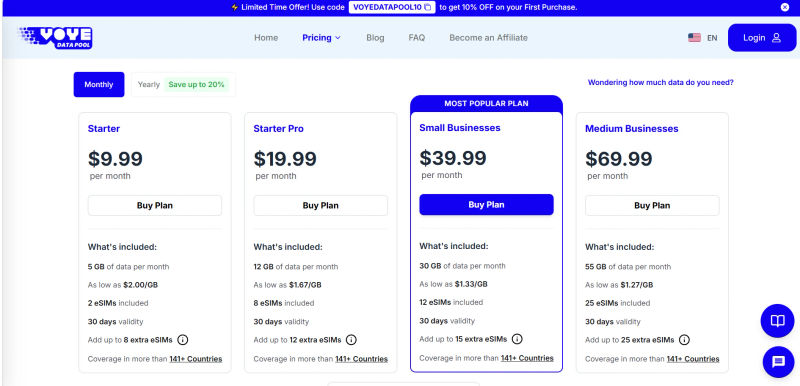
Understanding Voye Global pricing requires a shift in how you calculate mobile expenses. Instead of looking at the cost per individual plan, you must evaluate the effective price per usable gigabyte across your entire fleet.
1. The Data Pool Model vs. Per-User Plans
Traditional roaming "Day Passes" typically cost around $10 per day per user. If you have 50 employees traveling for 10 days a month, your roaming bill easily hits $5,000, regardless of whether they used 10MB or 1GB per day. Voye Global's shared mobile data for employees operates on a bulk purchasing model.
You might purchase a 500GB global data pool for $2,500 ($5/GB). This data is shared across all 50 employees. Because data usage is inherently variable, the pool absorbs the peaks and valleys, drastically reducing wasted spend on unused individual data allowances.
2. Minimum Buy-In and Scalability
For small-to-midsize fleets, operations managers should note that Voye Global typically requires a minimum buy-in to access the pooled enterprise tier. In 2027, this generally starts at around 100GB per month (approximately $400 to $500).
If you only have two or three employees traveling occasionally, this minimum buy-in may be less cost-effective than purchasing individual plans. However, for fleets of 10 or more regular travelers, the economies of scale quickly tip in favor of the data pool.
3. ROI and Hidden Administrative Efficiencies
Achieving predictable mobile data costs 2027 is about eliminating overage fees and hidden surcharges. By utilizing an ROI calculator approach—comparing trailing 12-month roaming expenses against Voye's pooled rates—most logistics managers find a cost reduction of up to 45%. It is important to note that results may vary depending on historical data waste and specific fleet usage patterns.
Beyond direct data costs, operations managers report a significant reduction in administrative hours. Instead of auditing 50 different carrier invoices with varying exchange rates, the finance department processes a single, predictable invoice.
Best Use Cases for Voye Global in Logistics
To truly understand if Voye Global is the right fit, we must look at how it performs in real-world logistics scenarios.
Scenario 1: Cross-Border Trucking Fleets
Consider a logistics coordinator managing a fleet of 75 trucks moving goods across the European Union and into non-EU emerging trade corridors. Drivers need constant connectivity for ELDs, routing updates, and communication with dispatch. Relying on physical SIM cards requires swapping cards at borders or paying exorbitant out-of-network fees.
With Voye Global, the entire fleet operates on a single data pool. As drivers cross borders, the eSIM automatically connects to the strongest local network without human intervention. The coordinator monitors the entire fleet's data consumption from a single dashboard, ensuring no driver loses connectivity due to an exhausted individual plan.
Join thousands of logistics leaders using AuthenCIO to make smart, data-driven software evaluations.
Scenario 2: Global Field Service Technicians
Enterprises deploying specialized technicians to repair industrial equipment globally face unpredictable travel schedules. A technician might be in Brazil on Monday and Germany on Thursday. Provisioning individual data plans for these rapid, multi-country deployments is an administrative nightmare.
Voye Global allows the IT department to provision an eSIM once. The technician draws from the corporate data pool instantly upon landing in any supported country, allowing them to access technical manuals and upload diagnostic reports securely.
Managing Mid-Month Pool Top-Ups
During peak shipping seasons (such as Q4 retail rushes), a fleet might burn through its data allocation prematurely. Voye Global handles this gracefully via automated top-ups. Administrators can configure the system to automatically add a 50GB block to the pool if total consumption reaches 95%, ensuring zero downtime. Alternatively, strict budgets can require manual managerial approval for top-ups, giving finance teams ultimate control over the monthly spend.
Implementation: Migrating to Voye Global
Deploying Voye Global across a fleet is streamlined through Mobile Device Management (MDM) platforms. Here is a standard checklist for migrating a corporate fleet to the Voye eSIM pool:
Device Audit: Verify that all corporate-issued devices (smartphones, tablets, logistics scanners) are eSIM compatible and carrier-unlocked.
MDM Integration: Connect Voye Global's provisioning API with your MDM platform (e.g., Jamf, Microsoft InTune) to enable centralized control.
Pool Sizing & Policy: Analyze historical data usage to purchase the appropriate initial data pool size (adding a 15% buffer). Set automated alerts at 75% usage and establish hard caps for individual lines.
Zero-Touch Deployment: Push the eSIM profiles over-the-air (OTA) to employee devices via the MDM, eliminating the need for physical QR code scanning by the end-user.
Find Perfect Software for Your Business
2027 Comparison: Voye Global vs. Airalo, GigSky, and Truphone
No review is complete without a side-by-side comparison. While Voye Global excels in pooled logistics data, the 2027 market offers several robust alternatives depending on your specific operational niche.
1. Voye Global vs GigSky
When comparing Voye Global vs GigSky, the primary differentiator is the operating environment. GigSky has heavily invested in offshore, maritime, and aviation connectivity. If your logistics operations extend to offshore oil rigs, maritime shipping routes, or in-flight connectivity, GigSky's specialized network agreements and dedicated maritime support make it the superior choice. However, for land-based supply chains and standard international business travel, Voye Global's data pool economics are generally more favorable and easier to manage at scale.
2. Voye Global vs. Airalo and Holafly
Airalo and Holafly are giants in the consumer eSIM space, but they often fall short for enterprise pool models. An Airalo for business alternative is necessary because Airalo primarily focuses on individual, per-user plans. While their app is incredibly user-friendly for a solo corporate executive taking an occasional trip, managing 100 individual Airalo plans without a unified shared data pool becomes administratively heavy.
Similarly, Holafly is famous for its "unlimited data" plans. However, these plans are strictly per-user, relatively expensive for short trips, and crucially, they frequently prohibit hotspot tethering. In logistics, tethering a laptop or diagnostic tool to a mobile device is often mandatory, making Holafly better suited for leisure travelers rather than a managed corporate fleet.
3. Keepgo vs Voye Global
Keepgo offers a unique value proposition: unexpiring data. Keepgo's data plans often remain valid for 365 days or more, provided there is a minimal top-up. This makes Keepgo an excellent alternative for IoT devices, backup connectivity terminals, or employees who travel very infrequently. If you have a sensor on a shipping container that uses a few megabytes a month, Keepgo is ideal. However, for a workforce consuming hundreds of gigabytes monthly, Voye Global's monthly data pool provides a significantly lower cost-per-gigabyte.
4. Flexiroam and Truphone for Enterprise
A Flexiroam enterprise review reveals a strong competitor in granular data slicing and emerging market coverage. For operations expanding into developing regions, Flexiroam often provides superior, unsteered coverage across challenging trade routes in South America and Sub-Saharan Africa. Flexiroam allows administrators to micromanage data allocations across a massive global footprint, making it highly effective for multi-country field service teams.
Truphone global connectivity 2027 remains the gold standard for highly regulated industries. If your logistics operations involve secure financial transport or require strict compliance with communication recording regulations, Truphone's deep integration with corporate compliance tools makes it the necessary choice, albeit usually at a premium price point compared to Voye Global.
Try AuthenCIO
Move to faster, smarter software evaluation with AI
Final Verdict: Is Voye Global the Best Choice for Your Operations?
For logistics and operations managers overseeing a mid-to-large fleet of traveling employees, Voye Global is a highly effective cloud communications software solution. It directly solves the pain points of unpredictable roaming charges, administrative bloat, and decentralized data management. By shifting from individual carrier plans to a centralized, cloud-managed mobile data pool, enterprises gain strict software-level control over their connectivity expenses while ensuring their workforce remains online in mission-critical environments.
However, the right choice ultimately depends on your specific fleet size, hardware compatibility, and travel footprint. If your operations are heavily maritime, GigSky might be the better fit. If you are expanding deep into emerging markets in Africa, Flexiroam is a strong contender. But for standard, land-based global logistics and cross-border operations requiring robust centralized software administration, Voye Global offers one of the most compelling ROI propositions in the 2027 market.
To begin your evaluation, we recommend downloading a standard trailing 12-month roaming audit template from your ERP provider to baseline your current costs. Compare those historical expenses against Voye Global's cloud-managed pooled data model to determine your exact potential savings.
Stop letting unpredictable roaming fees dictate your operational budget. Audit your device fleet for eSIM compatibility today, and consider migrating to a centralized cloud communications platform to secure, streamline, and future-proof your global connectivity.