
Introduction
The influencer marketing industry is projected to exceed $24 billion globally by 2026. For startup growth leads, this presents a massive opportunity to drive revenue, but it also creates a significant budget challenge. In the 2026 macroeconomic climate, marketing teams face intense pressure to lower their Cost-per-Acquisition (CPA) while scaling outreach. Software vendors are increasingly pushing multi-year contracts and bloated enterprise features that self-funded or early-stage VC-backed companies simply do not need. If you are evaluating platforms this year, you must cut through the marketing fluff and look directly at the feature-to-cost ratios.
Streamline your software evaluation process
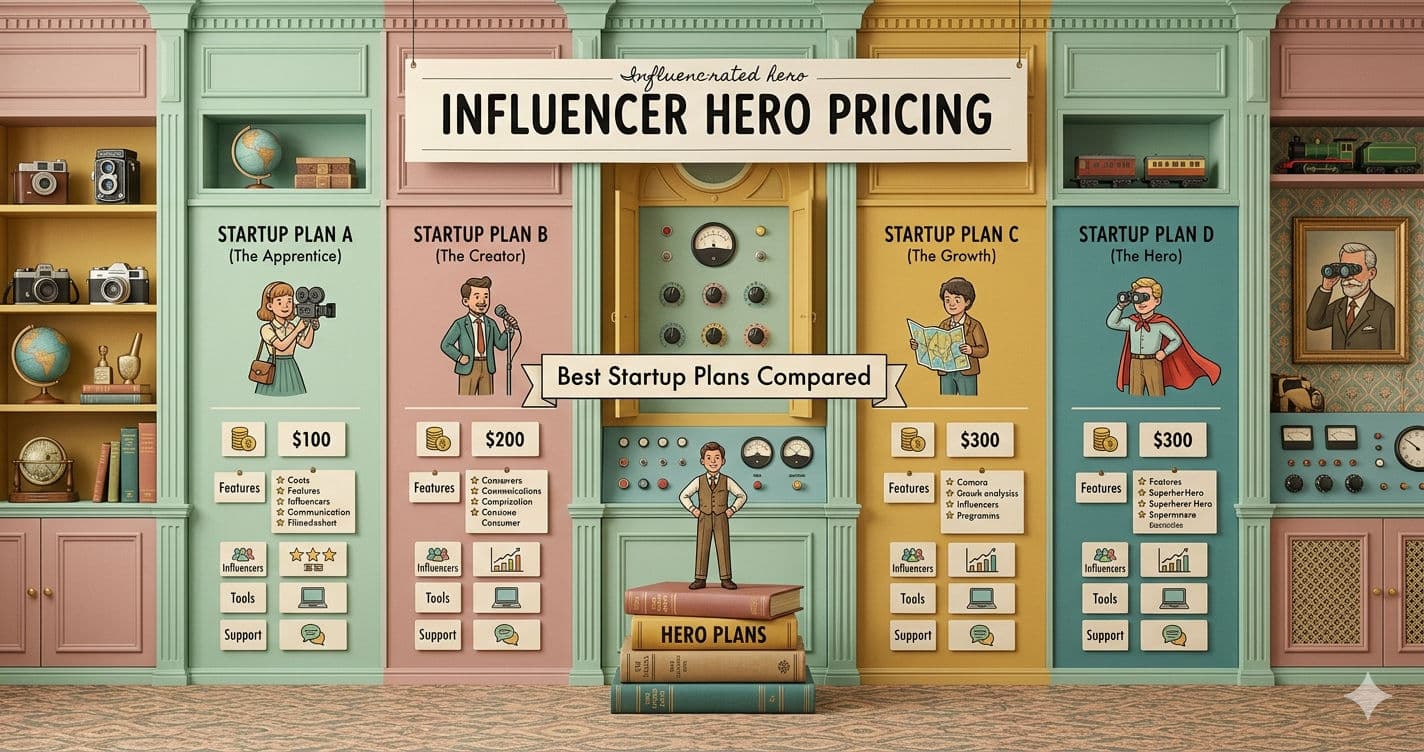
Analyzing Influencer Hero vs competitors pricing is the most effective way to understand what features you actually need and what you should pay for them. This guide breaks down the true pricing, hidden fees, and core use cases for the most popular tools on the market. We will focus strictly on decision-making factors: pricing differences, value for money, contract flexibility, and plan limitations to help you choose a tool that scales efficiently with your startup's growth trajectory.
Software Covered in this Article
To help you understand Earned Media & Creator Marketing software pricing in the right context, this article refers to a carefully curated set of leading alternatives:





Quick Comparison:
Tool | Best For | Pricing | Limitations |
Influencer Hero | All-in-one creator management | $649 - $2490+/mo | Capped at 1,000 reach-outs/mo |
Brand24 | Social listening & brand monitoring | $249 - $1499/mo | Lacks direct creator payment workflows |
Roster | Scaling brand ambassador programs | $599 - $1199+/mo | Not ideal for cold influencer discovery |
Upfluence | Integrated e-commerce workflows | Custom Pricing | High entry price, database view limits |
Grin | High-growth DTC brand management | Custom Pricing | Extremely expensive, long implementation |
AspireIQ | Community-led growth initiatives | Custom Pricing | Complex UI, heavy mandatory onboarding |
Traackr | Data-driven performance tracking | Custom Pricing | Prohibitive pricing for self-funded startups |
*Note: All prices shown reflect typical monthly billing. Vendors often offer lower pricing for annual commitments, but those discounts are excluded here for easier comparison. Actual costs may vary depending on your requirements, usage volumes, and negotiated terms.
See how Influencer Hero's cost compares to other startup-friendly tools on AuthenCIO.
Influencer Hero 2026 Pricing Breakdown: Value for Money?
Influencer Hero has positioned itself as the benchmark for startup value in 2026. Instead of forcing small teams into custom enterprise tiers, they offer transparent entry-level pricing designed specifically for scaling operations without compromising on essential features.
Pricing Overview: Influencer Hero’s pricing starts at around $349 per month for their base Growth tier, scaling up to $1,000+ per month for higher volumes and advanced enterprise features. Importantly, they offer flexible monthly billing, which is critical for startups managing tight cash flow.
Primary Use Case: This platform is best for startups needing an all-in-one creator management system. It handles everything from AI-driven discovery to CRM management, automated outreach, and hybrid pay models.
Feature-to-Cost Ratio: At $349 per month, the value is highly competitive. In 2026, 59% of marketers are relying on AI to scale creator discovery. A major differentiator for Influencer Hero is that its AI discovery tools are fully included in the base price, rather than operating on a predatory "per-search credit" system that punishes you for actively using the platform.
Furthermore, the platform actively filters out dead profiles, ensuring 90%+ database accuracy so your outreach efforts aren't wasted on inactive accounts.
For a startup looking to manage micro-influencers (who currently charge between $200 and $2,000 per post), minimizing software overhead is critical to maintaining a healthy Cost-per-Influencer-Acquired (CAC).
By consolidating discovery, outreach, and payments into one dashboard, startups can eliminate the need for piecemeal software stacks. Growth leads can also take advantage of a 14-day trial to test these features before committing budget.
Hidden Costs & Limitations: The primary limitation of the $349/month Growth plan is the outreach cap. Users are typically limited to 1,000 reach-outs per month.
If your growth strategy relies on massive, high-volume cold email blasts (e.g., 5,000+ monthly contacts), you will be forced to upgrade to the $1,000+ tier or pay overage fees. Additionally, advanced technical integrations with specific legacy ERPs might require custom API access, which is gated behind higher tiers.

Brand24 & Roster: Budget-Friendly Alternatives for Early Scaling
For bootstrapped startups with strict budget constraints or highly specific early-stage strategies, full-suite platforms might be overkill. Brand24 and Roster offer targeted functionalities at a fraction of the cost, though they come with distinct operational trade-offs.
1. Brand24: Best for Social Listening and Brand Monitoring
Pricing Overview: Brand24 remains one of the most affordable tools on the market, with plans ranging from $249 to $1997 per month. Their $199/month Pro Plan is typically the sweet spot for growing startups.
Feature-to-Cost Ratio: Brand24 is not a traditional influencer outreach CRM. Instead, it excels at social listening.
If your startup is bootstrapped and you want to find micro-creators who are already talking about your brand organically, Brand24 delivers exceptional ROI. It allows you to track brand mentions across social media, blogs, and forums, helping you identify organic advocates before you spend a dime on cold outreach.
Hidden Costs & Limitations: The true cost of Brand24 is measured in manual labor and Time-to-Value. The platform lacks direct creator payment workflows, contract management, and automated email outreach sequences.
You will still need to manage negotiations, content licensing, and payments via spreadsheets or third-party finance tools. For a growth lead, this lack of automation can easily translate to 10 to 15 hours of manual administrative work per week. While the software is cheap, the operational cost of your time makes it harder to justify as your influencer program scales past 20 active creators.
2. Roster: Best for Scaling Brand Ambassador Programs
Pricing Overview: Roster’s pricing typically starts around $599 per month for their Starter plan, scaling up to $1199+ for larger ambassador communities.
Feature-to-Cost Ratio: Roster is built specifically for turning existing customers into brand ambassadors.
If your e-commerce startup relies on affiliate links, discount codes, and community-led growth rather than paying $5,000 for a single mega-influencer post, Roster’s cost is easily justified by the direct sales generated through its referral tracking. It automates the reward process, sending products or store credit directly to your most loyal customers.
Hidden Costs & Limitations: Roster is heavily reliant on your existing customer base. It is crucial to distinguish between customer-led growth and cold discovery.
If you need to search a database of 100 million creators to find net-new partners, Roster will not serve that need. You are paying for community management and referral tracking, not an AI-driven discovery engine.
Upfluence & Grin: Mid-Market E-commerce Pricing Explained
As startups secure Series A funding and scale their e-commerce operations, the demand for deep technical integrations with platforms like Shopify and Klaviyo increases. Upfluence and Grin dominate this mid-market space, but their pricing reflects their robust feature sets and targets established revenue streams.
1. Upfluence: Best for Integrated E-commerce Influencer Workflows
Pricing Overview: Upfluence does not publish standard pricing, but 2026 market data shows their Growth plans typically start between $795 and $1,500 per month, depending on the number of user seats and database access levels.
Feature-to-Cost Ratio: Upfluence provides incredible value for e-commerce brands.
Its proprietary Chrome extension allows you to analyze an influencer’s audience data directly from their social profile, and its native Shopify integration seamlessly handles product seeding and affiliate code generation. For a startup doing $5M+ in ARR, the $1,000/month software cost is easily offset by the time saved on manual product dispatch and inventory reconciliation.
Hidden Costs & Limitations: Upfluence is notorious for requiring strict annual contracts. Startups cannot pay month-to-month, meaning you must commit $10,000+ upfront.
Furthermore, they do not offer a true "Lite" version for early-stage Series A startups, forcing growing teams to buy into the full ecosystem before they may be ready. Access to their premium creator database often comes with strict monthly profile view limits, meaning aggressive discovery campaigns could trigger overage fees.
2. Grin: Best for High-Growth DTC Brand Management
Pricing Overview: Grin is a premium, enterprise-grade platform. Pricing is entirely custom but rarely falls below $2,000 to $3,000 per month for growing brands.
Feature-to-Cost Ratio: Grin is exceptional for high-growth Direct-to-Consumer (DTC) brands.
It manages the entire lifecycle: discovery, outreach, product seeding, content licensing, and granular ROI tracking. If you are managing 500+ active influencer relationships and spending $50k+/month on creator fees, Grin’s automation will essentially replace the need for three full-time influencer marketing managers.
Hidden Costs & Limitations: Grin is exceptionally expensive and completely out of reach for bootstrapped startups. A critical distinction for e-commerce brands is the difference between "Gifting" workflows and "Paid" workflows.
Grin excels at complex, hybrid paid campaigns. However, if your startup primarily relies on simple product seeding (gifting) to nano-influencers, Grin's heavy infrastructure is overkill.
Beyond the high monthly subscription, Grin often charges significant implementation fees. The mandatory 30-day implementation roadmap requires dedicated internal resources, meaning the total cost of ownership in year one is substantially higher than just the software license.
Find Perfect Software For Your Business
AspireIQ & Traackr: Enterprise Costs vs Startup Budgets
When a startup transitions into a mid-market enterprise, the focus shifts from simple outreach to complex, multi-channel campaign management and granular data analytics. AspireIQ and Traackr cater to this transition, but their pricing models require careful budget justification from the CFO.
1. AspireIQ: Best for Community-Led Growth Initiatives
Pricing Overview: AspireIQ (now often referred to simply as Aspire) operates on custom annual contracts. Startups can expect to pay anywhere from $1,500 to $2,500+ per month for their Pro tiers.
Feature-to-Cost Ratio: AspireIQ excels in agency-style campaign management.
It offers a highly visual, workflow-driven interface that is perfect for managing large-scale content creation, licensed ad creative, and long-term ambassador programs. If your startup uses influencer content primarily to fuel paid social ads, AspireIQ’s content rights management features justify the premium price tag.
Hidden Costs & Limitations: The platform can be overly complex for small teams. The UI is built for dedicated, full-time influencer managers rather than scrappy growth leads.
Additionally, AspireIQ often mandates heavy onboarding fees, and startups may find themselves paying for advanced features—like custom landing page builders—that they never actually use.
2. Traackr: Best for Data-Driven Influencer Performance Tracking
Pricing Overview: Traackr is strictly an enterprise tool. Pricing starts around $2,500 per month and can easily exceed $5,000 per month for global teams requiring massive database access.
Feature-to-Cost Ratio: Traackr provides the most sophisticated data analytics in the industry.
It is the gold standard specifically for board-level attribution reporting and audience overlap deduplication. For a highly funded startup where the CMO demands granular reporting to ensure they aren't paying five different influencers to reach the exact same audience segment, Traackr delivers unparalleled data integrity.
Hidden Costs & Limitations: Traackr’s pricing is prohibitive for 90% of early-stage startups.
Furthermore, because it is so data-heavy, the learning curve is incredibly steep. You are not just paying for the software; you are paying for the time it takes your team to learn how to interpret the data.
There is also a lack of built-in e-commerce fulfillment tools compared to Grin or Upfluence, meaning you might still need secondary software for product seeding.
Join 8000+ businesses using AuthenCIO to optimize their software spend.
Influencer Marketing Software Costs: Hidden Fees to Watch For
Evaluating the monthly subscription fee is only the first step in software procurement. In 2026, SaaS vendors have become highly adept at burying costs in the fine print. To accurately calculate your Value-to-Price score, growth leads must account for the following hidden influencer marketing software costs:
Mandatory Onboarding and Implementation Fees Many mid-market and enterprise platforms refuse to let you self-serve. They mandate a 30-to-60-day implementation period, charging anywhere from $1,000 to $5,000 for dedicated success management. If your startup is agile and prefers to learn by doing, this is a massive waste of capital.
The Cost of Data Migration If you are migrating influencer data from legacy spreadsheets or a cheaper tool, data ingestion is rarely seamless. Cleaning up CSV files, mapping custom fields, and ensuring historical campaign data transfers correctly can cost your operations team dozens of hours. Some platforms charge professional service fees to handle this migration for you.
Overage Fees and Usage Limits Entry-level plans keep costs low by capping usage. You must meticulously track your metrics to avoid surprise bills:
Email Sends: Are you capped at 1,000 reach-outs per month?
Active Campaigns: Can you only run 3 concurrent campaigns?
Creator Profiles: Are you limited to saving 500 influencers in your CRM? Exceeding these limits often triggers automatic tier upgrades or steep overage penalties.
Premium Integration Paywalls A common 2026 pricing tactic is to advertise a low base rate but lock essential integrations behind the enterprise tier. For example, basic Shopify integration might be included, but connecting your influencer data to Klaviyo for email marketing or GA4 for advanced attribution might require a plan that costs twice as much. Always demand a technical integration checklist before signing a contract.
Seat Licenses and Per-User Fees As your startup scales, your marketing team will grow. Many platforms charge a base fee for the software but limit access to one or two user seats. Adding additional team members can cost anywhere from $50 to $150 per user, per month. You must project these costs based on your hiring roadmap.
Annual Contract Lock-Ins Macroeconomic shifts in 2026 mean startup budgets can be slashed overnight. Being locked into a $24,000 annual contract for an influencer tool that isn't delivering ROI is a massive liability. Always negotiate for quarterly billing or an opt-out clause at month three, even if it means paying a 10% premium on the monthly rate.
2026 ROI Benchmarks for Startups
To justify these software costs to your executive team, you must understand the current ROI landscape. In 2026, the shift toward performance-driven strategies is absolute. Successful startups are moving away from flat-fee mega-influencer posts and adopting hybrid pay models—typically offering a smaller base fee coupled with a 10-15% commission tied to sales performance.
For a high-growth CPG or SaaS startup, a healthy influencer marketing program should aim for a 3x to 5x Return on Ad Spend (ROAS) once the program matures past the 90-day mark. If your software costs (e.g., a $1,500/month subscription) are eating up more than 20% of your total influencer marketing budget, you are overpaying for your current growth stage and need to downgrade to a more affordable tool like Influencer Hero or Brand24.
Try AuthenCIO
Move to faster, smarter software evaluation with AI
Decision Matrix: Which Influencer Tool Fits Your 2026 Budget?
Choosing the right influencer marketing software in 2026 comes down to aligning the tool’s primary use case with your startup’s exact growth stage and budget constraints. There is no universally perfect platform, only the best platform for your specific financial reality.
If you are a bootstrapped startup or operating on a shoestring budget, Brand24 and Roster offer the most affordable entry points. They lack full-suite CRM capabilities but excel at social listening and ambassador management, respectively.
If you are a scaling startup looking for the best overall feature-to-cost ratio, Influencer Hero is the clear benchmark. At $349 per month, it provides the AI discovery and automated outreach necessary to scale a program without demanding a massive upfront annual commitment. It hits the sweet spot between affordability and functionality.
If you are a heavily funded, high-growth e-commerce brand doing millions in ARR, investing in Upfluence or Grin makes sense. Their deep Shopify integrations and automated product seeding workflows will save your team hundreds of hours, justifying the $1,000 to $3,000+ monthly price tags.
Finally, if you are transitioning into an enterprise organization where data analytics, community-led ad creation, and board-level reporting are paramount, AspireIQ and Traackr are the industry standards, provided you have the $20,000+ annual software budget to support them.
Next Steps: Your 14-Day Trial Checklist
Stop guessing about SaaS pricing and hidden fees. Take the time to audit your technical requirements. If you are opting for a tool that offers a trial period, use this 14-day implementation checklist to ensure it fits your needs:
Define Your KPIs: Establish your target Cost-per-Acquisition (CPA) before logging in.
Test the Discovery Engine: Search for 50 niche micro-influencers and verify the database accuracy (check for dead profiles).
Audit the Integrations: Connect your Shopify or WooCommerce store and run a test product seeding workflow.
Measure Time-to-Value: Track exactly how many hours the software saves your team compared to manual spreadsheet management.
Review the Fine Print: Confirm your seat limits, reach-out caps, and contract terms before signing the final agreement.