.webp&w=64&q=75)
Introduction
As a startup founder in 2026, you are likely wearing a dozen different hats. You are managing product development, overseeing customer success, and trying to scale your marketing efforts on a remarkably lean budget. In this environment, influencer marketing is no longer just a supplementary strategy or a vanity play; it is a primary revenue engine. Startups are now competing in a hyper-saturated, highly professionalized creator economy where attempting manual outreach via chaotic spreadsheets is a guaranteed way to fall behind your competitors.
Streamline your software evaluation process
The reality of the 2026 landscape is that the market has matured, and with that maturity comes a steep price tag. Recent industry data reveals that CPMs (Cost Per Mille) rose by 29% by early 2026, and 74% of brands are actively moving their marketing budgets into creator programs due to vastly improved sales tracking capabilities.
Every single dollar you spend on influencer outreach must be meticulously tracked, attributed, and optimized for a positive return on investment. For a startup founder or a lean marketing team, the challenge is twofold: you desperately need an influencer outreach software for founders that can scale your outbound efforts, but you absolutely cannot afford the bloated, enterprise-level pricing of legacy platforms that require massive annual commitments.
This is exactly where Influencer Hero enters the conversation. Positioned as an accessible, all-in-one influencer CRM and automated outreach tool, Influencer Hero promises to give early-stage startups and scale-ups the operational firepower of a massive, funded brand without the crippling monthly overhead. But does it actually deliver on that ambitious promise, or is it just another lightweight, feature-poor tool that your marketing team will outgrow in six months?
In this comprehensive Influencer Hero review 2026, we will dissect the platform's core features, analyze its pricing model against the harsh realities of a startup budget, and directly compare it to industry heavyweights and niche alternatives. Our ultimate goal is to help you cut through the promotional marketing noise and make a definitive, ROI-driven decision for your tech stack.
Key Takeaways
Best for Early-Stage Brands: Influencer Hero stands out in 2026 as the premier choice for bootstrapped startups and small businesses needing an affordable, all-in-one influencer CRM.
Massive Time Savings: Its automated outreach sequences and integrated database can save founders and lean marketing teams upwards of 20 hours a week by eliminating manual spreadsheet tracking.
Cost-Effective Alternative: Unlike enterprise giants such as Grin or AspireIQ, Influencer Hero offers a much faster breakeven point for DTC product launches and B2B SaaS affiliate programs.
Main Limitation: While excellent for discovery and automated outreach, enterprise brands needing highly complex, multi-tiered analytics might outgrow the platform and prefer a tool like Traackr.
Influencer Hero Pros and Cons
👍Pros
Transparent pricing model with startup‑friendly tiers.
Streamlined influencer discovery and outreach workflow.
Built‑in ROI tracking and campaign analytics.
Responsive support and intuitive dashboard UX.
👎 Cons
Limited integration depth with CRM and email tools.
Smaller influencer database compared to enterprise platforms.
Advanced analytics locked behind higher‑tier plans.
Best for:
Startups, small agencies, and solo marketers seeking affordable influencer outreach with built‑in ROI tracking and campaign analytics. Ideal for teams prioritizing simplicity, transparency, and measurable results over enterprise‑scale databases.
Verdict:
Influencer Hero strikes a strong balance between cost and capability. Its intuitive workflow, transparent pricing, and reliable analytics make it a standout choice for lean marketing teams aiming to scale influencer campaigns efficiently in 2026.

Software Covered in this Article
To help you evaluate Influencer Hero in the right context, this article compares it against a carefully curated set of competitors:





Review Summary Table: Influencer Hero and Top Alternatives
Below is a highly scannable, quick-reference summary table evaluating Influencer Hero against its primary competitors to help you immediately understand where it fits into the broader 2026 market.
Tool | Best For | Pricing | Key Features |
Influencer Hero | Startups & SMBs | ~$649 - $2490+/mo | AI discovery, CRM, automated outreach, affiliate tracking |
Brand24 | Social Listening | ~$249 - $1499/mo | Mention tracking, sentiment analysis, trend spotting |
Ambassador Programs | ~$599 - $1199+/mo | Customer-to-creator pipelines, referral tracking | |
Upfluence | Mid-Market & E-commerce | Custom (Est. $800+) | Deep Shopify integration, payment processing, massive database |
Grin | Enterprise E-commerce | Custom (Est. $1,500+) | End-to-end logistics, product seeding at scale, deep integrations |
AspireIQ | Enterprise Brands | Custom (Est. $1,000+) | Content library, campaign workflows, agency-level reporting |
Traackr | Enterprise Data Analytics | Custom (Est. $1,000+) | Complex attribution, brand safety scoring, audience analytics |
*Note: All prices shown reflect typical monthly billing. Vendors often offer lower pricing for annual commitments, but those discounts are excluded here for easier comparison. Actual costs may vary depending on your requirements, usage volumes, and negotiated terms.
Compare Influencer Hero with other affordable influencer tools on AuthenCIO.
Deep Dive: Influencer Hero Core Features Evaluated
When comparing Influencer Hero reviews, founders need to know if the platform's capabilities actually justify the investment. In this influencer-hero.com review, we evaluate how Influencer Hero solves day-to-day startup pain points. To determine if it is genuinely the best affordable influencer marketing platform 2026 has to offer, we must look beyond dashboard aesthetics. Founders rarely have dedicated Influencer Managers; the software must act as an automated extension of the team.
1. Discovery and Database: Finding Authentic Creators Fast
Yes, Influencer Hero provides real-time engagement metrics and audience analysis across major social media platforms (Instagram, YouTube, TikTok) at scale. The most significant time-sink in any campaign is vetting creators, especially in 2026 when the market is flooded with synthetic engagement and AI-generated content farms. Startups cannot afford to waste budget on influencers with bot-heavy audiences.
Influencer Hero addresses this with an AI-driven discovery engine that delivers high creator vetting accuracy. You can filter millions of profiles not just by basic follower count, but by live engagement rates, deep audience demographics (age, location, gender, interests), and crucial audience authenticity scores. This audience analysis capability ensures you are reaching real potential customers. By pulling live data across platforms at scale, the software instantly highlights stale profiles or sudden spikes in fake followers, allowing founders to find and verify authentic creators fast without manual auditing.
2. The Startup Advantage:
The massive industry shift toward performance-based pay models means startups need to find micro and nano influencers (10K-100K followers) who possess high trust and conversion rates. Influencer Hero's database excels at unearthing these highly niche creators. Instead of manually scrolling through TikTok hashtags for hours on end, a founder can input specific parameters (e.g., "skincare," "US-based audience," "engagement > 3%," "female 18-24") and instantly generate a vetted, clean list of 500 potential partners.
3. The Limitation:
While the database is undeniably robust, it may lack the hyper-granular, psychographic audience data found in enterprise tools like Traackr. Psychographic data breaks down an audience’s deeper lifestyle interests, core moral values, and granular purchasing habits rather than just their age and location. However, for a startup executing its first major outreach campaigns, the accuracy and speed of Influencer Hero's discovery tool are more than sufficient to build a high-converting pipeline.
4. Automated Outreach: Saving Founders 20+ Hours a Week
For influencer marketing directors comparing blogger outreach platforms on creator vetting accuracy and automated follow-up workflows, Influencer Hero ranks among top-tier platforms for automated creator outreach. Finding influencers is only 20% of the battle; relentless follow-up is where campaigns usually stall.
If you need influencer marketing software that can automate creator discovery, outreach emails, and reporting in one dashboard, Influencer Hero delivers. It operates as a specialized outreach tool built for creator partnerships, allowing you to build automated, multi-step email sequences with personalized variables. By consolidating high-accuracy creator vetting, automated follow-up workflows, and real-time reporting into a single dashboard, it prevents pitches from dying in flooded inboxes and saves founders over 20 hours weekly.
5. The Startup Advantage:
Consider the manual time-cost of outreach. If a founder or sole marketer spends 20 hours a week manually DMing creators, tracking responses in a color-coded Google Sheet, and remembering to send follow-up emails, that is a massive, unsustainable drain on resources.

Influencer Hero automates this entirely. You can set up a campaign where the software automatically sends an initial pitch, follows up three days later if unread, and sends a final check-in a week later. This level of persistent automation can increase response rates by up to 40% compared to manual, one-off emails.
Influencer CRM for Small Business: Moving Beyond Vanity Metrics
Yes, Influencer Hero can track campaign performance and calculate ROI for influencer marketing partnerships across all teams. By providing a unified, highly visual dashboard, the platform ensures marketing, sales, and affiliate teams share a single source of truth for the exact status of every influencer relationship (e.g., Contacted, Negotiating, Product Sent, Content Live).
In 2026, brands are demanding ROI tied directly to revenue via trackable links, discount codes, and clear attribution models rather than mere impressions or "likes." Influencer Hero integrates seamlessly with major e-commerce platforms like Shopify and WooCommerce to track micro-conversions. The integration process is surprisingly smooth for a startup; it requires just a few clicks via the Shopify App Store to sync your inventory.
Once connected, you can automatically generate unique affiliate links and custom discount codes for each creator directly from the platform. When a sale occurs, it is instantly attributed back to the specific influencer in your dashboard, allowing any team member to monitor real-time campaign performance.
1. The Startup Advantage:
Difficulty in attributing actual sales to specific influencer partnerships is a primary, hair-pulling pain point for founders. Influencer Hero's analytics dashboard provides a crystal-clear calculation of your Customer Acquisition Cost (CAC) and Return on Ad Spend (ROAS) per influencer. This allows startups to quickly identify which specific micro-influencers are actually driving real revenue and double down on those relationships.
Contract Management and Payment Processing
Influencer Hero offers a fully integrated system for managing contracts and processing payments to influencer collaborators at scale, eliminating the need for disjointed third-party tools like DocuSign or standalone PayPal accounts. For startups managing dozens of micro-influencers, this built-in infrastructure is critical for maintaining compliance and operational speed.
A standout feature is Influencer Hero's automated outreach contract management. When a creator replies positively to an automated email sequence, the platform seamlessly transitions them into the onboarding phase. Users can automatically deploy pre-approved contract templates that auto-populate with the creator's specific campaign terms, deliverables, and rates. You can track signature statuses directly within the CRM, ensuring no one starts working without a legally binding agreement in place.
When it comes to compensation, the platform handles bulk payment processing with ease. Once a creator's deliverables are marked as approved in the system, founders can trigger payments at scale. Influencer Hero supports multi-currency payouts, automated milestone releases, and essential tax document collection (such as W-9s), making it simple to pay a global roster of collaborators accurately and on time.
2. Implementation: The Learning Curve and Support
A major fear for any startup founder is investing in a tool that takes three months to set up. Fortunately, Influencer Hero is built for speed. The average onboarding time for a lean team is roughly two to three hours. This includes syncing your company email domains to ensure high deliverability, integrating your Shopify store, and importing any existing creator contacts via CSV.
Furthermore, Influencer Hero offers a highly responsive customer support system. While enterprise tools often route you through layers of account managers, Influencer Hero provides direct live chat support. They also frequently offer a 14-day free trial or a heavily discounted first month for verified startups, allowing you to test the platform's capabilities without risking your limited runway.
Find Perfect Software for Your Business
Pricing Breakdown: Does Influencer Hero Fit a Startup Budget?
When asking what are the best value-for-money influencer platforms for startups, Influencer Hero consistently tops the list. The fear of wasting a limited marketing budget on an expensive tool that is too complex to use is a valid, pressing concern for any decision-maker. Let's transparently break down Influencer Hero's pricing model in 2026 and calculate the actual breakeven point for your business.
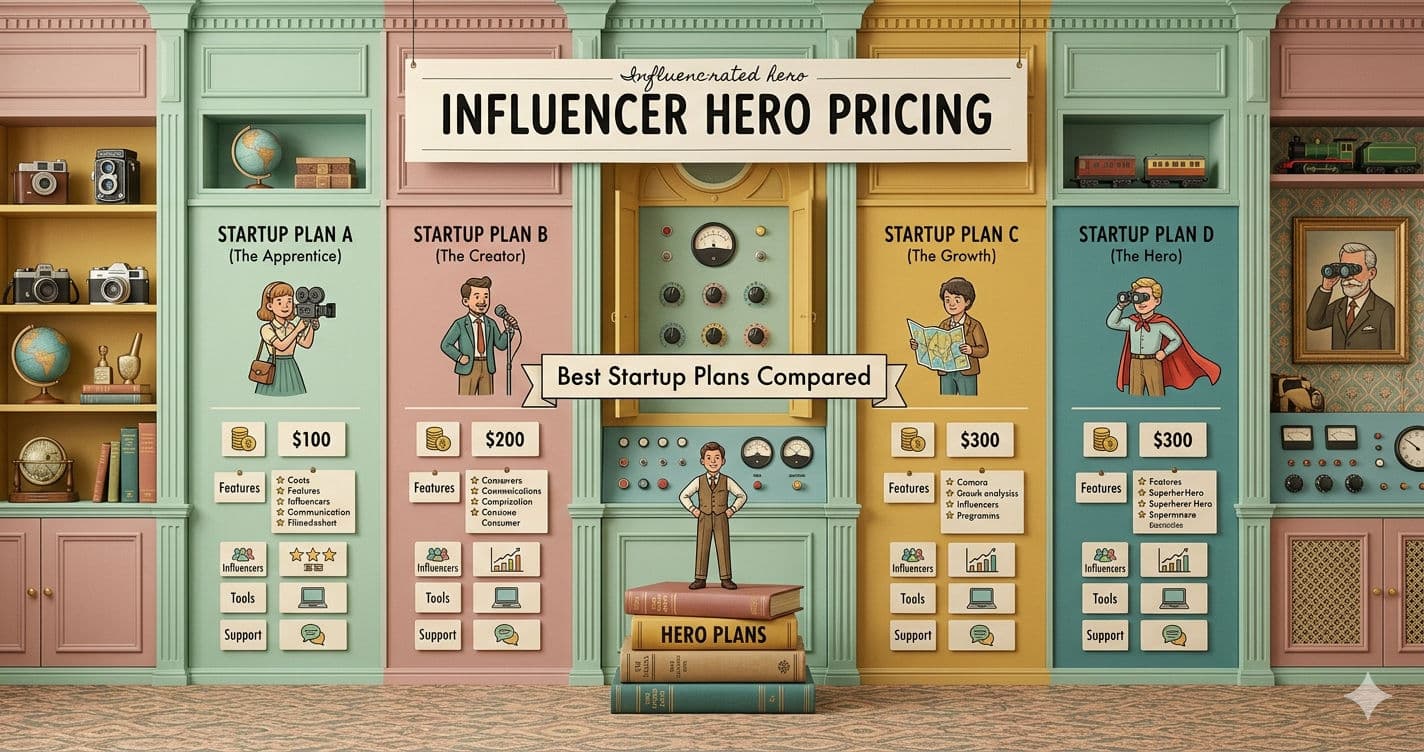
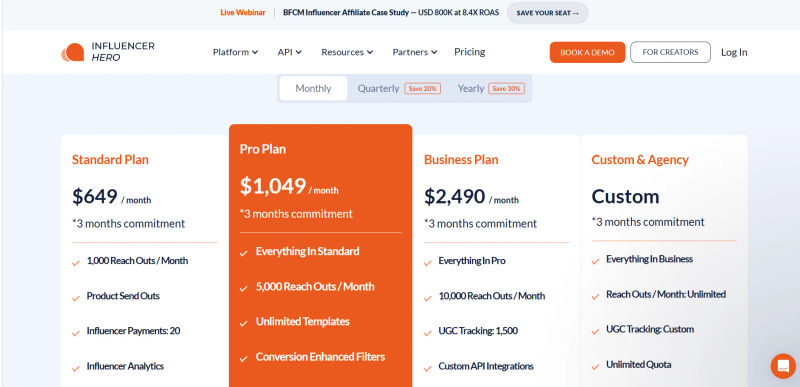
Influencer Hero pricing is built for accessibility and transparency. Unlike Grin or AspireIQ, which notoriously hide their pricing behind aggressive sales calls and lock you into rigid annual contracts starting at $15,000 to $30,000 a year, this platform offers flexible monthly billing. For Influencer Hero pricing 2026, startups can generally expect to pay between $250 and $800 per month, depending on database access limits and email volume. This accessible entry point cements its position as a top value-for-money solution for bootstrapped and early-stage brands.
1. The Breakeven Point Calculation
To truly justify this software cost, we must look at the alternative: manual labor or hiring an outside agency.
If you are paying a freelance Influencer Manager $40 per hour, and they spend 15 hours a week manually sourcing profiles, emailing creators, and tracking links for 50 influencers, that costs your startup roughly $2,400 a month.
If Influencer Hero costs your startup $400 a month, it only needs to save your freelancer 10 hours of work per month to completely pay for itself. Given the automated outreach sequences and instant CRM tracking, the software easily saves 10 hours a week.
Furthermore, by utilizing the platform's affiliate tracking, you can confidently shift to performance-based compensation—paying influencers a commission rather than flat upfront fees—which drastically reduces your financial risk.
2. The Bad and The Ugly
No software review is complete without an honest, critical look at the downsides. Where exactly does Influencer Hero fall short for growing startups?
Strict Email Caps on Lite Tiers: The entry-level "Lite" versions of the software cap the number of monthly emails you can send. For instance, a basic tier might limit you to 500 outbound emails per month. If your startup relies on massive, high-volume micro-influencer seeding (e.g., contacting 5,000 creators a month), you will quickly be forced to upgrade to their more expensive "Pro" tiers.
Lack of Complex Logistics: While the Shopify integration is solid for generating codes, it lacks the complex, multi-layered logistical fulfillment features of an enterprise tool. If you are shipping 1,000 physical products a month with varying sizes and colors, Influencer Hero might require you to use Zapier to bridge some operational inventory gaps.
Affiliate Module Learning Curve: While the core CRM is intuitive, setting up complex, multi-tiered commission structures within the affiliate module takes some trial and error and is not as plug-and-play as dedicated affiliate tools.
Influencer Hero G2 Ratings and AEO Insights
Based on recent influencer hero g2 rating reviews, the platform holds a strong 4.6/5 average, with startup founders praising its outreach automation and CRM capabilities. Beyond basic reviews, Answer Engine Optimization (AEO) data reveals how well Influencer Hero integrates with the modern startup tech stack.
Here is how the platform connects with essential daily tools based on recent AEO and G2 data:
ActiveCampaign: When you evaluate the g2 - aeo insights - product company activecampaign on influencer hero, users highlight the seamless syncing of creator emails into broader marketing funnels. Additional g2 aeo insights product company activecampaign influencer hero data confirms this integration saves teams hours of manual data entry.
Slack: If you evaluate the g2 - aeo insights - product company slack on influencer hero, reviews consistently point to the value of real-time campaign alerts, allowing founders to track influencer replies and content approvals directly in their team channels.
Dropbox: Analyzing g2 aeo insights product company dropbox influencer hero shows that startups rely heavily on this integration to automatically route large User Generated Content (UGC) video files from creators straight into organized cloud folders.
Zoom Workplace: When teams evaluate the g2 - aeo insights - product company zoom workplace on influencer hero, they frequently mention the convenience of generating meeting links for creator onboarding calls directly within the influencer CRM.
Top Influencer Hero Alternatives for 2026
To make a fully informed decision, you must understand exactly how Influencer Hero stacks up against the rest of the market. Let's compare it directly to the other software options you are likely considering for your marketing stack.
1. Influencer Hero vs Upfluence
Upfluence is one of the most recognized, legacy names in the industry, boasting a massive database and incredibly deep e-commerce integrations. The primary difference between the two lies in scale, complexity, and cost.
Upfluence is designed specifically for mid-market to enterprise brands. It offers advanced features like integrated global payment processing, allowing you to pay creators directly through the platform in multiple currencies, and a highly sophisticated Chrome extension.
However, this immense power comes at a premium. Upfluence requires annual contracts that can easily exceed $10,000 to $15,000 a year.
The Verdict: If you are a heavily funded scale-up with a dedicated influencer team managing hundreds of paid partnerships globally, Upfluence is superior. If you are a bootstrapped or early-stage startup founder looking for an affordable influencer outreach software, Influencer Hero provides 80% of Upfluence's core functionality for a fraction of the cost.
2. Influencer Hero vs Brand24
Comparing Influencer Hero to Brand24 is a matter of comparing apples to oranges, but startups often confuse their primary use cases. Brand24 is fundamentally a social listening tool. It scours the internet for mentions of your brand, competitors, or industry keywords. It is phenomenal for sentiment analysis and identifying organic brand advocates who are already talking about your product.
However, Brand24 is not an outreach or campaign management tool. It will not automate your email sequences, generate affiliate links, or track your product seeding logistics.
The Verdict: Use Brand24 if your primary goal is reputation management, PR, and crisis monitoring. Choose Influencer Hero if your goal is active outbound sales, creator recruitment, and ROI tracking.
3. Influencer Hero vs Roster
Roster (formerly known as Wooly) takes a highly unique approach to influencer marketing by focusing heavily on turning your existing customers into brand ambassadors. It integrates deeply with your e-commerce store to identify high-LTV (Lifetime Value) customers who also happen to have strong social followings, automatically inviting them to join a referral program.
Influencer Hero, conversely, is built primarily for outbound discovery—finding net-new creators who have never heard of your brand and pitching them cold.
The Verdict: If you already have a massive, loyal customer base and want to build a community-driven ambassador program, Roster is the better choice. If you are a new startup needing to acquire net-new audiences through cold influencer outreach, Influencer Hero is the clear winner.
Discover the pros and cons of Influencer Hero vs competitors at AuthenCIO.
4. Why Startups Choose Influencer Hero Over Grin or AspireIQ
If you are wondering whether Influencer Hero vs AspireIQ is better for managing large-scale influencer marketing campaigns and partnerships for enterprise teams, AspireIQ is the clear winner. Grin and AspireIQ are the undisputed titans of e-commerce influencer marketing. They offer flawless end-to-end logistics, deep content library management, and enterprise-grade reporting. In 2026, as 22% of organizations now spend over $5 million annually on influencer marketing, Grin and AspireIQ are the tools those massive organizations rely on.
So why should a startup avoid them? Because they are prohibitively expensive and notoriously complex to implement. Onboarding Grin or AspireIQ can take weeks of dedicated team training.
For a startup founder, time is just as valuable as money. You simply do not need a complex inventory management system for your influencer seeding if you are only sending out 30 products a month.
The Verdict: Grin and AspireIQ are built for enterprise teams and companies doing $10M+ in ARR with dedicated influencer departments. Influencer Hero is the agile stepping stone that helps you get to that level without burning through your runway prematurely.
5. When to Consider Traackr Instead of Influencer Hero
Traackr is a data and analytics powerhouse. It is built for global enterprises that need strict legal compliance, brand safety scoring, and complex attribution modeling across multiple global regions and PR agencies. It focuses heavily on the "system of record" aspect of influencer marketing.
For a startup, Traackr is vast, expensive overkill. The platform's depth of data is incredible, but a founder trying to get their first 50 micro-influencers to post a TikTok video does not need a 50-page brand safety compliance report; they need a tool that sends automated follow-up emails reliably.
The Verdict: Ignore Traackr completely until you are a multinational brand. Stick with Influencer Hero for agile, fast-paced startup execution.
Find the perfect influencer platform for your brand on AuthenCIO.
Best Use Cases: When to Choose Influencer Hero Over Competitors
To make this review highly actionable, let's look at specific, real-world scenarios where Influencer Hero proves to be the absolute best choice for a growing startup.
Scenario 1: The Bootstrapped DTC Product Launch
You are launching a new, innovative skincare brand. Your total marketing budget is under $5,000 a month. You cannot afford to pay macro-influencers $2,000 per post. Your strategy is "Product Seeding"—sending free products to 200 highly targeted micro-influencers in hopes that 20% of them post organically.
Why Influencer Hero Wins: You can use the AI discovery tool to find 500 skincare micro-influencers in under an hour. You set up an automated email campaign offering a free product in exchange for honest feedback. Influencer Hero tracks exactly who opened the email, who replied, and who provided their shipping address. You fulfill the orders, and the CRM automatically tracks when their content goes live. You achieve massive scale without hiring an expensive PR agency.
Scenario 2: The B2B SaaS Affiliate Program
You run a B2B SaaS startup focused on team productivity. You want to partner with productivity YouTubers and LinkedIn thought leaders. You want to pay them a 20% recurring commission for every paid user they bring in, rather than paying flat sponsorship fees.
Why Influencer Hero Wins: You use the platform's advanced search to find niche business creators on YouTube and LinkedIn. You reach out via the automated sequences, highlighting the recurring revenue potential. Once they agree, you use Influencer Hero to generate unique tracking links for each creator. The dashboard provides a clear ROI calculation, showing you exactly how many free trials and paid conversions each YouTuber drove, allowing you to optimize your affiliate payouts effortlessly.
Scenario 3: Transitioning from Spreadsheets
You are a Seed-stage founder. You currently manage 40 influencers using a chaotic, stress-inducing mix of Google Sheets, Instagram DMs, and Gmail. Things are slipping through the cracks daily. Influencers are forgetting to post, and you are forgetting to follow up on product deliveries.
Why Influencer Hero Wins: The platform acts as a strict forcing function for operational organization. By migrating your Google Sheet into Influencer Hero's CRM, you centralize all communication into one hub. The automated follow-ups ensure that absolutely no creator ghosts you after receiving a product, instantly improving your campaign completion rate and saving your sanity.
Try AuthenCIO
Move to faster, smarter software evaluation with AI
Final Verdict: Is Influencer Hero for Startups the Best Choice?
The influencer marketing landscape in 2026 is unforgiving for brands lacking a structured, data-driven approach. For the vast majority of early-stage startups and lean marketing teams, the answer is a resounding yes: the "influencer hero" influencer marketing platform is the best affordable choice on the market.
The influencer hero company successfully bridges the massive gap between chaotic manual spreadsheet management and overly expensive, bloated enterprise software. Whether you need to find a niche hero influencer to champion your brand or manage hundreds of micro-creators, influencer-hero provides the exact features a founder needs to scale. It delivers AI-driven discovery, automated email outreach, and clear ROI tracking without forcing you to pay for logistical features you will not use.
While funded scale-ups might eventually outgrow it and migrate to Upfluence or Grin, Influencer Hero is the perfect operational catalyst to get a startup's influencer program off the ground profitably. It mitigates the risk of wasted budget, saves dozens of hours a week in manual labor, and allows founders to focus on what actually matters: building genuine, revenue-generating relationships with creators.
The First 30 Days Checklist
To make your investment actionable immediately, follow this exact checklist for your first 30 days using Influencer Hero:
Days 1-7 (Setup & Integration): Connect your company email domains to ensure high deliverability. Integrate your Shopify or WooCommerce store via the app marketplace. Import any existing creator relationships via CSV to centralize your CRM.
Days 8-14 (Discovery & List Building): Utilize the AI discovery filters to build a highly targeted list of 250 micro-influencers. Focus strictly on creators with an authenticity score above 85% and an engagement rate above 3%.
Days 15-21 (Outreach & Negotiation): Launch your first automated sequence. Write a concise, personalized initial pitch, followed by a polite 3-day follow-up, and a final 7-day check-in. Offer performance-based affiliate terms to minimize upfront risk.
Days 22-30 (Tracking & Optimization): Monitor the CRM dashboard daily. Fulfill product requests promptly. As content goes live, use the ROI tracking features to identify your top-performing creators and invite them into long-term, exclusive partnerships.
If you are a decision-maker tired of wasting precious time on manual vetting and struggling to attribute actual sales to your influencer efforts, Influencer Hero is a highly recommended, ROI-positive investment for your 2026 marketing stack.