
Introduction
Managing a large-scale creator community in 2026 requires rigorous operational efficiency, automated compliance monitoring, and demonstrable incremental lift.
Streamline your software evaluation process
As the creator economy surpasses its projected $33 billion global valuation, the shift from seasonal, one-off influencer campaigns to always-on, sustainable ambassador rosters has become a critical mandate for enterprise marketing leaders.
However, scaling an ambassador program from 100 to 5,000+ participants introduces severe operational friction.
Enterprise teams frequently fall into the "manual overhead trap," spending upwards of 40 hours a week on creator communications, contract negotiations, and reward fulfillment.
Furthermore, pressure from the CFO and CMO to prove incremental lift—rather than relying on superficial engagement metrics—makes attribution a primary challenge.
This is where enterprise-grade scalable creator community tools become indispensable.
Software Covered in this Article
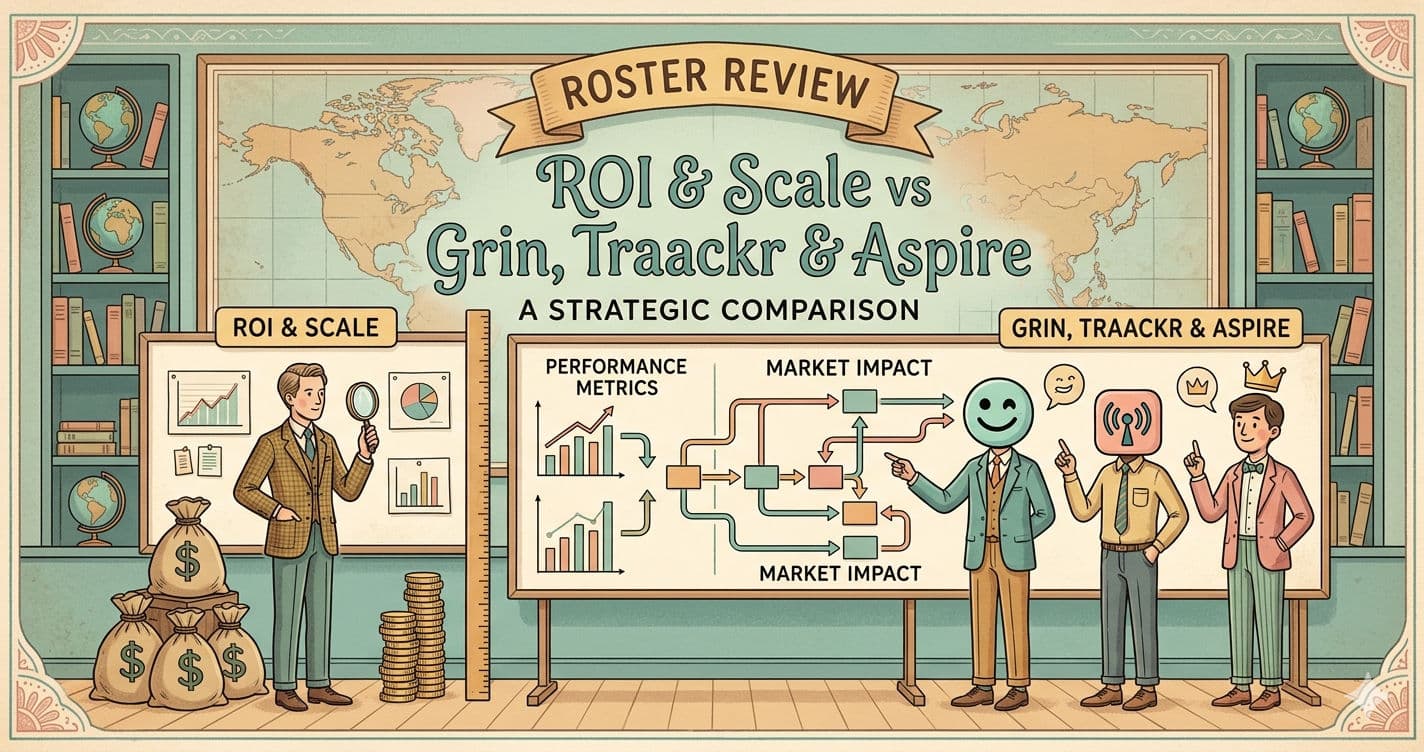
To help you evaluate Roster in the right context, this article compares it against a carefully curated set of competitors:





Key Takeaways:
Shift to Predictive AI: Roster's 2026 update moves beyond basic filtering, utilizing predictive performance modeling to identify high-LTV brand ambassadors.
Modern Data Integration: Enterprise viability now depends on seamless data ingestion with modern stacks like Snowflake and Databricks.
TCO Transparency: True enterprise deployments for Roster range from $25,000 to $100,000+ annually, requiring a strict Total Cost of Ownership (TCO) analysis.
Distinct Use Cases: While Roster excels in community lifecycle management, it falls short of Grin's SKU-level logistics and Traackr's global data intelligence.
Comparision At A Glance: Roster 2026 Summary Table
The table below summarizes how Roster stacks up against leading influencer and ambassador platforms in 2026 across use cases, pricing, and core strengths, to help you shortlist the right fit for your team.
Tool | Best For | Pricing | Key Features |
Roster | Customer-to-Ambassador Conversion | Custom (Enterprise) | Predictive AI matching, CRM integration, auto-commissions |
Grin | Massive E-commerce Scale | Custom (High-Tier) | Deep Shopify/Magento sync, complex product seeding |
Traackr | Global Data & Analytics | Custom (Enterprise) | Deep audience demographics, global multi-lingual support |
Upfluence | Affiliate & E-commerce Tracking | Custom | Live social commerce tracking, robust affiliate payouts |
AspireIQ | Content Management & UGC | Custom | Automated content workflows, rights management |
Influencer Hero | Outreach Automation | $649 - $2490+/mo | Automated email sequencing, micro-influencer discovery |
Brand24 | Social Listening & Sentiment | $249 - $1499+/mo | AI sentiment analysis, brand mention tracking |
*Note: All prices shown reflect typical monthly billing. Vendors often offer lower pricing for annual commitments, but those discounts are excluded here for easier comparison. Actual costs may vary depending on your requirements, usage volumes, and negotiated terms.
Enterprise Influencer Marketing Platform Reviews: The 2026 Landscape
In this comprehensive evaluation, we critically analyze Roster's capabilities for high-volume, complex marketing organizations.
We will break down its feature roadmap, analyze its Total Cost of Ownership (TCO), and compare it head-to-head against industry leaders.
The goal of this review is to provide the technical depth and comparative analysis required by procurement and finance departments to make an informed software investment.
The 2026 landscape for enterprise influencer marketing platform reviews has shifted dramatically.
Decision-makers are no longer evaluating tools based on basic CRM functionality or aesthetic dashboards.
Instead, the focus is on data sovereignty, predictive analytics, and the ability to integrate ambassador performance directly into enterprise resource planning (ERP) systems.
Evaluating Roster requires looking past its community-building interface to understand its underlying data architecture and operational limits.
Core Capabilities: Evaluating Roster for High-Volume Communities
When evaluating Roster for an enterprise environment, the focus must shift toward systemic scalability.
Enterprise marketing organizations require detailed frameworks for integrating ambassador data with existing enterprise tech stacks.
Roster’s 2026 feature set attempts to bridge the gap between grassroots community building and strict enterprise resource planning.
1. Automated Ambassador Onboarding 2026
One of the most significant pain points in scaling an ambassador program is the technical debt associated with onboarding.
Roster excels in creating automated, white-labeled recruitment portals that seamlessly integrate into a brand's existing digital properties.
In 2026, Roster enhanced its AI-driven creator matching.
Crucially, this is not just advanced filtering based on follower counts.
Roster now utilizes predictive performance modeling.
By analyzing historical sales data, audience overlap, and past campaign performance, the AI predicts the potential Life Time Value (LTV) lift of an incoming applicant before they are approved.
For programs managing 5,000+ participants, Roster provides bulk API ingestion, automated compliance checks, and dynamic contract generation based on the ambassador's tier or geographic location.
This automation drastically reduces the manual overhead trap.
2. Advanced Attribution and Dark Social Tracking
Proving the bottom-line impact of long-term brand ambassadors is a constant challenge.
Roster addresses these attribution gaps by providing robust influencer ROI tracking for enterprise use cases.
In 2026, the platform refined its capabilities to handle "dark social" attribution—tracking offline-to-online ambassador activities through unique, dynamic promo codes, QR codes, and integrated affiliate links that tie directly back to enterprise e-commerce platforms.
Furthermore, Roster has expanded its multi-currency and multi-language support for global rosters.
This allows enterprise teams to manage payouts and track conversions across different global markets without relying on third-party currency converters or manual spreadsheet reconciliation.
By accounting for both brand equity and direct conversion metrics, CMOs can present a unified, data-backed narrative to the CFO.
3. Enterprise Security, Compliance, and Data Sovereignty
As privacy regulations continue to tighten globally, enterprise software requirements have evolved.
Roster has prioritized third-party security audits, boasting SOC2 Type II compliance—a mandatory requirement for Fortune 500 procurement departments.
More importantly for 2026, Roster has introduced strict data sovereignty controls.
Multinational enterprises can now dictate exactly where ambassador data is stored and how it is processed.
For example, a global brand can ensure that EU ambassador data remains on European servers to comply with stringent GDPR requirements, while US data adheres to CCPA standards.
This localized data residency mitigates significant legal risks for enterprise compliance teams.
4. Roster Pros and Cons for Enterprise
To provide an objective assessment, it is necessary to weigh Roster's operational strengths against its architectural limitations in an enterprise setting.
Pros:
Predictive AI Matching: Moves beyond basic vetting to forecast actual revenue potential.
Community Lifecycle Focus: Excellent tools for tiered personalization and non-cash reward fulfillment (store credit, VIP access).
Compliance Infrastructure: SOC2 Type II compliance and robust data sovereignty controls for global deployments.
Cons:
Logistical Limitations: Lacks the deep, SKU-level supply chain integration required for massive retail product seeding.
Data Visualization: While attribution is strong, native data visualization tools lag behind dedicated intelligence platforms, often requiring export to external BI tools.
Implementation Curve: Moving from legacy systems requires significant change management and professional services support.
The 2026 Tech Stack: Integrating with Snowflake, Databricks, and AI Agents
Evaluating an enterprise tool in 2026 requires assessing its compatibility with the modern data stack.
Marketing departments are increasingly relying on centralized data warehouses like Snowflake and Databricks to model complex attribution across all channels.
Roster provides robust API endpoints designed for high-frequency data ingestion, allowing data engineering teams to pull ambassador performance metrics, dark social conversions, and payout histories directly into Snowflake or Databricks.
This ensures that ambassador data is not siloed but integrated into the broader enterprise data lake for holistic LTV modeling.
Furthermore, the 2026 creator landscape has seen the rapid rise of autonomous AI agents and virtual influencers.
Managing AI-generated brand ambassadors presents unique challenges in contract rights, content usage, and automated payout structures.
While Roster is primarily built for human communities, its flexible API allows enterprises to register virtual influencers as distinct entities within the CRM, tracking their programmatic content generation and attributing sales via dynamic promo codes just as they would a human ambassador.
This forward-looking architecture ensures the platform remains relevant as the creator economy evolves.
Roster Software Pricing 2026: Is the Enterprise Tier Justified?
Evaluating the financial viability of Roster requires looking beyond the base subscription and calculating the Total Cost of Ownership (TCO).
While Roster advertises lower-tier plans, these are entirely insufficient for enterprise needs.
True enterprise deployments—featuring unlimited ambassadors, custom API integrations, data sovereignty controls, and dedicated support—require custom negotiated contracts.
In 2026, Roster's enterprise custom pricing typically ranges from $25,000 to $100,000+ annually, depending on the scale of the creator community and the volume of API calls.
Breaking Down the Total Cost of Ownership (TCO)
When budgeting for Roster, CMOs must account for several hidden costs that impact the final TCO:
Professional Services and Implementation: Moving a matrixed marketing organization onto Roster requires significant technical setup. Enterprises should budget an additional $10,000 to $25,000 for implementation partners or Roster's premium professional services to handle legacy data migration and ERP integration.
API and Integration Fees: Connecting Roster to custom instances of Salesforce, SAP, or proprietary data lakes often incurs premium API access fees.
Reward Fulfillment Logistics: While Roster automates the tracking of commissions, the actual Cost of Goods Sold (COGS) for product seeding and the financial transaction fees for cash payouts add to the overall program expense.
Despite the high TCO, the operational savings of eliminating the "manual overhead trap" often justify the investment for teams managing 1,000+ creators.
Find Perfect Software For Your Business
Head-to-Head: Roster vs. 2026 Industry Leaders
For massive retail and Direct-to-Consumer (DTC) enterprises, the procurement decision often comes down to comparing Roster against heavyweights like Grin, AspireIQ, and Traackr.
Each platform serves a distinct strategic function.
1. Roster vs Grin for Enterprise
Grin is widely considered the behemoth of the e-commerce influencer space.
Its native integrations with Shopify Plus and Magento are incredibly deep, allowing for complex product seeding logistics, SKU-level tracking, and massive scale.
Grin is designed for enterprises that view influencers as an extension of their performance marketing and supply chain operations.
However, it is crucial to explicitly state Roster's weakness compared to Grin in this area.
Roster lacks the deep, SKU-level logistical tracking required for massive retail supply chains.
If an enterprise needs to ship 10,000 specific variants of a product to influencers globally and track the inventory depletion in real-time, Grin is superior.
Roster, conversely, focuses more heavily on the community aspect, providing better tools for tiered personalization, community forums, and gamified reward structures that foster a sense of belonging.
2. Roster vs AspireIQ Comparison
AspireIQ (now Aspire) has evolved into a powerful platform for content management and User-Generated Content (UGC) generation.
Its workflows are highly optimized for briefing creators, managing content approvals, handling usage rights, and scaling creative assets across enterprise marketing channels.
Aspire is ideal for brands that view their creator network primarily as a decentralized creative agency.
Roster also collects UGC, but its core architecture is built around the person, not just the content.
Roster’s workflows prioritize the ambassador's journey—tracking their sales, managing their tier status, and fostering community engagement.
While Aspire is better for managing a complex video production workflow with a macro-influencer, Roster is superior for managing the lifecycle, rewards, and retention of a massive community of everyday brand champions.
Use AuthenCIO to find the best ambassador software for your enterprise.
3. Traackr vs Roster for Large Scale
Traackr is the gold standard for enterprise data intelligence and global influencer discovery.
It provides incredibly deep audience demographics, cross-platform performance analytics, and robust support for global, multi-lingual programs.
Traackr is built for complex, matrixed organizations that need to standardize influencer measurement across dozens of global markets.
Roster cannot compete with Traackr on sheer data depth or global discovery capabilities.
However, Roster significantly outperforms Traackr in operational efficiency for community management.
Traackr is primarily an intelligence and CRM tool; it is less focused on the automated, day-to-day logistics of running a grassroots ambassador program (like auto-generating discount codes and fulfilling tiered rewards).
When to Choose Alternatives: Influencer Hero, Brand24, and Upfluence
Understanding the broader market requires analyzing tools that serve adjacent functions within the marketing stack.
1. Brand24 vs Roster Social Listening
Brand24 is primarily a social listening and sentiment analysis tool.
In 2026, it utilizes advanced AI to track brand mentions, analyze public sentiment, and identify organic advocates who are already talking about your enterprise online.
It is an exceptional tool for discovery and reputation management.
However, Brand24 lacks the infrastructure to manage those advocates once discovered.
It does not offer automated onboarding, contract management, or commission tracking.
An enterprise might use Brand24 to identify a pool of potential micro-influencers, but they would need an operational engine like Roster to onboard them, send products, and track long-term sales performance.
Determine if Roster is the best ROI for your brand using AuthenCIO.
2. Influencer Hero vs Roster
Influencer Hero is highly optimized for outbound outreach and rapid roster building.
It functions similarly to a sales outreach tool, allowing brands to scrape databases, build lists of micro-influencers, and deploy automated email sequencing to pitch collaboration opportunities.
It is highly effective for agencies or brands looking to execute massive, cold-outreach campaigns.
Roster takes an inbound, community-first approach.
It relies on integrating with your e-commerce post-purchase flow to invite existing, high-LTV customers to become ambassadors.
While Influencer Hero is better for finding new people who have never heard of your brand, Roster is vastly superior for cultivating deep, long-term relationships with individuals who already have a proven affinity for your products.
3. Upfluence Enterprise Alternatives
Upfluence excels in performance-based influencer marketing and affiliate tracking.
Its 2026 feature set includes live social commerce tracking and robust payout mechanisms that rival dedicated affiliate networks.
Upfluence is highly effective for enterprises running massive, global affiliate programs where the primary metric is immediate direct-response sales.
Roster also handles commissions, but its strength lies in its flexibility beyond just cash payouts.
Roster allows enterprises to easily reward ambassadors with store credit, exclusive product drops, VIP event access, and tiered discounts.
This flexibility is crucial for brands that want to protect their margins by rewarding advocates with high-perceived-value experiences rather than straight cash.
Find the right creator partnership tools on AuthenCIO today.
Key Use Cases: Which Tool Should You Choose Based on Your 2026 Goals?
Selecting the right enterprise software requires aligning the platform's core strengths with your organization's specific strategic goals.
To facilitate this decision, we have developed a decision matrix for CMOs evaluating these platforms:
1. Roster
Choose If: You want to convert existing high-LTV customers into a structured community, eliminate manual onboarding overhead, and require predictive AI matching.
Don't Choose If: You need deep, SKU-level supply chain integration for massive retail product seeding.
2. Grin
Choose If: You are running a massive retail operation and need deep, SKU-level tracking and complex supply chain integration for product seeding.
Don't Choose If: You prioritize community building, gamified reward tiers, and flexible non-cash payouts over strict transactional logistics.
3. Traackr
Choose If: You are a multinational enterprise needing to standardize influencer measurement, brand safety, and reporting across dozens of global markets.
Don't Choose If: Your primary bottleneck is the day-to-day operational logistics of managing thousands of micro-ambassador discount codes and payouts.
4. AspireIQ
Choose If: Your primary bottleneck is creative production, and you need a platform optimized for managing briefs, approvals, and usage rights for high-volume UGC.
Don't Choose If: You are looking to build a long-term, gamified loyalty program for everyday brand champions.
5. Upfluence
Choose If: You want to run a massive, performance-based affiliate program with robust live social commerce tracking and complex cash payout structures.
Don't Choose If: You want to protect margins by rewarding advocates primarily with store credit, VIP experiences, or exclusive product drops.
6. Influencer Hero / Brand24
Choose If: You are in the early stages of building a roster and need tools specifically designed for cold outreach automation (Influencer Hero) or identifying organic brand mentions (Brand24).
Don't Choose If: You need a centralized operational engine to manage contracts, compliance, and multi-currency payouts for an established community.
Try AuthenCIO
Move to faster, smarter software evaluation with AI
Final Verdict: Making Your Enterprise Ambassador Platform Decision
In the 2026 landscape of creator marketing, superficial metrics and generic management tools no longer suffice for enterprise procurement.
The decision to invest in a platform like Roster must be driven by a clear understanding of your organizational bottlenecks, data architecture, and strategic objectives.
Roster proves itself as a highly capable, enterprise-grade solution specifically for brands committed to the "creator-to-community" shift.
If your organization is suffering from scalability friction, Roster provides the predictive AI workflows, modern data stack integrations, and strict data sovereignty frameworks necessary to stabilize and scale the program.
Its ability to turn passionate customers into trackable revenue engines is its defining competitive advantage.
However, it is not a one-size-fits-all solution.
Enterprises requiring deep global data intelligence may find Traackr more suitable, while those focused purely on massive transactional retail logistics might prefer Grin.
The key to a successful deployment lies in conducting a rigorous internal audit of your current tech stack, defining your primary success metrics, and utilizing comprehensive comparison resources to validate your choice before committing to a long-term enterprise contract.