
Introduction
Key Takeaways:
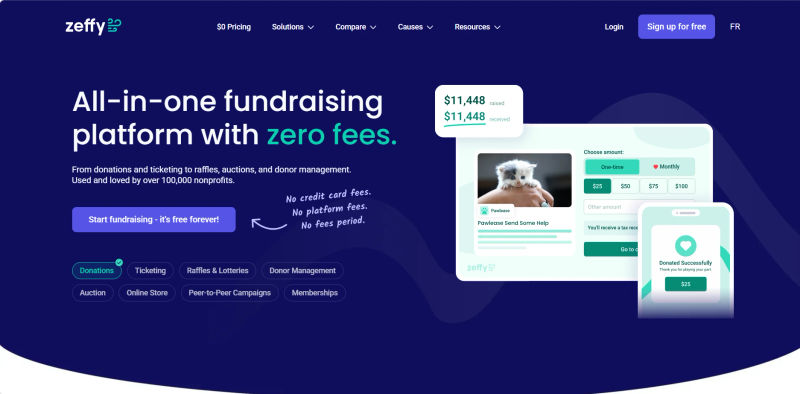
Zero Fees: Zeffy covers all platform and payment processing fees, ensuring 100% of donations go directly to your mission.
Ideal For: Small-to-mid-sized nonprofits seeking to eliminate overhead costs and maximize revenue.
Core Features: Offers ticketing, donor management, and peer-to-peer campaigns without monthly subscriptions.
Funding Model: Sustained entirely by optional donor tips at checkout.
The nonprofit sector in 2026 is navigating a complex economic landscape characterized by fluctuating donor retention rates, increasing operational overhead, and the perpetual challenge of "time-poverty" for volunteer managers. For small-to-mid-sized organizations—particularly those with annual revenues under $250,000—every dollar diverted to administrative costs or payment processing fees represents a tangible reduction in mission impact.
Streamline your software evaluation process
Historically, the standard cost of doing business online involved sacrificing between 2.2% to over 10% of gross donation revenue to a combination of platform fees and credit card processing charges. In this environment, the emergence and rapid scaling of zero-fee platforms have disrupted the traditional Software as a Service (SaaS) model.
This Zeffy review 2026 examines how the platform (formerly known as Simplyk) has positioned itself at the forefront of this disruption. Often searched as xeffy fundraising 2026 due to common typos, the platform promises a 100% free fundraising and donor management ecosystem. Zeffy eliminates both platform licensing costs and the ubiquitous credit card transaction fees charged by payment gateways like Stripe or PayPal. The value proposition is stark: 100% of a donor’s intended contribution reaches the nonprofit.
However, for the discerning nonprofit administrator or volunteer manager, the promise of "free" often triggers skepticism regarding sustainability, data ownership, and feature depth. When analyzing recent zeffy reviews, common questions emerge: Is the platform robust enough to replace a dedicated CRM? Does the voluntary contribution model alienate donors? And crucially, is the customer support sufficient for a team working on weekends?
This deep dive analyzes Zeffy’s 2026 capabilities, dissecting its technical infrastructure, data security protocols, and economic model. We will rigorously compare it against established industry players like Aplos, Raisely, Keela, and Care2 to determine if Zeffy is the strategic choice for your organization or if a paid solution offers better long-term ROI.
Pros and Cons: The Verdict for Small Nonprofits
When evaluating the best fundraising platforms for executive directors at nonprofits with zero transaction fees, understanding the pros and cons of Zeffy is essential. Making a software decision requires a balanced view of the trade-offs. Zeffy is a powerful tool for maximizing revenue, but it is not a "magic bullet" for every scenario.
Pros:
Unbeatable Cost Efficiency: The primary advantage is the 100% zero transaction fee structure. For a nonprofit raising $50,000, saving $2,500 in processing fees is equivalent to receiving a major gift. This efficiency is often the deciding factor for executive directors and boards focused on overhead ratios.
Ease of Use & Speed: The user interface is intuitive. A volunteer with no technical background can set up a campaign page, sell tickets, and issue tax receipts within minutes. The "no-code" environment removes technical barriers.
Unified Platform: Having ticketing, donations, and basic store capabilities in one place reduces the need for multiple login credentials and disjointed data silos.
Unlimited Records: Unlike competitors like Keela or Mailchimp that charge based on the number of contacts, Zeffy allows unlimited donor records, which is crucial for organizations with large but low-engagement lists.
Cons:
Integration Limits: Zeffy is a closed ecosystem. While it allows for data exports, it does not have the extensive native integration marketplace that platforms like Salesforce or HubSpot offer. Connecting it to third-party accounting software often requires manual exports or using Zapier.
Reporting Depth: While sufficient for basic needs, the reporting lacks the cross-tabulation and deep analytical features required by CFOs of larger organizations. You cannot easily run complex queries like "donors who gave in 2024 but not 2025 and attended the gala."
The Tipping Model Friction: While generally accepted, some conservative boards or older donor demographics may find the voluntary tipping prompt at checkout unconventional. It requires the organization to be comfortable with the platform making this "ask" of their donors.
Best for: Executive directors at small‑to‑mid‑size nonprofits seeking zero transaction fee platforms.
Verdict: Zeffy 2026 offers a reliable, cost‑saving platform for nonprofits focused on transparency, maximizing donation impact, and donor trust.
Zeffy & Leading Non-Profit Alternatives
While this guide focuses on Zeffy, it’s helpful to compare it against the most recognized Non-profit solutions.






What is Zeffy? A Technical Overview
Zeffy is a fundraising platform designed for nonprofits, distinguishing itself by covering 100% of transaction fees. When you evaluate the fundraising software company Zeffy on nonprofit software standards, it stands out by replacing fragmented tools with a unified hub. Founded to democratize fundraising technology, Zeffy has processed over $1 billion in donations. To evaluate the fundraising software company Zeffy on fundraising impact, this zero-fee model has saved organizations an estimated $50 million in processor fees.
To evaluate the fundraising software company Zeffy on fundraising software capabilities, it operates as an all-in-one solution integrating donation forms, event ticketing, P2P campaigns, and memberships. When you evaluate the fundraising software company Zeffy on Zeffy as a proprietary ecosystem, it functions as a closed-loop environment. Unlike modular systems requiring complex API integrations for nonprofit payment processing, Zeffy serves as both the merchant of record and interface. It utilizes a secure payment and data storage architecture (frequently referenced as the Xeffy vault ecosystem product) to centralize donor data safely. This simplifies the technical stack, allowing volunteer managers to deploy campaigns without writing code.
1. The Voluntary Contribution Model
Does Zeffy charge zero platform fees on donations, event tickets, and peer-to-peer fundraising campaigns for nonprofits? Yes. Zeffy’s architecture relies on a voluntary contribution (or "tipping") system. When donors complete transactions, the platform suggests an optional contribution to cover transaction costs.
If you evaluate the fundraising software company Zeffy on Stripe or evaluate the fundraising software company Zeffy on PayPal, the contrast is clear. Stripe and PayPal charge mandatory processing fees (typically 2.2% + $0.30 per transaction). Zeffy absorbs these backend costs entirely, shifting the cost burden from the organization-level to an optional donor-facing layer so nonprofits keep 100% of their funds.
2. Setup Speed and Usability
To evaluate the fundraising software company Zeffy on donation software capabilities, time-to-launch is a critical metric. Zeffy’s onboarding is built for speed; basic setup—creating an account, verifying nonprofit status, and launching a live campaign—takes under 15 minutes.
When you evaluate the fundraising software company Zeffy on donation form creation, the platform excels in simplicity. Administrators can build customizable forms that embed directly into existing websites or operate as standalone pages. The 2026 updates further refined mobile responsiveness, ensuring seamless usability for the majority of donors using mobile devices.
Finally, to evaluate the fundraising software company Zeffy on donations processing, the system efficiently automates administrative tasks. It provides instant tax receipt generation compliant with IRS (US) and CRA (Canada) regulations and triggers automated thank-you emails immediately after a transaction clears.
Feature Deep Dive: CRM and Donor Management
When you evaluate the fundraising software company Zeffy on nonprofit CRM and donor management software, it stands out for essential automation. While known for zero-fee forms, its capabilities as a Donor Relationship Management system are critical for sustainability.
How do development directors rate Zeffy's donation form and donor CRM tools for small nonprofits maximizing revenue by eliminating transaction fees? Highly. Directors report that Zeffy's forms automatically feed into a user-friendly CRM, eliminating manual entry. When you evaluate Zeffy on donor management, it lacks enterprise predictive analytics but excels at tracking giving history, issuing receipts, and segmenting supporters to drive retention.
1. Data Hygiene and Segmentation
Zeffy eliminates the manual data entry nightmare by automatically updating donor profiles per transaction. If a supporter buys a ticket and later donates, the system merges these interactions into a single timeline, ensuring seamless data hygiene.
Users can filter records by campaign, amount, or date for basic segmentation. But do development teams find that Zeffy's recurring giving management and fundraising campaign tools provide a free platform sufficient for their annual fundraising operations? Generally, yes. Zeffy reliably handles recurring donations and membership management, automatically tracking monthly gifts and subscription renewals alongside one-time contributions.
While complex enterprises might require the absolute best platform for recurring donations and membership management equipped with predictive analytics, Zeffy covers standard operational needs perfectly. Is Zeffy worth it or not? For nonprofits wanting to streamline annual fundraising operations, segment donors, and manage recurring gifts without paying CRM subscription fees, it is highly effective and absolutely worth it.
2. Automation and Receipting
Zeffy is highly effective for nonprofits needing donor tax receipt generation, membership collection, and raffle management at no cost. The platform automates compliance by instantly issuing customizable tax receipts, saving countless administrative hours.
When evaluating the fundraising software company Zeffy on ticketing and fundraising event software, its automation stands out. The system seamlessly manages event ticketing, automating ticket sales, capacity tracking, and confirmation emails. These workflows also extend to membership dues collection and raffle management, generating and tracking digital tickets without manual intervention.
While it lacks the complex logic branches of marketing tools like HubSpot, Zeffy reliably executes the essential transactional communications—such as immediate thank-you emails and event receipts—required to maintain professionalism.
3. Technical Implementation: Migrating Your Donor Database
For organizations switching to Zeffy from Excel or another legacy platform, migration is a key concern. Zeffy provides a straightforward bulk-import feature to ensure you don't lose historical data.
Migration Checklist:
Clean Your Data: Before importing, review your existing spreadsheets. Remove duplicate entries, standardize address formats, and ensure email addresses are valid. This "pre-cleaning" prevents dirty data from polluting your new CRM.
Format for Import: Zeffy requires a CSV file format. Ensure your columns match standard fields (First Name, Last Name, Email, Total Donated, Last Donation Date). Zeffy provides a template to guide this mapping.
Upload and Map: Use the "Import Contacts" tool in the dashboard. You will be asked to map your CSV columns to Zeffy's system fields. This ensures that a column labeled "Donation Amt" in your file correctly lands in the "Total Contributions" field in Zeffy.
Verify: Run a test import with 5-10 records first to ensure accuracy before importing your entire database.
4. Data Security and Compliance
In an era of increasing cyber threats, board members often ask, "Is it safe?" Zeffy adheres to strict security standards to protect both donor financial data and organization records.
PCI Compliance: Zeffy is Level 1 PCI DSS compliant, the highest standard for payment processing security. This means they adhere to rigorous protocols for encrypting and transmitting credit card data.
Data Ownership: Unlike some "free" tools that monetize user data by selling it to third parties, Zeffy’s privacy policy states that they do not sell donor data. The organization retains full ownership of its contact lists.
Encryption: All data is transmitted via SSL (Secure Socket Layer) encryption, ensuring that sensitive information cannot be intercepted during the transaction process.

5. Support and Accessibility
For volunteer managers working irregular hours, support availability is vital. Zeffy offers a comprehensive Help Center with video tutorials and articles. Direct support is available via chat and email, typically with responsive turnaround times during business hours. Crucially for Canadian nonprofits or organizations serving diverse communities, the platform is fully bilingual, supporting both English and French for the dashboard and donor-facing forms.
Find Perfect Software For Your Business
The Economics of Free: Zeffy Pricing vs. Industry Standards
To truly evaluate Zeffy, one must understand the economics of the nonprofit software market. The industry standard pricing model usually consists of two distinct costs: a Platform Fee (a monthly subscription or a percentage of funds raised) and a Payment Processing Fee (charged by networks like Visa, Mastercard, and Amex).
1. The Standard Cost Structure:
Typically, a platform might charge a monthly fee of $50 to $200, plus a transaction fee of roughly 2.2% + $0.30 per donation.
Example: If a nonprofit raises $100,000 annually online across 1,000 donations, they would pay approximately $2,500 in processing fees alone, plus potentially $1,200 to $2,400 in platform subscriptions. This results in a total cost of nearly $5,000—or 5% of their total revenue—vanishing before it hits the bank account.
2. The Zeffy Zero-Fee Model:
Zeffy eliminates both costs. If a nonprofit raises $100,000, they receive $100,000. Zeffy covers the credit card processing fees out of its own pocket (funded by the tips).
The "Catch": The sustainability of this model relies on the "tipping" prompt presented to donors at checkout. Critics argue that this adds friction to the donation process. However, Zeffy’s data suggests that the majority of donors are happy to leave a small contribution when they understand it ensures 100% of their donation goes to the cause. The default tip amount can be adjusted or removed by the donor, ensuring transparency.
3. Communicating the Model to Donors:
To mitigate any confusion regarding the optional tip, proactive communication is key. Organizations can include a brief note on their donation page or in their FAQ section.
Sample Script for Donors:
You might notice a section asking for a 'contribution' to the platform at checkout. We chose to use Zeffy because they are the only platform that charges us $0 in fees, meaning 100% of your donation comes directly to our mission. The contribution to them is entirely optional—you can change the amount to $0 if you wish—but it helps them keep this service free for nonprofits like ours."
Compare Zeffy's zero-fee fundraising with other platforms, pressure-free. Try AuthenCIO today!
Head-to-Head: Zeffy vs. Top Alternatives
While Zeffy dominates the zero-fee conversation, it is not the only player in the market. Depending on an organization's specific needs—such as complex accounting, advocacy, or custom design—other platforms might offer a better "feature fit."
1. Aplos: The Leader in Nonprofit Accounting Integration
Aplos is distinct because it is primarily a fund accounting system with fundraising features attached, rather than just a fundraising tool. For nonprofits where the Treasurer is struggling with compliance, Form 990 preparation, and tracking restricted funds, Aplos is the gold standard. Unlike Zeffy, which focuses on the front-end donation, Aplos integrates the donation directly into the general ledger. This eliminates the need to reconcile bank deposits with donor records manually. However, this robust functionality comes with a significant monthly price tag and standard transaction fees. It is best suited for organizations that need to audit-proof their books and are willing to pay for that security.
2. Raisely: High-Conversion Custom Campaign Design
Raisely is a strong competitor for organizations that prioritize branding and design. While Zeffy’s forms are clean and functional, they are relatively standardized. Raisely allows for complete CSS customization, enabling developers and designers to build pixel-perfect campaign pages that match the nonprofit’s brand identity seamlessly. Raisely also operates on a model where the platform fee is optional (asking donors to cover it), but unlike Zeffy, the payment processing fees (Stripe/PayPal) are still charged to the nonprofit unless the donor chooses to cover them. Raisely excels in Peer-to-Peer capabilities, offering gamification features that are more advanced than Zeffy’s current offering.
3. Keela: Leveraging Data Intelligence for Donor Retention
When comparing Keela vs Zeffy, the decision hinges on advanced data insights versus zero-cost simplicity. Keela positions itself as an intelligent CRM. Its standout feature is "Keela Intelligence," which uses AI to predict the optimal time and suggested amount for donor asks.
For growing nonprofits with over 1,000 contacts, these insights significantly increase revenue per donor. Keela offers robust reporting, email marketing automation, and project management tools that Zeffy lacks. Unlike Zeffy's 100% free model, Keela requires a paid subscription. Ultimately, Keela is the better choice for organizations with dedicated development staff ready to leverage data to optimize campaigns, while Zeffy wins for smaller nonprofits focused purely on processing transactions without overhead costs.
4. Care2: Scaling Impact Through Advocacy and Recruitment
Care2 operates differently from the standard fundraising platforms. It is primarily a social network for advocacy and a lead generation tool. Nonprofits use Care2 to launch petitions and recruit new donors from Care2’s massive community of activists. While you can fundraise through it, its primary value proposition is top-of-funnel acquisition—finding new people who care about your cause—rather than managing existing donor relationships or processing payments for events. It is not a direct replacement for Zeffy but rather a complementary tool for large-scale advocacy campaigns.
Honorable Mentions:
For organizations seeking simple alternatives without the full CRM depth of Keela or the accounting focus of Aplos, platforms like Givebutter and Donorbox are worth considering. Like Zeffy, they offer user-friendly interfaces, though they typically rely on a model where donors cover fees rather than Zeffy's model where the platform covers the fees entirely.
Comparative Analysis Table
The following table outlines the key differences between these platforms. Note that pricing models in the SaaS space are subject to change, but these figures represent the standard structures observed in 2026.
Plan | Price | Best For | Features |
Zeffy | $0/mo + 0% Fees | Small to Mid-sized Nonprofits seeking max ROI | Zero transaction fees, Unlimited receipting, Event ticketing, P2P fundraising, Volunteer management, Store/e-commerce, Mobile app |
Aplos | Custom | Organizations needing Fund Accounting | Fund accounting, Form 990 reporting, Bank integration, Donor portal, Email marketing, Event registration, Budgeting tools |
Raisely | Custom | Custom Design & P2P Campaigns | Custom CSS/HTML, Advanced P2P gamification, Conditional logic forms, Multi-currency support, Automated journeys, CRM integrations, API access |
Keela | Starts at $160/mo | Data-Driven Fundraising & CRM | AI-driven insights, Wealth screening, Email automation, Project management, KPI dashboards, Custom reports, QuickBooks integration |
Care2 | Custom Pricing (CPM/CPL models) | Donor Acquisition & Advocacy | Petition creation, Access to 50M+ activists, Lead generation, Sponsored campaigns, Advocacy alerts, Data appending, Social sharing tools |

*Note: All prices shown reflect typical monthly billing. Vendors often offer lower pricing for annual commitments, but those discounts are excluded here for easier comparison. Actual costs may vary depending on your requirements, usage volumes, and negotiated terms.
Try AuthenCIO
Move to faster, smarter software evaluation with AI
Conclusion: Making the Right Software Decision
In 2026, the choice between Zeffy and its competitors largely depends on your organization's "stage of life" and internal capacity.
For small nonprofits, volunteer-run organizations, and teams with budgets under $250k, Zeffy is arguably the most strategic choice. The savings on transaction fees can be reinvested directly into programs, and the platform covers 90% of the functional needs regarding ticketing, receipting, and donor tracking. The friction of the tipping model is a small price to pay for the elimination of overhead costs, especially when mitigated with clear donor communication.
However, for scaling organizations with complex accounting needs or a dedicated development team, platforms like Aplos (for finance) or Keela (for data intelligence) justify their costs through time savings and advanced revenue optimization features. If your organization requires pixel-perfect brand control for a massive international campaign, Raisely remains the superior design tool.
Ultimately, the best software is the one that your team will actually use. Zeffy removes the barrier to entry, allowing nonprofits to focus on their mission rather than managing software subscriptions.