
Introduction
European online retailers face a critical challenge in 2026: balancing rising carrier surcharges, fluctuating fuel costs, and new regulations like the Carbon Border Adjustment Mechanism (CBAM) with the urgent need for scalable shipping automation. If you are evaluating Sendcloud as your logistics platform, you need to know exactly what you are paying for, what the hidden limitations are, and whether a competitor offers a better return on investment for your specific parcel volume.
Streamline your software evaluation process
Choosing the right shipping software is no longer just about printing labels; it is about automating customs documentation for post-Brexit trade, managing localized return portals, and routing orders to the most cost-effective carriers in real-time. This guide bypasses the marketing fluff to break down Sendcloud’s 2026 pricing tiers, expose hidden fees, and compare it directly against the top alternatives in the European market.
Your goal as a decision-maker is to choose a tool that protects your profit margins, not just browse software options. To help you evaluate pricing quickly, we have summarized the top shipping automation platforms in the market right now. Let's start with the hard numbers.
Plan | Best For | Pricing (USD $) | Primary EU Markets | Limitations |
Sendcloud | European mid-market scaling automation | Free, Starts at 35/mo | DACH, Benelux, France, Spain, UK | Strict label caps per tier; premium carrier add-ons cost extra |
Shippo | Pay-as-you-go flexibility | Free, starts at $19/mo | Global (Strong in North America, UK) | Limited European local carrier depth compared to EU-native tools |
Packlink | Low-volume SMBs and micro-sellers | $0 (Pay per label) | Spain, France, Germany, Italy | Lacks advanced workflow automation and custom API routing |
ShipStation | Multi-channel global sellers | Free, starts at $15/mo | Global (Strong in UK, France) | Surcharges for BYOC (Bring Your Own Contract) on lower tiers |
Metapack | High-volume enterprise retailers | Custom Pricing | Global (Strong in UK, DACH) | Massive implementation time and cost; overkill for mid-market |
Seven Senders | Cross-border European delivery | Custom Pricing | DACH, France, Benelux, Italy, Spain | Requires high minimum monthly parcel volumes (5,000+) to be viable |
Byrd | Fulfillment-first shipping (3PL pivot) | Custom Pricing | DACH, UK, France, Netherlands | You must use their fulfillment centers; not a standalone software |
Note: The prices listed below are based on publicly available information for 2026 and may represent starting tiers. Many platforms offer month-to-month flexibility, but some may offer discounts for annual contracts. Always confirm final pricing and contract terms with a sales representative.
Compare Sendcloud plans with other European shipping tools for free on AuthenCIO.
Software covered in this article
To help you understand SendCloud Software in the right context, this article refers to a carefully curated set of key Competitors:




Deep Dive: Sendcloud's 2026 Plans, Hidden Costs, and Value for Money
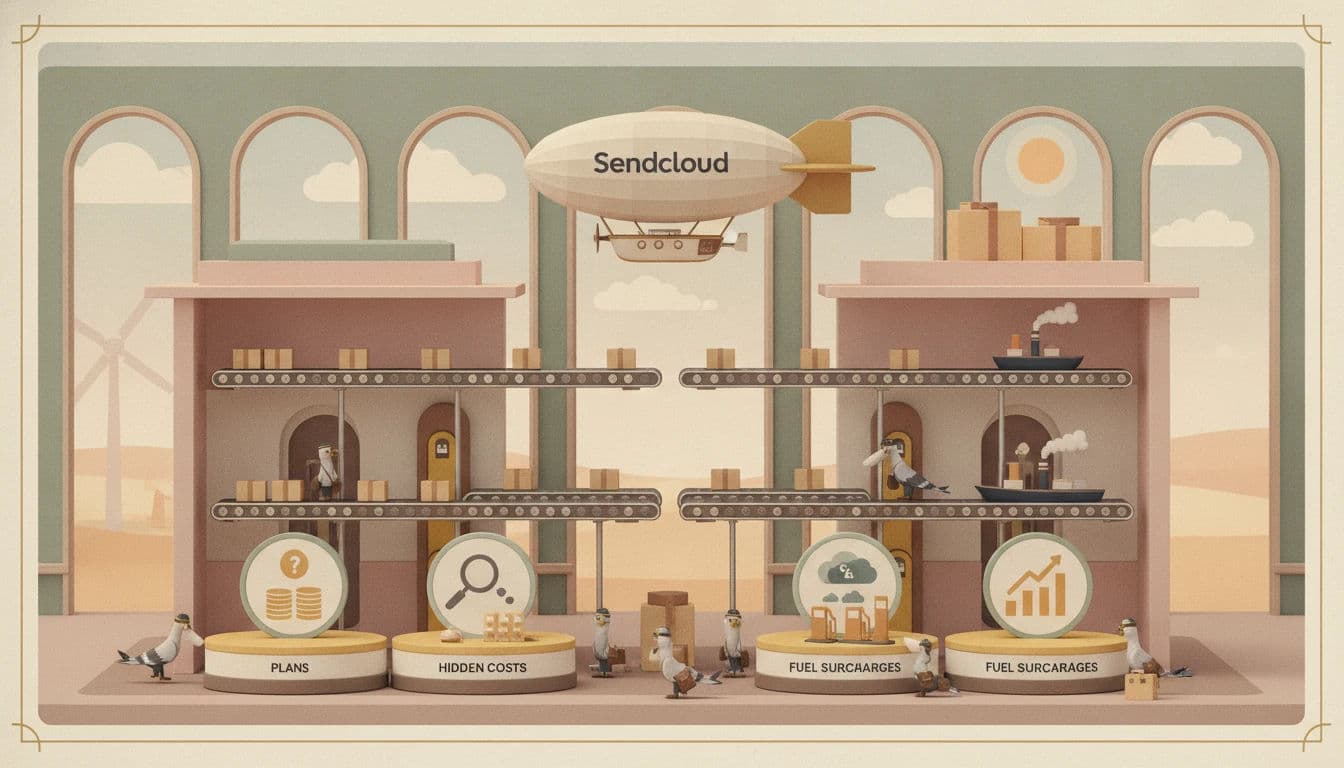
To understand if Sendcloud is the right investment, you must look beyond the advertised monthly subscription fee. Sendcloud’s 2026 pricing structure is divided into distinct tiers based on shipping volume and feature requirements. The core paid plans are Lite (approximately $38/month or €35/month), Growth ($118/month or €109/month), and Premium ($238/month or €219/month). There is also an Enterprise tier for custom, high-volume operations.
1. Sendcloud Pricing Tiers
The Lite Plan: Aimed at growing boutiques, this plan allows up to 400 labels per month. It includes basic automation rules and access to standard pre-negotiated carrier rates. However, it lacks advanced features like custom return portals or dynamic checkout options.
The Growth Plan: Designed for scaling retailers, this tier increases the limit to 1,000 labels per month. It unlocks essential mid-market features, including automated return handling, multi-language tracking emails, and the ability to connect multiple shop integrations.
The Premium Plan: Built for established brands, this plan supports higher volumes (often up to 3,000 labels before custom pricing kicks in) and offers advanced routing rules, API priority access, and dedicated customer success management. Advanced features like 'Dynamic Checkout' (offering pick-up points and multiple delivery options) are typically included here.
2. Hidden Costs and Limitations
The most critical factor in evaluating Sendcloud is the label limit. If your business experiences seasonal spikes—such as Black Friday—you will be hit with overage fees. The Sendcloud cost per label for exceeding your tier's cap can quickly erode your margins if you do not proactively upgrade.
While Sendcloud offers a trial, there are significant Sendcloud free plan limitations; it is not a permanent free-to-use platform like Packlink. Furthermore, while Sendcloud allows you to "Bring Your Own Contract" (BYOC), managing multiple direct carrier contracts often requires higher-tier plans. Another hidden cost lies in the return portal; advanced analytics and automated refund triggers require the Growth or Premium tiers.
3. Who is Sendcloud best for?
Sendcloud is best for mid-market European retailers who are rapidly scaling and need a robust, automated system to handle multi-carrier shipping and localized returns across different EU countries. It is the sweet spot for businesses shipping between 500 and 5,000 parcels a month that want to reduce manual warehouse labor.
Shippo vs. Sendcloud: The Best Option for Pay-As-You-Go Flexibility
1. Pricing Differences and Value
The most glaring difference is the pricing model. Shippo is famous for its pay-as-you-go structure. In 2026, Shippo continues to offer a plan with no monthly subscription fee, charging a flat rate of $0.05 per label generated using your own carrier accounts. They also offer a Professional plan starting around $19/month that removes the per-label fee.
If you ship 400 parcels a month, Shippo’s pay-as-you-go model costs $20, while Sendcloud’s Lite plan costs $38. However, Sendcloud’s primary advantage is its deep integration with European local carriers like PostNL, Bpost, and Colissimo, which Shippo lacks.
2. Hidden Costs and Limitations
Shippo’s hidden costs become apparent when scaling complex European operations. It lacks the nuanced, multi-language return portals that Sendcloud has perfected for the EU market. For post-Brexit trade, ensuring robust support for IOSS (Import One-Stop Shop) filings is critical, and EU-native platforms often handle this more seamlessly.
Additionally, if you require highly customized API builds, Shippo’s rate limits on lower tiers can force you into expensive custom contracts sooner than expected.
3. Who is Shippo best for?
Shippo is best for e-commerce businesses with highly seasonal or fluctuating shipping volumes that want to avoid fixed monthly overhead. It is particularly valuable for merchants who primarily use major global carriers.
Packlink vs. Sendcloud: The Top Choice for Low-Volume SMBs
1. Pricing Differences and Value
Packlink PRO operates on a "free-to-use" model. There are no monthly subscription tiers or setup fees. Instead, Packlink acts as a shipping rate aggregator, monetizing the margin on the shipping rates they negotiate with carriers.
For a micro-seller, this is an incredible value proposition: access to enterprise-level shipping rates without a monthly software fee. However, as volume grows, the ability to negotiate your own direct carrier rates (BYOC) and plug them into Sendcloud’s automated routing rules will save you far more money.
2. Hidden Costs and Limitations
Packlink’s main limitation is its lack of advanced workflow automation. It is a more manual platform. You will spend more time managing edge cases, handling complex multi-box shipments, and processing returns.
The "hidden cost" of Packlink is the labor cost of your warehouse staff. What you save in software subscriptions, you may pay in hourly wages due to slower fulfillment.
3. Who is Packlink best for?
Packlink is best for low-volume SMBs, micro-sellers, and boutique online stores shipping fewer than 300 parcels a month. It is the ideal starting point for businesses that want access to discounted carrier rates without committing to a fixed monthly software expense.
ShipStation vs. Sendcloud: The Winner for Multi-Channel Global Sellers
1. Pricing Differences and Value
ShipStation, owned by Auctane, is a heavyweight with highly tiered 2026 pricing, starting at $9/month and scaling to $229+/month. At first glance, its tiers look similar to Sendcloud’s. However, ShipStation’s true value lies in its unparalleled multi-channel integration capabilities.
If you are selling simultaneously on Shopify, Amazon, eBay, Etsy, and WooCommerce, ShipStation’s ability to aggregate all those orders into one unified dashboard is best-in-class. Where Sendcloud wins is in European localization; its checkout integrations and customs documentation are generally more intuitive for EU-based merchants than ShipStation’s US-first architecture.
2. Hidden Costs and Limitations
ShipStation has historically charged surcharges or restricted the use of BYOC on its lower-tier plans. If you have a highly negotiated rate with DPD but are forced to use ShipStation’s aggregated rates because you are on a cheaper plan, you are losing money.
Additionally, its customer support in European time zones has been a point of contention for some merchants, potentially leading to costly downtime.
3. Who is ShipStation best for?
ShipStation is best for global, multi-channel sellers managing complex inventory across various marketplaces. If your strategy relies heavily on Amazon and eBay alongside your direct-to-consumer site, its aggregation tools justify the premium pricing.
Metapack vs. Sendcloud: The Enterprise Solution for High-Volume Retailers
1. Pricing Differences and Value
Comparing Metapack to Sendcloud is like comparing a freight train to a delivery van. Metapack is a pure enterprise solution with custom pricing that typically involves tens of thousands of dollars annually. Its value lies in its network of over 400 carriers and its ability to handle millions of parcels a month without system degradation.
It offers highly advanced dynamic delivery options at checkout based on real-time carrier capacity. While Sendcloud has an enterprise plan, Sendcloud enterprise pricing is more of a scaled-up SaaS model, whereas Metapack is a deeply integrated infrastructure project.
2. Hidden Costs and Limitations
The hidden costs of Metapack are the massive implementation time (months, not days) and the requirement for dedicated internal IT resources. Any changes to carrier logic or adding new local carriers often require paid professional services from Metapack’s team. It is complete overkill for the mid-market.
3. Who is Metapack best for?
Metapack is best for massive enterprise retailers shipping hundreds of thousands of parcels globally per month, where a 0.01% improvement in delivery efficiency translates to millions in savings.
Find Perfect Software for Your Business
Seven Senders vs. Sendcloud: The Ultimate Cross-Border European Delivery Network
1. Pricing Differences and Value
Seven Senders is a physical delivery network combined with software. Their pricing is a comprehensive quote based on freight volume, line-haul transportation, and last-mile carrier injection.
If you are a German retailer selling to France, Seven Senders will physically collect your aggregated parcels, drive them across the border, and inject them directly into Colissimo's local network. This is almost always cheaper and faster than standard international shipping, saving massive amounts on cross-border surcharges.
2. Hidden Costs and Limitations
The limitation of Seven Senders is accessibility. They require high minimum monthly parcel volumes—typically over 5,000 international parcels per month—to make the physical logistics viable. The "hidden cost" is the complexity of managing physical freight forwarding alongside software integration.
3. Who is Seven Senders best for?
Seven Senders is best for high-volume cross-border European sellers (5,000+ international parcels/month) who want to reduce shipping costs by utilizing local carrier injection.
Byrd vs. Sendcloud: The Best Fulfillment-First Shipping Alternative
1. A Strategic Pivot, Not a Direct Alternative
Byrd represents a strategic pivot from in-house shipping to a fully outsourced model. While Sendcloud is software for your own warehouse staff, Byrd is a Third-Party Logistics (3PL) provider with an integrated software layer. You do not use Byrd to print labels; you use Byrd to outsource your warehouse entirely.
2. Pricing Differences and Value
Byrd’s pricing is entirely custom and based on fulfillment metrics: a receiving fee, storage fee, a pick-and-pack fee per order (often $1.50 - $3.00+), and the final shipping fee. When comparing the cost of Byrd to Sendcloud, you are comparing the total Operating Expense (OpEx) of running your own warehouse versus outsourcing.
With Sendcloud, you pay $118/month for software, but you also pay for warehouse rent, staff salaries, and packing materials. With Byrd, you convert all those fixed costs into variable costs.
3. Hidden Costs and Limitations
The hidden costs of using a 3PL like Byrd include long-term storage fees for slow-moving inventory. You also lose direct quality control over the unboxing experience. If a packer at a Byrd facility makes a mistake, it reflects on your brand. There are also minimum monthly order requirements to maintain an active account.
4. Who is Byrd best for?
Byrd is best for rapidly growing e-commerce brands that want to scale internationally without signing commercial real estate leases or managing warehouse staff. It is the ultimate solution for businesses that want to focus purely on marketing and product development.
Decision Matrix: Choosing Your Shipping Partner in 2026
Use this checklist to identify the most cost-effective platform for your specific needs. Answering these questions will point you to the right solution.
Volume & Seasonality: Is my monthly parcel volume consistent or highly fluctuating? (Consistent -> Sendcloud; Fluctuating -> Shippo)
Scale: Am I shipping fewer than 300 parcels per month? (Yes -> Packlink)
Geographic Focus: Is my business primarily focused on cross-border EU sales at high volume (5,000+/month)? (Yes -> Seven Senders)
Channel Complexity: Do I sell across multiple global marketplaces like Amazon and eBay? (Yes -> ShipStation)
Operational Model: Do I want to eliminate my physical warehouse and outsource all logistics? (Yes -> Byrd)
Budget vs. Control: Is my top priority minimizing fixed software costs, even if it means more manual work? (Yes -> Packlink/Shippo)
Enterprise Needs: Do I ship over 100,000 parcels per month and need a custom, deeply integrated logistics infrastructure? (Yes -> Metapack)
Try AuthenCIO
Move to faster, smarter software evaluation with AI
Final Verdict: Which European Shipping Tool Delivers the Best ROI in 2026?
Choosing the right shipping automation software in 2026 requires a rigorous audit of your monthly parcel volume, geographic focus, and internal warehouse capabilities. Do not base your decision solely on the entry-level monthly subscription price. The true cost of shipping software is hidden in label overage fees, carrier surcharges, and the manual labor required to manage returns and exceptions.
If you are a mid-market European retailer shipping between 500 and 5,000 parcels a month, Sendcloud remains the most balanced choice. Its localized carrier integrations and automated return portals offer the best immediate ROI for EU-based operations.
However, if your volume is highly volatile, Shippo’s pay-as-you-go model will protect your cash flow. If you are a micro-seller, Packlink offers the lowest barrier to entry. For global sellers dominating Amazon and eBay, ShipStation’s multi-channel aggregation is unmatched. And if you are ready to completely outsource your warehouse, Byrd provides the physical infrastructure to scale without limits.
Stop paying for features you do not use, and stop losing margin to hidden carrier fees. Evaluate your volume, define your primary use case, and choose the platform that aligns with your 2026 growth targets.