
Introduction
The Q4 forecast just landed, and the numbers are both exhilarating and terrifying. E-commerce sales are projected to double, a new B2B distribution channel is launching, and the executive team expects flawless execution. Yet, your warehouse operations are creaking under the strain. Your best supervisors spend hours reconciling inventory in spreadsheets, pickers navigate aisles with paper lists, and the term 'real-time visibility' is a distant dream. This scenario is the 2026 reality for many Logistics Directors: your company's growth is being throttled by an operational infrastructure that was never designed to scale.
Streamline your software evaluation process
The transition from manual processes to a strategic, automated, and cloud-based ecosystem is no longer an optional upgrade; it is the central mandate for survival and growth. Driven by relentless e-commerce demand and a chronic labor shortage, the need for effective logistics automation has never been more acute. With the global warehouse management system (WMS) market projected to hit USD 10.04 billion by 2030, a 17.1% CAGR from 2025, it's clear the industry is rapidly moving beyond manual methods. For Logistics Directors, the challenge isn't just implementing software; it's architecting a scalable future. This guide provides a strategic framework for navigating this critical transition, from identifying the breaking points of manual systems to selecting the right technology partners for long-term, sustainable growth.
Key Takeaways:
Manual systems and spreadsheets are the primary barrier to warehouse scalability, introducing unacceptable risks and inefficiencies in a modern logistics environment.
A phased approach to automation, beginning with a foundational cloud-based WMS, is the most effective strategy for sustainable, scalable growth.
Choosing the right technology stack requires a forward-looking assessment of business needs, integration capabilities, and total cost of ownership—not just current features.
A successful WMS implementation is as much about change management, data hygiene, and staff training as it is about the technology itself.
Software Covered in this Article
To help you understand Logistics & Supply Chain Software in the right context, this article refers to a carefully curated set of key players:









Compare warehouse management software for free on AuthenCIO.
The Hidden Costs of Manual Spreadsheet Tracking
For years, spreadsheets served as a default tool for inventory management. However, in a high-growth environment, this reliance becomes a significant liability. The hidden costs extend far beyond occasional data entry errors, creating systemic inefficiencies that directly impact your bottom line and ability to scale.
1. Crippling Labor Inefficiency
Manual systems are inherently labor-intensive. Every task requires manual entry and verification, consuming hours that could be redirected toward value-added activities. As order volume increases, the only way to scale is by adding more headcount—a linear, unsustainable model that inflates costs. This is compounded by high labor turnover, leading to costly, continuous training cycles for new staff on convoluted manual processes that are often unappealing to a younger workforce accustomed to intuitive digital interfaces.
2. The High Price of Inaccuracy
Even with a diligent team, manual entry is prone to error. A single typo can cause phantom stock, mis-picks, and incorrect shipments, eroding customer trust and triggering costly reverse logistics. While a well-run manual warehouse might achieve 92-98% inventory accuracy, modern cloud-based WMS platforms consistently deliver rates exceeding 99.5%. That small percentage delta represents thousands in lost revenue, wasted labor, and reputational damage.
3. The Inability to Optimize
Spreadsheets provide a static, historical snapshot. They cannot offer the real-time data needed for dynamic optimization. Without live visibility, it's impossible to implement strategic slotting for high-velocity items, optimize picking paths to reduce travel time, or proactively manage labor based on incoming order flows. Your warehouse operates reactively, constantly fighting fires instead of preventing them.
4. The Risk of a Single Point of Failure
An intricate web of interconnected spreadsheets is a fragile system. A corrupted file or a deleted formula can bring operations to a standstill. This lack of a centralized, secure 'source of truth' creates data silos and makes reliable reporting nearly impossible. With nearly 80% of warehouses globally still non-automated as of 2026, the competitive advantage for those who digitize is immense. The risk of inaction is no longer just inefficiency; it's obsolescence.
The Strategic Shift: Moving from Legacy Systems to Cloud-Based WMS
The transition away from the limitations of manual synchronization is the foundational step toward building a scalable warehouse. A modern, cloud-based WMS acts as the central nervous system for your operation, providing a single source of truth, directing workflows with precision, and capturing real-time data for intelligent decision-making. Unlike legacy on-premise solutions, cloud platforms offer lower upfront costs, faster implementation, and the flexibility to scale usage as business needs change. This enables a strategic shift from a capital expenditure (CapEx) heavy model to a more predictable operating expenditure (OpEx) model.
However, the WMS market is not one-size-fits-all. The right solution depends entirely on your company's current scale, complexity, and growth trajectory.
1. Mid-Market Agility: Scaling with Katana, MRPeasy, and Finale Inventory
For small to mid-market businesses in e-commerce, DTC, and light manufacturing, agility is paramount. These companies need powerful inventory and order management without enterprise-level complexity or cost.
Katana Cloud Inventory: Katana excels for businesses that both make and sell products, seamlessly integrating inventory management with manufacturing resource planning (MRP). This provides a clear view of raw materials, work-in-progress (WIP), and finished goods, which is crucial for scaling production alongside sales.
MRPeasy: As its name implies, MRPeasy simplifies production planning for small manufacturers. It provides a robust, all-in-one system for managing production, stock, customers, and purchasing, creating the critical link between warehouse stock levels and the production floor's needs.
Finale Inventory: Geared towards high-volume multichannel e-commerce, Finale Inventory is a powerhouse for preventing stockouts. It offers multi-location support, serial/lot tracking, and deep integrations with marketplaces like Amazon and Shopify, centralizing inventory across disparate sales channels.
Implementation Reality: These cloud-native systems are designed for rapid deployment. For mid-market businesses, a typical implementation timeline, from data migration to go-live, ranges from 3 to 6 months.
2. Enterprise-Grade Power: SAP S/4HANA, Oracle SCM, and Manhattan Associates
For large enterprises with complex, multi-site distribution networks and global supply chains, the requirements are different. Scalability here means managing immense complexity and integrating with a wide array of corporate systems.
SAP S/4HANA (with Extended Warehouse Management): SAP's EWM module offers granular control over every warehouse process, from inbound processing and quality checks to complex outbound waving and labor management. It's designed to run the world's largest distribution centers and integrates deeply into the broader SAP ecosystem.
Oracle SCM (Fusion Cloud): Oracle's Supply Chain Management cloud offers a comprehensive suite that leverages AI and machine learning for predictive insights. It can optimize inventory placement across a global network and automate key decisions, moving beyond simple execution.
Manhattan Associates: A long-standing leader, Manhattan Active® Warehouse Management is a cloud-native platform known for its rich functionality in highly complex and automated fulfillment operations. It's designed to be versionless, ensuring customers are always on the latest software without disruptive upgrades.
Implementation Reality: These enterprise-grade platforms are a significant undertaking. Due to their complexity, deep integration requirements, and the scale of the operations they manage, implementation projects typically range from 12 to 18 months, or even longer.
Business Profile & Scale | Key Scalability Challenge | Example Software Solutions |
Rapidly Scaling E-commerce / DTC Brands | Managing high order volumes, multichannel inventory, and preventing stockouts across platforms like Shopify and Amazon. | Finale Inventory, Katana Cloud Inventory |
Small to Mid-Sized Manufacturing | Integrating shop floor production needs with raw material and finished goods inventory for end-to-end visibility. | MRPeasy, Katana Cloud Inventory |
Specialized High-Turnover Retail (e.g., Fashion) | Handling complex SKU variations (size/color), enabling single inventory pool across all channels, and rapid fulfillment. | Increff |
Large Enterprise & Global Distribution | Managing multi-site complexity, deep ERP integration, advanced labor management, and global supply chain visibility. | SAP S/4HANA, Oracle SCM, Manhattan Associates |
AI-Driven Supply Chain Optimization | Moving beyond execution to predictive analytics, demand forecasting, and network-wide inventory optimization. | Blue Yonder, Oracle SCM |
Asset-Light Scalability (Outsourcing) | Achieving rapid geographic expansion and accessing enterprise-level fulfillment technology without capital investment in facilities. | ShipBob (as a 3PL partner) |
Find Perfect Software for Your Business
Optimizing Fulfillment with Increff, Blue Yonder, and ShipBob
Beyond core WMS, specialized solutions are solving specific scalability challenges. Increff offers SaaS-based technology for the fashion and lifestyle industries, where its WMS is designed for speed in handling complex SKUs (size, color, style variants), enabling brands to expose their entire inventory to all sales channels simultaneously.
Blue Yonder represents the pinnacle of AI-driven supply chain optimization. Its strength lies in connecting your warehouse to the entire supply chain, using AI for everything from demand forecasting to orchestrating labor and robotics on the floor. For directors building a truly predictive and autonomous supply chain, Blue Yonder provides the intelligent layer on top of core execution.
Alternatively, outsourcing fulfillment can be the ultimate scalability play. A tech-enabled 3PL like ShipBob allows growing brands to access a global network of fulfillment centers and advanced technology without the massive capital investment in their own infrastructure, effectively offering scalability-as-a-service.
The Physical Layer: Integrating Scanners, Hardware, and Robotics
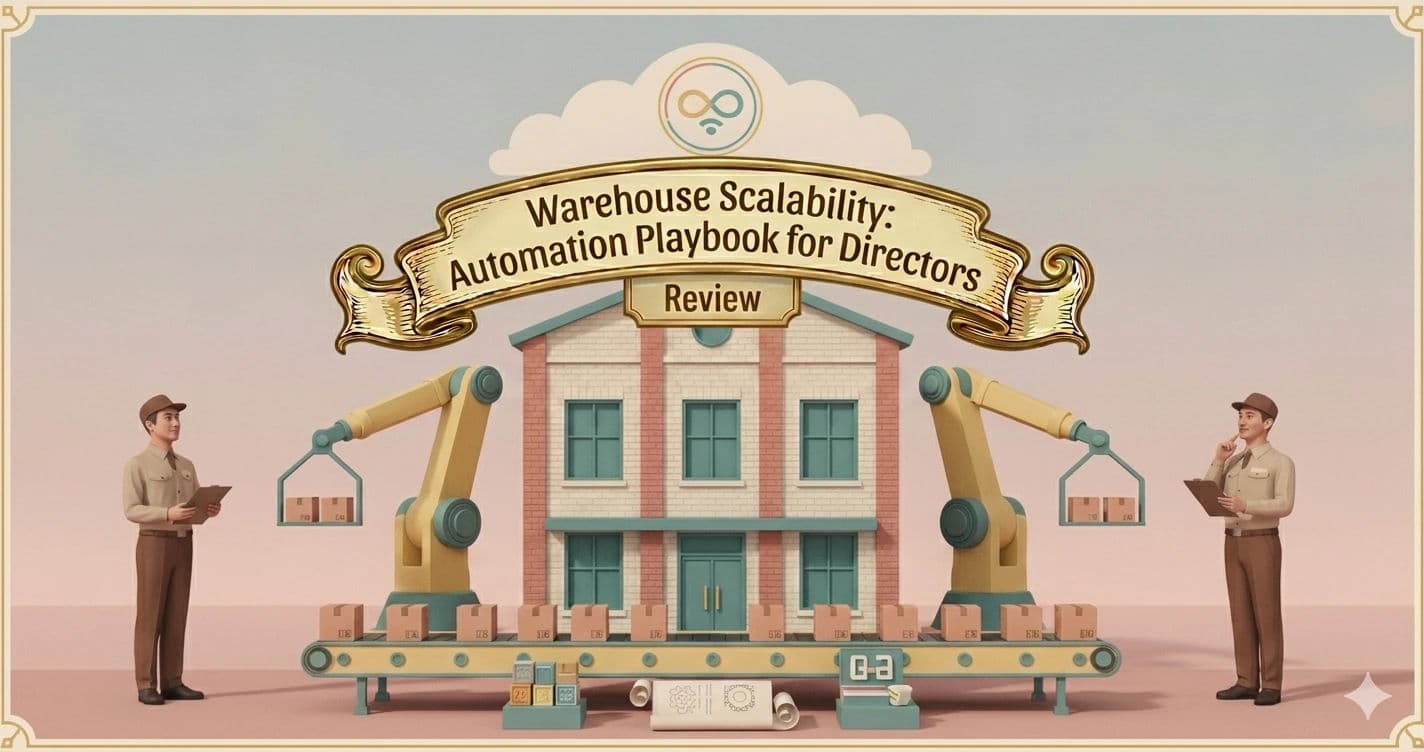
A WMS is the brain, but it needs a body. The physical layer—the hardware your team uses and the automation you deploy—is critical for translating digital commands into real-world action. A key part of your warehouse scalability strategy must involve planning for this hardware ecosystem.
Data Capture is Non-Negotiable: At a minimum, a scalable operation requires ruggedized mobile scanners and tablets for every associate involved in inventory movement. This ensures real-time, accurate data capture at every touchpoint, from receiving to shipping. Planning for reliable Wi-Fi coverage across the entire facility is a foundational prerequisite.
Preparing for Automation: Your chosen WMS must have robust APIs and a proven track record of integrating with physical automation. Whether you are considering Autonomous Mobile Robots (AMRs) for goods-to-person picking or an Automated Storage and Retrieval System (AS/RS) for high-density storage, the software must be able to manage these systems seamlessly. This modular approach allows you to add automation incrementally as ROI is proven.
Cybersecurity in a Connected Warehouse: As you connect more devices—from scanners to IoT sensors on conveyor belts—your warehouse becomes a node on the corporate network. Ensure your WMS vendor has strong cybersecurity protocols and that your own IT policies extend to all operational technology on the floor.
Empower your warehouse for 2026 — explore AuthenCIO’s automation solutions today.
Overcoming the Friction of Digital Transformation
Implementing a state-of-the-art WMS is only half the battle; the most significant challenge is the human element. A successful transition requires a deliberate change management strategy.
1. Data Cleansing and Migration
Before you go live, you must ensure the data you're putting into the new system is clean. Migrating inaccurate inventory counts, incomplete SKU data, or flawed location information from old spreadsheets into a new WMS will only automate your existing problems. Dedicate time and resources to a thorough data cleansing project before migration.
2. Training and Incentive Alignment
Develop a multi-faceted training program that includes hands-on practice in a test environment and on-the-floor support during go-live. More importantly, align incentives with the new system. If your team's performance is measured by KPIs like picking accuracy and order cycle time—metrics tracked precisely by the WMS—they will be motivated to adopt the new workflows that help them succeed.
3. Communication and Buy-In
Involve key supervisors and floor staff in the selection and planning process. Their practical insights are invaluable, and their early involvement will turn them into champions for the new system. Clearly articulate the 'why' behind the change, framing the WMS as a tool that will make their jobs easier, reduce frustrating errors, and allow them to focus on more engaging tasks.
Future-Proofing Your Infrastructure for Post-2026 Growth
The WMS you choose in 2026 is the foundation for your future capabilities. As you plan, think beyond your immediate needs.
The global warehouse software market is forecast to grow from USD 9.2 billion in 2025 to USD 22.1 billion by 2032, fueled by demand for systems that can not only report what happened but predict what will happen. Look for platforms investing heavily in AI for practical applications like AI-driven wave release, which optimizes order batching for maximum efficiency, and dynamic slotting, which continuously adjusts inventory placement based on shifting demand patterns.
Furthermore, modern warehouse optimization is increasingly linked to sustainability. An advanced WMS helps reduce energy consumption by optimizing equipment routing, minimizes waste by improving inventory accuracy, and enables more efficient packaging (cubing) to reduce shipment footprints. These efficiencies benefit both the planet and the bottom line.
Try AuthenCIO
Move to faster, smarter software evaluation with AI
Conclusion: The Logistics Director's Mandate for Scalability
The transition from the constraints of manual tracking to the clarity of a cloud-based WMS is the single most impactful step a Logistics Director can take to prepare their organization for future growth. Sticking with manual processes in 2026 is an active decision to accept inefficiency, risk, and a hard ceiling on your operational capacity.
A successful scaling strategy is built on a phased approach. It begins with establishing a foundational WMS as your single source of truth. From there, you can layer on process optimizations and, eventually, advanced automation and intelligence. This journey requires a careful selection of technology partners that align not only with your current needs but with your long-term strategic vision.
Your mandate is clear: transform the warehouse from a cost center into a strategic asset and a powerful engine for growth. By embracing this change, you can build a resilient, efficient, and infinitely scalable operation ready for the challenges and opportunities of tomorrow.