
Introduction
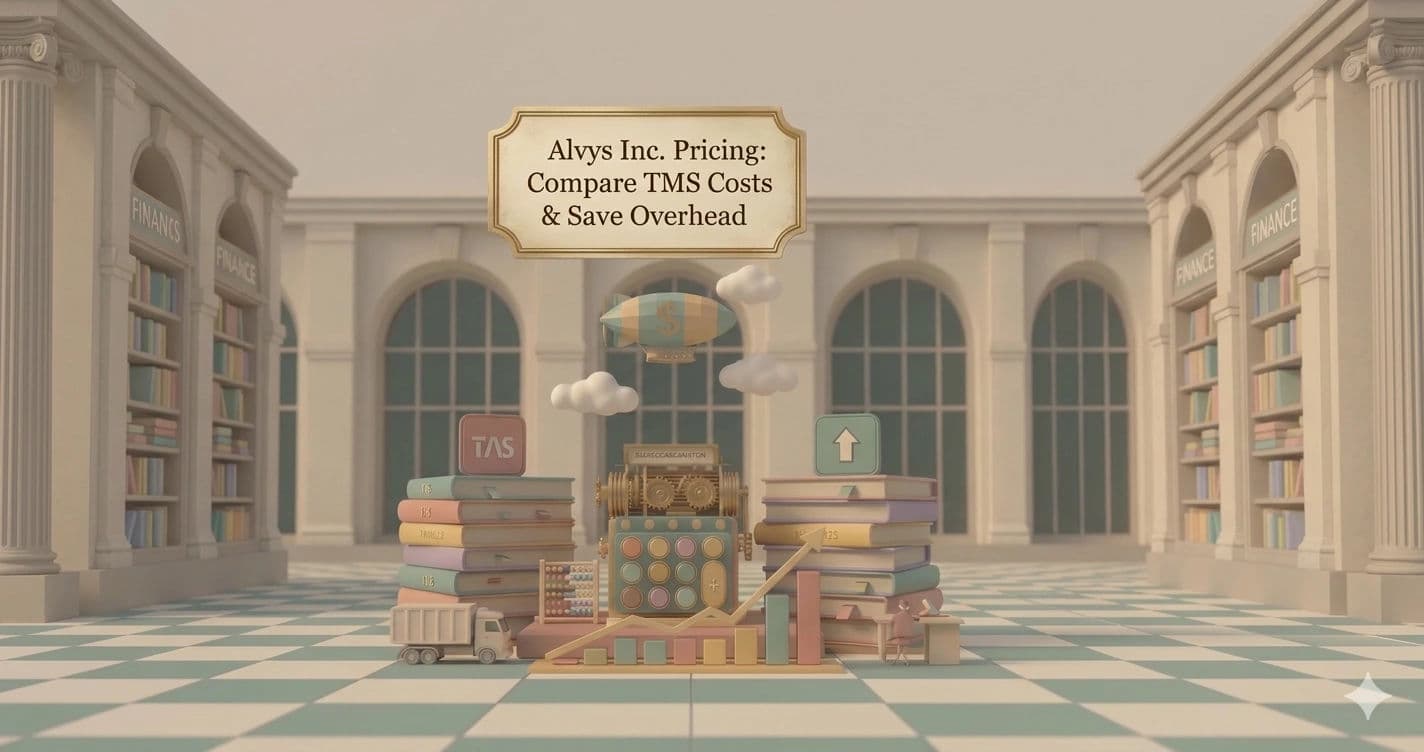
Fleet owners managing small teams know that every dollar spent on administrative overhead is a dollar taken straight from the bottom line. In 2026, relying on manual paperwork, fragmented spreadsheets, and disjointed communication channels is a guaranteed way to bleed profit.
Streamline your software evaluation process
Finding a Transportation Management System (TMS) that balances operational power with budget reality is critical for survival and growth. You do not need a bloated enterprise software suite that takes six months to implement, nor do you need a cheap, bare-bones tool that you will outgrow in a year. You need a system that cuts administrative hours, tracks profit-per-mile accurately, and keeps dispatchers and drivers connected without draining your cash flow.
This article breaks down the true cost of Alvys Inc. and compares it directly against industry competitors like Motive, Samsara, Trimble, PCS Software, Rose Rocket, and Truckstop.
We are stripping away the marketing fluff to focus strictly on decision-making factors: pricing differences, value for money, hidden costs, contract flexibility, and plan limitations. By evaluating these platforms side-by-side, you can confidently choose the most cost-effective software for your fleet today.
Key Takeaways
Total Cost of Ownership Matters: Base subscriptions are only part of the equation; hardware lock-ins, implementation fees, and data export charges dictate your true software overhead.
Beware of Per-User Penalties: Growing your back-office staff can exponentially increase your monthly software bill if your TMS charges per seat rather than per load or per truck.
Match the Tool to the Freight: Specialized platforms for LTL or spot-market brokering will waste FTL asset-based carriers' budgets on unused features.
Driver Experience Impacts ROI: A clunky mobile app leads to driver frustration, increased turnover, and higher indirect operational costs.
2026 TMS Pricing Comparison Table
Plan | Best For | Pricing ($) | Limitations | Contract Terms |
Alvys Inc. Core | Hybrid carriers needing unlimited users | Custom | Usage-based pricing scales with volume; lacks deep enterprise custom architecture | Month-to-month or Annual |
Motive TMS | Asset-heavy fleets needing ELD/telematics | Custom (Est. $40-$60/truck/month) | Requires hardware lock-in; software costs are secondary to hardware investments | 1 to 3-Year Lock-in |
Samsara | Fleets requiring deep safety/camera tracking | Custom (Est. $30-$50/truck/month) | High upfront hardware costs; strict long-term contract lock-ins | 3 to 5-Year Lock-in |
Trimble | Large enterprise carriers | Custom (Est. $150+/truck/month) | Steep learning curve; massive implementation fees; overkill for small teams | Multi-Year Custom |
PCS Software | Mid-to-large automated fleets | Custom (Est. $100+/truck/month) | Complex onboarding process; features far exceed the needs of sub-20 truck fleets | Annual to Multi-Year |
Rose Rocket | LTL-focused brokerages and carriers | Custom | Per-user pricing punishes growing dispatch teams; heavily optimized for LTL over FTL | Annual |
Truckstop | Spot market freight matching and brokers | Starts at $399/user/month | Lacks comprehensive asset management and maintenance tracking for dedicated fleets | Month-to-Month |
Note: The prices listed below are based on publicly available information for 2026 and may represent starting tiers. Many platforms offer month-to-month flexibility, but some may offer discounts for annual contracts. Always confirm final pricing and contract terms with a sales representative.
Compare Alvys Inc. pricing with other TMS platforms for free on AuthenCIO.
Software covered in this article
To help you understand Logistics & Supply Chain Software in the right context, this article refers to a carefully curated set of key players:






Alvys Inc. Pricing Breakdown: Is It Worth the Cost?
When evaluating the Alvys TMS cost in 2026, the most prominent financial differentiator is its starting price of $514 per month combined with an "unlimited users" model. For a small fleet owner, this structure is fundamentally different from legacy platforms that charge by the seat or by the truck.
Alvys positions itself as a cloud-based, all-in-one suite designed to maximize efficiency for carriers, brokers, and hybrid logistics companies.
The unlimited user model is a massive financial advantage for growing teams. Imagine a 15-truck fleet with two dispatchers, one safety manager, one billing clerk, and the owner. Under a traditional per-user model charging $150 per seat, that office staff alone costs $750 a month—before accounting for driver access or load volume.
With Alvys, the entire back office can access the system under the flat base rate. This encourages collaboration and eliminates the need to share logins, which often leads to audit and compliance risks.
However, the $514 per month is a starting point based on a usage-based pricing model. It is critical to understand exactly how this usage is calculated to forecast your budget accurately.
Alvys calculates usage on a per-load or per-invoice basis, rather than per-mile. This means if your small fleet suddenly takes on a massive seasonal brokerage contract and processes 500 loads a month instead of your usual 150, your software costs will rise alongside your load volume. This structure aligns your software expenses directly with your revenue generation, but it requires careful forecasting during peak seasons.
Key Financial Takeaways for Alvys:
Predictable Office Overhead: Unlimited users mean you can hire administrative help without instantly increasing your software subscription costs.
Hybrid Flexibility: Perfect for fleets that operate their own assets but also broker out excess freight, eliminating the need for two separate software subscriptions.
Volume Sensitivity: Because pricing is tied to load volume, highly active spot-market brokers might see costs scale faster than purely asset-based carriers running dedicated, low-frequency lanes.
Who is this best for? Alvys is best for small to mid-sized hybrid carriers and brokerages that want predictable user costs but need a modern, cloud-based system to handle both asset management and freight brokering in one unified dashboard.
Find Perfect Software for Your Business
Motive & Samsara: Telematics Heavyweights vs. Your Budget
Motive and Samsara approach transportation management from a completely different angle: the hardware. Both platforms are telematics heavyweights that have evolved into comprehensive fleet management systems.
Their pricing models are typically structured on a per-truck or per-asset basis, meaning your software costs scale linearly with the physical size of your fleet.
Motive (formerly KeepTruckin) is highly regarded for its seamless integration between ELD compliance, dashcams, and dispatch workflows. In 2026, Motive's pricing generally falls between $40 and $60 per truck per month for its software suite, plus the upfront cost of the hardware. For a 10-truck fleet, the monthly software cost is roughly $400 to $600, which is highly competitive.
However, the hidden cost lies in the hardware lock-in. You must purchase and install their specific ELDs and cameras, which can require thousands of dollars in upfront capital and lead to installation downtime.
Samsara operates on a similar model but positions itself as a premium safety and operational platform. Known for its advanced AI dashcams and real-time asset tracking, Samsara's pricing is heavily customized but generally ranges from $30 to $50 per truck per month, alongside significant hardware investments.
Samsara is incredibly powerful for reducing insurance premiums and mitigating accident liability, which offers a tangible ROI. However, it requires signing long-term contracts (often 3 to 5 years) that lock small fleets into a rigid financial commitment.
Furthermore, fleet owners must consider the difficulty of switching away from these platforms. Ripping out hardwired telematics gateways and dashcams to switch to a competitor is a logistical nightmare that costs time and money.
Finally, driver experience is a critical, often-overlooked cost factor. Both Motive and Samsara offer robust mobile apps, but if a driver finds the interface confusing or clunky, it leads to delayed status updates, missed compliance logs, and ultimately, driver turnover.
Replacing a driver costs an average of $8,000 to $10,000; therefore, ensuring the TMS mobile app is user-friendly is a direct cost-saving measure.
Key Financial Takeaways for Motive and Samsara:
Hardware Dependency: You cannot use these TMS platforms effectively without buying into their proprietary hardware ecosystems.
Linear Scaling: Your costs increase exactly as your truck count increases, making budgeting predictable but potentially expensive as you scale.
Insurance ROI: The high upfront costs can sometimes be offset by the insurance discounts gained from their advanced safety and monitoring features.
Who is this best for? Motive and Samsara are best for asset-heavy fleets where DOT compliance, real-time GPS tracking, and driver safety are the absolute highest priorities, and where brokerage features are secondary or unnecessary.
Trimble & PCS Software: Enterprise Tools Scaled for Small Teams?
When small fleet owners begin researching TMS options, they inevitably encounter legacy enterprise giants like Trimble and PCS Software.
While these platforms are incredibly robust, their pricing and structural complexity often make them a dangerous financial trap for fleets with fewer than 20 trucks.
Trimble is the definition of an enterprise-grade TMS. It is designed to handle the complex, multi-layered operations of 500+ truck carriers. Pricing for Trimble is entirely custom, but industry benchmarks in 2026 place it well over $150 per truck per month when fully featured.
More importantly, Trimble requires massive implementation fees that can easily exceed $5,000 to $10,000, alongside a 3-to-6-month onboarding process. For a small fleet owner, paying for advanced features like multi-currency cross-border settlement or complex LTL cross-docking algorithms is a complete waste of capital.
PCS Software offers a highly automated, AI-driven platform that excels in mid-to-large fleet environments. While slightly more accessible than Trimble, PCS still operates on a premium pricing tier (estimated at $100+ per truck per month). The platform is designed to automate dispatch and accounting at scale.
However, the learning curve for dispatchers and drivers is steep. The true cost of PCS Software for a small fleet is not just the subscription; it is the "training debt" and lost productivity during the transition phase.
Key Financial Takeaways for Trimble and PCS Software:
Feature Bloat: Small fleets will likely only use 15% of the platform's capabilities while paying for 100% of the enterprise development costs.
Implementation Drain: High upfront setup fees and long integration timelines destroy short-term ROI and drain cash reserves.
IT Requirements: These systems often require dedicated IT personnel or advanced technical knowledge to maintain and customize.
Who is this best for? Trimble and PCS Software are best for large, established enterprise carriers (100+ trucks) that require deep, custom architectural integrations, dedicated IT support, and highly automated dispatch workflows at massive scale.
Rose Rocket & Truckstop: Specialized Solutions Pricing
Not all TMS platforms are built for standard Full Truckload (FTL) asset carriers.
Rose Rocket and Truckstop represent specialized solutions that excel in their specific niches but present unique pricing challenges for standard small fleets.
Rose Rocket is a modern, beautifully designed TMS built primarily for Less-Than-Truckload (LTL) carriers and modern brokerages. Its pricing model is heavily focused on per-user licensing, starting around $300 per user per month.
For a small fleet owner, this pricing structure is aggressive. If your operation requires three dispatchers and a billing manager, your base software cost is $1,200 a month—more than double the starting price of Alvys.
How do you know if you are LTL-focused enough to justify Rose Rocket's cost? As a general rule in 2026, if more than 40% of your revenue comes from multi-stop, consolidated freight requiring complex rating engines and customer portals, Rose Rocket is worth the premium.
If you primarily run dedicated FTL lanes, you will find yourself overpaying for LTL tools you do not need while being penalized for growing your office staff.
Truckstop is an industry staple, primarily known as a premier load board. Its TMS offerings are deeply integrated with its freight matching network, with plans starting around $149 per user per month. This is highly affordable for a pure freight broker looking to match spot market loads.
However, for an asset-based fleet owner, Truckstop's TMS lacks the deep, comprehensive asset management, preventative maintenance tracking, and complex driver payroll features found in Alvys or Motive. Choosing Truckstop often forces asset carriers to purchase a second software tool just to manage their trucks, defeating the purpose of an all-in-one TMS and creating a fragmented tech stack.
Key Financial Takeaways for Rose Rocket and Truckstop:
Per-User Penalties: Rose Rocket's $300/user fee makes scaling your back-office team prohibitively expensive compared to unlimited user models.
Niche Focus: Paying for specialized LTL rating engines (Rose Rocket) or spot-market matching (Truckstop) is wasted money if you run dedicated FTL lanes.
Fragmented Tech Stack: Relying on a broker-first tool like Truckstop may require you to buy additional software for fleet maintenance, increasing total overhead.
Who is this best for? Rose Rocket is best for LTL-focused carriers and brokerages needing advanced customer portals. Truckstop is best for pure freight brokers and owner-operators who rely almost entirely on spot market load boards for revenue.
Skip the sales pressure and see transparent pricing comparisons on AuthenCIO.
Hidden Costs to Watch Out For When Choosing a TMS in 2026
The base subscription price of a TMS is rarely the final number on your monthly invoice. In 2026, software vendors have shifted toward modular pricing, meaning the Total Cost of Ownership for the first 12 months is often much higher than the advertised monthly rate.
Small fleet owners must aggressively audit software contracts for these five hidden costs to avoid blowing their overhead budgets.
1. Implementation and Onboarding Fees
Many TMS providers charge a one-time setup fee to configure your account, build your database, and train your staff. While modern cloud tools like Alvys try to keep these low, enterprise platforms can charge anywhere from $1,000 to $5,000 just to turn the system on.
Always ask if the implementation fee is waivable or if it can be amortized over the first year of the contract so you do not take a massive hit to your cash flow in month one.
2. Integration Surcharges for Affordable Fleet Management Software
Even the most affordable fleet management software is only as good as its ability to talk to your other tools. If you use QuickBooks for accounting, Motive for your ELD, and RMIS for carrier onboarding, you need those systems to sync seamlessly.
Some TMS vendors charge a monthly "API access fee" or a per-integration surcharge to connect third-party software. A $500/month TMS can quickly become an $800/month TMS once you connect your accounting and telematics tools.
3. Premium Support Tiers
When a truck is stuck at a weigh station because of a dispatch error, you cannot wait 48 hours for an email response. Basic TMS plans often only include email or chat support.
If you want a dedicated account manager or 24/7 phone support, vendors will frequently force you into a higher, more expensive pricing tier. Calculate the cost of downtime when evaluating whether premium support is a hidden necessity rather than an optional luxury.
4. Data Migration and Transition Costs
Moving your historical load data, customer directories, and driver files from spreadsheets or a legacy TMS into a new system takes time. Some vendors charge hourly rates for their data engineers to format and import your historical data.
Furthermore, you must account for the transition cost—the temporary drop in dispatcher productivity as your team learns the new interface. A steep learning curve translates directly to lost revenue.
5. Data Export Fees
One of the most overlooked hidden costs is the price of leaving. If a TMS does not work out, you need to take your data with you.
Many vendors hold your historical load and financial data hostage, charging exorbitant "Data Export Fees" to format and release your files. Before signing any contract in 2026, ensure that data ownership is clearly defined and that you can export your records via CSV or API at no additional cost.
Try AuthenCIO
Move to faster, smarter software evaluation with AI
Final Verdict: Which TMS Delivers the Best ROI for Small Fleets?
Choosing the most affordable TMS in 2026 requires looking past the marketing brochures and calculating your Total Cost of Ownership based on your specific operational model.
There is no single "cheapest" option; there is only the most cost-effective option for your unique use case.
If you operate a hybrid model—managing your own trucks while brokering out excess freight—Alvys Inc. offers the most compelling financial package. Its starting point and unlimited user model allow small teams to scale their back-office operations without facing punitive per-seat charges.
However, if you are a purely asset-based fleet where DOT compliance and ELD tracking are your primary concerns, bundling your software and hardware with Motive or Samsara will likely yield the best ROI, despite the upfront hardware lock-ins.
Conversely, small teams should strictly avoid the enterprise bloat of Trimble and PCS Software, as the implementation fees and complex features will drain your budget without providing actionable value.
Next Steps Checklist for Evaluating a TMS
Use a Burner Email: Set up a dedicated email address for software trials to avoid spamming your primary business inbox.
Demand a Sandbox: Do not settle for a guided demo. Ask for a 7-day sandbox environment to test the mobile app with one of your actual drivers.
Cap Implementation Fees: If a vendor insists on a setup fee, demand a hard-coded cap in the contract to prevent scope creep.
Verify Data Export Policies: Get written confirmation that you can export your data for free if you cancel the service.
Ultimately, the goal is to reduce administrative overhead so you can focus on hauling freight and growing your margins.
Do not let complex pricing models force you into a bad financial decision.