
Introduction
If you are wondering exactly what PipelinePRO is (often searched as Pipeline Pro, GoPipeline Pro, or even misspelled as piplinepro), it is an all-in-one CRM and marketing automation platform designed for funnel-driven businesses. Is it PipelinePRO or Go Pipeline Pro? Officially, it is PipelinePRO, though its domain and user community often use the "go" prefix. Regardless of what you call it, the marketing automation suite Pipeline Pro aims to consolidate your fragmented tech stack—replacing separate landing page builders, email marketing tools, and sales pipelines with a single cohesive unit.
The landscape of Customer Relationship Management (CRM) has shifted tectonically in 2026. The era of the CRM acting merely as a static data silo or a legacy ledger is effectively over. For modern performance marketers and growth-focused SMEs, a CRM must now function as a dynamic revenue engine—a central nervous system that actively processes data through sophisticated revenue workflow automation.
Streamline your software evaluation process
In this high-stakes environment, the distinction between a traditional database and a funnel-driven marketing automation platform is the difference between stagnation and scale. Businesses demand high-velocity execution, where API endpoints trigger instant communication, and AI agents predict conversion probability in real-time.
However, the market is crowded. With giants like Salesforce dominating the enterprise and agile disruptors like HighLevel capturing the agency market, does PipelinePRO stand its ground as a viable solution?
This review dissects the platform's architecture, pricing, and 2026-specific AI capabilities to determine if it is the right tool for your growth strategy.
Key Takeaways
AI-First Automation: PipelinePRO's 2026 engine moves beyond basic chatbots, offering predictive revenue workflows and advanced AI lead nurturing that significantly reduces manual follow-ups.
Cost-Effective Scaling: The platform provides exceptional value compared to enterprise giants like HubSpot and Salesforce by avoiding per-user pricing penalties, though users must monitor hidden SMS and email usage fees.
Agency-Friendly Architecture: Built as a robust all-in-one wrapper, it excels in funnel building and pipeline management, but beginners should expect a moderate learning curve during the initial setup.
Fierce Competition: While GoHighLevel and ActiveCampaign remain strong alternatives, PipelinePRO stands out for marketers who want deep funnel analytics natively tied to AI communication tools.
Structured Migration: Moving to PipelinePRO requires a dedicated 30-day transition roadmap to properly audit existing data, mirror complex automations, and ensure a seamless go-live phase.
PipelinePRO Pros and Cons: A Balanced 2026 Perspective
Before evaluating the platform's specific strengths and weaknesses, it is important to clarify a common point of confusion: PipelinePRO is not PipelineDeals. Users frequently search for "pipelinedeals pros and cons" expecting an all-in-one marketing platform, but PipelineDeals (now Pipeline CRM) is strictly a traditional, sales-focused CRM.
PipelinePRO, on the other hand, is an automation-first engine designed for complex marketing, sales, and operational workflows. Whether you are scaling lead generation funnels, automating client onboarding, or integrating a core HR software review process into your recruitment pipeline, PipelinePRO offers extensive versatility. However, this massive breadth of functionality brings both significant advantages in tech-stack consolidation and notable drawbacks regarding platform complexity.
PipelinePRO Pros
Consolidated Tech Stack: The primary value proposition is the elimination of "subscription fatigue." By replacing landing page builders, calendar tools, and video hosting, the financial and cognitive load on the team is reduced.
Speed of Deployment: The "Snapshot" ecosystem allows businesses to clone proven funnel structures instantly. This is a massive advantage over Salesforce, which often requires a dedicated administrator and months of setup.
Community & Training: PipelinePRO invests heavily in education, providing users with blueprints for lead generation, not just the tool to manage it.
PipelinePRO Cons
Learning Curve: Despite the "easy" marketing, the sheer volume of features can be overwhelming. It is not as simple as Pipedrive, which focuses purely on sales pipeline visibility. Users often experience "dashboard shock."
Integration Depth: While it integrates with Zapier, native integrations with enterprise data warehouses (like Snowflake) or niche ERPs are less robust than what you would find in HubSpot or Zoho.
Data Portability: Migrating away from an all-in-one platform is difficult. While you can export CSVs of contacts, rebuilding complex automation workflows and funnel pages on a new platform is a manual, labor-intensive process.
Best for: Businesses seeking automation with strong compliance and scalable workflow logic.
Verdict: A forward‑thinking CRM that blends AI precision with regulatory trust for smarter growth.
Software covered in this article
To help you evaluate PipelinePRO in the right context, this article compares it against a carefully curated set of competitors:








What is PipelinePRO? An Automation-First CRM for Marketers
At its core, PipelinePRO CRM (or Pipeline Pro CRM) is an automation-first platform combining sales pipelines with marketing funnels. In any comprehensive funnel CRM review, it stands out by eliminating friction between lead acquisition and nurturing. Unlike legacy systems requiring complex integration with third-party tools, PipelinePRO is architected as an all-in-one ecosystem.
For users seeking a pipeleads.ai CRM review 2026, the contrast is clear: while Pipeleads targets outbound generation, PipelinePRO delivers a broader end-to-end infrastructure for building landing pages, automating follow-ups, and tracking revenue.
The Architecture: Wrapper vs. Proprietary Engine
To understand PipelinePRO in 2026, one must address the elephant in the room: its relationship with HighLevel. PipelinePRO utilizes the robust HighLevel framework as its backend infrastructure—a common practice in the "SaaSpreneur" space. However, dismissing it merely as a white-label reseller misses the nuance of its value proposition. PipelinePRO operates as a curated "wrapper" that simplifies the often overwhelming raw power of HighLevel.
Where the base HighLevel platform is a blank canvas designed for agencies to paint on, PipelinePRO offers a pre-configured environment tailored for direct-response marketers. It strips away the complexity of setup, offering a proprietary library of "Snapshots" (pre-built account configurations) and a distinct support ecosystem. This architecture allows users to leverage the enterprise-grade API flexibility of the underlying engine without needing a developer to configure the ignition sequence.
Deep Dive: Funnels, AI & Automation Capabilities
For the 2026 marketer, the funnel builder is the command center. PipelinePRO’s builder is robust, offering a drag-and-drop interface that rivals dedicated page builders like ClickFunnels 2.0. The load speeds—a critical factor for SEO and conversion rate optimization (CRO)—are optimized for mobile responsiveness, ensuring that the high-intent traffic you drive from TikTok or Google Ads doesn't bounce due to latency. But the real story in 2026 is how Artificial Intelligence has permeated the stack.
1. 2026 AI Integration: Beyond Basic Chatbots
When evaluating PipelinePRO AI capabilities in 2026, the platform has moved far beyond basic "If-This-Then-That" (IFTTT) recipes. PipelinePRO’s latest iteration introduces native Large Language Model (LLM) integration designed for both revenue generation and internal operations. For businesses conducting a core HR software review, PipelinePRO AI now doubles as a powerful recruiting automation tool. It deploys autonomous follow-up agents that contextually reply to SMS and email inquiries from sales prospects or job candidates without human intervention until a booking intent is detected.
Research indicates that **86% of B2B marketing teams use **AI for content creation, but only 32% leverage it for predictive analytics. PipelinePRO bridges this gap by offering advanced predictive lead scoring models. These models analyze behavioral data—such as video watch time, email click depth, or application engagement—to assign a dynamic score to every contact. When a score crosses a threshold, the system automatically triggers a "Hot Lead" or "Top Candidate" workflow, alerting your sales or HR team instantly.
2. Advanced Revenue Workflows
The platform allows for multi-channel attribution and complex conditional logic. You can design workflows where a lead score increments based on specific behaviors—such as watching 50% of a VSL (Video Sales Letter).
For example, you can configure a trigger that fires a webhook to a third-party application only when a prospect moves from the "Warm Lead" stage to "Booking Requested." This level of granularity is essential for reducing churn and increasing Customer Acquisition Cost (CAC) efficiency.
Unlike Monday, which is fantastic for project management but requires heavy lifting to act as a marketing automation engine, PipelinePRO’s automation is purpose-built for revenue generation. It supports native 2-way SMS and email marketing, integrated directly into a unified conversation stream, solving the "data silo" problem where communication history is lost between different tools.

PipelinePRO Pricing 2026: Value Analysis
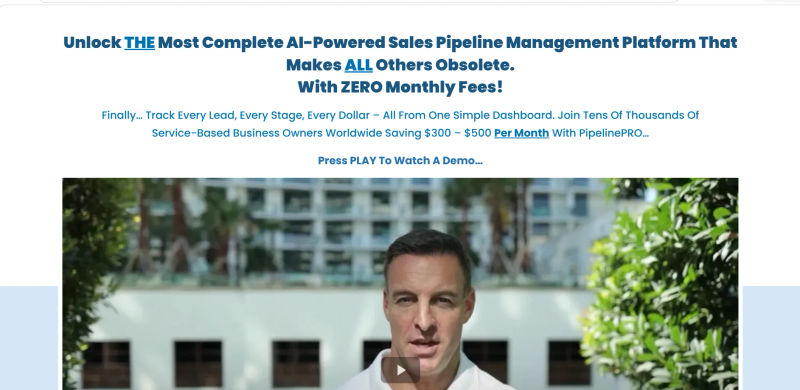
For 2026, PipelinePRO pricing remains highly competitive. The standard Pipeline Pro pricing offers lifetime access for just $67. This one-time fee provides an all‑in‑one CRM solution without recurring monthly subscriptions, complete with core features, pipelines, and support.
Hidden Costs and ROI Analysis
While the headline pricing is attractive, particularly the "Unlimited" contacts claim, marketers must account for the variable costs of communication. PipelinePRO, like most platforms in this tier, relies on third-party telephony and email relays (often powered by Twilio and Mailgun on the backend).
SMS & Email Credits: These are not included in the base subscription. You will pay per segment for SMS and per 1,000 emails. For a high-volume sender, this can add $50-$200/month to the bill.
Dedicated IPs: To maintain high deliverability rates and avoid the "spam folder" death spiral, purchasing a dedicated IP is recommended, which is an additional monthly cost.
Premium Integrations: While Zapier integration is standard, heavy usage of "Premium Zaps" to connect with tools like Salesforce or Oracle NetSuite can inflate your external software costs.
Find Perfect Software For Your Business
PipelinePRO vs ClickFunnels & CRM Integrations
When evaluating PipelinePRO vs ClickFunnels in 2026, the fundamental difference is architectural. ClickFunnels remains a dedicated funnel builder that relies heavily on external CRM connections, whereas PipelinePRO is a unified, all-in-one ecosystem. With PipelinePRO, the funnel and the database are natively connected, eliminating the need for complex software bridges.
Historically, growth teams have wasted countless hours testing ClickFunnels Zoho CRM integration, troubleshooting broken webhooks while testing ClickFunnels Pipedrive integration, or mapping intricate contact tags when testing ClickFunnels Keap integration. These multi-tool stacks are inherently fragile; a single API update from either platform can instantly break your lead flow and result in lost revenue.
PipelinePRO solves this by replacing the fragmented stack entirely. Because the page builder, CRM, and automation workflows share the exact same codebase, lead data flows instantly without third-party connectors like Zapier. You get the high-converting checkout pages expected from a funnel builder, paired with the robust sales pipelines of a dedicated CRM—ultimately lowering your monthly software overhead and eliminating tedious integration maintenance.
PipelinePRO Alternatives: Top Competitor Comparisons for 2026
Choosing a CRM in 2026 requires a side-by-side analysis of your specific revenue workflows. While PipelinePRO is a strong contender, several industry giants offer compelling alternatives depending on your vertical.
1. HighLevel (GoHighLevel)
The Agency Juggernaut. PipelinePRO and HighLevel share the same DNA, but their target audiences diverge. HighLevel is aggressively positioned toward marketing agencies and SaaSpreneurs who want to resell the software under their own brand.
Use Case Scenario: If you are an agency owner planning to manage 50+ client accounts and want to charge them for the software usage, HighLevel is the superior choice due to its mature agency dashboard and rebilling features. If you are a single business owner who just wants the tool to work without configuring backend settings, PipelinePRO’s curated experience is better.
2. Keap (formerly Infusionsoft)
The Automation Veteran.Keap remains a powerhouse for small businesses that need rigorous automation but want a more stable, less "beta-feeling" environment. Keap’s "Campaign Builder" is legendary for its visual logic and stability.
Use Case Scenario: Choose Keap if your business relies on complex, long-term nurture sequences (e.g., 12-month life insurance nurturing) where deliverability and logic stability are paramount. Choose PipelinePRO if you need to spin up a webinar funnel in 24 hours and drive paid traffic immediately.
3. HubSpot
The Inbound King. If your strategy relies heavily on content marketing and SEO rather than paid traffic funnels, HubSpot is the superior choice. Its CMS and blogging tools are unmatched.
Use Case Scenario: If you are scaling an editorial team and need deep integration with Google Search Console and content analytics, HubSpot is worth the premium. However, be warned: HubSpot’s pricing ramps up aggressively. PipelinePRO offers "unlimited" contacts on its core plans, whereas HubSpot can cost thousands per month as you scale beyond 10,000 contacts.
4. ActiveCampaign
The Email Logic Specialist.ActiveCampaign is a Customer Experience Automation (CXA) platform first, and a CRM second. Its email deliverability and conditional logic are arguably the best in the industry.
Use Case Scenario: If you already have a high-performing website on WordPress and just need a backend brain to handle complex email logic (e.g., "If user clicks link A, wait 2 hours, then send SMS B"), ActiveCampaign is the specialist choice. If you want to cancel your landing page software subscription and consolidate, PipelinePRO is the logical switch.
5. Zoho CRM
The Budget Ecosystem.Zoho offers an incredible breadth of tools (Zoho One) for a very low price. It is highly customizable but lacks the "out-of-the-box" marketing focus of PipelinePRO.
Use Case Scenario: Zoho is excellent for operations-heavy businesses (logistics, wholesale) that need to customize modules for inventory or supply chain management alongside their CRM. It feels clunky for digital marketers trying to launch high-conversion funnels.
6. Pipedrive
The Sales Pure-Play.Pipedrive is designed for sales teams, period. Its visual pipeline is intuitive and forces sales reps to focus on activities.
Use Case Scenario: If you have a sales team of 10+ reps who refuse to use complex software, Pipedrive is the safe bet to ensure adoption. However, it does not natively handle landing pages. You would need to integrate it with a tool like PipelinePRO or ActiveCampaign to handle the marketing side, creating a fragmented stack.
7. Salesforce
The Enterprise Standard. Comparing Salesforce to PipelinePRO is apples to oranges. Salesforce is an infinite canvas for enterprise resource planning.
Use Case Scenario: If you require SOC 2 compliance, deep integration with legacy ERPs, or have a dedicated developer team, Salesforce is the only option. For a $10M revenue business focused on agility, Salesforce is often overkill, introducing unnecessary complexity and technical debt.
8. Monday.com
The Project Manager.Monday has aggressively moved into the CRM space. It is visually stunning and highly collaborative.
Use Case Scenario: If your sales process is project-based (e.g., construction, creative services, custom fabrication), Monday is superior because it seamlessly transitions a "Closed Won" deal into a project management board. For high-volume, transactional lead generation, it lacks the automation depth of PipelinePRO.
Optimizing Your Tech Stack: A 30-Day Migration Roadmap
Moving to a new CRM is surgery for your business. To ensure success and avoid data loss, follow this 2026-optimized migration roadmap.
Discover how PipelinePRO stacks up on pricing, GDPR compliance, and predictive analytics.
Week 1: The Audit & Cleanse
Before importing anything into PipelinePRO, audit your existing data. Identify "dead" leads that haven't engaged in 12 months and archive them. This improves your domain reputation when you start sending emails. Map your current data fields to PipelinePRO’s custom fields to ensure no data points are lost.
Week 2: The Infrastructure Setup
Connect your domains for landing pages and email sending. Verify your DNS records (SPF, DKIM, DMARC) to ensure high deliverability. Set up your integration with Stripe and your calendar. This is the time to configure your "Global Settings" in PipelinePRO so that your branding is consistent across all funnels.
Week 3: The Automation Mirroring
Rebuild your core workflows. Don't try to migrate everything at once. Start with your "Speed to Lead" workflow (what happens when a new lead enters) and your "Long Term Nurture" sequence. Test these workflows using internal emails to ensure triggers fire correctly.
Week 4: The Import & Go-Live
Import your cleaned CSV lists. Start with a small batch (e.g., 500 contacts) to warm up your sending IP. Monitor open rates closely. Once validated, migrate the full list and switch your ad traffic to point to your new PipelinePRO landing pages.
User Experience & Interface: The Learning Curve
In 2026, UX is a feature. PipelinePRO’s dashboard is dense, reflecting its massive feature set. New users often experience "dashboard shock"—the paralysis of seeing too many options. However, once navigated, the "Opportunities" tab provides a clear, Kanban-style view of revenue potential that rivals Pipedrive for clarity.
Mobile App Analysis
The mobile app experience has seen significant upgrades in the last year, moving beyond basic notification pings. It now allows sales teams to text, email, and call leads directly from the app with call recording automatically synced to the contact record. This functionality is crucial for field sales teams. While the UI lacks the polished, minimalist aesthetic of Monday, it prioritizes utility and density of information, which power users appreciate. Analytics reporting is robust, offering granular views on ad attribution, though it may require third-party connectors for deep visualization comparable to Tableau.
Try AuthenCIO
Move to faster, smarter software evaluation with AI
Final Verdict: Is PipelinePRO the Right CRM for Your 2026 Strategy?
To conclude this pipeline pro review, the platform proves to be more than just a CRM; it is a declaration of independence from fragmented tech stacks. When comparing pipelinepro reviews against other platforms, it emerges as the ideal solution for digital agencies, course creators, coaches, and service-based businesses that rely on automated follow-ups to drive revenue.
If you are evaluating pipeline review software, PipelinePRO offers a cohesive, high-ROI environment that is hard to beat in 2026. However, as noted in various pipeline pro tools reviews, if you require complex enterprise ERP integrations (Salesforce territory) or organic search-focused hubs (HubSpot territory), it may feel restrictive.
Ultimately, any thorough pipeline review comes down to your core workflow. Are you building a static database, or a revenue machine? If your business lives and dies by the funnel, the consensus across pipeline pro reviews is clear: PipelinePRO is a top-tier choice.