.webp&w=64&q=75)
Introduction
If you are looking for what are the best AI eCommerce automation tools for managing multi-channel advertising campaigns and integrations, the top platforms in 2026 are BidX, Quartile, Adwisely, Skai, and Teikametrics. These platforms also rank as the best tools for automatic ROAS optimization in 2025 and 2026, shifting campaign management from manual spreadsheet updates to autonomous, AI-driven execution. With the global eCommerce automation market now valued at over $28.5 billion, relying on manual bids or pausing ads for out-of-stock products is a competitive liability. The challenge is selecting the best ad automation software 2026 has to offer to handle the complexity of multi-channel catalog sales.
Streamline your software evaluation process
As customer acquisition costs (CAC) fluctuate and privacy regulations reshape data tracking, the ability to automate product-level ads based on real-time inventory and margin data is the primary differentiator between scaling profitably and bleeding budget. The tools dominating the market this year do not just adjust bids; they manage the entire lifecycle of a product ad, from creative generation to cross-channel budget allocation.
This guide provides an in-depth analysis of these top automated product ads platforms. We will examine how BidX, Quartile, Adwisely, Skai, and Teikametrics integrate with your store to optimize performance, ensuring you make an informed decision for your business's growth.
Key Takeaways
Top Platforms for 2026: The leading eCommerce ad automation tools are BidX (best for multi-channel), Quartile (best for high-volume AI optimization), Adwisely (best for growing stores), Skai (best for enterprise retail media), and Teikametrics (best for marketplace sellers).
Core Benefits: Ad automation is now mandatory for scaling ROAS. It solves real-time inventory synchronization, combats creative fatigue through automated testing, and bridges cross-channel attribution gaps in privacy-first environments.
The AI Shift: The industry has moved from simple rule-based bidding to advanced AI reasoning, allowing platforms to handle complex edge cases and leverage first-party data securely.
How to Choose: Base your software decision on your catalog complexity, specific channel mix, and budget. Consider adopting a "co-pilot" approach—combining software with human oversight—rather than relying entirely on automation or traditional agencies.
Top Software Picks
If you want to get an e-commerce advertising and retail media optimization platform, these five tools currently hold the best reputations for reliability and performance:
BidX — best for Amazon ad automation
Quartile — best for AI‑driven campaign scaling
Adwisely — best for cross‑channel social ads
Skai — best for enterprise omnichannel strategy
Teikametrics — best for marketplace growth analytics
Software Covered in this Article
While this guide explores key industry insights, seeing these principles in action requires the right platform. Here is a snapshot of the most recognized Ad Automation solutions currently shaping the market.





The State of eCommerce Ad Automation in 2026
The definition of "automation" has evolved from rule-based automation to true AI-driven optimization. When evaluating what are the top ROAS-driven advertising technologies, the answer lies in platforms acting as autonomous agents.
Today's AI ecommerce automation approach improves reporting dashboards, sales, inventory, and ad performance automatically. These systems ingest first-party data, predict demand surges, and adjust ad spend across channels simultaneously. By linking catalog data to bidding algorithms, they instantly pause ads for low-stock items and transform static reporting into real-time command centers that maximize profitability without human intervention.
1. From Rules to Reasoning
Modern autonomous agents have moved beyond simple "if/then" logic. They now employ predictive modeling to anticipate market shifts before they happen. For example, instead of reacting to a drop in conversion rate, 2026-era algorithms analyze upper-funnel metrics—like click-through rate (CTR) decay or view-through attribution—to adjust bids proactively. This prevents the "wasted spend" lag time inherent in older, rule-based systems.
2. Handling Edge Cases and Safety
A common concern for founders is the "hallucination" risk—what if the AI overspends? Leading platforms have introduced "Guardrail Protocols." These are hard-coded safety nets that override AI decisions if specific thresholds are breached (e.g., if spend exceeds 20% of the daily budget in one hour without a corresponding spike in sales). This ensures that while the AI has autonomy to optimize, it cannot drain a marketing budget due to a glitch or an anomaly in data reporting.
3. Privacy and First-Party Data
With the final deprecation of third-party cookies, automation platforms have become the custodians of first-party data. The top tools now integrate directly with Server-Side APIs (like Meta CAPI or Amazon Marketing Cloud) to feed clean, consented customer data back into the ad networks. This "signal resilience" is critical; without it, ad platforms fly blind. In 2026, an automation tool is only as good as its ability to bridge the gap between your Shopify backend and the ad network's algorithm.
Evaluate the best eCommerce ad automation tools without sales pressure using AuthenCIO.
Why Automating Product-Level Ads is Non-Negotiable
To understand the value of these tools, one must look at the mechanics of eCommerce catalog sales optimization. In a manual setup, a marketing manager might run a campaign for a "Summer Collection." If a specific red dress within that collection sells out, the ad often keeps running until a human manually pauses it. In 2026, this latency is unacceptable.
1. Real-Time Inventory Synchronization
An AI ecommerce automation approach improves reporting dashboards for sales, inventory, and ad performance automatically by connecting directly to your store's API (Shopify, BigCommerce, Amazon Seller Central). When inventory hits zero, the ad pauses instantly and updates your dashboard in real-time. Conversely, if a product is stagnant, the system automatically triggers a clearance campaign. This granularity ensures every dollar spent is tied to a purchasable SKU, significantly improving Return on Ad Spend (ROAS) while keeping your performance data perfectly synced.
2. Solving Creative Fatigue
Modern platforms now include creative automation features, dynamically overlaying pricing, "Best Seller" badges, or star ratings onto ad creatives based on live feed data. This ensures that the customer always sees accurate, compelling information without a designer needing to update the creative manually. For high-volume catalogs, this capability is essential to prevent ad fatigue and maintain high click-through rates.
3. The Learning Phase: What to Expect
One major friction point for decision-makers is the "Learning Phase"—the period where a new automation tool spends budget to gather data before optimizing. In the past, this could cost thousands of dollars in wasted spend. However, 2026 platforms have mitigated this by ingesting historical data. By analyzing the last 12 months of your ad performance and organic sales data during onboarding, these tools can "warm start" their algorithms. While a 2-4 week calibration period is still standard, the efficiency during this phase is significantly higher, often maintaining a break-even ROAS rather than a loss.
Attribution & Creative Testing: The New Battleground
Beyond simple bid management, eCommerce dominance requires accurate attribution and rapid creative testing. When determining what e-commerce advertising or retail media optimization platform has the best analytics, Skai leads for enterprise retail media attribution, while Quartile offers the best e-commerce advertising analytics for high-volume creative testing.
1. Cross-Channel Attribution in Walled Gardens
As Amazon, TikTok, and Meta build higher walls around their data, understanding the true customer journey is difficult. Multi-channel ad management tools now serve as the "source of truth." They use data clean rooms to match users across platforms without violating privacy norms. This allows a founder to see, for instance, that a view on a TikTok video contributed to a search on Amazon three days later. Without this unified view, brands often over-invest in bottom-of-funnel channels (like branded search) while starving the top-of-funnel channels that drive actual growth.
2. Automated Creative Testing
It is no longer enough to test one image against another. 2026 platforms automate the testing of elements within creatives. They can take a product feed and generate video assets, carousel overlays, and static images, then test them against specific audience segments. For example, the system might learn that "User Segment A" responds better to user-generated content (UGC) style videos, while "User Segment B" converts higher on static images with discount overlays. The platform then automatically routes the budget accordingly, a task that would be impossible for a human team to manage at scale.
Find Perfect Software for Your Business
Best eCommerce Ad Automation Platforms: Deep Dive
If you want an e-commerce advertising or retail media optimization platform with great features, these five market-leading tools excel at scaling catalog sales automatically. We selected these specific e-commerce advertising / retail media optimization platforms with top-tier customization capabilities to serve every market segment, from Amazon-centric sellers to enterprise omnichannel retailers.
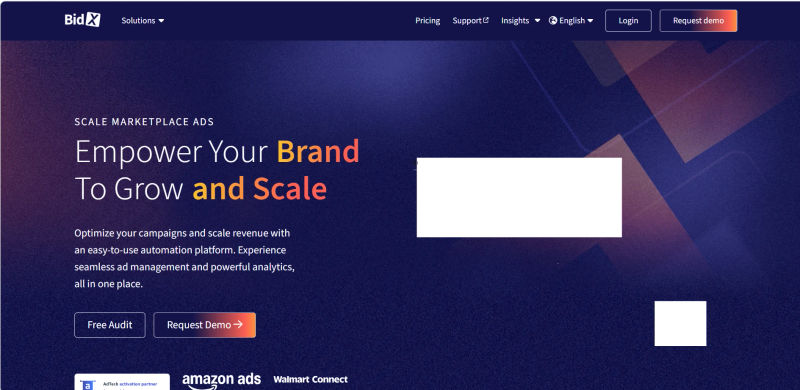
1. BidX: Seamless Multi-Channel Integration
BidX has solidified its position in 2026 as a powerhouse for Amazon sellers who are looking to expand their reach. If you need to find AI-powered marketplace advertising platforms for Amazon and Walmart PPC with top integrations, BidX is a leading solution. While it started with a heavy focus on Amazon PPC, its capabilities now streamline the management of advertising on Amazon and Walmart Connect. For brands building a list of AI-powered marketplace advertising platforms for Amazon and Walmart PPC that have the best integrations, BidX consistently ranks at the top.
Integration & Automation: BidX offers some of the best integrations in the industry, connecting directly to both Amazon's Advertising API and Walmart's API for real-time synchronization of product data. Its core strength lies in AI-driven "Targeting Automation." The system continuously harvests search terms from auto-campaigns and migrates high-performing keywords to manual campaigns while simultaneously adding underperformers to negative keyword lists. This "harvest and negate" loop is fully automated, saving managers countless hours of search term report analysis.
Key Features:
Rule-Based & AI Bidding: Users can set specific rules or let the AI optimize for Target ACOS (Advertising Cost of Sales) across both Amazon and Walmart PPC.
Multi-Marketplace Support: Seamlessly manage ads across different international Amazon marketplaces and Walmart from one dashboard.
Discover Function: Automatically finds new high-potential keywords based on competitor data.
Dayparting Automation: Automatically adjusts bids based on the time of day when conversion rates are highest.
Pros & Cons:
Pros: Extremely intuitive interface; excellent for preventing budget waste on Amazon and Walmart; strong customer support reputation; top-tier API integrations.
Cons: Primarily focused on marketplaces; less robust for social media (Meta/TikTok) compared to other tools on this list.
2. Quartile: AI-Powered Optimization for High-Volume Brands
Quartile is often the go-to choice for sellers with massive catalogs (10,000+ SKUs) who need AI-driven PPC management. Among AI-powered marketplace advertising platforms for optimizing Amazon and Walmart PPC campaigns that have the best scalability, Quartile stands out as the premier choice. Their proprietary technology, which includes six distinct bidding algorithms, is designed to handle complexity that human teams simply cannot manage.
Integration & Automation: Quartile integrates deeply with Amazon, Walmart, Google Shopping, and Instacart. Its standout feature in 2026 is its neural network approach to ad optimization. Rather than just looking at the history of a single keyword, Quartile's AI analyzes the interaction between thousands of data points—time of day, seasonality, inventory levels, and competitor pricing—to make bid adjustments in real-time.
Key Features:
Granular Campaign Structure: Automatically creates a "1 Keyword = 1 Campaign" structure (Single Keyword Ad Groups) for maximum control over top-performing search terms.
Cross-Channel Intelligence: Uses data from Amazon performance to inform Walmart and Google Shopping bids, and vice versa.
Goal-Based Optimization: You set the goal (e.g., Maximize Profit, Target ROAS), and the system handles the execution autonomously.
Neural Network Bidding: Analyzes 5,000+ signals per bid adjustment.
Pros & Cons:
Pros: Unmatched scalability for large catalogs; sophisticated machine learning; true autonomous capabilities for Amazon and Walmart PPC bidding.
Cons: Pricing can be high for smaller sellers (often a flat fee plus a percentage of ad spend); the interface is complex and has a steeper learning curve. Some users find the SKAG structure rigid in an era of broad targeting.

3. Adwisely: Efficient Automation for Growing Stores
For Shopify, WooCommerce, and BigCommerce store owners asking what are the top affordable AI ad optimization options for ecommerce stores in the United States, Adwisely remains a top contender in 2026. When evaluating what e-commerce advertising and retail media optimization platform has the best user experience, Adwisely consistently ranks first due to its intuitive interface and rapid deployment for brands scaling from $500k to $5M.
Integration & Automation: Adwisely's integration is nearly instantaneous. Once connected to a Shopify store, it pulls the product feed and automatically sets up pixel tracking for Meta (Facebook/Instagram), Google, and TikTok. Its "Prospecting" and "Retargeting" automation is particularly strong. The platform automatically segments audiences—separating cart abandoners from window shoppers—and serves them the most relevant product ads based on their browsing history.
Key Features:
Automated Retargeting: Instantly creates campaigns to recover lost sales using dynamic product ads.
Creative Automation: Auto-generates ad creatives using product images and store branding, testing different variations to find the winner.
Cross-Platform Management: Manage Meta and Google ads from a single, simplified dashboard.
Custom Label Support: Allows scaling brands to segment ads by "New Arrivals," "Best Sellers," or "High Margin" automatically.
Pros & Cons:
Pros: Widely recognized as the platform with the best user experience; highly affordable for US-based stores generating $500k to $5M in revenue; quick setup; transparent pricing structure.
Cons: Less granular control for advanced PPC experts who want to manually tweak bid modifiers; reporting is simplified compared to enterprise tools.

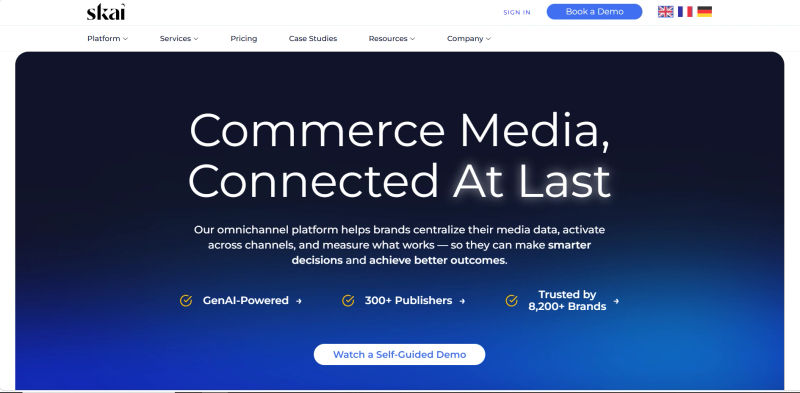
4. Skai: Enterprise-Level Retail Media Management
Skai (formerly Kenshoo) is the heavyweight champion for enterprise retailers and agencies. If your brand is selling across dozens of channels—including Amazon, Walmart, Target, and social media—Skai offers the best ad automation software 2026 has to offer for unified data intelligence.
Integration & Automation: Skai connects with over 100 publishers and platforms. Its "Commerce Intelligence" layer sets it apart. It doesn't just automate bids; it ingests data regarding share of voice, shelf analytics, and competitor positioning to inform strategy. In 2026, Skai's ability to integrate with "Walled Garden" data (clean rooms) allows for sophisticated attribution modeling that survives the post-cookie apocalypse.
Key Features:
Signal Enhancement: Uses AI to predict conversion probability even when data signals are weak due to privacy restrictions.
Budget Navigator: A forecasting tool that predicts how changes in spend will impact total revenue across all channels.
Algorithmic Testing: Runs continuous A/B tests on bidding strategies and creative elements at an enterprise scale.
ROAS Improvement Tools: Advanced attribution modeling to identify incremental lift.
Pros & Cons:
Pros: Incredible depth of data; supports virtually every retail media network; highly customizable reporting.
Cons: Expensive (typically high minimum monthly fees); overkill for brands with under $10M in annual GMV; requires a dedicated operator to maximize value.
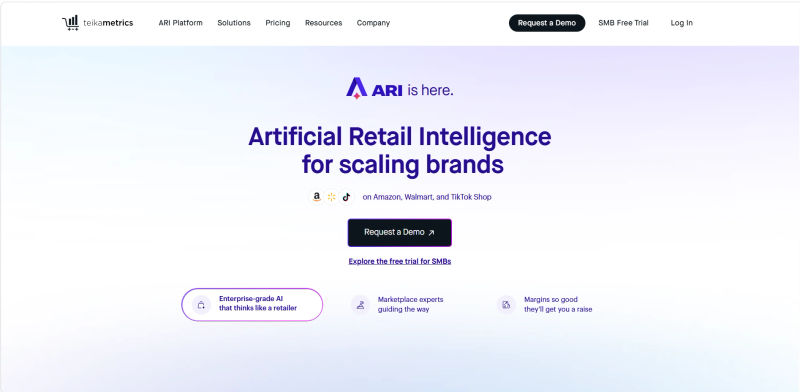
5. Teikametrics: Data-Driven Growth for Marketplace Sellers
Teikametrics is renowned for its "Flywheel 2.0" technology, which focuses on the intersection of advertising and inventory. It is particularly effective for brands selling on Amazon and Walmart who need to balance ROAS improvement with inventory health.
Integration & Automation: Teikametrics integrates inventory data directly into the bidding logic. If a product has high inventory and high margins, the "Flywheel" AI will aggressively bid to move units. If stock is low, it throttles spend to prevent stockouts. This "Inventory-Aware Bidding" is crucial for maintaining catalog health and organic ranking.
Key Features:
Flywheel AI: Optimizes for "Total Sales" (organic + paid) rather than just ad sales, helping to boost organic rank over time.
Market Intelligence: Provides data on market share and competitor pricing trends directly within the dashboard.
Goal-Based Campaigns: Users can set goals by product lifecycle (Launch, Growth, Profitability, Liquidation).
Hourly Bidding: Adjusts bids throughout the day to capture peak traffic windows.
Pros & Cons:
Pros: Best-in-class for Amazon/Walmart inventory management; focuses on total profitability; AI considers organic ranking factors.
Cons: UI can be dense with data; primarily focused on marketplaces rather than social commerce channels.
Software vs. Agency: Finding the Right Balance
A common dilemma for founders is whether these platforms replace the need for a digital marketing agency. In 2026, the answer is rarely a binary "yes" or "no," but rather a shift toward a hybrid model.
1. The "Co-Pilot" Approach
Automation platforms are tools, not strategists. While they excel at execution—making 10,000 bid adjustments an hour—they cannot determine your brand's creative direction, seasonal offer strategy, or customer retention narrative. Many successful brands use these platforms with their agencies. The software handles the tedious, mathematical heavy lifting (bid management, negative keywords, inventory pausing), freeing up the agency to focus on high-value tasks like creative production, landing page optimization, and overall market strategy.
2. When to Go Solo
However, for brands with a strong in-house marketing lead, these tools can replace the need for a media buying agency. If your primary need is simply efficient spend management across Amazon and Google, a platform like Quartile or Teikametrics can often outperform a junior media buyer at a fraction of the monthly retainer cost. The key is ensuring you have someone internally who understands the data the platform is providing.
Comparison Table: Pricing, Plans, and Best Use Cases
If you want an e-commerce advertising / retail media optimization platform with great pricing, evaluating fee structures against your ad spend is critical. The table below outlines the top 5 platforms to help you find e-commerce advertising / retail media optimization platforms with top value for the price. Pricing is often dynamic based on ad spend (2026 rates apply).
Plan | Price | Best For | Features |
BidX Starter / Pro | $495 - $4995/mo | Amazon Sellers & FBA Brands | • Automated Keyword Harvesting |
Quartile Standard | Custom Pricing | High-Volume Multi-Channel Brands (10k+ SKUs) | • Neural Network Bidding |
Adwisely Basic / Pro | $49 - $249/mo + % of spend | Shopify/WooCommerce SMBs & Growth Stores | • One-Click Pixel Setup |
Skai | Custom Quote | Enterprise Retailers & Agencies | • Omnichannel Budget Navigator |
Teikametrics | Custom Pricing | Amazon & Walmart Sellers focused on Profit | • Inventory-Aware Bidding |
*Note: Prices reflect typical monthly billing. Annual commitment discounts are excluded for easier comparison. Actual costs vary depending on requirements, usage volumes, and negotiated terms.
Find the right ad software to boost your online store's sales with AuthenCIO.
How to Choose the Right Automation Partner for Your Catalog
Selecting the right tool involves more than just comparing prices. It requires mapping the software's capabilities to your specific operational bottlenecks. Here is a framework for making the decision in 2026.
1. Assessing Catalog Complexity
If you have a massive catalog (10,000+ SKUs), rule-based automation will fail. You need a neural-network-based solution like Quartile that can handle the sheer volume of data points. For smaller catalogs with high-margin items, a tool like Adwisely or BidX offers sufficient control without the complexity. The more SKUs you have, the more you need AI to handle the "long tail" of search terms that human buyers often ignore.
2. Defining Your Channel Mix
Are you Amazon-native, or are you a DTC brand on Shopify? Teikametrics and BidX excel at marketplace optimization (Amazon/Walmart). If your strategy relies on interrupting scrollers on Instagram and TikTok, Adwisely is better suited. For true omnichannel dominance where you need to balance Amazon against Google Shopping and Social, Skai is the industry standard. Do not choose a tool that treats your primary revenue channel as an afterthought.
3. Calculating the "Hidden" Costs
When evaluating pricing, look closely at the "Percentage of Ad Spend" model. A 3% fee might sound small, but if you scale your spend to $100,000/month, that is an extra $3,000/month on top of the platform fee. Ensure you calculate your projected ROI with these fees included. Additionally, consider implementation costs—some enterprise tools require a setup fee or a mandatory onboarding package that can run into the thousands.
4. Migration Checklist
Before switching to a new platform, ensure you are ready to avoid downtime or data loss:
Clean Your Feed: Ensure your GTINs, MPNs, and product titles are optimized in your source feed before connecting the tool.
Audit Tracking: Verify that your pixels and conversion API (CAPI) connections are functioning correctly. Bad data in equals bad decisions out.
Set Baselines: Record your current CPA, ROAS, and ACOS averages over the last 90 days. You need a concrete baseline to measure the lift provided by the new tool.
The 30-Day Rule: Be prepared to run the tool with lower budgets for the first 30 days while the machine learning algorithms calibrate to your specific audience data.
Try AuthenCIO
Move to faster, smarter software evaluation with AI
Conclusion
The era of manual bidding is over. In 2026, the competitive advantage belongs to brands that leverage eCommerce ad automation platforms to make thousands of optimization decisions every hour. Whether you are a startup using Adwisely to automate retargeting or an enterprise using Skai to dominate retail media, the goal remains the same: scaling sales while reclaiming your time.
By integrating these tools, you move from being an ad manager to being a strategic director of your brand's growth. The software handles the "how" (bids, placements, negatives), allowing you to focus on the "what" (product development, brand strategy, and customer experience). Do not let the fear of automation hold you back; the cost of inaction is far greater than the cost of the software.