
Introduction
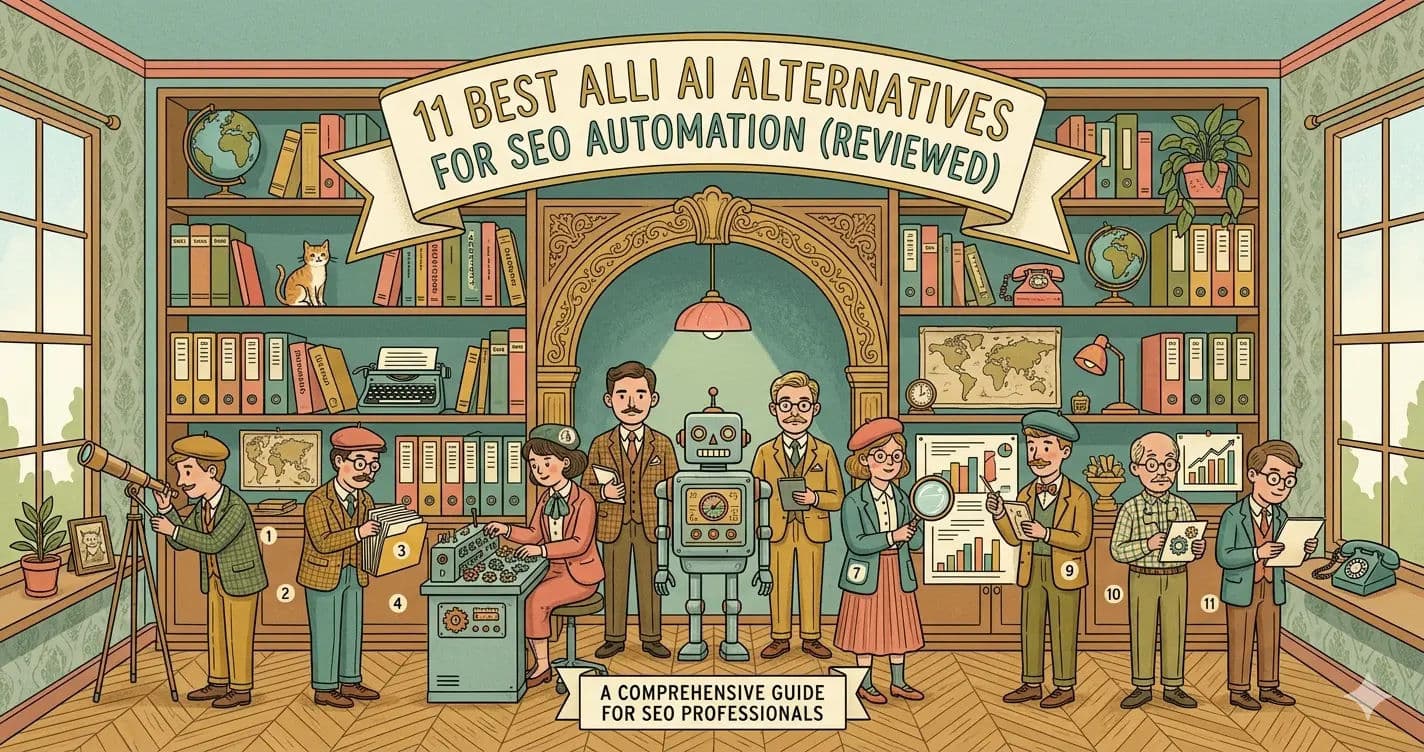
Alli AI carved out its space by promising hands-off SEO automation, letting you deploy code-level changes and on-page fixes at scale. For many, it was a powerful solution to the perennial developer bottleneck. But it's 2026, and the landscape of AI-driven search has shifted dramatically. The volatility of AI Overviews (formerly SGE), the complexities of headless CMS architectures, and the demand for more nuanced, strategic automation have led many seasoned SEO specialists to ask: Is a 'set and forget' tool still the right tool?
Streamline your software evaluation process
The answer is often no. The market has moved beyond Tactical Automation—the simple, rule-based implementation of fixes—to Strategic Automation. This new paradigm is about creating an integrated SEO operating system that uses AI for predictive analytics, semantic optimization, and revenue-connected insights, empowering specialists, not just replacing them. If you're finding Alli AI's rigid auto-remediation approach limiting, its pricing misaligned with your needs, or its capabilities lacking in specialized areas, you're not alone.
This guide is designed for you—the in-the-trenches SEO specialist at a mid-sized firm. We're cutting through the marketing hype to deliver a direct, comparative analysis of the 11 best Alli AI alternatives. We'll focus on the single most important question: 'Who is this tool best for?' to help you move from consideration to a confident decision.
Comparison Table: Top SEO Automation Tools at a Glance
Tool | Best For | Pricing | Key Features |
Surfer | Automated Content Optimization & NLP | Starts at $119/mo | AI content briefs, Real-time content editor, SERP analyzer |
AI-Driven Strategy & Prompt Engineering | Starts at $49/mo | Automated keyword clustering, SGE-optimized workflows, Strategic prompt library | |
Semrush | Comprehensive Marketing Automation | Starts at $140/mo | Scheduled site audits, Automated reporting, Position tracking alerts |
Screaming Frog | Desktop-Based Technical Auditing | $279/year | Scheduled crawls, Custom extraction, Headless JavaScript rendering |
Sitebulb | Visual Technical SEO Insights | Starts at $18/mo | Crawl maps, Prioritized audit recommendations, PDF report generation |
Ahrefs | Automated Backlink Analysis | Starts at $129/mo | New/lost backlink alerts, Competitor monitoring, Internal linking opportunities |
Moz | Local SEO Automation & Domain Metrics | Starts at $99/mo | Automated listing management, Review monitoring alerts, Link Explorer automation |
Ryte | Website Quality Assurance & UX | Custom Pricing | Real-time user journey analysis, Core Web Vitals monitoring, Technical issue alerts |
OnCrawl | Data-Driven SEO Log Analysis | Custom Pricing | Log file & crawl data blending, Indexability monitoring, SEO impact reports |
Lumar | Real-Time Technical SEO Guardrails | Custom Pricing | Pre-production issue detection, Automated QA for dev cycles, Site health monitoring |
SE Ranking | Cost-Effective Rank Tracking Automation | Starts at $129/mo | Daily SERP position updates, Competitor rank tracking, Scheduled reporting |
*Note: All prices shown reflect typical monthly billing. Vendors often offer lower pricing for annual commitments, but those discounts are excluded here for easier comparison. Actual costs may vary depending on your requirements, usage volumes, and negotiated terms.
Software Covered in this Article
To help you understand SEO & Search Visibility Tools Software in the right context, this article refers to a carefully curated set of key players:




Why SEO Specialists are Moving Beyond Alli AI in 2026
While Alli AI excels at programmatic implementation, the demands of 2026 require a more sophisticated approach. Specialists are seeking alternatives for several key reasons:
Need for Deeper Specialization: All-in-one solutions can be a jack-of-all-trades but a master of none. Teams often need a best-in-class tool for a specific function, whether it's enterprise-grade crawling, AI content optimization, or automated backlink analysis.
Flexibility and Control: The one-size-fits-all auto-remediation of Alli AI can sometimes clash with unique site architectures or custom JavaScript frameworks. Many specialists now prefer powerful suggestion engines that keep them in the driver's seat, avoiding the risk of automated changes causing ranking drops or code bloat.
AI Overview & Entity Optimization: The game has changed. Optimizing for AI-generated content and tracking visibility within AI Overviews requires platforms built with these new realities in mind, focusing on semantic optimization and entity mapping that go beyond basic meta tag fixes.
Integration with Modern Stacks: As more companies adopt headless CMS platforms, the need for tools with robust APIs and proven compatibility with these architectures has become paramount. A tool's ability to integrate smoothly into a larger marketing tech stack is now a critical evaluation point.
Transparent ROI: With rising tool prices, leadership demands clear justification for every dollar spent. Specialists need platforms that excel at connecting SEO activities directly to revenue and business KPIs, a task where more comprehensive suites often have an edge.
Detailed Reviews: The 11 Best Alli AI Alternatives for Every Use Case
We've categorized the top alternatives into three core groups based on their primary strengths: All-in-One Platforms for broad automation, Technical SEO Specialists for deep-dive analysis, and Content Optimization Engines for AI-powered content workflows.
1. Surfer: Best for Automated Content Optimization & NLP
Who it's best for: Teams where content velocity and on-page relevance are the primary growth levers. Surfer excels at turning keyword strategy into actionable, optimized content briefs at scale.
Key Automation Features: Surfer's automation is centered on the pre-writing and optimization phases. Its Grow Flow feature uses AI to find and suggest new content opportunities, internal linking improvements, and keyword gaps weekly. The core Content Editor provides real-time scoring based on NLP analysis of top competitors, automating the process of ensuring comprehensive topical coverage.
How it Compares to Alli AI: Surfer is a specialized content tool, whereas Alli AI's content features are part of a broader technical suite. If your main bottleneck is producing high-quality, SERP-aligned content quickly, Surfer provides a far more sophisticated and effective automation workflow than Alli AI's more basic on-page text changes.
2. Rank Prompt: Best for AI-Driven Strategy & Prompt Engineering
Who it's best for: Forward-thinking SEO teams that are heavily invested in leveraging generative AI for strategy and execution, particularly for optimizing against AI Overviews.
Key Automation Features: Rank Prompt automates the strategic layer of content SEO. It uses AI to perform massive keyword clustering, identifying topic hubs and content gaps. Its standout feature is a library of SGE-optimized prompts that automate the creation of strategic outlines and briefs designed to perform well in generative search interfaces. It bridges the gap between raw keyword data and an executable content plan.
How it Compares to Alli AI: Rank Prompt automates strategy, while Alli AI automates implementation. Rank Prompt helps you decide what to write about and how to structure it for 2026's search landscape. Alli AI would then (in theory) implement the on-page elements. For teams needing to scale their strategic output, Rank Prompt is an essential upstream addition or alternative.
3. Semrush: Best for Comprehensive Marketing Automation
Who it's best for: Mid-sized firms that need an integrated platform for monitoring and reporting across multiple marketing channels, not just SEO.
Key Automation Features: Semrush's power lies in its automated intelligence gathering. The Site Audit tool can be scheduled to run weekly, sending alerts on new issues. Its Position Tracking tool offers triggers for SERP feature changes and volatility, crucial for monitoring AI Overview visibility. The My Reports feature automates the entire stakeholder communication process with custom, scheduled PDF reports pulling from over 50 data widgets.
How it Compares to Alli AI: Semrush provides strategic suggestions and automated monitoring, keeping the specialist in control. It does not perform auto-remediation of code. Choose Semrush when your primary automation need is market intelligence, competitive tracking, and streamlined reporting across the entire marketing funnel, rather than hands-off technical implementation.
4. Screaming Frog: Best for Desktop-Based Technical Auditing
Who it's best for: Hands-on technical SEOs who require granular control and infinite flexibility for deep-diving into complex site architectures, including those with heavy JavaScript.
Key Automation Features: Screaming Frog's automation is for the power user. The licensed version allows for scheduled crawls that can run headless (rendering JavaScript) and automatically export specific reports (e.g., 404s, Core Web Vitals data, schema validation). Its command-line interface allows you to integrate it into larger scripts, creating a fully customized and automated auditing system that can push data to other platforms.
How it Compares to Alli AI: This is the ultimate 'suggestion engine' versus 'auto-remediation' tool. Screaming Frog gives you unparalleled diagnostic power to find every issue, no matter how obscure. Alli AI tries to fix the most common ones for you. For specialists who trust their own expertise to make the final call, Screaming Frog provides the raw, automated data feed they need.
5. Sitebulb: Best for Visual Technical SEO Insights
Who it's best for: SEOs in agency settings or in-house teams who need to communicate complex technical issues to non-technical stakeholders (like project managers or C-suite executives).
Key Automation Features: Sitebulb automates the process of turning raw crawl data into actionable, prioritized insights. After a crawl, it automatically generates hundreds of context-rich recommendations. Its key automation feature is the creation of visual crawl maps and easily digestible PDF reports that clearly explain issues, saving hours of time typically spent translating technical jargon for other departments.
How it Compares to Alli AI: Sitebulb automates understanding and communication. Where Alli AI automates the fix, Sitebulb automates the 'why' and 'how important' behind the fix. If your biggest bottleneck is getting buy-in and developer resources, Sitebulb's automated, clear reporting is a more effective tool for driving change.
Find Perfect Software For Your Business
6. Ahrefs: Best for Automated Backlink Analysis
Who it's best for: Teams in competitive niches where organic growth is heavily dependent on building and maintaining a strong backlink profile.
Key Automation Features: Ahrefs automates the entire off-page monitoring workflow. You can set up real-time alerts for new and lost backlinks for your domain and your competitors'. This allows for rapid link reclamation outreach or capitalizing on a competitor's new link source. Its Site Audit tool also provides automated internal linking suggestions to better distribute authority across your site.
How it Compares to Alli AI: The focus is entirely different. Ahrefs automates the monitoring of off-page factors, while Alli AI automates on-page implementation. If your strategy is authority-driven, the real-time intelligence Ahrefs provides is indispensable. It tells you where to focus your efforts, a strategic function Alli AI doesn't cover.
7. Moz: Best for Local SEO Automation & Domain Metrics
Who it's best for: Multi-location businesses and agencies managing local clients where maintaining NAP consistency and online reputation is a primary KPI.
Key Automation Features: Through Moz Local, the platform automates the tedious process of managing and syncing business listings across a vast network of directories and data aggregators. It also provides automated alerts for new customer reviews, allowing for timely responses. This suite of tools is designed to put local SEO management on autopilot.
How it Compares to Alli AI: This is a specialist vs. generalist comparison. Alli AI is built for universal on-page optimization, while Moz Pro is purpose-built to solve the unique automation challenges of local SEO. For any business reliant on local pack rankings, Moz's automation is far more relevant and impactful.
8. Ryte: Best for Website Quality Assurance & UX
Who it's best for: Teams that view SEO as part of a larger Website Quality Assurance (WQA) and user experience mission, focusing on metrics like Core Web Vitals and accessibility.
Key Automation Features: Ryte automates the monitoring of the entire user journey. It continuously scans for broken links, performance issues, and accessibility errors. Its alerts are not just about SEO tags but about anything that could harm the user experience or brand perception. It provides a holistic, automated view of website health beyond traditional SEO metrics.
How it Compares to Alli AI: Ryte takes a much broader view of site health. While Alli AI focuses on automating fixes for search engine crawlers, Ryte automates the detection of issues for human users. If your company's philosophy is 'what's good for the user is good for Google,' Ryte's user-centric automation is a better fit.
9. OnCrawl: Best for Data-Driven SEO Log Analysis
Who it's best for: Technical SEOs at large e-commerce or publisher sites who need to understand exactly how search engines are crawling their site to optimize crawl budget.
Key Automation Features: OnCrawl automates the complex process of blending data from your website crawl with server log files. This provides an unparalleled view of which pages Google is crawling, how often, and which sections are being ignored. It automates the detection of indexability issues and crawl waste, providing data-backed insights that are impossible to get from a standard crawler.
How it Compares to Alli AI: OnCrawl provides the deep, diagnostic data that informs high-level technical strategy. Alli AI provides tactical implementation. If you are struggling with getting important pages indexed on a million-page site, the automated insights from OnCrawl are critical. It answers the 'why' behind indexation problems, making it a powerful strategic alternative.
10. Lumar: Best for Real-Time Technical SEO Guardrails
Who it's best for: SEO teams at companies with fast-paced development cycles (CI/CD) who need to prevent SEO issues from being deployed to production in the first place.
Key Automation Features: Lumar integrates directly into the development pipeline. It automates technical SEO testing in pre-production environments. This creates 'technical SEO guardrails,' automatically flagging any code pushes that would negatively impact SEO (e.g., removing canonical tags, blocking pages in robots.txt). It's a truly proactive form of automation.
How it Compares to Alli AI: Lumar is preventative, while Alli AI is corrective. Lumar stops the 'developer bottleneck' before it even starts by embedding automated SEO checks into the workflow. This is one of the most advanced forms of programmatic SEO software in 2026, making it a highly strategic alternative for mature organizations.
11. SE Ranking: Best for Cost-Effective Rank Tracking Automation
Who it's best for: Budget-conscious mid-sized firms and agencies that need a reliable, all-in-one platform with a strong emphasis on accurate, automated rank tracking and reporting.
Key Automation Features: SE Ranking's core strength is its automated, daily SERP position updates, which are known for their accuracy. The platform automates the entire reporting workflow with a flexible, white-label report builder that can be scheduled and sent to clients or stakeholders. Its site audit tool also offers scheduled monitoring to track technical health over time.
How it Compares to Alli AI: SE Ranking is the pragmatic choice. It replaces Alli AI's auto-implementation with a comprehensive suite of monitoring and reporting tools at a fraction of the cost of other all-in-one platforms. If your main goal is to automate intelligence gathering and reporting without a large budget, SE Ranking offers the best value.
Buyer’s Guide: How to Choose the Right SEO Automation Tool for Your Firm
Choosing the right Alli AI alternative requires a strategic approach, not just a feature comparison. Use this 4-step framework to make a confident decision.
Step 1: Audit Your Workflow & Identify the Real Bottleneck
Before looking at any tool, map your team's current SEO process. Where does work slow down? Is it the developer queue for technical fixes? The time it takes to create a content brief? The hours spent building monthly reports? Your true bottleneck dictates the type of automation you need most.
Step 2: Define Your 'Must-Have' Automation Features
Based on your bottleneck, create a short list of non-negotiable features. Examples include:
If the bottleneck is dev time: You need automated technical monitoring and pre-production guardrails (Lumar).
If the bottleneck is content creation: You need AI-driven brief generation and SERP analysis (Surfer, Rank Prompt).
If the bottleneck is reporting: You need scheduled, white-label report builders (Semrush, SE Ranking).
Step 3: Match Your Use Case to a Tool Category
Use the categories in this article to narrow your search. Don't evaluate a technical crawler if your main problem is content velocity. This is the most crucial step to avoid being distracted by features you don't need.
All-in-One Platforms: For teams needing broad visibility and reporting automation.
Technical SEO Specialists: For teams managing large, complex sites where technical health is paramount.
Content Optimization Engines: For teams where content is the primary driver of growth.
Step 4: Run a Pilot Project or Trial
Never buy a tool based on a demo alone. Sign up for a trial and give it a real-world task. For example, audit a specific subfolder of your site, generate three content briefs, or set up a weekly report for one project. This is the only way to test its true impact on your team's productivity.
Stop the sales pressure and choose your next automation tool using AuthenCIO.
Maximizing ROI with SEO Automation in 2026
Investing in a new tool requires justification. To get C-suite buy-in, you must connect the platform's features to business outcomes.
Presenting ROI to Stakeholders
Frame the investment around three key pillars:
Cost Savings (Efficiency): Calculate the hours your team currently spends on manual tasks that the tool automates. Multiply those hours by your team's hourly cost. (e.g., 'This tool automates 20 hours of manual reporting per month, saving us $1,500 in productivity costs.')
Risk Mitigation (Prevention): For technical tools like Lumar or Ryte, the ROI is in preventing costly mistakes. Frame it as insurance. (e.g., 'By catching critical SEO bugs before they go live, we prevent potential ranking drops that could cost us an estimated $10,000 per day in lost revenue.')
Revenue Growth (Performance): Connect the tool's output to KPIs that leadership understands. Use data from your trial period to create a forecast. (e.g., 'Our pilot with Surfer improved our content scores by 30%. We project this will lead to a 15% increase in organic traffic to our key service pages, valued at $25,000 in new leads per quarter.')
Try AuthenCIO
Move to faster, smarter software evaluation with AI
Final Verdict: Which Alli AI Alternative Wins?
The truth is, there is no single 'winner.' The best SEO automation software for your mid-sized firm in 2026 is the one that solves your most significant bottleneck. The era of a single tool to do everything is over; the future is a strategic, layered stack.
If your developer queue is your biggest problem, a preventative tool like Lumar is your best bet.
If content quality and velocity are holding you back, a content engine like Surfer or Rank Prompt will deliver the highest ROI.
If you need to automate intelligence and reporting to make smarter decisions, an all-in-one platform like Semrush or SE Ranking is the right choice.
The key is to move from tactical fixes to strategic empowerment. Stop looking for a tool that will 'do SEO for you' and start looking for one that will make your team smarter, faster, and more impactful.