
Introduction
Surfer SEO has undeniably carved out a significant space in the content optimization world. Its intuitive editor and data-driven scores made it a go-to for many content agencies. But as we navigate the competitive landscape of 2026, a critical question emerges for agency owners focused on profitability: is Surfer still the undisputed king? For those seeking the best Surfer SEO alternatives in 2026, the answer is becoming more complex.
Streamline your software evaluation process
The search landscape has fundamentally evolved. With AI-driven paradigms like Generative Engine Optimization (GEO) and Semantic Retrieval Optimization (SRO) dictating visibility, the 'best' tool is no longer just about keyword density. It's the one that aligns perfectly with your agency's specific workflow, client demands, and budget. For many scaling agencies, Surfer's credit-based system creates unpredictable costs, the feature set includes tools you never use, and the price point can be prohibitive when managing dozens of client projects.
This guide is designed to cut through the noise. We're providing a direct, comparison-focused breakdown to help you, a decision-maker, choose the right Surfer SEO alternative to fuel your agency's growth. We'll start with a high-level comparison before diving deep into each platform.
Key Takeaways for Agency Owners
Predictable Pricing is Key: Flat-rate subscriptions are better for scaling than credit-based models.
Specialized Tools Reduce Waste: Paying only for features you use maximizes your software ROI.
Focus on ROI, Not Scores: The best tool's recommendations translate into actual ranking improvements.
Collaboration is Non-Negotiable: Your tool must support multi-user workflows efficiently.
Quick Comparison: Top Surfer SEO Alternatives at a Glance
Tool | Best For | Pricing | Key Features |
Clearscope | High-End Enterprise Content Strategy | Starts at $129/month | A.I.-powered briefs, term mapping, Google Docs integration, high-quality NLP. |
Frase | Rapid Content Briefing & AI Integration | Starts at $49/month | Automated briefs, AI writer, SERP analysis, question research, GSC integration. |
MarketMuse | Deep Topical Authority & Gap Analysis | Custom Pricing | Content inventory analysis, personalized difficulty scores, topic modeling. |
Jasper | AI-Driven Content Creation & Optimization | Starts at $69/month | Advanced AI writing templates, brand voice features, multi-format generation. |
Dashword | Simple, Affordable Content Grading | Starts at $99/month | Minimalist UI, content briefs, SERP analysis, easy-to-understand scoring. |
Outranking | Data-Driven Content Strategy & ROI | Starts at $19/month | Guided SEO workflows, factual accuracy checks, internal linking automation. |
PageOptimizer Pro | Technical On-Page SEO Precision | Starts at $40/month | E-E-A-T analysis, schema recommendations, precise keyword recommendations. |
Rank Math | WordPress-Integrated Content Optimization | Starts at ~$8/month | Deep WordPress integration, on-page SEO suggestions, schema markup. |
NeuronWriter | Semantic SEO & NLP on a Budget | Starts at $23/month | Advanced content editor, NLP-based recommendations, internal linking ideas. |
Content Harmony | High-Volume Agency Workflows | Starts at $50/month | Keyword reports, intent analysis, visual/video analysis, team collaboration. |
SE Ranking | All-in-One SEO Suite with Content Tools | Starts at $129/month | Content editor, rank tracking, site audits, keyword research, white-label reports. |
Serpstat | Comprehensive Competitor Content Analysis | Starts at $55/month | Keyword clustering, text analytics, SERP analysis, site audit, rank tracking. |
*Note: All prices shown reflect typical monthly billing. Vendors often offer lower pricing for annual commitments, but those discounts are excluded here for easier comparison. Actual costs may vary depending on your requirements, usage volumes, and negotiated terms.
Software Covered in this Article
To help you understand SEO & Search Visibility Tools Software in the right context, this article refers to a carefully curated set of key players:











Why Content Agencies are Switching from Surfer SEO for Affordable SEO Content Tools
While Surfer remains a powerful platform, its model presents several challenges for growing content agencies in 2026. The push towards alternatives isn't just about finding a cheaper tool; it's about finding a smarter tool for a specific business model.
Here are the primary pain points driving the shift:
Unpredictable and High Costs: Surfer's credit system for its Content Editor and Audit features can make budgeting a nightmare. As you scale client work, these costs can balloon unexpectedly, eating directly into your profit margins. Many alternatives offer more predictable, tiered pricing with higher or unlimited usage, making financial forecasting simpler.
Feature Bloat vs. Specialized Needs: Agencies often pay for a suite of features within Surfer when they only need one or two core functions. A team focused on technical on-page SEO has different needs than one churning out AI-assisted blog posts. Specialized alternatives allow agencies to pay only for the functionality they use, optimizing their tool stack for maximum ROI.
The Content Score Dilemma: The ultimate goal is improved search visibility, not just a high score. Some agencies report frustration when a '90+' score in Surfer doesn't translate to tangible ranking improvements. This has led to a search for tools with different scoring logic, focusing more on NLP entities and semantic relevance, which are critical for visibility in today's AI-powered search results.
Limited Team Collaboration: As agencies grow, managing multiple writers, editors, and client projects within a single account becomes a significant operational bottleneck. The lack of granular user permissions and project management features in Surfer pushes teams towards platforms built for collaborative agency workflows.
Join 10,000+ businesses using AuthenCIO to find the best SEO software for their agency.
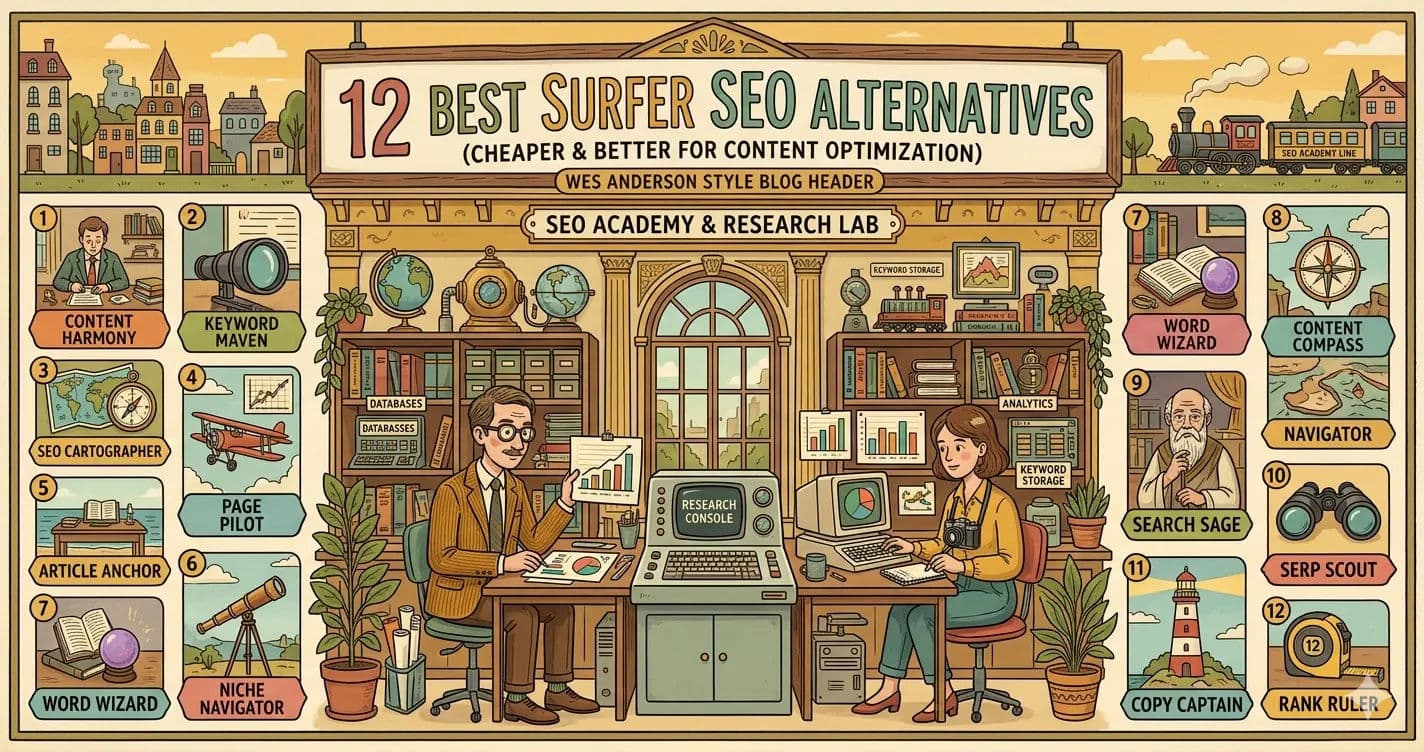
The 12 Best Surfer SEO Alternatives for Every Agency Use Case
Let's dive deeper into what makes each of these tools a compelling alternative to Surfer SEO for a specific type of agency.
1. Clearscope: Best for High-End Enterprise Content Strategy
Who is this best for? Agencies working with enterprise-level clients where content quality and subject matter expertise are paramount. If your clients are in competitive B2B tech, finance, or healthcare, Clearscope is your tool.
Clearscope positions itself as a premium offering, and for good reason. Its core strength lies in its sophisticated NLP engine, which excels at identifying relevant entities and semantic terms. While Surfer provides a strong list of keywords, Clearscope's recommendations often feel more nuanced and aligned with establishing true topical authority. Its content grading system is straightforward and highly respected, making it easy to train writers and demonstrate value. While it doesn't support bulk content brief generation, its API allows for custom workflow integrations. The downside is its price; starting at $170/month, it's not a budget option, but for agencies that can bake this cost into high-value retainers, the ROI is undeniable.
2. Frase: Best for Rapid Content Briefing and AI Integration
Who is this best for? High-volume content agencies that need to produce quality content briefs at lightning speed. If your workflow bottleneck is the research and outlining phase, Frase is your solution.
Frase’s standout feature is its ability to generate comprehensive, well-structured content briefs from a target keyword in minutes, and it supports bulk brief creation to further accelerate high-volume workflows. It analyzes top SERP results and pulls in headings, common questions, and statistics, organizing it all into an editable document. This dramatically cuts down on manual research time. With pricing starting around $38/month annually, it's one of the most cost-effective alternatives. Its integrated AI writer is also a powerful addition for drafting initial sections, making it a versatile tool for agencies focused on operational efficiency.
3. MarketMuse: Best for Deep Topical Authority and Gap Analysis
Who is this best for? SEO strategy-focused agencies that manage entire content ecosystems for clients and aim to build them into recognized industry authorities.
MarketMuse goes beyond single-page optimization. Its power lies in its suite of tools for content strategy, including auditing a client's entire website to identify content gaps and build a topical model. Its personalized difficulty score is a game-changer, telling you how hard it is for your specific domain to rank for a keyword. While Surfer is excellent for optimizing a given article, MarketMuse helps you decide which articles to write in the first place. For bulk processing, its platform is designed around managing large content inventories and strategic plans. It's a strategic weapon for agencies that sell long-term content strategies, not just one-off blog posts.
4. Jasper: Best for AI-Driven Content Creation and Optimization
Who is this best for? Agencies that have fully embraced AI in their content workflow and need a best-in-class writing assistant that also handles optimization.
Jasper has evolved from a simple AI writer into a comprehensive content platform. Its key advantage is the sheer quality and versatility of its AI writing capabilities, with dozens of templates and a sophisticated brand voice feature. Jasper now integrates SEO optimization directly, allowing you to use its own features or connect to your Surfer account. Its API allows for extensive bulk content generation, making it a powerhouse for programmatic SEO and high-volume needs. For an agency that wants one tool to handle both initial creation and on-page SEO, Jasper streamlines the process significantly.
Find Perfect Software For Your Business
5. Dashword: Best for Simple, Affordable Content Grading
Who is this best for? Agencies and freelance writers who want a clean, no-frills content editor that provides clear grading and competitive insights without a steep learning curve.
Dashword is the answer to feature bloat. It does one thing exceptionally well: it helps you write content that ranks. Its user interface is minimalist and incredibly easy to learn, making it perfect for onboarding new writers quickly. The tool generates a report based on your target keyword, showing you the terms to include, a target word count, and a readability score. While it lacks deep strategic tools or native bulk processing, its API can be used to build custom solutions. Its focus on core optimization makes it a fast, efficient, and affordable Surfer alternative for teams that value simplicity and speed.
6. Outranking: Best for Data-Driven Content Strategy and ROI
Who is this best for? Methodical, process-driven agencies that want a guided workflow from keyword research and clustering to writing and optimization.
Outranking is built for agencies that love structured processes. It's more than just a content editor; it's a platform that guides you through the entire content lifecycle. It excels at SERP analysis, providing deep insights and factual data to inform your writing. One of its most powerful features is its emphasis on factual accuracy and its ability to automate internal linking suggestions. It supports bulk processing of SERP analysis and content brief generation, saving immense amounts of time for large projects. For agencies that need to prove ROI to clients with data at every step, Outranking provides the framework to do so effectively.
7. PageOptimizer Pro: Best for Technical On-Page SEO Precision
Who is this best for? Technically-minded SEO agencies that specialize in on-page optimization and believe in a scientific, reverse-engineering approach to ranking.
Created by SEO expert Kyle Roof, PageOptimizer Pro (POP) operates on the principle of scientific testing, focusing on the exact signals Google is rewarding for a specific keyword. POP's recommendations are incredibly precise, covering everything from keyword placement in H-tags to schema and E-E-A-T signals. While bulk analysis is possible through its API, the tool shines in its granular, page-by-page tuning capabilities. While Surfer gives you a broad content score, POP gives you a field-by-field checklist to implement. For agencies that offer highly technical on-page SEO services, POP provides a level of detail that other tools simply can't match.
8. Rank Math: Best for WordPress-Integrated Content Optimization
Who is this best for? Agencies that work exclusively or primarily with clients on WordPress and want to centralize their on-page SEO efforts within the CMS.
Rank Math has rapidly become a dominant force in the WordPress SEO plugin space. Its Content AI feature makes it a direct Surfer alternative, bringing optimization suggestions directly into the WordPress editor. The convenience of not having to switch between a third-party app and your CMS is a massive workflow improvement. While it lacks the standalone app's bulk processing power, its deep integration simplifies the optimization of individual posts at scale. With a generous free version and an incredibly affordable Pro plan, it offers unbeatable value for WordPress-centric agencies.
9. NeuronWriter: Best for Semantic SEO & NLP on a Budget
Who is this best for? Agencies seeking the advanced NLP and semantic analysis features of premium tools like Clearscope but at a more accessible price point.
NeuronWriter is a powerful hidden gem that punches well above its weight class. It provides a sophisticated content editor with NLP-driven term recommendations, SERP analysis, and competitor breakdowns. Its standout features include Google Search Console integration for content planning and a focus on user intent. It supports bulk analysis and content scoring, allowing you to manage large projects and prioritize optimization efforts efficiently. For agencies that want deep semantic optimization capabilities without the enterprise-level price tag, NeuronWriter offers an exceptional balance of power and affordability.
10. Content Harmony: Best for High-Volume Agency Workflows
Who is this best for? Scaling agencies that need a robust, repeatable process for producing high-quality content briefs and managing a large team of writers.
Content Harmony is built from the ground up for agency workflows. It automates the most tedious parts of content research, pulling data on search intent, keyword difficulty, competitor outlines, visual content, and internal link opportunities into a comprehensive brief. The entire platform is designed around team collaboration, with clear project folders and user roles. Its credit system is based on reports, not articles, making it predictable for bulk brief generation. If your primary goal is to standardize and scale your content briefing process, Content Harmony is one of the best purpose-built tools on the market.
11. SE Ranking: Best for All-in-One SEO Suite with Content Tools
Who is this best for? Agencies looking to consolidate their tool stack and reduce monthly software costs by combining content optimization with rank tracking, site audits, and keyword research.
SE Ranking is a powerful all-in-one SEO platform that competes with giants like Semrush, but at a more accessible price. Its Content Marketing Platform is a direct answer to Surfer, including a Content Editor and AI Writer. The key value proposition is consolidation. Instead of paying separately for Surfer, a rank tracker, and a site audit tool, you get it all in one subscription. Its API is robust, and white-label reports are a core feature, making it ideal for agency client management. It's a high-ROI choice for agencies wanting to streamline operations and offer a wider range of services under one roof.
Discover which visibility tool fits your agency best without the sales pressure via AuthenCIO.
12. Serpstat: Best for Comprehensive Competitor Content Analysis
Who is this best for? Agencies that heavily focus on competitive analysis to drive their content strategy, particularly in identifying and clustering keywords.
Like SE Ranking, Serpstat is an all-in-one platform, but its unique strength lies in its text analytics and keyword clustering features. You can input a list of competitors and Serpstat will analyze their top-performing content, identify missing keywords on your own domain, and group related terms into semantic clusters. This is incredibly powerful for building out pillar pages and topic clusters. Its API supports bulk analysis, allowing you to scale your competitive research efforts. For agencies whose strategy is built on outsmarting the competition, Serpstat provides the specific analytical tools needed to find and exploit content opportunities.
How to Choose the Right Surfer SEO Alternative for Your Agency
Selecting the right tool requires looking inward at your agency's unique operational DNA. A shiny feature is useless if it doesn't solve a core business problem. Use this decision-making framework to find your perfect fit.
1. Define Your Primary Use Case:
Are you creating briefs at scale? Your bottleneck is research. Top Contenders: Frase, Content Harmony.
Are you optimizing existing content? Your focus is on technical precision. Top Contenders: PageOptimizer Pro, Clearscope.
Are you building long-term topical authority? You need strategic, site-wide analysis. Top Contenders: MarketMuse, Serpstat.
Are you generating full drafts with AI? You need a best-in-class AI writer. Top Contenders: Jasper, Outranking.
2. Assess Your Budget and Pricing Model:
What is your budget per client or per article? Calculate your current spend with Surfer's credits and compare it to the flat-rate plans of alternatives like Frase or SE Ranking.
Do you prefer predictable monthly costs? Subscription models are better for retainers than pay-as-you-go credits.
3. Evaluate Your Team's Workflow and Tech Stack:
Where do you create content? If your team lives in WordPress, an integrated plugin like Rank Math eliminates context switching.
How quickly do you need to onboard new writers? A simple UI like Dashword's has a much faster learning curve than a complex platform like MarketMuse.
Does it integrate with your project management tools? Check for compatibility with your existing tech stack (e.g., Slack, Asana, custom CMS) via API or native integrations.
4. Consider Your Tool Stack:
Are you looking to consolidate? An all-in-one platform like SE Ranking or Serpstat can replace multiple subscriptions, saving you money and administrative hassle.
Do you need a specialized tool to fill a gap? Perhaps you keep an all-in-one for research but add PageOptimizer Pro for its technical precision.
Try AuthenCIO
Move to faster, smarter software evaluation with AI
Final Verdict: Which Alternative Should You Pick in 2026?
As we've seen, the title of 'best Surfer SEO alternative' is highly contextual. The right choice in 2026 is not about finding a tool that does everything Surfer does, but about finding a tool that does exactly what your agency needs it to do—more efficiently and cost-effectively.
Quick Verdict by Agency Size
For Boutique Agencies & Startups: Frase offers an unmatched blend of speed, AI features, and affordability, perfect for lean teams.
For Mid-Market & Scaling Agencies: SE Ranking provides the best all-in-one solution to consolidate tools, manage clients, and control costs during growth.
For Enterprise & High-End Agencies: Clearscope delivers the premium NLP analysis and authority-building features needed to win in the most competitive niches.
The key takeaway is that you have powerful, specialized, and budget-friendly options that can help you scale your agency more profitably. The final step is to move from reading to doing. Stop guessing which tool might be the best fit for your unique workflow.