
Introduction
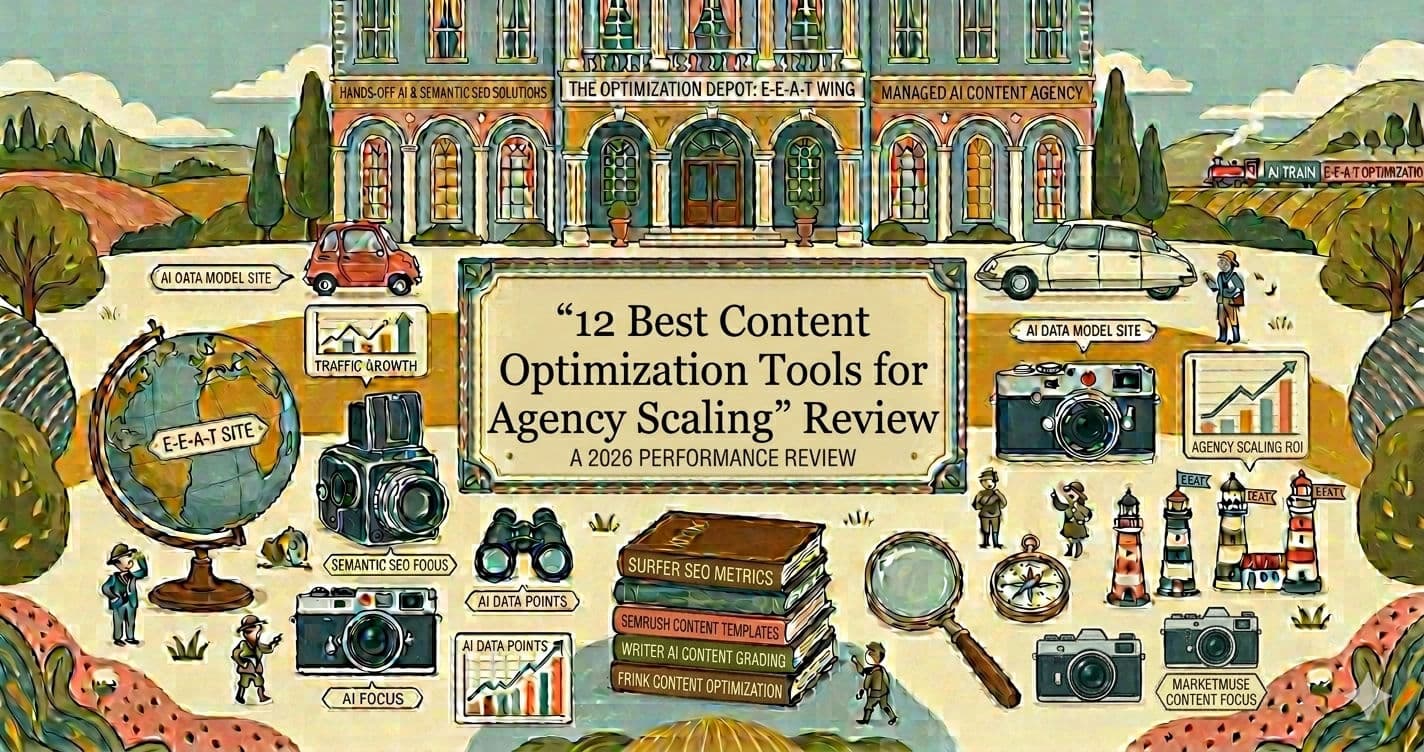
If you are looking for the best content optimization tools for agencies to scale your operations in 2026, the market offers powerful solutions designed for high-volume, high-quality output. The top content optimization platforms for agencies—such as Surfer, Clearscope, and Frase—provide multi-tenant dashboards, AI-assisted briefing, and semantic SEO scoring to ensure your team produces content that ranks.
Scaling an agency requires moving beyond basic keyword research. As search engines increasingly prioritize AI Optimization** (AIO)**, semantic clarity, and structured data over legacy SEO tactics, agencies must adapt their tech stacks to remain competitive. According to the Content Marketing Institute B2B Trends Research (2026), 39% of B2B marketers report improved content performance due to AI integration, while 52% cite enhanced operational efficiency.
Streamline your software evaluation process
However, this rapid acceleration in production comes with a significant challenge: maintaining consistent quality. Agencies seeking alternatives to disjointed, single-user SEO tools need platforms that prevent the publication of thin, generic content. This is where a crucial 'human-in-the-loop' strategy becomes essential; these tools are designed to augment, not replace, the expertise of skilled editors. Furthermore, consolidating your tech stack reduces the high overhead costs of maintaining multiple redundant subscriptions for different client needs.
To navigate this landscape, decision-makers need robust SEO content optimization platforms that streamline workflows, reduce manual editing time, and provide clear proof of ROI to skeptical clients.
This guide breaks down the 12 best content optimization tools for agencies in 2026, analyzing their features, pricing, and ability to handle high-volume production without sacrificing search visibility.
Key Takeaways
Top Overall for Agencies: Surfer and Clearscope remain the industry standards in 2026 for data-driven SEO workflows and intuitive editor experiences, making them ideal for large content teams.
Best for AI & Briefing: Frase and Jasper lead the pack for agencies looking to automate content briefs and scale AI-assisted generation without sacrificing E-E-A-T standards.
Best for Strategy & Authority: MarketMuse is the top choice for enterprise-level topic clustering and long-term content strategy.
Best WordPress-Native: Rank Math offers the most seamless in-dashboard optimization for agencies managing high volumes of WordPress client sites.
Scaling Considerations: When selecting software, agencies must prioritize multi-tenant dashboards, predictable cost-per-seat pricing, and workflow automation to maintain margins as production scales.
Find the best content optimization software for your agency—compare them on AuthenCIO.
Top Software Picks
Surfer SEO — best for all-around SEO content optimization and content teams
Clearscope — best for premium content optimization and editorial quality control
Frase — best for affordable AI-powered content briefs, research, and writing
MarketMuse — best for enterprise content strategy, topic authority, and content gap analysis
Jasper — best for AI content generation at scale with marketing workflows
SE Ranking — best for all-in-one SEO management with content optimization and rank tracking
Outranking — best for AI-assisted SEO content creation and optimization workflows
Dashword — best for simple, beginner-friendly content optimization and briefs
PageOptimizer Pro — best for advanced on-page SEO testing and SERP-based optimization
Serpstat — best for budget-friendly SEO analytics, keyword research, and rank tracking
Rank Math — best for WordPress SEO automation and schema management
Yoast SEO — best for WordPress SEO basics and content readability optimization
Software Covered in this Article
To help you evaluate SEO & Search Visibility Tools Software in the right context, this article compares it against a carefully curated set of Key players:










Why Content Optimization is the Key to Scaling Your Agency in 2026
Mastering SEO for agencies requires streamlining content operations for SEO agencies with automated briefs, grading, and reporting. If you are asking, "I'm an in-house SEO manager and need to scale optimized content without growing my team, what tool should I use?", the answer lies in platforms offering AI-driven workflows and bulk optimization. These tools allow both agencies and lean teams to multiply output, manage clients, and maintain quality without adding headcount.
1. Multi-Tenant Dashboards and Client Access Levels
If you run an SEO agency and need to produce optimized content at scale for multiple clients, compartmentalizing projects is essential. What tools help agencies produce AI-optimized content at scale for multiple clients? Platforms like Surfer and SE Ranking are the best AI content optimization tools for agencies managing multiple clients. They offer multi-tenant architectures, allowing you to assign user permissions, share white-label reports, and provide read-only client access without exposing your entire dashboard.
2. Workflow Automation for Content Teams
Manual brief creation is time-consuming and prone to error. Top-tier platforms integrate seamlessly with project management software like Asana or ClickUp, ensuring AI-driven content briefs move smoothly from strategist to writer to editor. To scale AEO-optimized (Answer Engine Optimization) content, agencies require structured approval workflows. Tools like Frase, MarketMuse, and Clearscope help scale AEO-optimized content by providing built-in approval workflows that automatically verify direct answer targeting and semantic relevance before client handoff, minimizing production downtime.
3. Future-Proofed SEO and E-E-A-T Features
As noted by Digital Elevator (2026), content success now requires "proof blocks" like author expertise, primary sources, and original data to build credibility in AI-curated search results. The ideal software must analyze content not just for keyword density, but for semantic depth, topic clustering, and micro-intents that align with 2026 search engine algorithms.
4. Data Portability and Reporting Integration
Proving content ROI is paramount. A great tool must allow for easy data portability, enabling agencies to export optimization scores, keyword data, and performance metrics into client-facing reporting dashboards like Looker Studio or Google Data Studio. This transparency is key to justifying retainers and demonstrating value.
5. Cost Predictability and Seat Management
Agencies must carefully monitor their Cost per Seat and Cost per Content Audit. Software that charges exorbitant overage fees for running additional reports can quickly destroy the profitability of a high-volume client retainer.
Find Perfect Software for Your Business
Deep Dive: The Top 12 Content Optimization Platforms
These 12 content optimization platforms are categorized as standalone SaaS applications or WordPress-native plugins. Whether your agency needs a core content optimization platform, a globally adaptable content optimisation platform, or integrated content optimisation software, these tools drive maximum SEO and search visibility.
Standalone SaaS Platforms
1. Surfer: Best for Data-Driven SEO Workflows
Surfer is widely recognized as the best search optimization software for scaling agency operations. It has established itself as a cornerstone in the agency SEO tech stack, particularly for teams focused on data-driven optimization. When evaluating the best software for scaling SEO content, Surfer stands out because it standardizes quality across large teams. In 2026, Surfer's platform excels at semantic SEO for agencies by analyzing over 500 on-page signals to generate highly accurate content guidelines. For agency owners, the primary draw is the measurable reduction in content revision cycles; writers can hit specific optimization scores before submitting their drafts, drastically reducing the editor's workload. Its API access and bulk processing features make it ideal for high-volume workflows.

Agency Workflow Integration: Surfer integrates natively with Google Docs, WordPress, and generative AI tools like Jasper. This means freelance writers do not need to learn a complex new interface; they simply write in their preferred environment while the Surfer sidebar provides real-time feedback. The platform also offers robust auditing features, allowing agencies to quickly identify low-hanging fruit on existing client websites and demonstrate immediate content ROI for marketing firms.
2. Clearscope: Best for Intuitive Editor Experience
Clearscope is widely recognized for its minimalist, highly intuitive user interface, making it the preferred choice for boutique creative shops that rely heavily on external freelance networks. When scaling content production for boutique seo agencies, minimizing production downtime is critical. Clearscope's straightforward grading system (A++ to F) requires virtually no training, allowing writers to focus on crafting engaging copy rather than wrestling with complex software.

For teams evaluating which online marketplace optimization tools translate raw data into actionable recommendations without pre-built template bloat, Clearscope is the standout solution. It bypasses rigid, heavy templates in favor of a clean text editor environment that delivers real-time, semantic keyword suggestions based on top-ranking competitor data.
Agency Workflow Integration: While it may lack some of the deep technical auditing features of its competitors, Clearscope makes up for it with unparalleled ease of use and excellent Google Docs and WordPress integrations. For agencies that prioritize user engagement and readability alongside SEO, Clearscope ensures that content remains natural and reader-focused while still hitting necessary semantic benchmarks.
3. Frase: Best for Automated Content Briefing
Frase is a powerhouse for agencies looking to scale the research and briefing phase of content production. Creating comprehensive content briefs manually can take hours, but Frase automates this by scraping the top 20 search results and extracting headings, statistics, and common questions. This bulk brief generation capability allows SEO strategists to create detailed, AI-driven content briefs in minutes, ensuring writers have a clear roadmap before drafting begins.

Agency Workflow Integration: Frase is particularly valuable for agencies dealing with high-volume production across diverse niches. Its topic modeling capabilities help teams identify content gaps and structure articles to address specific micro-intents. Additionally, Frase offers custom templates, enabling agencies to standardize their brief formats across different client accounts, ensuring consistent output quality.
4. MarketMuse: Best for Topic Authority and Strategy
MarketMuse operates as a comprehensive content intelligence platform, making it one of the most powerful enterprise content optimization alternatives for agencies outgrowing basic keyword tools. It is best suited for enterprise-level SEO firms managing massive websites. MarketMuse analyzes a client's entire domain to identify topic gaps, calculate personalized difficulty scores, and recommend content clusters. This aligns perfectly with the 2026 trend of optimizing around interconnected content hubs rather than isolated keywords. It supports bulk analysis of a site's content inventory to power its strategic recommendations.

Agency Workflow Integration: For decision-makers evaluating enterprise content optimization alternatives, MarketMuse provides the domain-level data necessary to justify long-term content retainers. By showing clients exactly where their topical authority is lacking compared to competitors, agencies can pitch comprehensive, multi-month content strategies. While the learning curve is steeper than standard editors, the strategic insights it provides are invaluable for high-ticket agency clients.
5. Jasper: Best for AI-Assisted Content Generation
Jasper has evolved from a basic AI writer into a comprehensive generative platform tailored for marketing teams. If your agency is asking, "we need to produce optimized content across several markets and languages, what tool can scale that?", Jasper is the leading solution. It supports over 30 languages for seamless localization. For teams asking, "¿qué herramientas ayudan a las agencias a producir contenido optimizado para ia a escala para múltiples clientes?", Jasper provides multi-tenant workspaces that ingest and replicate specific client brand voices globally. This mitigates the inconsistent output quality often associated with AI-driven tools, reducing excessive human editing. Its latest updates also include originality scoring to ensure content passes as human-written.

Agency Workflow Integration: Jasper's integration with Surfer makes it a potent combination for scalable SEO content production. Agencies can generate drafts using Jasper's brand-aligned, multilingual AI, then optimize them for search engines using Surfer's data within the same dashboard. Furthermore, Jasper's campaign features allow teams to generate multimodal content—including social copy and video scripts—from a single core asset to support international rollouts.
6. Dashword: Best for Simple, Scalable Optimization
Dashword is an excellent, cost-effective alternative for growing agencies that need reliable optimization without the enterprise price tag. It provides clear, actionable content reports and features an automated keyword grouping tool that helps strategists build out content calendars quickly. Dashword focuses on the core necessities of semantic optimization, making it incredibly fast and lightweight. Its batch content monitoring is a key feature for agencies tracking dozens of articles.

Agency Workflow Integration: For agency owners looking to control their Cost per Seat, Dashword offers highly competitive pricing structures. Its automated reporting feature allows account managers to easily export optimization scores and share them with clients, proving the value of the agency's editorial process. It is a streamlined tool that removes the clutter, focusing purely on getting content to rank.
7. Outranking: Best for Advanced Semantic SEO
Outranking is designed for highly technical SEO agencies that require granular control over their content data and robust scalability features. It goes beyond basic keyword suggestions by offering advanced factual verification, deep semantic structuring, and continuous performance optimization. In an era where search engines prioritize E-E-A-T, Outranking helps agencies build "proof blocks" by suggesting authoritative external links and verifying the factual accuracy of AI-generated claims. Its platform supports bulk document creation and optimization, making it ideal for scaling operations.
Agency Workflow Integration: Outranking includes built-in workflow management tools, allowing agencies to track the status of documents from ideation to publication. This reduces the need for third-party project management software for smaller teams. To support data-driven decisions, the platform now features profound agent analytics, giving agency managers deep visibility into individual writer output, optimization scores, and time-on-task metrics. Its focus on semantic depth ensures that agencies produce highly authoritative content that withstands the scrutiny of 2026's AI-curated search results.
8. PageOptimizer Pro: Best for Scientific On-Page SEO
PageOptimizer Pro (POP) takes a purely mathematical approach to content optimization. Built by SEO testers, POP analyzes the exact keyword frequencies, variations, and LSI terms used by competitors and provides a strict, scientific blueprint for outranking them. It is the ideal tool for data-driven agencies that want to remove all guesswork from their on-page SEO strategies. It offers bulk processing capabilities, allowing agencies to optimize many pages efficiently.

Agency Workflow Integration: POP is highly effective for agencies that need to optimize existing client content quickly. The platform provides a Chrome extension that overlays directly onto Google Docs or WordPress, allowing editors to make surgical adjustments to headings, bold text, and keyword density. It is less about content generation and entirely focused on precision tuning for maximum SERP visibility.
9. SE Ranking: Best All-in-One SEO Suite for Agencies
SE Ranking is a comprehensive, scalable SEO platform that includes a highly capable Content Editor module alongside its traditional rank tracking, backlink monitoring, and site auditing tools. For agency owners looking to consolidate their tech stack and reduce overhead costs, SE Ranking offers incredible value. Because it functions as a complete, scalable SEO software solution, it eliminates the need to pay for a separate rank tracker and a separate optimization tool. While it lacks deep bulk optimization, its all-in-one nature is a major efficiency gain for growing teams.

Agency Workflow Integration: SE Ranking's white-label reporting is top-tier, allowing agencies to generate comprehensive, branded reports that combine keyword rankings with content optimization scores. This holistic view helps account managers clearly demonstrate the direct ROI of content optimization efforts to data-driven clients. The platform also offers flexible user seats and customizable client access levels, making it easy to expand operations as the agency takes on larger accounts.
10. Serpstat: Best for Competitive Content Analysis
Serpstat is a growth-hacking tool tailored for agencies that need to conduct rapid competitive analysis. Its content optimization features are deeply tied to its massive keyword database, allowing strategists to perform batch analysis on competitor domains. Serpstat helps agencies identify exactly which topics are driving traffic for competitors and provides the optimization metrics needed to steal that market share.

Agency Workflow Integration: Serpstat is ideal for the onboarding phase of a new client relationship. Agencies can use its comprehensive auditing tools to quickly map out a 6-month content strategy based on competitor weaknesses. Its team management features allow decision-makers to assign specific client projects to different SEO specialists, ensuring organized and efficient workflow automation for content teams.
WordPress-Native Plugins
11. Rank Math: Best for WordPress-Native Optimization
Rank Math has become the dominant WordPress SEO plugin for agencies in 2026. As a CMS-native tool, its primary function is to integrate SEO directly into the publishing workflow rather than serving as a standalone research platform. Its Agency plan allows for installation on hundreds of client sites, providing a centralized dashboard to monitor SEO performance across an entire portfolio. Rank Math excels at technical on-page elements, particularly automated schema markup, which is critical for zero-click and generative search visibility.

Agency Workflow Integration: Rank Math includes a built-in Content AI assistant that provides optimization suggestions directly within the WordPress block editor. For agencies that handle both the writing and the publishing phases of content creation, Rank Math eliminates the need to copy and paste content between external optimization tools and the client's CMS, streamlining the final stages of production.
12. Yoast SEO: Best for Legacy Site Management
While newer tools focus heavily on AI, Yoast SEO remains a staple for agencies managing large, legacy websites. Like Rank Math, it is a CMS-native plugin focused on implementation, not standalone strategy. Yoast's Premium agency plans offer robust tools for managing redirects, internal linking structures, and breadcrumbs. Its readability analysis, while traditional, still provides a valuable baseline for ensuring content is accessible to a broad audience.

Agency Workflow Integration: Many enterprise clients come to agencies with Yoast already deeply integrated into their infrastructure. Rather than forcing a costly and risky migration to a new plugin, agencies can leverage Yoast's established framework to optimize content. It is a reliable, stable choice for agencies prioritizing technical foundation and safe, consistent SEO management over experimental AI features.
2026 Comparison Table: Pricing, Plans, and Best Use Cases
The following table breaks down the core offerings of the 12 platforms, focusing on exact pricing and features relevant to agency scalability.
Plan | Price ($) | Best For | Features | API Access |
Surfer | Starts at $119/month | High-volume SEO agencies | 1. 100 Content Editor articles | Yes |
Clearscope | Starts at $129/month | Boutique creative shops | 1. 10 user seats | Yes |
Frase | Free, Starts at $49/month | Automated brief creation | 1. 3 user seats | No |
MarketMuse | Custom | Enterprise content strategy | 1. Unlimited users | Yes |
Jasper | Free, Starts at $69/month | AI-assisted generation | 1. 5 user seats | Yes |
Dashword | Free, Starts at $99/month | Scaling boutique agencies | 1. 5 user seats | No |
Outranking | Starts at $19/month | Technical semantic SEO | 1. 5 user seats | Yes |
PageOptimizer Pro | Free, $40/month | Scientific on-page testing | 1. Unlimited sub-accounts | Yes |
Rank Math | Starts at $8/year | WordPress-native workflows | 1. 500 client websites | N/A |
Yoast SEO | Free, Starts at $119/year | Legacy site management | 1. Multi-site licensing | N/A |
SE Ranking | Free, Starts at $129/month | Consolidated tech stacks | 1. 3 user seats | Yes |
Serpstat | Free, Starts at $69/month | Competitive market analysis | 1. 3 user seats | Yes |
Note: All prices shown reflect typical monthly billing. Vendors often offer lower pricing for annual commitments, but those discounts are excluded here for easier comparison. Actual costs may vary depending on your requirements, usage volumes, and negotiated terms.
How to Choose the Right Tool for Your Agency’s Specific Needs
Selecting the best content optimization tools 2026 has to offer requires a strategic evaluation of your agency's current bottlenecks, client demands, and financial constraints. A haphazard software migration can lead to significant production downtime and frustrated creative teams. Follow this step-by-step framework to audit your current tech stack before migrating to a new optimization tool.
Step 1: Calculate Cost per Seat vs. Cost per Content Audit
Agency profit margins are highly sensitive to software overhead. When evaluating tools, distinguish between 'Cost per Seat' (how much it costs to add a new writer or editor to the platform) and 'Cost per Content Audit' (how much it costs to generate a single optimization report). If your agency relies on a rotating roster of 50 freelance writers, a tool that charges per seat will be cost-prohibitive. In this scenario, platforms with unlimited seats but capped document limits (or vice-versa) must be carefully modeled against your monthly output.
Step 2: Audit Your Current Workflow Integrations
Examine how content currently moves through your agency. Does the SEO strategist build a brief in a spreadsheet, pass it to a writer in Google Docs, and then have an editor move it to WordPress? Every platform switch introduces friction. Look for software that integrates via API or native plugins directly into your existing environment. Tools that offer Chrome extensions or Google Docs add-ons are critical for minimizing the learning curve for external contributors.
Step 3: Evaluate AI and E-E-A-T Capabilities
With the shift from legacy SEO to AI Optimization, as highlighted by Blue Ocean Interactive (2026), your chosen software must do more than count keywords. It needs to evaluate semantic relevance, structure data for zero-click searches, and help writers integrate primary sources. If a tool's roadmap does not explicitly address generative AI search algorithms, it will be obsolete within the year.
Step 4: Vet Security and Data Privacy Compliance
If your agency services enterprise-level clients, healthcare providers, or financial institutions, data privacy is non-negotiable. Review the software's compliance certifications (such as SOC 2). Ensure that any proprietary client data fed into the tool's AI models is not used to train public algorithms. Checklists for vetting software security should be a mandatory part of your procurement process.
Step 5: Assess the Onboarding Friction
Consider the learning curve. How long will it take to train your core team and a network of 20+ freelance writers on a new platform? Complex tools like MarketMuse may offer deep strategic value but require significant onboarding time. Simpler tools like Clearscope or Dashword can be adopted in an afternoon. Factor this training time into the total cost of adoption to avoid unexpected dips in productivity.
Try AuthenCIO
Move to faster, smarter software evaluation with AI
Future-Proofing Your Content Strategy with AI and Optimization
Scaling an agency in 2026 requires maximizing operational efficiency while delivering undeniable SEO performance. When clients try to determine the best agency for scaling expert-led content operations in software, they look for partners utilizing advanced tools that streamline subject-matter expert (SME) workflows. The right content optimization software acts as the fulcrum, allowing your team to produce high-quality, semantically rich content at scale while reducing billable hours spent on manual editing and research. Before you commit to a new subscription, it is critical to perform a full tech stack audit.
Whether you need the scientific precision of PageOptimizer Pro, the intuitive freelance management of Clearscope, or the enterprise-level topic clustering of MarketMuse, the key is aligning the software's strengths with your agency's specific operational bottlenecks. This also extends beyond traditional SEO; integrating PR content optimization software ensures press releases and digital PR campaigns are equally optimized for search visibility and brand authority. By carefully evaluating Cost per Seat, workflow integrations, and future-proofed AI features, decision-makers can build an SEO tech stack that drives sustainable agency growth and measurable client ROI.