
Introduction
When HR leaders evaluate the applicant tracking system (ATS) company TeamTailor, they find an all-in-one platform that merges core recruitment tracking with a robust Content Management System (CMS) for employer branding. While legacy systems focus primarily on database management, TeamTailor is built for HR managers and startup founders who treat hiring as a marketing function. If your primary goal is to track compliance, a standard ATS will suffice. However, if you need to actively market your Employee Value Proposition (EVP) and convert passive candidates, TeamTailor offers a specialized toolkit designed to improve pipeline velocity and reduce cost-per-hire.
Streamline your ATS software evaluation process
In this 2026 review, we conduct a factual, deep-dive analysis of TeamTailor’s capabilities. We dissect its feature set—from AI-driven automation to GDPR compliance—examine its pricing structure, and compare it directly against competitors like Greenhouse, Lever, and SmartRecruiters.
📌 KEY TAKEAWAYS: WHAT TO EXPECT IN THIS GUIDE
Employer Branding Dominance: How TeamTailor’s career site builder rivals dedicated design tools like Webflow.
AI & Ethics: An inside look at the new "Co-pilot" features and how they handle bias mitigation.
Migration Reality: A step-by-step checklist for moving from legacy systems like Greenhouse.
Pricing Transparency: A complete breakdown of 2026 costs, including hidden fees for SMS and premium add-ons.
Competitor Showdown: Detailed comparisons with Ashby, Workable, and Lever.
Pros and Cons: The HR Manager's Perspective
Every piece of software has trade-offs. While TeamTailor excels in design and usability, it may not be the perfect fit for every organization, particularly those with complex, rigid hiring hierarchies.
The Pros
Superior Employer Branding: The ability to build stunning, media-rich career pages without a developer is the platform's biggest selling point. It turns recruitment into a marketing engine.
Exceptional Ease of Use: The platform offers an intuitive interface that ensures quick adoption by hiring managers who typically resist clunky systems. Nearly every TeamTailor ATS ease of use review highlights how this frictionless experience drives better data integrity and faster feedback loops compared to complex alternatives like Greenhouse.
Unlimited Users: The pricing model encourages collaboration. You can invite the entire team to refer candidates or participate in interviews without worrying about seat costs.
Customer Support: User reviews on G2 consistently highlight TeamTailor’s responsive support team, often citing it as a refreshing change from the ticket-based purgatory of larger enterprise vendors.
The Cons
Reporting Limitations: While improved, TeamTailor’s analytics suite can still feel lightweight compared to the deep, granular business intelligence tools found in Ashby or Greenhouse. Power users who need to run complex regression analyses on their hiring funnel or export raw data to Tableau may find the native reporting restrictive.
Permission Granularity: For massive enterprises with thousands of employees, the permission settings in TeamTailor can sometimes lack the extreme granularity required for complex governance structures. SmartRecruiters or Workday often handle these complex, multi-layered permission matrices better.
Integration Depth: While the number of integrations is high, the depth of those integrations can vary. Some users report that specific two-way sync capabilities with legacy HRIS systems are less robust than expected, occasionally requiring manual data verification.
Best for: Mid‑to‑large HR teams seeking branded candidate experiences.
Verdict: A modern ATS blending marketing and automation for smarter hiring workflows.

Software covered in this article
To help you evaluate Teamtailor software in the right context, this article compares it against a carefully curated set of competitors:







Core Features: Beyond Basic Tracking
To evaluate the applicant tracking system (ATS) company Teamtailor on recruiting tools, HR managers must look beyond basic pipeline management. The platform streamlines talent acquisition through advanced candidate sourcing and intelligent automation. Recent updates specifically target the perennial pain point of high-volume screening, allowing teams to process applications efficiently without sacrificing the human touch.
👉 Try Authencio.com for free — compare Teamtailor with other ATS platforms built for modern hiring teams.
1. Advanced Career Page Customization and Employer Branding
TeamTailor provides an applicant tracking system with career site builder tools that help companies attract candidates through employer branding and seamless application experiences. While competitors like Workable or Breezy HR offer functional, template-based career pages, TeamTailor delivers a drag-and-drop interface similar to modern website builders like Squarespace. This empowers Talent Acquisition Leads to update the "Jobs" page directly, without relying on engineering or marketing resources.
In 2026, the platform features dynamic content blocks that tailor the career site based on a visitor's location or department interest. For example, a candidate in London looking for engineering roles can see a completely different hero video and testimonial set than a sales candidate in New York. Recruiters can embed employee testimonials, life-at-the-company videos, and social feeds directly into the page without writing code, allowing startups to project an enterprise-level image.
Beyond aesthetics, these tools ensure a frictionless, mobile-optimized application flow. By combining highly personalized employer branding with an intuitive interface, TeamTailor minimizes candidate drop-off and significantly boosts conversion rates from page visitor to submitted applicant.
2. Recruitment Automation and Candidate Experience
When HR teams evaluate the applicant tracking system (ATS) company TeamTailor on candidate experience, they consistently highlight its frictionless, mobile-first application flow. A positive TeamTailor ATS candidate experience review often centers on the platform's decision to eliminate mandatory login credentials—a major friction point still found in older systems like SmartRecruiters. Automated interview self-scheduling and transparent status updates further elevate the journey and directly lower drop-off rates.
Similarly, when you evaluate the applicant tracking system (ATS) company TeamTailor on automation for sourcing and nurturing candidates, its proactive talent pool management is a clear differentiator. Teams can build automated workflows that capture passive candidates via custom landing pages, then deploy nurturing sequences like drip email campaigns to keep them engaged until the right role opens.
For active pipelines, TeamTailor’s automation suite uses "Smart Triggers" to handle complex workflows. If an applicant fails a knockout question, the system automatically moves them to "Rejected" and sends a delayed rejection email. Conversely, high-potential candidates identified via Boolean Search are auto-tagged and routed to hiring managers, improving Time-to-Hire and preventing talent from getting lost in administrative bottlenecks.
3. AI Co-Pilot: Efficiency Meets Ethical Hiring
When evaluating TeamTailor's applicant tracking system (ATS) capabilities, its AI tools stand out by embedding a "Co-pilot" directly into daily recruiter workflows. By 2026, TeamTailor's AI acts as a comprehensive virtual sourcing assistant. It excels at drafting optimized job descriptions, generating structured interview questions based on role competency frameworks, and instantly summarizing dense candidate profiles.
For modern HR managers, efficiency must balance with fairness. TeamTailor addresses this through "Bias Mitigation" flags within its AI summaries. During the initial screening phase, the AI anonymizes demographic data and strictly highlights skill matches. This "human-in-the-loop" architecture ensures the AI handles the heavy lifting of resume parsing while recruiters retain final judgment control.
Compared to Ashby—which leans heavily into predictive analytics and data-driven sourcing—TeamTailor’s AI tools focus more on the creative and communicative aspects of hiring. For example, the platform evaluates candidate email sentiment to suggest optimal follow-up times, prioritizing candidate experience alongside recruiter efficiency.
4. Mobile App Experience: The Pocket Recruiter
Recruitment doesn't happen solely at a desk. TeamTailor’s mobile app supports hiring managers on the go, offering more robust features than the mobile versions of Greenhouse or Lever. Users can handle full scorecard submissions, team communication, and candidate scheduling directly from a smartphone.
This functionality keeps pipeline velocity high for leaders reviewing assessments while commuting. For HR teams looking to evaluate the applicant tracking & recruitment software company TeamTailor on mobile accessibility, the platform performs exceptionally well. Both the native iOS and Android apps, along with the mobile-optimized career pages, target WCAG 2.1 AA standards. They support screen readers (VoiceOver and TalkBack), dynamic text sizing, and high-contrast modes, ensuring an inclusive experience for candidates and recruiters with visual or motor impairments.
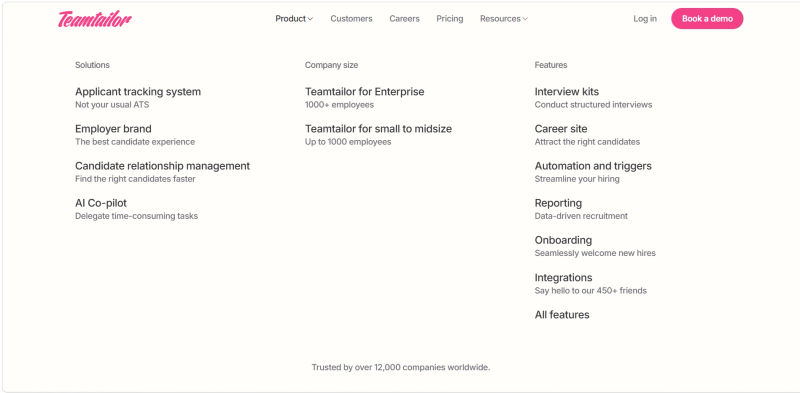
Integrations, Ecosystem, and Migration
No ATS exists in a vacuum. A modern recruitment stack requires seamless connectivity between sourcing tools, the ATS, and the downstream HRIS. TeamTailor’s marketplace has expanded significantly, offering native integrations that rival the extensive ecosystems of Greenhouse and SmartRecruiters.
1. The Integration Landscape
If you need to evaluate the applicant tracking system (ATS) company TeamTailor on integrations with job boards, its native multiposting is the core feature to consider. The platform connects with thousands of global and niche boards—including LinkedIn, Indeed, and Glassdoor—allowing recruiters to publish vacancies across multiple channels simultaneously and track source quality directly within the system.
Those looking to evaluate the applicant tracking system (ATS) company TeamTailor on sourcing candidates and finding candidates will find its proactive outreach tools highly effective. TeamTailor offers browser extensions to "clip" profiles from LinkedIn and GitHub directly into the pipeline. While standard in tools like Gem or Ashby, this native integration simplifies workflows for teams avoiding a separate sourcing CRM. It also includes employee referral portals and automated talent pool nurturing to find candidates passively.
Post-hire, the integration with payroll and onboarding systems like Deel and Rippling is strong. Moving a candidate to "Hired" automatically initiates contract generation, reducing manual data entry so HR can focus on strategic workforce planning.
2. Migration & Implementation: A Reality Check
When HR leaders evaluate the applicant tracking system (ATS) company TeamTailor on easiest implementation, the platform consistently ranks as one of the fastest to deploy. While the pain of migration is a common concern for Talent Acquisition Leads, moving from a legacy system to TeamTailor is exceptionally smooth compared to an enterprise giant like Workday. Thanks to intuitive setup and dedicated onboarding support, the "Time to Value" is typically just 2-4 weeks for mid-sized companies, far faster than the 3-6 months required for traditional enterprise solutions.
Standard Operating Procedure** (SOP) for Migration:**
Data Audit: Before exporting from your old ATS (e.g., Workable), clean your data. Archive old roles and delete GDPR-expired candidates. TeamTailor's bulk import tools easily handle the remaining transfer.
Field Mapping: Map your current "Stages" to TeamTailor’s "Triggers." For example, if you use a "Reference Check" stage in Greenhouse, ensure the corresponding stage in TeamTailor has the automated email trigger set up via the visual builder.
Career Site Redirects: If replacing an existing career page, work with IT to set up 301 redirects from old job URLs to new TeamTailor links to preserve SEO value.
Integration Testing: Connect your HRIS (e.g., BambooHR) in the sandbox environment first to ensure custom fields transfer correctly using TeamTailor's plug-and-play integrations.
3. Global Compliance and GDPR
When evaluating the applicant tracking and recruitment software company TeamTailor on compliance and regulation support for GDPR, SOC 2, and HIPAA, its European roots provide a strong baseline for data security. For global startups, GDPR compliance is non-negotiable. TeamTailor handles this through a "privacy-by-design" architecture, using automated retention triggers to anonymize or delete candidate data. This ensures continuous compliance without requiring constant manual audits.
The platform also holds SOC 2 Type II certification, guaranteeing strict data encryption and security controls. However, TeamTailor is not natively HIPAA-compliant; healthcare organizations requiring a Business Associate Agreement (BAA) will need to look for specialized alternatives.
Find the right Application Tracking Software for your business
TeamTailor Pricing Plans (2026)
TeamTailor pricing is calculated based on your total company size (number of employees) rather than per-user licenses. This unlimited-user approach makes the TeamTailor price highly predictable and encourages collaborative hiring across all departments. Based on market research and user reports, base plans for small teams (under 50 employees) typically start in the $300 to $400 per month range, scaling predictably as your headcount grows. Exact quotes require a custom demo.
Small to mid-sized businesses benefit from this structure by accessing enterprise-grade employer branding and career page tools without the burden of per-recruiter fees. It offers a more accessible entry point than enterprise-heavy solutions like Workday or iCIMS.
Hidden Costs to Watch For:
While the base license is comprehensive, buyers should be aware of potential extra costs. SMS credits for candidate texting often come in bundles. Additionally, premium features like the "AI Co-pilot" or advanced "Nurture" campaigns may be gated behind Business or Enterprise tiers. Always ask your sales rep about implementation fees, which can range from $0 for self-service to $5,000+ for managed migration.
Plan | Price ($) | Best For | Features |
Standard / Growth | Custom quote | Startups (<50 Employees) | Unlimited users, Career site builder, Basic analytics, Job board posting, Standard support, GDPR compliance tools, Mobile app access. |
Business / Pro | Custom quote | Mid-Market (51-250 Employees) | Automated triggers, Nurture campaigns, Advanced AI Co-pilot, Custom user roles, SSO (Single Sign-On), Dedicated Customer Success Manager, SMS communication. |
Enterprise | Custom Quote (Typically $10k+) | Large Orgs (250+ Employees) | Unlimited departments, Multi-brand career sites, Data warehouse/API access, Priority SLA support, Advanced reporting suite, Custom implementation. |
Note: All prices shown reflect typical monthly billing. Vendors often offer lower pricing for annual commitments, but those discounts are excluded here for easier comparison. Actual costs may vary depending on your requirements, usage volumes, and negotiated terms.
2. ROI Framework: Calculating Value
To justify the investment, focus on Cost-per-Hire and Scalability. When you evaluate the applicant tracking system (ATS) company TeamTailor on small businesses looking to scale, the immediate ROI is agency spend reduction. If a $6,000/year subscription yields one direct hire instead of a $20,000 agency fee, it pays for itself.
Furthermore, to evaluate the applicant tracking & recruitment software company TeamTailor on helping scale companies from 100 to 1,000 employees, measure HR efficiency. Its automation allows a lean team to manage hyper-growth without linearly adding recruiters, proving its value as a foundational core HR software.
TeamTailor vs. The Competition: Top 2026 Alternatives
If you are evaluating core HR software, the best TeamTailor alternatives in 2026 are Greenhouse, Lever, Workable, Breezy HR, Ashby, and SmartRecruiters. While TeamTailor excels at employer branding, these TeamTailor alternatives may better suit complex enterprise workflows or high-volume hiring. Choosing an ATS requires aligning platform features with your company's specific growth stage and culture. Here is how TeamTailor stacks up against the top competition.
1. TeamTailor vs. Greenhouse and Lever
Greenhouse is widely considered the gold standard for "Structured Hiring." If your organization is obsessed with removing bias through rigid scorecards and data-driven interview plans, Greenhouse is the heavyweight champion. However, Greenhouse’s candidate-facing features (career pages) are notoriously basic and often require a third-party web developer to look good. TeamTailor wins on the frontend (branding), while Greenhouse wins on the backend (process rigor).
Lever (now part of Employ) was one of the first to combine ATS and CRM. Lever is excellent for teams that do heavy proactive sourcing and need to manage long-term relationships with passive talent. While TeamTailor has added CRM features (Nurture campaigns), Lever’s sourcing extension and "archive" management are still slightly superior for pure headhunting teams. However, TeamTailor offers a much better out-of-the-box career site experience than Lever.
2. TeamTailor vs. Workable and Breezy HR
Workable is perhaps the closest direct competitor to TeamTailor in the mid-market space. Both offer great mobile apps and ease of use. However, Workable’s pricing can scale aggressively with the number of active jobs, which can punish high-growth startups. TeamTailor’s design capabilities for the career site are generally superior to Workable’s more rigid templates.
Breezy HR is a strong contender for smaller businesses (SMBs) and agencies due to its lower price point and unlimited job slots on some plans. Breezy excels at "Pipeline Management" with a Trello-like interface that is very visual. However, as you scale, Breezy’s reporting and compliance features may feel less robust than TeamTailor’s. If employer branding is your #1 priority, TeamTailor is the clear winner. If budget is the only constraint, Breezy HR is a solid alternative.
📈 Start on Authencio.com — see how Teamtailor stacks up against leading applicant tracking systems, side by side.
3. TeamTailor vs. Ashby and SmartRecruiters
Ashby has taken the startup world by storm with its incredible analytics. If your Head of Talent is a data wizard who wants to measure "pass-through rates by interviewer calibration," Ashby is the tool of choice. It aggregates data beautifully. However, Ashby often sits on top of other tools or acts as a lean ATS. TeamTailor provides a more holistic "full-suite" feel for the candidate journey (Career Site + ATS). Choose Ashby for data; choose TeamTailor for candidate experience.
SmartRecruiters is a true enterprise solution designed for companies with 5,000+ employees. It handles complex global hierarchies, internal mobility, and massive applicant volumes better than TeamTailor. However, for a 200-person startup, SmartRecruiters can feel like overkill—too many clicks to perform simple tasks. TeamTailor offers 80% of the enterprise functionality with 20% of the complexity, making it the better choice for the mid-market.
Try AuthenCIO
Move to faster, smarter software evaluation with AI
Final Verdict: Is TeamTailor Right for Your Talent Strategy?
After reviewing the features, pricing, and competitive landscape, the verdict is clear: TeamTailor is arguably the best applicant tracking system 2026 for companies that prioritize Employer Branding and Candidate Experience above all else.
It is the ideal solution for:
Growth-Stage Startups: Who need to look bigger than they are to attract top talent.
Mid-Market Companies: Who are outgrowing email/spreadsheets but don't want the bureaucracy of legacy enterprise software.
Retail/Hospitality: Who need high-volume, mobile-friendly application flows.
However, if you are a massive global enterprise requiring complex matrix reporting, or a boutique executive search firm needing pure CRM power, alternatives like SmartRecruiters or Lever might be better aligned with your needs.
Ultimately, TeamTailor transforms recruitment from a back-office administrative burden into a front-office marketing advantage. In the talent-short market of 2026, that difference is worth paying for.