
Introduction
The global print-on-demand (POD) market is experiencing explosive growth, estimated to reach $13.1 billion in 2026.
Streamline your software evaluation process
With e-commerce expanding and consumer demand for personalized, limited-edition products at an all-time high, starting a low-inventory business has never been more appealing.
However, the reality of 2026 is that while the barrier to entry is lower than ever, the competition is incredibly fierce.
The success of your online store relies entirely on the fulfillment partner you choose.
If your print provider delivers low-quality items or ships late, your brand takes the hit.
For aspiring e-commerce entrepreneurs and small business owners, choosing from the best print on demand platforms 2026 has to offer is a critical first step.
Printify has long been positioned as the go-to platform for maximizing profit margins.
But as the market becomes more saturated and customer expectations for fast, reliable shipping increase, you need to know if Printify's decentralized network model can still keep up.
In this comprehensive 2026 review, we will evaluate Printify's pricing, product quality, fulfillment reliability, global tax compliance, and e-commerce integrations.
How Printify Works: The Print Provider Network Model
To understand whether Printify is the right choice for your business, you first need to understand its operational model.
Unlike platforms that own and operate their own printing facilities, Printify acts as a massive decentralized network.
It connects your e-commerce store to dozens of third-party print providers around the world, such as Monster Digital, SwiftPOD, and Awkward Styles.
When a customer places an order on your Shopify or Etsy store, Printify automatically routes that order to the specific print provider you selected during the product creation phase.
The Advantages of the Network Model
Unmatched Product Variety: Because Printify aggregates the catalogs of numerous manufacturers, you have access to over 900 products, ranging from standard apparel to eco-friendly home decor.
Competitive Pricing: Print providers within the Printify ecosystem compete for your business. This internal competition drives down base costs, allowing you to secure some of the highest profit margins in the POD industry.
Geographic Flexibility: You can choose a print provider located close to your target audience, significantly reducing shipping times and costs.
The Drawbacks of the Network Model
Inconsistent Quality Control: Because Printify does not print the items itself, quality can vary between providers. A t-shirt printed by one facility might look different from the exact same t-shirt printed by another.
Fragmented Shipping: If a customer orders a mug and a t-shirt sourced from two different print providers, the customer will receive two separate packages at different times. You will also pay shipping fees twice. Pro Tip: To manage customer expectations, explicitly state on your shipping policy page that items may arrive in separate packages because you utilize specialized printing facilities for different product types.
To mitigate stock shortages, Printify has heavily upgraded its Order Routing feature for 2026.
If your chosen provider runs out of a specific blank garment or color, Printify's system can automatically reroute the order to another facility that has it in stock, preventing costly delays.
Best for: eCommerce brands optimizing margins through flexible print‑on‑demand fulfillment.
Verdict: A leading choice in 2026 for cost‑focused sellers seeking variety and control.
.webp?tr=w-800%2Cq-80%2Cf-auto%2Cc-at_max)
Software Covered in this Article
To help you understand Dropshipping Software in the right context, this article refers to a carefully curated set of players:







Printify and its alternatives comparision guide:
Tool | Best For | Pricing (USD $) | Key Features | Typical Shipping Times | Use Cases |
Printify | Maximizing profit margins and product variety | Free; Premium at $39/mo | 900+ products, global network, order routing | 2-5 business days (domestic) | Scaling an online store, testing diverse niches |
Printful | Consistent quality and premium branding | Free; Custom enterprise | In-house printing, custom pack-ins, labels | 2-5 business days (domestic) | Building a premium brand with strict quality control |
Gelato | Fast, localized global shipping | Free, Starts at $20/mo | Local production in 32 countries | 1-4 business days (local) | Selling internationally with reduced customs |
Gooten | Established businesses scaling operations | Free (Invite based) | B2B focus, advanced order management | 3-6 business days | High-volume sellers needing account management |
Spreadshop | Ultra-fast fulfillment | Free | 48-hour turnaround, Spreadshirt backing | 2-4 business days | Trend-chasing stores requiring rapid delivery |
CustomCat | High-volume apparel printing | Free; Pro at $30/mo | Efficient apparel printing, competitive pricing | 2-6 business days | High-volume apparel sellers |
Redbubble | Hands-off marketplace selling | Free (Revenue share) | Built-in marketplace traffic | 4-8 business days | Artists wanting passive income without a storefront |
*Note: All prices shown reflect typical monthly billing. Vendors often offer lower pricing for annual commitments, but those discounts are excluded here for easier comparison. Actual costs may vary depending on your requirements, usage volumes, and negotiated terms.
Evaluating Printify Pricing and Profit Margins
Printify pricing for entrepreneurs is designed to scale with your business.
For decision-makers, pricing is often the most critical factor.
The fear of low profit margins due to rising base costs and shipping fees is a valid concern in 2026.
Printify tackles this by offering a highly scalable pricing structure.
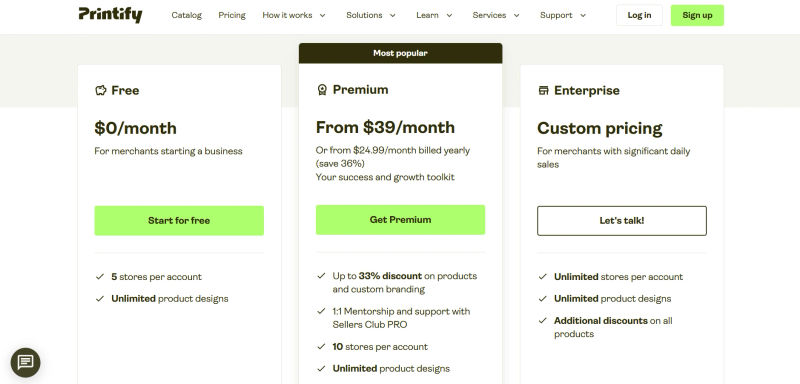
1. Printify Pricing Tiers
Free Plan: Ideal for beginners testing the waters. You can connect up to 5 stores per account and create unlimited product designs. You only pay for the base cost of the product and shipping when a customer makes a purchase.
Premium Plan ($39/month): This is where Printify shines. For $39 a month, you get up to 10 stores per account and, most importantly, up to a 20% discount on all base products.
Enterprise Plan (Custom Pricing): Designed for merchants processing over 10,000 orders a day, offering unlimited stores, custom API integrations, and dedicated account management.
2. The Profit Margin Calculator: Is Premium Worth It?
Let's break down the return on investment (ROI) for the Premium plan using a standard Bella+Canvas 3001 t-shirt, one of the most popular POD products.
Free Plan Base Cost: ~$10.50
Premium Plan Base Cost: ~$8.10
Savings per shirt: $2.40
If you sell the t-shirt for $25.00, your gross profit on the Free plan (before shipping and platform fees) is $14.50.
On the Premium plan, your gross profit jumps to $16.90.
To justify the $39/month Premium subscription, you only need to sell about 13 t-shirts a month ($39 divided by $2.40 savings).
For any serious e-commerce entrepreneur, hitting 13 sales a month is a baseline goal, making the Premium tier an absolute necessity for scaling and protecting your profit margins.
3. Factoring in Hidden Costs
When calculating your final margins, do not forget to factor in hidden operational costs.
These include platform transaction fees (Shopify or Etsy usually take around 3% to 6%), payment gateway fees (Stripe or PayPal charge roughly 2.9% + $0.30 per transaction), and currency conversion fees if you are selling internationally.
While Printify gives you the margin buffer to absorb these costs, failing to account for them will artificially inflate your projected profits.
Product Catalog and Customization Options
In 2026, consumers expect more than just a standard graphic tee.
The market is shifting heavily toward personalization at scale, unique home decor, and sustainable printing practices.
Printify's catalog is well-equipped to handle these trends.
1. Sustainable POD
Sustainability is no longer a niche requirement; it is a baseline expectation, particularly in European markets which are seeing a 24% CAGR in sustainable POD demand.
Printify has expanded its eco-friendly line, partnering with providers that offer organic cotton, recycled polyester, and water-based, non-toxic inks.
When browsing the catalog, look for products with recognized certifications like GOTS (Global Organic Textile Standard) and OEKO-TEX to ensure you are marketing genuinely sustainable goods to your eco-conscious buyers.
2. AI-Driven Design Tools
Printify's design interface is highly intuitive and has evolved significantly.
The 2026 updates have integrated native AI-driven design tools.
Sellers can now upscale low-resolution images, remove backgrounds with a single click, and generate seamless patterns directly within the dashboard.
While it does not replace professional design software like Adobe Illustrator, it drastically speeds up the workflow for entrepreneurs trying to react to micro-trends quickly.
3. Branding and Custom Packaging
Building a unique brand identity is a common challenge when using a third-party fulfillment service.
Printify allows you to add custom neck labels to certain apparel items, depending on the print provider.
However, it is important to note that Printify falls short of Printful when it comes to custom packaging.
Printify does not currently support custom packaging inserts, branded stickers, or fully custom poly mailers.
If the unboxing experience is a core part of your brand's value proposition, this is a limitation you must consider.

Print Quality and Fulfillment Reliability
This is the make-or-break section for any Printify review.
Because Printify relies on a network of third-party printers, you are entirely responsible for vetting the facilities you choose to work with.
1. DTG vs. DTF Printing
Most apparel on Printify is printed using Direct-to-Garment (DTG) technology, which sprays ink directly into the fabric.
It is excellent for complex, highly detailed designs on 100% cotton.
In 2026, several Printify providers have also adopted Direct-to-Film (DTF) printing.
DTF involves printing a design onto a film and heat-pressing it onto the garment.
DTF often yields more vibrant colors and significantly better durability on synthetic blends (like polyester hoodies).
When choosing a provider, pay attention to the printing technology they offer, as it directly impacts customer satisfaction and product longevity.
2. Vetting Providers
To avoid high return rates and customer dissatisfaction, never blindly choose the cheapest provider. Use this decision matrix:
Check the Printify Rating: Printify scores providers out of 10 based on quality, production speed, and stock reliability. Only use providers with a score of 9.0 or higher.
Analyze Average Production Time: Look for providers averaging under 2.5 days for production.
Review Shipping Origins: If your audience is in the US, choose a US-based provider. If your audience is in the UK, choose a UK-based provider to avoid customs delays and high shipping fees.
Order Samples: You must order samples. Benchmark the print quality, washability, and shipping speed yourself. While Printify does not offer a dedicated "sample discount" tier, if you are subscribed to Printify Premium, that 20% discount applies to your sample orders, effectively reducing the cost of testing.
In a no-inventory model, managing returns can be complex.
Printify will refund or replace items that are misprinted or damaged in transit.
However, they will not accept returns for buyer's remorse or sizing issues.
You must clearly state this in your store's return policy or be prepared to absorb the cost of refunds yourself.
Skip the sales pitch and compare Printify with other print-on-demand solutions on AuthenCIO.
Global Operations: International Tax and VAT Compliance
Selling internationally in 2026 requires strict adherence to global tax regulations, which can be a major source of anxiety for new entrepreneurs.
Printify has streamlined much of this process, but you still need to understand your obligations.
If you are selling to customers in the European Union or the United Kingdom, Value Added Tax (VAT) applies.
Printify acts as the merchant of record for the fulfillment side.
If you are not VAT-registered, Printify will calculate and charge the appropriate VAT on the fulfillment cost of your order.
For sellers utilizing the Import One-Stop Shop (IOSS) scheme for EU orders, Printify allows you to input your IOSS number into your store settings.
This ensures that VAT is collected at the point of sale on your storefront, and the package passes through EU customs smoothly without your customer being hit with surprise tax bills upon delivery.
While Printify provides the infrastructure to handle these taxes on the production side, you are still responsible for ensuring your e-commerce platform (like Shopify) is correctly configured to collect taxes from your end consumer.
E-commerce Integrations and Ease of Use
Platform integration is a core requirement for POD businesses in 2026.
Your fulfillment software must communicate flawlessly with your storefront to automate order processing and tracking updates.
Printify offers native, one-click integrations with the most popular e-commerce platforms and marketplaces:
Shopify: The integration is seamless. Products sync instantly, and orders flow automatically from Shopify to Printify.
Etsy: Highly popular for niche creators. Printify automatically updates tracking numbers in Etsy, keeping your "Star Seller" metrics safe.
WooCommerce, BigCommerce, and Wix: Fully supported for those hosting their own stores.
Marketplaces: Printify integrates with Walmart and eBay.
Social Commerce: With social selling dominating 2026, Printify's ability to connect with TikTok Shop (often via Shopify) is a major advantage for creators leveraging micro-trends.
For advanced users, Printify offers a robust API, allowing developers to build custom integrations for bespoke e-commerce setups.
Overall, the user interface is clean, modern, and built for efficiency, making it easy to manage hundreds of SKUs without feeling overwhelmed.
Find Perfect Software for Your Business
Printify Alternatives: How Does It Compare?
While Printify is a powerhouse, it is not the only option.
Depending on your specific business model, one of these alternatives might be a better fit.
1. Printify vs. Printful
This is the most common comparison. Printful operates entirely in-house, meaning they own the printing facilities.
The Verdict: Printful offers superior, standardized quality control and premium branding options (custom neck labels, packaging inserts). However, Printful's base costs are significantly higher. If your brand relies on premium, boutique quality and you can charge high retail prices, choose Printful. If you want to maximize profit margins and scale a massive catalog, choose Printify.
2. Printify vs. Gelato
Gelato focuses heavily on localized global production, with facilities in 32 countries.
The Verdict: If you are targeting an international audience (e.g., selling to Europe, Australia, and North America simultaneously), Gelato is superior. It routes orders to the facility closest to the buyer, drastically reducing shipping times and carbon emissions. However, Gelato's apparel catalog is smaller than Printify's.
3. Niche Alternatives: Gooten, Spreadshop, and CustomCat
Gooten: Best for established, high-volume businesses. Gooten acts more like a B2B supply chain partner. They have strict quality controls and a VIM (Very Important Merchant) program but are less beginner-friendly than Printify.
Spreadshop: Spreadshop's main selling point is its 48-hour order turnaround. If you are selling trend-based apparel where speed is everything, Spreadshop beats Printify's average fulfillment times.
CustomCat: Known for highly efficient apparel printing and competitive pricing, especially for high-volume sellers. However, their product catalog outside of apparel is limited compared to Printify.
4. Marketplaces: Redbubble and Spring
Platforms like Redbubble and Spring (formerly Teespring) are marketplaces, not just fulfillment engines.
The Verdict: If you do not want to build your own website, drive your own traffic, or handle customer service, use Redbubble or Spring. However, your profit margins will be incredibly small (often just a few dollars per shirt), and you do not own the customer data. For serious entrepreneurs building a standalone brand, Printify is the clear winner.
Try AuthenCIO
Move to faster, smarter software evaluation with AI
Final Verdict: Is Printify Worth It for Your Business in 2026?
So, is Printify worth it in 2026?
For the vast majority of aspiring e-commerce entrepreneurs and small business owners, the answer is a resounding yes.
Printify remains the most cost-effective print-on-demand platform on the market.
The combination of its massive product catalog, seamless e-commerce integrations, and the margin-boosting Printify Premium plan makes it the ultimate engine for scaling a low-inventory business.
By leveraging the internal competition of its print provider network, you can keep your base costs low and your profits high.
However, Printify is not a "set it and forget it" solution.
The decentralized model requires you to be proactive.
You must take the time to vet print providers, order samples, and monitor quality metrics to ensure your customers receive a product that reflects well on your brand.
If you demand 100% standardized quality control and premium unboxing experiences, you may want to look toward Printful.
If global, localized shipping is your primary goal, Gelato is a strong contender.
But for pure scalability and margin control, Printify is incredibly hard to beat.
2026 POD Launch Checklist
Before you launch your Printify store, ensure you have completed these essential steps:
Select a Profitable Niche: Identify a specific target audience rather than selling generic designs.
Vet Print Providers: Filter providers by a 9.0+ rating and production times under 2.5 days.
Order Physical Samples: Utilize the Premium plan discount to test print quality, washability, and shipping speed.
Calculate True Margins: Factor in Printify base costs, shipping, Shopify/Etsy fees, and currency conversion.
Update Store Policies: Clearly communicate fragmented shipping times and your strict return policy for misprints only.
Configure Tax Settings: Ensure your IOSS number (if applicable) and VAT settings are correctly integrated.