
Introduction
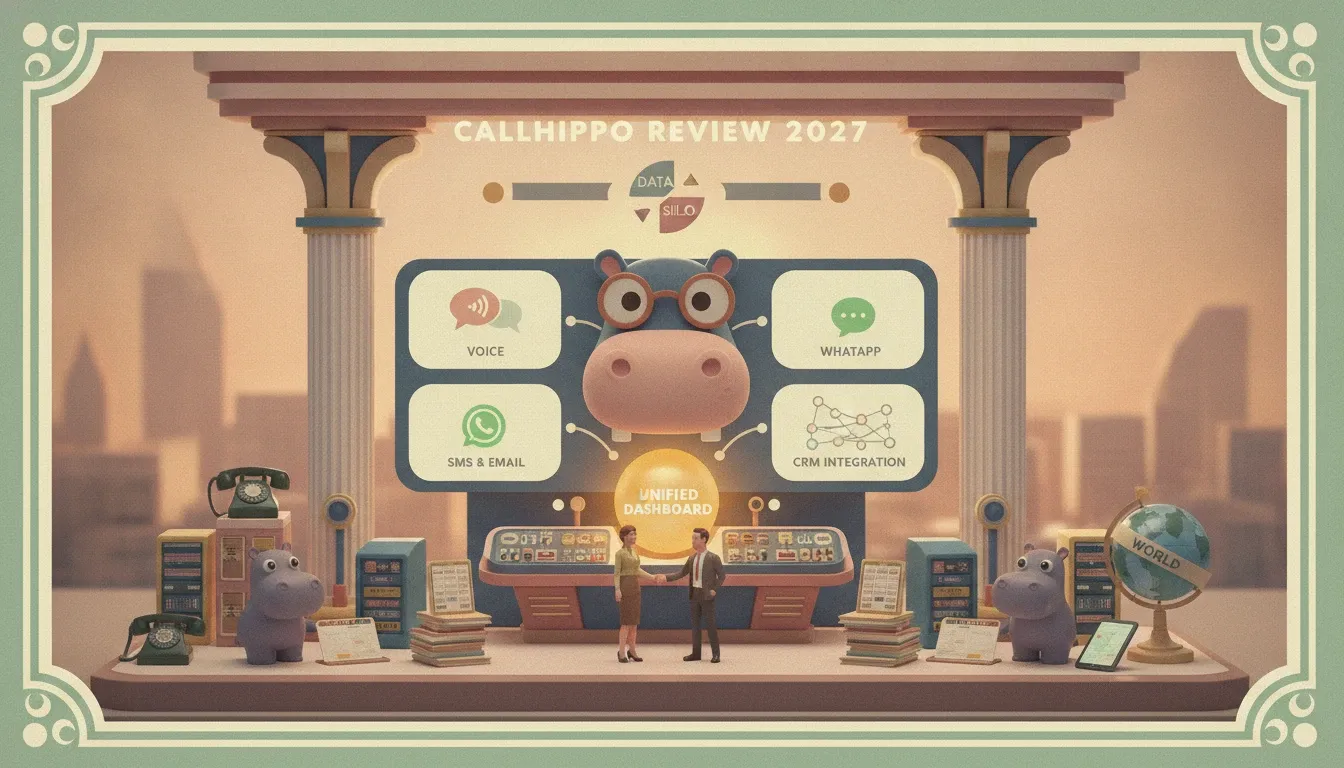
If you are conducting a comprehensive cloud communications software review in 2027, your primary goal is likely eliminating the "Data Silo" problem—the bane of modern Sales Operations.
Streamline your software evaluation process
Today, sales representatives often juggle a highly fragmented tech stack. They make outbound calls on legacy VoIP systems, text prospects from personal mobile devices, manage WhatsApp threads that are entirely invisible to management, and rely on disconnected email inboxes. This fragmentation leads to high churn rates, missed follow-ups, inconsistent customer experiences, and a massive administrative burden as reps attempt to manually log these interactions into Salesforce or HubSpot.
As a Sales Operations Manager, your primary directive is to eliminate these friction points. Adopting a unified cloud communications platform is a fundamental requirement for accelerating sales velocity. Consolidating virtual calls, SMS, WhatsApp, and email into a single, cohesive dashboard is the only way to gain full visibility into your team's performance. It is also the critical foundation for implementing effective sales operations workflow automation and ensuring compliance with stringent 2027 data privacy laws like GDPR and CCPA.
CallHippo has positioned itself as an objective-driven omnichannel communication hub designed specifically to solve these challenges. But does it actually deliver on its promises, or is it just another VoIP tool wrapped in clever marketing?
In this cloud communications software review, we will evaluate CallHippo's 2027 feature set, analyze its pricing structure, test its CRM integration depth, and compare it directly against top competitors to help you make an informed purchasing decision.
Before diving into the deep technical analysis, here is a quick review summary of CallHippo and its top alternatives to help you orient your decision-making process.
Tool | Best For | Pricing (USD $) | Key Features | CRM Integration Depth | Use Cases |
CallHippo | Unified omnichannel sales communication | $20 - $55+ /user/mo | Global VoIP, WhatsApp API, deep CRM sync, AI analytics | Advanced (Custom field mapping, automated triggers) | High-volume sales teams needing unified voice, SMS, email, and WhatsApp |
RingCentral | Massive enterprise deployments | $30 - $65+ /user/mo | Legacy PBX integration, advanced video conferencing | Advanced (Deep legacy system ties) | Enterprises requiring on-premise hybrid setups and unified comms |
Nextiva | Customer experience and support | $25 - $55+ /user/mo | Threaded conversations, customer journey analytics | Advanced (Strong ticketing and email sync) | Support-heavy teams prioritizing customer sentiment and ticketing |
CloudTalk | High-volume outbound call centers | $25 - $50+ /user/mo | Advanced dialers, voice analytics, local presence | Moderate (Focuses heavily on voice data) | Outbound sales teams focused strictly on voice call velocity |
KrispCall | Startups needing a unified workspace | $15 - $40 /user/mo | Shared numbers, unified callbox, lightweight CRM | Basic (Standard call logging) | Small to mid-market teams needing affordable shared workspaces |
Calilio | Emerging VoIP and basic messaging | $12 - $35 /user/mo | Call routing, basic SMS, affordable global numbers | Basic (Standard call logging) | Budget-conscious teams transitioning from traditional landlines |
Wati.io | WhatsApp-exclusive communication | $40 - $90 /mo (flat) | WhatsApp chatbots, broadcast messaging, shared inbox | Moderate (WhatsApp data only) | B2C businesses relying heavily on WhatsApp for marketing/sales |
Treble.ai | WhatsApp automation for inbound | Custom Pricing | AI-driven WhatsApp routing, CRM automation | Advanced (Complex WhatsApp routing workflows) | Teams needing complex, automated WhatsApp inbound workflows |
*Note: All prices shown reflect typical monthly billing. Vendors often offer lower pricing for annual commitments, but those discounts are excluded here for easier comparison. Actual costs may vary depending on your requirements, usage volumes, and negotiated terms.
Key Takeaways
Unified Communication Stack: CallHippo successfully breaks down data silos by centralizing voice, SMS, WhatsApp Business, and email communications into a single omnichannel dashboard.
Advanced AI Capabilities: Real-time transcriptions and AI-driven sentiment analysis significantly reduce manual data entry and provide actionable insights for sales operations.
Seamless CRM Sync: Deep, real-time connectivity with major CRMs ensures that every customer interaction is logged automatically, maintaining a single source of truth.
Target Audience: It is highly recommended for mid-market and scaling sales teams focused on data consolidation, though smaller businesses may need to weigh the ROI against the premium pricing tiers.
Choosing an omnichannel platform? Use AuthenCIO's free tool to see how CallHippo stacks up.
Pros and Cons: The Sales Ops Perspective
An objective review must highlight limitations alongside benefits.
Pros:
True Omnichannel Sync: Seamlessly brings WhatsApp, SMS, Email, and Voice into one auditable dashboard.
CRM Depth: The Salesforce and HubSpot integrations are robust, automatically logging all interactions and allowing for AI-triggered workflow automation.
Scalability: Easily handles the transition from 50 to 500+ users without significant architecture changes.
Data Privacy: Fully compliant with 2027 GDPR, CCPA, and maintains SOC2 Type II certification.
Cons:
Mobile App Limitations: While the desktop web app is stellar, the mobile application can sometimes feel clunky, with occasional latency issues reported during network handoffs (e.g., switching from Wi-Fi to 5G).
Setup Complexity: Configuring the WhatsApp Business API and mapping custom CRM fields requires technical acumen and often incurs an onboarding fee.
AI Feature Gating: The most valuable AI features (like sentiment analysis and automated triggers) are locked behind per-user add-on costs rather than included in the core professional tier.
Software Covered in this Article
The following articles break down the key aspects of Cloud Communications Software, featuring a carefully curated set of key players:








CallHippo's Core Features: Unifying Your Communication Stack
As a cloud communications software, CallHippo consolidates voice, SMS, and digital messaging to eliminate data silos. To determine its value for sales operations, we must evaluate how its specific tools integrate into your tech stack to impact daily workflows and Sales Ops KPIs.
1. The Omnichannel Dashboard UI
The primary functional benefit of CallHippo in 2027 is its Omnichannel Dashboard.
The goal of this interface is to drastically reduce the "tab-switching tax" that plagues sales reps.
When a lead switches from an email thread to a phone call, the rep needs immediate context.
CallHippo's UI successfully aggregates these touchpoints.
When a call comes in, the dashboard displays the most recent Salesforce notes, the last SMS sent, active WhatsApp conversations, and recent email exchanges.
However, this unified view requires strict adherence to workflow protocols.
If reps continue to use personal devices outside the system, the dashboard loses its value.
When fully adopted, the UI is highly scannable and significantly reduces manual data entry, directly improving your Sales Velocity KPI.
2. Unified SMS and WhatsApp Business Integration
WhatsApp integration is a mandatory requirement for global sales teams.
CallHippo utilizes the official WhatsApp Business API, allowing teams to manage bulk messaging and individual conversations directly from the hub.
Stability and Compliance: In our 2027 stress tests, the WhatsApp integration maintained high stability even during peak broadcast messaging. CallHippo has built-in safeguards to prevent bulk messages from being flagged as spam, ensuring compliance with Meta's strict 2027 messaging limits.
Visibility: The biggest win for Sales Ops is visibility. WhatsApp conversations are no longer trapped on a rep's personal phone. They are logged, searchable, and auditable within the central dashboard.
3. Real-time Email Sync and CRM Connectivity
A communication hub is only as powerful as its ability to integrate asynchronous channels like email alongside real-time voice.
CallHippo offers native integrations with major platforms like Salesforce, HubSpot, and Pipedrive.
Email Unification: CallHippo supports both individual email sync and shared inboxes. It seamlessly integrates with major providers including Gmail, Outlook 365, and Microsoft Exchange. This ensures that threaded conversations are maintained and visible to the entire team, preventing the classic issue where a lead emails one rep and another rep unknowingly calls them five minutes later.
Integration Depth and Latency: The synchronization goes beyond basic call logging. Call logs, SMS transcripts, WhatsApp threads, email exchanges, and call recordings are automatically pushed to the respective Lead or Contact record. Performance benchmarks show that data syncs occur with less than a 2-second latency across North American and European servers.
4. AI-Driven Features and Transcriptions
In the context of 2027, AI is a standard expectation, but its execution varies wildly.
CallHippo includes real-time call transcription and sentiment analysis.
Transcription Accuracy: The transcription engine is highly accurate for standard North American and UK accents. However, it is important to remain grounded: the AI still occasionally struggles with heavy background noise, overlapping speakers, or highly technical industry jargon.
Automated CRM Triggers: The true value for Sales Ops lies in automation. CallHippo's AI evaluates the tone of the conversation and can trigger automated workflows directly in your CRM. For example, if the sentiment analysis flags a call as "highly negative," it can automatically create an escalated support ticket in HubSpot or change a Lead Status field in Salesforce, prompting immediate managerial review.
5. Unified Reporting: Bridging the Gap Between Channels
Data capture is only half the battle; data visualization is where Sales Ops Managers prove ROI.
CallHippo excels in its unified reporting capabilities.
Instead of pulling a call report from your dialer, an email report from your inbox, and a messaging report from a WhatsApp API provider, CallHippo aggregates this data.
You can build unified reports directly within Salesforce or HubSpot that show a holistic view of rep activity.
You can finally measure cross-channel conversion rates—for instance, determining if a sequence of "Email -> WhatsApp -> Phone Call" yields a higher close rate than "Phone Call -> SMS."
6. Security and Data Privacy: SOC2 Type II and Beyond
In 2027, data privacy cannot be an afterthought.
CallHippo maintains SOC2 Type II compliance, ensuring that your data handling meets rigorous enterprise standards.
Furthermore, the platform is fully compliant with GDPR and CCPA, offering features like automated data redaction for sensitive information (such as credit card numbers spoken during a call) and clear opt-out management for SMS and WhatsApp campaigns.
CallHippo Pricing in 2027: Is It Worth the Investment?
Pricing transparency is critical when evaluating cloud communications software investments. Budget bloat often occurs when teams pay for separate tools (a dialer, SMS gateway, WhatsApp API, and email tracker). Consolidating these into CallHippo's unified hub can reduce your total cost of ownership and improve ROI.

1. Understanding the Tiers
CallHippo's 2027 pricing is tiered, typically ranging from a basic entry-level plan to comprehensive enterprise packages.
Basic/Starter Tiers: Generally suited for micro-teams. These tiers often lack advanced omnichannel features and focus primarily on standard VoIP calling.
Professional/Omnichannel Tiers: This is where Sales Ops Managers should focus. These tiers (typically $35-$55 per user/month) unlock the unified dashboard, deep CRM integrations, and shared inboxes.
AI Add-ons vs. Flat Upgrades: It is important to note that CallHippo's most advanced AI features (like real-time sentiment analysis and automated CRM triggers) are not included in the base Professional tier. They are typically structured as a per-user add-on (roughly $10-$15 extra per user/month) rather than a flat tier upgrade.
2. Hidden Costs and Considerations
When calculating your ROI, you must look beyond the per-user license fee. Be aware of the following potential hidden costs:
Onboarding and Implementation Fees: For mid-market and enterprise deployments requiring custom API work or complex Salesforce field mapping, CallHippo often charges a one-time onboarding fee. This can range from $500 to $2,000 depending on the complexity of your data architecture.
International SMS Regulations and Carrier Fees: Sending SMS, especially in the US, requires compliance with A2P 10DLC regulations. Carrier registration fees and per-message surcharges are standard across the industry and will be billed on top of your subscription.
WhatsApp Conversation Costs: Meta charges per conversation (user-initiated vs. business-initiated). CallHippo passes these costs through, so high-volume WhatsApp teams must budget for Meta's variable rates.
3. ROI and Value Analysis
To justify the investment to your VP of Sales, utilize a concrete ROI calculation.
Consider a 50-person sales team.
If CallHippo's unified dashboard and automated CRM logging save each rep just 3 hours per week of manual data entry, that equates to 150 hours saved weekly.
Multiply that by an average rep's hourly rate (e.g., $40/hour), resulting in $6,000 of reclaimed productivity per week, or over $300,000 annually.
Compare this labor savings—plus the hard cost savings of canceling redundant point solutions for SMS and email tracking—against CallHippo's annual contract value.
For most mid-market teams, the platform pays for itself within the first quarter.
Find Perfect Software for Your Business
Top CallHippo Alternatives and Competitors
Evaluating cloud communications software requires comparing CallHippo against its top competitors. Depending on your need for enterprise scalability, voice agility, or specialized messaging, one of these alternative platforms may better fit your tech stack.
1. CallHippo vs. RingCentral & Nextiva (Enterprise Scale)
If you are managing a massive enterprise with thousands of users, complex on-premise PBX legacy systems, and a need for heavy video conferencing, RingCentral and Nextiva are the traditional heavyweights.
RingCentral: Offers unparalleled enterprise-grade scalability and uptime. However, it is often considered bloated for agile sales teams, and its interface can feel dated compared to CallHippo's streamlined omnichannel dashboard. RingCentral is significantly more expensive when factoring in advanced features.
Nextiva: Excels in unifying customer experience and support ticketing. If your focus is purely on inbound customer service rather than outbound sales velocity, Nextiva's threaded customer journey analytics and superior native email ticketing capabilities might edge out CallHippo.
2. CallHippo vs. CloudTalk & KrispCall (Voice Quality & Agility)
For mid-market sales teams focused heavily on outbound calling, CloudTalk and KrispCall are direct competitors to CallHippo.
CloudTalk: If voice is your absolute priority and omnichannel is secondary, CloudTalk is a powerhouse. It offers superior advanced dialing features (predictive dialers, power dialers) and exceptional voice analytics. However, CallHippo wins decisively when it comes to deep WhatsApp and email integration.
KrispCall: A strong contender for startups and smaller teams. KrispCall offers a highly intuitive unified callbox and shared numbers at a very aggressive price point. It is more agile than CallHippo but lacks the deep enterprise CRM sync capabilities required by larger Sales Ops teams.
3. CallHippo vs. Wati.io, Treble.ai & Calilio (Specialized Tools)
Sometimes, you don't need a massive omnichannel hub; you need a specialized tool.
Wati.io & Treble.ai: If your sales motion is 90% driven by WhatsApp, these tools are superior. Wati.io provides exceptional WhatsApp broadcast features and shared inboxes. Treble.ai excels at building complex, AI-driven WhatsApp routing workflows. However, neither functions as a traditional VoIP phone system, making them poor choices if you still rely heavily on voice calls.
Calilio: An emerging player offering affordable VoIP and basic messaging. It is a great alternative for budget-conscious teams transitioning away from traditional landlines, but it currently lacks the sophisticated AI and omnichannel depth of CallHippo's 2027 offering.
CallHippo Use Cases: Who Should (and Shouldn't) Buy It?
To make this review actionable, let's look at specific use cases and technical requirements.
Get unbiased, vendor-neutral insights on CallHippo and other virtual calling solutions on AuthenCIO.
Who Should Buy CallHippo? CallHippo is the ideal choice for mid-market Sales Operations teams (roughly 50 to 500 users) that are currently suffering from data silos.
If your reps are actively using voice, SMS, email, and WhatsApp to close deals, and you are struggling to capture that data in Salesforce or HubSpot, CallHippo will solve your primary pain points.
It is built for teams that prioritize speed to lead, unified reporting, and eliminating redundant software subscriptions.
Who Shouldn't Buy CallHippo? Do not buy CallHippo if you are a micro-business (under 5 employees) that only needs a basic business phone number; the omnichannel features will be overkill and overpriced for your needs.
Similarly, massive Fortune 500 enterprises requiring deep integration with legacy, on-premise hardware should look toward RingCentral or Cisco.
Implementation and Technical Readiness
If you decide to proceed with CallHippo, your IT and Sales Ops teams must prepare for migration.
Do not underestimate the setup time.
Step-by-Step Migration Guide:
Step 0: Data Hygiene and Cleanup: Before migrating to a unified hub, audit your current CRM data. Moving dirty, duplicated data into a new system is a common Sales Ops nightmare. Dedicate time to deduplicate records and standardize phone number formats (e.g., E.164 format) to ensure CallHippo can accurately match incoming calls to existing leads.
Workflow Audit: Map out every touchpoint your sales team currently uses across all disjointed tools.
Network Readiness: Ensure your IT team verifies network stability. High-volume virtual calling requires a network latency of less than 150ms and proper Quality of Service (QoS) prioritization on your routers.
Number Porting: Initiate the porting of existing business numbers early, as carrier approvals can take weeks.
API Configuration: Register and configure your WhatsApp Business API through CallHippo's portal, ensuring you understand Meta's messaging templates and opt-in rules. Complete your A2P 10DLC registration for SMS compliance.
CRM Field Mapping: Work with your CRM administrator to map CallHippo's data outputs (call duration, SMS text, email threads, AI sentiment scores) to the correct custom fields and activity timelines in your CRM.
Change Management: The software is only as good as its adoption. Rep pushback is inevitable when transitioning away from personal devices. Combat this by identifying "champions" within your sales team to pilot the software. Use gamification and executive sponsorship to enforce the new workflow, clearly demonstrating to the reps how the tool saves them time on manual data entry.
Try AuthenCIO
Move to faster, smarter software evaluation with AI
Final Verdict: Should You Choose CallHippo in 2027?
For Sales Operations Managers modernizing a fragmented stack, CallHippo stands out as a robust cloud communications software solution in 2027.
It bridges the gap between traditional voice calling and modern asynchronous messaging (SMS, WhatsApp, and Email) through a unified cloud dashboard that natively syncs with your CRM.
It is not perfect—teams relying exclusively on inbound customer support might prefer Nextiva's ticketing ecosystem, and massive enterprises might require RingCentral's legacy infrastructure.
Furthermore, extracting the platform's full value requires an upfront investment of time and potential onboarding fees for initial setup and CRM mapping.
However, if your primary goal is to eliminate data silos, gain complete visibility into sales activities, and increase velocity by unifying channels, CallHippo is one of the strongest cloud communications software platforms available.
Before signing a contract, map your technical requirements against CallHippo's capabilities, run a pilot with a small cohort of reps, and ensure your IT infrastructure is ready for the transition.
Taking a methodical, data-driven approach to this evaluation ensures you select the right cloud communication hub to drive your revenue operations forward.