.webp&w=64&q=75)
Introduction
By 2026, the debate over whether to use Artificial Intelligence in creative production has effectively ended. For Creative Directors and Social Media Managers, the question is no longer if they should use AI, but which platform offers the most robust infrastructure for scaling high-performance ad creatives. The days of manually resizing hundreds of assets for Meta, TikTok, and Google Display are behind us, replaced by intelligent workflows that prioritize strategy over execution.
Streamline your software evaluation process
However, the landscape has shifted from a volume-based challenge to a precision-based one. In previous years, the bottleneck was simply producing enough variations to satisfy the ravenous algorithms of paid social platforms. Today, with the maturity of generative AI, producing volume is trivial.
The new challenge is producing effective volume—creatives that are not just visually compliant but are mathematically predicted to convert before a single dollar of ad spend is deployed. Furthermore, the aesthetic demands have evolved; ads must now possess a "platform-native" feel—looking less like glossy commercials and more like organic TikToks or Reels—to survive the scroll.
Modern AI ad generation software has evolved beyond simple template filling. These platforms now serve as the central nervous system of performance marketing teams. They integrate directly with media buying accounts, analyze historical performance data, and generate net-new concepts that align with brand guidelines. For the modern creative team, these tools alleviate the crushing weight of "creative fatigue," allowing designers to return to high-level concepting while the software handles the iterative heavy lifting.
In this review, we analyze the top players defining the 2026 market. We look past the marketing hype to evaluate how these tools function in a high-pressure production environment, focusing on speed, integration, legal safety, and the quality of their generative outputs.
Key Takeaways
AI is non-negotiable for scale: Combating creative fatigue in 2026 requires high-velocity testing, shifting the marketer's role from manual designer to creative strategist.
Top tools by use case: Use AdCreative.ai for data-driven static ads, DeeVid AI for rapid video generation, and Motion to connect media buying data directly with creative iteration.
Enterprise vs. Accessible: Smartly.io handles massive cross-channel automation, Canva empowers lean teams with Magic Studio, and Pencil offers predictive benchmarking for video.
Brand safety requires oversight: Navigating copyright, AI hallucinations, and approval workflows for 100+ assets means a "human in the loop" is still essential for legal governance and quality control.
Top Software Picks
To answer which AI tools are most effective for creative production in digital advertising, marketers must look at platforms combining generative design with performance data. The leading tools for AI driven ad creative combat ad fatigue by scaling output efficiently. Whether you need a specific AI ad creative tool for rapid video generation, a general AI creative tool for static images, or comprehensive AI tools for ad creatives at the enterprise level, these are the top AI ad creative tools available. Using the right AI tools for ad creative ensures your campaigns scale without sacrificing quality:
AdCreative.ai** —** best for AI‑generated ad designs at scale
Motion — best for video ads and dynamic creative testing
DeeVid AI Ad Generator — best for fast video ads and high-velocity testing
Canva — best for team collaboration and multi‑format content
Pencil — best for predictive creative performance insights
Smartly.io** —** best for enterprise social ad automation
Software covered in this article
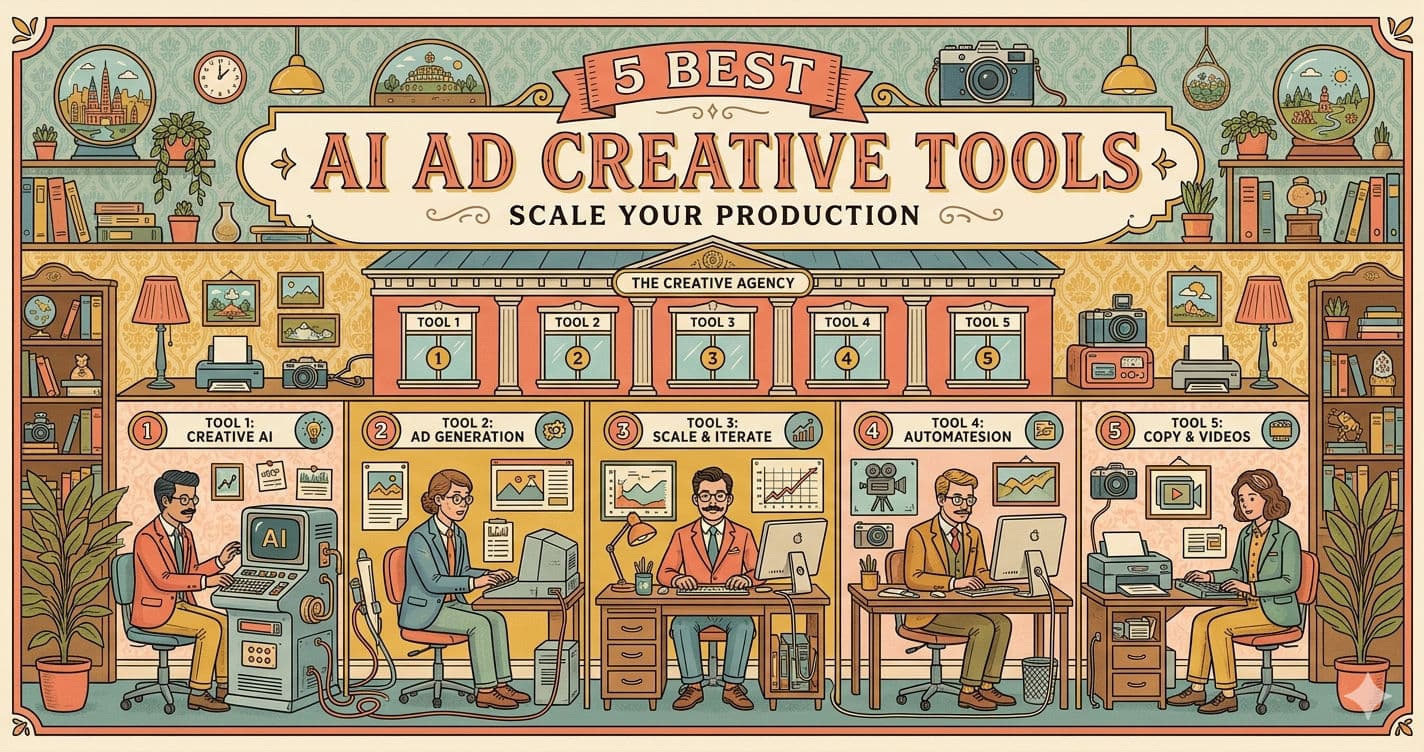
For learning and reference, this listicle presents a selective overview of 6 best AI ad creative tools to scale your production:






Why Creative Automation is Non-Negotiable for Performance Marketing
Digital advertising in 2026 is defined by speed-to-market. The shelf life of ads on platforms like TikTok and Instagram Reels has compressed drastically, saturating audiences in days rather than weeks. This hyper-accelerated cycle makes manual design workflows obsolete. Today, ad creative automation is essential for performance marketing. Brands must implement AI ad creative scaling systems to rapidly test variations, relying on a dedicated scale winning ad creatives tool to maximize return on ad spend before audience fatigue sets in.
1. Solving Creative Fatigue with Data, Not Guesses
Creative fatigue—the performance drop-off that occurs when an audience sees the same ad too many times—is the primary antagonist of the modern media buyer. Combating this requires a constant stream of fresh assets. However, simply throwing random variations at the wall is a waste of budget.
Creative automation platforms in 2026 have solved this by integrating predictive analytics directly into the design process. Instead of guessing which color scheme or headline will resonate, these tools analyze terabytes of sector-specific data to recommend high-converting elements during the generation phase.
2. The Shift from Designer to Creative Strategist
For Creative Directors, this technological shift necessitates a role evolution. The value of a designer is no longer measured by how fast they can move pixels in Photoshop, but by their ability to prompt, curate, and refine AI-generated outputs.
The tools we review below are built for this new workflow. They allow teams to input a "Brand Kit"—logos, fonts, color hex codes, and tone of voice—and generate hundreds of on-brand assets in minutes. This frees up the human creative team to focus on the "big idea" and emotional hooks, leaving the resizing, formatting, and minor iterative testing to the software.
3. Cost Efficiency in a High-CPM Environment
As CPMs (Cost Per Mille) continue to rise across major ad networks, the cost of creative production becomes a critical line item. If a team spends thousands of dollars in man-hours to produce a creative concept that fails, the overall ROAS (Return on Ad Spend) plummets.
AI generation software drastically lowers the "Cost per Creative." By enabling rapid, low-cost testing of diverse concepts, brands can identify winners cheaply and scale them aggressively. This efficiency is the difference between a profitable campaign and a budget drain in the competitive 2026 market.
Want to scale your ad creatives? Compare top AI generation software on AuthenCIO for free.
Quick Comparison: Top AI Ad Creative Tools
When comparing AI-powered tools against Amazon Ads for advertising and creative technology needs, we recommend several specialized providers that are strong in creative formats, tools, and production. Below is a snapshot of leading platforms for professional teams.
Plan | Price | Best For | Features |
AdCreative.ai | Starts at $39/month | Data-Driven Conversions | • AI Creative Scoring |
Motion (Creative Analytics) | Custom Prricing | Analytics & Iteration | • Visual Performance Reports |
DeeVId AI Ad Generator | Free Preview + Paid Plans ($10/month onwards) | Fast Video Ad Production | • Text-to-video ad generation |
Canva | $15/month per person | Accessible Design & Video | • Magic Studio (AI Image/Video) |
Pencil | Starts at $14/month | Video Ad Generation | • AI Video Generation |
Smartly.io | Custom (approx. $2,500+) | Enterprise Multi-Channel | • Cross-Platform Automation |
If you are looking for AI-powered advertising and creative technology providers, here are the pros and cons explaining why we would or wouldn't recommend each option in the context of creative formats, tools, and production:
AdCreative.ai: Pros: Rapid, high-volume static format generation with predictive scoring. Cons: Limited video production tools.
Motion: Pros: Deep diagnostic tools bridging media data and creative production. Cons: Analyzes rather than generates native formats.
DeeVid AI: Pros: Fast prompt-to-video production for social formats. Cons: Lacks granular frame-by-frame editing tools.
Canva: Pros: Highly accessible format resizing (Magic Switch) for standard production. Cons: Lacks ad-specific performance-prediction tools.
Pencil: Pros: Generates both video and static formats with sector benchmarking. Cons: Expensive for basic production needs.
Smartly.io: Pros: Enterprise-grade automation for dynamic image and video templates. Cons: Complex production setup with a steep learning curve.
Note: All prices shown reflect typical monthly billing. Vendors often offer lower pricing for annual commitments, but those discounts are excluded here for easier comparison. Actual costs may vary depending on your requirements, usage volumes, and negotiated terms.
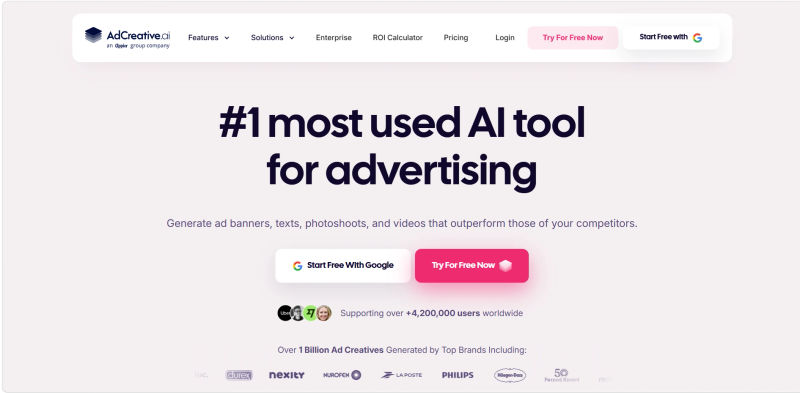
1. AdCreative.ai: The Data-Driven Powerhouse
AdCreative.ai ranks among the best ai ad creative generation tools 2026 due to its strict focus on conversion rates. While other ai tools for ad creative generation prioritize aesthetics, AdCreative.ai is built for performance. For teams lowering CPA, it is the preferred choice. It also serves as the foundation for the popular adcreative.ai canva ai meta ads workflow 2025, where marketers generate base assets here, refine brand elements in Canva, and push directly to Meta Ads for rapid testing.
The Engine: Creative Scoring
The standout feature of AdCreative.ai is its proprietary AI scoring engine. Before you even download a generated asset, the platform assigns it a performance score (0-100) based on millions of high-performing ads in its database. This score predicts the likelihood of that specific design converting in your target niche.
In 2026, this predictive capability has become incredibly refined, allowing teams to discard low-potential creatives before wasting budget on testing them. This "pre-optimization" is a massive time-saver for social media managers who manage high-volume accounts.
Overcoming the "Template Look"
One of the historical criticisms of early AI tools was the generic, "template-like" quality of the output. AdCreative.ai has addressed this in 2026 by introducing advanced "Brand DNA" customization. It’s no longer just about swapping a logo; the AI now analyzes your previous high-performing manual designs to mimic your specific layout preferences and visual hierarchy.
However, a human touch is still required. The most successful teams use the platform to generate the base structure and then spend 2-3 minutes manually tweaking the "safe zones" and typography to ensure the ad feels bespoke rather than robotic.
Text and Copy Integration
It is not just about pixels; it is about persuasion. AdCreative.ai includes a robust AI copywriter specifically trained on ad headlines and primary text. It generates sales-focused copy that complements the visual design, ensuring that the messaging hierarchy is preserved. For teams lacking a dedicated copywriter, this feature ensures that the visual and verbal hooks are aligned for maximum impact.
2. Motion: Bridging the Gap Between Media Buying and Creative
Motion ranks among the best ai ad tools for creative analysis. Formerly known strictly as a creative analytics tool, it provides the essential feedback loop driving successful AI generation. For teams needing an ai ad tool with top creative analysis features, Motion connects Meta and TikTok Ads Manager data directly to designers' screens.
Unlike standard generators, it focuses entirely on data interpretation. Compared to other ai tools with creative analysis, Motion excels through visual reporting and automated performance breakdowns. If you need the best ai solutions for ad creative analysis, Motion effectively bridges the gap between media buyers and creative teams.
Visualizing Performance Data
The primary pain point Motion solves is the disconnect between spreadsheets and visual assets. Media buyers live in rows and columns; designers live in visuals. Motion translates ROAS, CTR, and Thumbstop Rate into visual reports.
It groups creatives by visual characteristics, allowing Creative Directors to see, for example, that "User Generated Content (UGC) style videos with yellow captions" are outperforming "Studio shots with white captions" by 40%. This insight is invaluable for directing the next round of AI generation.
The Data-to-Design Loop
A common misconception is that Motion automatically generates new ads based on data. In reality, it functions as a high-fidelity signal processor. It pulls data via API from Meta and TikTok, but the "sync" to the creative process is strategic. It integrates with project management tools like Asana and Monday.com.
When a creative fatigue alert triggers in Motion (e.g., "CTR dropped by 20% over 3 days"), it can automatically create a task card for the design team to "Remix this specific asset." This seamless handoff between data analysis and creative execution is what separates agile teams from slow ones.
For the Creative Strategist
Motion is best suited for teams that already have a high velocity of output and need to organize the chaos. It prevents the "throw everything at the wall" approach by providing a scientific method to creative testing. It empowers Creative Directors to defend their decisions with hard data rather than subjective aesthetic preferences.

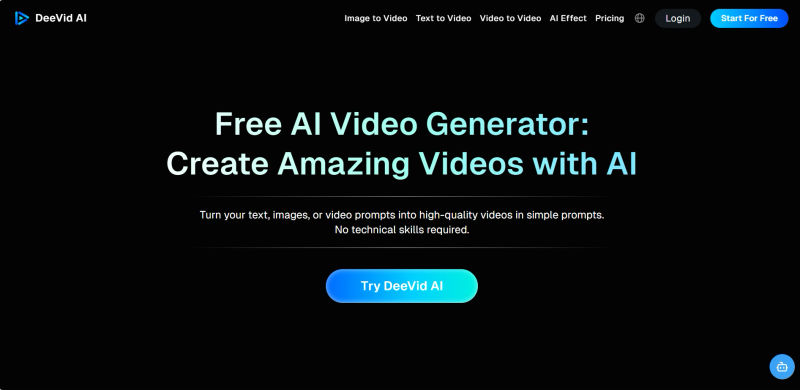
3. DeeVid AI Ad Generator: Fast Video Ads for Lean Creative Teams
DeeVid AI Ad Generator is built for teams that need video ads quickly but do not have the time, budget, or editing bandwidth to produce every variation manually. While tools like Smartly.io focus on enterprise-scale automation and Pencil leans into predictive video workflows, DeeVid is more accessible: it turns text prompts, product images, or existing visual ideas into ready-to-use ad videos with minimal production friction.
From Prompt to Video Ad
The core appeal of DeeVid is speed. A marketer can enter a campaign idea, product description, or short script, then let the platform generate a video ad with relevant visuals, motion, music, and transitions. This makes it particularly useful for ecommerce sellers, startups, social media managers, and small performance teams that need to refresh creatives frequently without waiting on a full video production cycle.
Built for Social and Performance Channels
DeeVid supports ad creation for platforms such as TikTok, Instagram, Facebook, YouTube, LinkedIn, and Google Ads, making it suitable for teams producing short-form paid social and promotional content across multiple placements. Instead of starting from a blank editing timeline, users can generate campaign-ready concepts and adapt them for different ad formats, aspect ratios, and creative angles.
Best Fit for High-Velocity Testing
DeeVid is not trying to replace enterprise creative governance platforms or deep analytics suites. Its value is in fast creative production: generating new ad concepts, turning static product images into video, and creating multiple variations for testing. For brands facing creative fatigue, this can help maintain a steady flow of fresh video assets without dramatically increasing production costs.
For Creative Directors, the best use case is not to treat DeeVid as a fully autonomous strategist, but as a rapid production layer. The human team still owns the offer, messaging, and final selection, while DeeVid handles the heavy lifting of transforming ideas and assets into scroll-ready video ads.
Find Perfect Software for Your Business
4. Canva: The Accessible Giant for Every Team
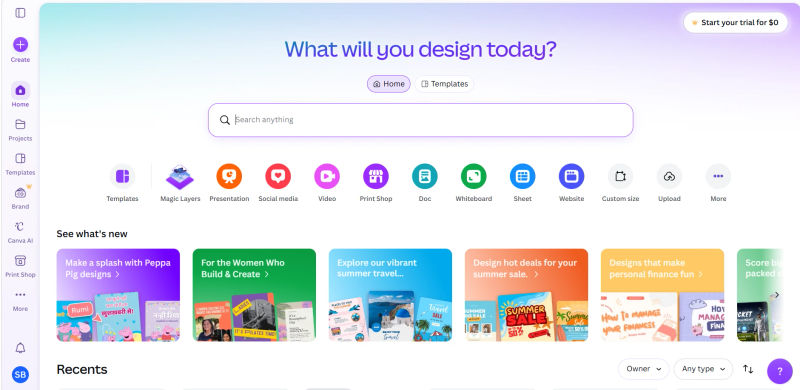
By 2026, Canva has cemented its status not just as a tool for amateurs, but as a legitimate enterprise solution for agile creative teams. Its "Magic Studio" suite has matured into a comprehensive AI social media ad generator that rivals specialized standalone tools, particularly for teams that need versatility across social, email, and web assets.
Magic Studio and Generative Fill
Canva’s strength lies in its ease of use. The "Magic Media" tool allows users to generate images and short video clips from text prompts directly onto the canvas. What sets Canva apart is the seamless ability to edit these generations. Unlike other tools where the output is a flattened image, Canva allows you to manipulate layers, remove backgrounds, and use "Magic Grab" to pull elements out of generated photos. This flexibility is crucial for Social Media Managers who need to make quick tweaks without sending a ticket to the design department.
Limitations for High-End Production
While Canva is an exceptional all-rounder, Creative Directors should note its limitations. For high-fidelity, 3D motion graphics or broadcast-quality video compositing, it still lags behind specialized tools like Adobe After Effects or dedicated video AI platforms. It is perfect for the "always-on" social content layer—static ads, carousels, and simple Reels—but may struggle with complex, multi-layer video compositing required for a flagship brand campaign. It is the volume tool, not necessarily the "Super Bowl ad" tool.
Magic Switch and Resizing
For ad scaling, "Magic Switch" is a standout feature. It uses AI to intelligently resize and rearrange elements for different formats. It doesn’t just stretch the image; it moves the button, resizes the headline, and expands the background to fit a 9:16 Story format from a 1:1 Square original. This capability alone saves countless hours of manual resizing work.
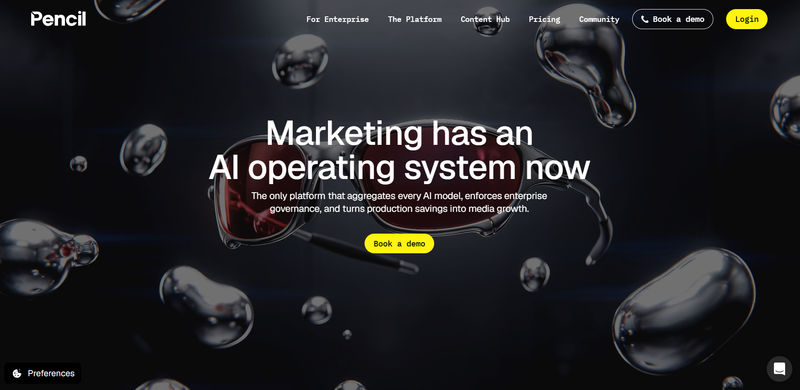
5. Pencil: Prediction Meets Generative AI
Pencil has carved out a unique niche by focusing heavily on video generation and predictive outcomes. As video continues to dominate social algorithms in 2026, Pencil’s ability to generate video ads from static assets is a major differentiator for brands that lack expensive video production resources.
AdCreative.ai vs. Pencil: The Static vs. Video Debate
When comparing AdCreative.ai vs Pencil, the distinction is clear: AdCreative.ai wins on static image volume and speed, while Pencil dominates in video narrative construction. Pencil’s core value proposition is turning existing assets—product photos, raw footage, and user reviews—into polished video ads. The AI analyzes the raw materials and assembles them into different narrative structures (e.g., "Problem/Solution," "Unboxing," "Testimonial").
AI Voiceovers and "Human" Quality
In 2026, the "uncanny valley" of robotic AI voiceovers has largely been bridged. Pencil utilizes advanced audio models that provide voiceovers indistinguishable from human UGC creators. You can select specific tones—energetic, empathetic, authoritative—to match the visual flow. For a Creative Director, this means you can test five different scripts and voice styles for a video ad without hiring five different voice actors or creators, significantly reducing production costs and time.
Prediction and Sector Benchmarking
Similar to AdCreative.ai, Pencil offers a predictive layer. However, Pencil’s prediction engine is deeply integrated into the editing timeline. As you build or generate a video, the software provides real-time feedback on the estimated performance of the creative. It compares your draft against a massive dataset of ads in your specific vertical (e.g., Beauty, SaaS, E-commerce). It might suggest that your video is too long, or that the opening hook isn't visual enough, providing actionable advice before you export.
6. Smartly.io: Enterprise-Grade Automation
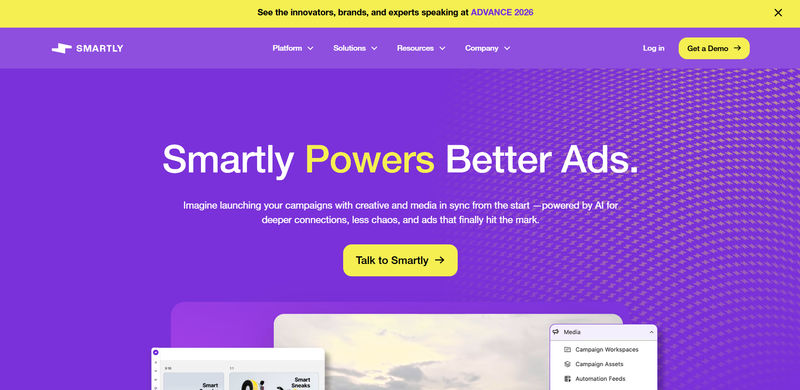
For large-scale advertisers, Smartly.io is the heavyweight champion. It is the premier creative automation tool to help fashion brands test different overlay formats across 500+ products to find the highest CTR. Its dynamic templates automatically rotate pricing and promotional graphics across massive catalogs to identify winning combinations. While its price point excludes smaller businesses, its capabilities for multi-channel scaling are unmatched in the 2026 landscape.
Image and Video Templates on Steroids
Smartly.io works by connecting to a product feed (like a Shopify or Google Merchant Center catalog). It uses dynamic image and video templates to automatically generate creatives for thousands of SKUs. If a price changes in the catalog, the ad creative updates automatically. In 2026, their Generative AI features allow for dynamic background removal and replacement, meaning a standard white-background product shot can be instantly contextualized into a lifestyle scene (e.g., placing a sneaker on a city street) at scale across thousands of products.
The Managed Service Reality
Unlike the self-serve nature of Canva or AdCreative.ai, Smartly.io often involves a "Managed Service" component. The learning curve is steep, and the setup is complex, often requiring a dedicated implementation team to map your product feeds and set up the logic rules. However, for enterprise brands spending millions a month, this high-touch service is a feature, not a bug. It ensures that global governance rules are followed and that the automation doesn't accidentally scale an error across ten different markets.
Automated Optimization
Beyond generation, Smartly.io automates the buying and optimization process. It uses "triggers" to rotate creatives. For example, if an ad's CTR drops below 1%, the system can automatically pause it and swap in a fresh AI-generated variation from the library. This level of automation is critical for enterprise teams managing millions in monthly ad spend, ensuring that budget is always directed toward the highest-performing assets.
The Legal Frontier: Copyright, Ownership, and Brand Safety
As AI adoption matures, the conversation has shifted from "Can we build it?" to "Do we own it?" In 2026, legal and brand safety are top priorities for Creative Directors.
Compare AI creative tools now — find the best fit for your 2026 ad strategy.
1. Copyright and Ownership
Most premium platforms (like AdCreative.ai, Canva Enterprise, and Pencil) now operate under terms that grant the user full commercial rights to the generated output. However, the nuance lies in exclusivity. Because AI models are trained on vast datasets, there is a non-zero chance that a generated background or element could look similar to another brand's asset. To mitigate this, enterprise plans often offer "indemnification" clauses, protecting the brand from legal action regarding AI-generated assets.
2. Brand Safety and Hallucinations
"Hallucinations"—where AI generates bizarre or offensive imagery—are rare in 2026 but possible. The reviewed tools have implemented strict "Negative Prompting" layers and brand guardrails. For example, you can upload a "Blacklist" of visual elements (e.g., "no red backgrounds," "no alcohol imagery") that the AI is hard-coded to avoid. This ensures that even when generating at scale, the output remains within the safety corridors of the brand's identity.
Managing the Machine: Approval Workflows for 100+ Assets
The ability to generate 500 ads in an hour creates a new bottleneck: approval. How does a Creative Director audit 500 assets without slowing down the process?
1. Governance by Exception
The most effective workflow in 2026 is "Governance by Exception." Instead of reviewing every single variation, teams review the templates and the rules. If the template is approved and the brand assets are locked, the variations are generally safe. Teams then only spot-check a random 10% sample or review assets that the AI has flagged with a low "Brand Consistency Score."
2. Integration with DAM Systems
For seamless operations, these tools must talk to your Digital Asset Management (DAM) system. AdCreative.ai and Smartly.io offer integrations with platforms like Bynder or Google Drive. This allows approved assets to flow directly from the generation tool into the DAM, where they are tagged with metadata (e.g., "Q1 Campaign," "High Contrast," "Video"), making them searchable for the media buying team immediately.
How to Choose the Right AI Creative Tool
Selecting the right software in 2026 depends on your team's structure, budget, and bottlenecks. To avoid manual resizing, prioritize a cross-platform ad creative tool that adapts assets for Meta, Google, and TikTok seamlessly. If your primary challenge is ad fatigue, focus on AI tools for marketing creatives at scale that can generate and test hundreds of variations quickly. There is no universal winner, but matching these capabilities to your specific production needs ensures the highest return on investment.
1. Assess Your Volume and Budget
If you are a small to mid-sized business (SMB) or a solo media buyer, AdCreative.ai offers the best balance of price and performance. It provides the necessary volume and data-backed confidence without a steep learning curve. For enterprise brands with massive product catalogs, Smartly.io is the only viable option that handles feed-based automation at the necessary scale.
2. Identify Your Media Format
If your strategy relies heavily on video (which it should in 2026), Pencil is the superior choice for generating net-new video assets from static inputs. Canva is fantastic for generalist teams that need to produce a mix of static posts, stories, and simple videos, offering the most flexibility for manual editing.
3. Consider Your Workflow Integration
Do you need deep analytics to inform your design? Motion is indispensable for bridging the gap between the media buyer's data and the creative director's vision. It doesn't replace the generation tools but enhances them. Many advanced teams use Motion in conjunction with Canva or AdCreative.ai to create a complete feedback loop.
4. Evaluate the "Human in the Loop" Requirement
Some tools, like AdCreative.ai, are "low-touch," meaning they generate finished assets with minimal input. Others, like Canva, are "high-touch," offering powerful AI assistance but still expecting a human designer to drive the process. Choose the tool that matches your team's available bandwidth and design capability.
Try AuthenCIO
Move to faster, smarter software evaluation with AI
Conclusion: The Future of AI in Ad Design
As we move through 2026, the integration of AI into ad creative generation is proving to be the most significant efficiency jump in the history of digital advertising. These tools do not replace human creativity; they amplify it. They remove the tedious, repetitive tasks of resizing and formatting, allowing Creative Directors to focus on strategy, storytelling, and emotional connection.
The competitive advantage now belongs to teams that can master these workflows. By adopting platforms like AdCreative.ai, Motion, Canva, Pencil, or Smartly.io, brands can achieve the velocity required to win in modern social feeds. The ability to test, learn, and iterate at the speed of AI is the new standard for performance marketing success.