
Introduction
The era of manual bid adjustments and spreadsheet-based campaign management is rapidly closing. With global advertising spend projected to reach $1.15 trillion in 2026, the sheer volume of data points required to remain competitive has surpassed human processing capacity. Today, the operational shift to algorithmic ad management is not merely a convenience; it is a survival mechanism for scaling performance. However, the transition from manual control to automated orchestration is fraught with peril. Misconfiguration, data silos, and a lack of strategic oversight can turn a powerful optimization tool into a budget-draining liability. This article serves as a comprehensive best practices implementation guide to ensure a smooth, profitable rollout.
Streamline your software evaluation process
One of the most pervasive fears among marketing directors is the "Black Box" problem—the anxiety that handing control to an algorithm means losing visibility into why decisions are being made. This fear is valid. The industry is littered with case studies of failed rollouts where algorithms were given too much leash too soon, or where opaque platforms were fed low-quality data, resulting in the classic "garbage in, garbage out" scenario.
Successful implementation requires a fundamental shift in mindset. It is no longer about executing trades; it is about architecting systems that execute trades on your behalf. The goal is to move from reactive firefighting to proactive strategy, leveraging machine learning to identify efficiency gains that a human buyer would miss.
To navigate this transition, marketing leaders must adopt a phased "Crawl-Walk-Run" implementation framework. This best practices guide prioritizes data hygiene, establishes clear guardrails, and redefines the role of the media buyer from operator to pilot. By following this structured rollout, organizations can harness the efficiency of automation—which is now delivering up to 82% higher conversion rates for early adopters in high-volume verticals—without sacrificing control or brand safety.
Key Takeaways
Prioritize Data Hygiene: Establish a single source of truth and standardize your taxonomy before activating any automated campaigns to prevent algorithmic misfires.
Set Strict Guardrails: Define clear logic strings and budget caps early. Avoid rule overlap, which can cause automation systems to bid against themselves or stall entirely.
Maintain a Creative Feedback Loop: Use automated intelligence to monitor creative fatigue, but ensure fresh assets are continuously fed into the system to sustain performance.
Keep the 'Human-in-the-Loop': Automation is not "set it and forget it." Assign clear ownership roles for regular anomaly detection and strategic intervention.
Leading Ad Automation Solutions to Know
While this guide explores key industry insights, seeing these principles in action requires the right platform. Here is a snapshot of the most recognized Ad Automation solutions currently shaping the market.




Phase 1: Pre-Flight Data Hygiene and Infrastructure
Before a single automated rule is activated, the underlying data infrastructure must be audited and fortified. Automation algorithms rely entirely on the signals they receive to make optimization decisions. If your conversion data is delayed, duplicative, or fragmented, the algorithm will optimize toward false positives. The first step in any rollout is a rigorous "Pre-Flight Check" of your tracking pixel health and data feeds.
Establishing a Single Source of Truth
One of the most common failure points in ad automation is the discrepancy between platform data (e.g., Meta Ads Manager, Google Ads) and backend truth (e.g., Shopify, Salesforce, HubSpot). Automation tools often default to platform-reported metrics, which can be inflated due to view-through attribution windows.
To counter this, you must implement server-side tracking (such as Facebook CAPI or Google Enhanced Conversions) to ensure signal resilience. This creates a robust feedback loop where the automation software optimizes based on verified backend events rather than modeled platform estimates.
Navigating Signal Loss and Privacy Sandboxes
The modern digital landscape is defined by signal loss. With the enforcement of ATT (App Tracking Transparency) and GDPR compliance, relying solely on browser-based pixels is a strategic vulnerability. Algorithms need data density to function; when privacy filters cut that data by 30-40%, the "brain" of your automation software starves.
Best practices now dictate the implementation of offline conversion imports (OCI) and enhanced matching protocols. By feeding hashed first-party data back into your ad automation platforms, you bridge the gap created by cookie deprecation. This ensures that your automated bidding strategies are not reacting to a partial picture of performance, but are instead grounded in a holistic view of customer acquisition.
Taxonomy Standardization and Feed Hygiene
Algorithms thrive on structure. If your campaign naming conventions are inconsistent, the automation software cannot effectively aggregate data for decision-making. You must enforce a strict taxonomy that categorizes campaigns by objective, funnel stage, and creative type. For example, a naming convention like [Region]_[Funnel_Stage]_[Product_Category]_[Creative_ID] allows the software to parse performance data granularly.
Furthermore, for e-commerce advertisers, the product feed is the lifeblood of automation. Attributes must be complete and accurate. Missing GTINs, vague product titles, or incorrect categorization will hamstring dynamic ad generation. Before deployment, run a comprehensive audit of your product feeds to ensure they meet the strict requirements of your chosen automation platforms. This provides the machine learning model with the rich context it needs to match the right product to the right user intent.
AuthenCIO – Your guide to choosing the right ad automation platform.
Phase 2: Strategic Configuration and Rule Setting
Once the data foundation is secure, the next phase involves configuring the logic that will govern your automation. This is where the "Crawl" phase of the framework begins. Rather than handing over full autonomy to a "black box" solution immediately, you should start with rule-based automation that mimics your best manual strategies. This allows you to validate that the software behaves as expected before scaling.
Defining Guardrails and Logic Strings
Automation requires strict boundaries to prevent budget bleeding. You must define ROAS floors (Return on Ad Spend) and CPA caps (Cost Per Acquisition) that trigger specific actions. For instance, an "If-Then" logic string might look like this: "If CPA > $50 and Spend > $200 in the last 7 days, decrease bid by 15%."
These rules act as a safety net, ensuring that the algorithm does not chase expensive conversions in an attempt to spend the daily budget. It is also critical to manage the "Learning Phase." Most algorithms require a specific number of conversion events (often 50 per week) to stabilize. During the rollout, consolidate your budget into fewer, higher-volume ad sets to exit the learning phase faster.
Warning: The Perils of Rule Overlap
A frequent pitfall in the configuration phase is Rule Overlap, where two conflicting logic strings trigger simultaneously, causing erratic behavior. For example, Rule A might increase bids based on high Click-Through Rate (CTR), while Rule B decreases bids based on high CPA. If an ad has both high CTR and high CPA, the system enters a conflict loop, potentially stalling delivery or spiking costs.
To prevent this, you must prioritize rules hierarchically. Establish a "Master Rule" that overrides all others—typically tied to profitability (ROAS) or hard budget caps. Before launching, map your logic strings in a flowchart to identify and resolve these "race conditions" ensuring a clean decision tree for the software to follow.
Leveraging Specialized Tools for Complex Inventory
Different platforms require different automation logic. For high-velocity marketplaces like Amazon, standard rules often fail to keep pace with real-time auction dynamics. This is where specialized tools like Quartile become essential. Quartile utilizes machine learning to manage thousands of keywords simultaneously, adjusting bids based on hourly conversion trends and inventory levels.

To maximize algorithmic efficiency within Quartile, strict campaign naming conventions on Amazon are critical. Quartile's AI relies on structured data parsing to group and optimize campaigns effectively. A best practice is to structure your Amazon campaign naming convention using a standardized delimiter (like a pipe | or underscore _) to separate key attributes: [Brand] | [Product Category or ASIN] | [Ad Type] | [Targeting Type] | [Margin/Strategy]. This granular campaign naming allows Quartile to accurately map performance data and segment your portfolio by margin. High-margin products should have aggressive automation rules to capture market share, while low-margin SKUs should have conservative efficiency targets. By mapping your inventory strategy and naming structure to the tool's capabilities, you ensure that the automation aligns with your broader business profitability goals.
Phase 3: The Creative Feedback Loop
As bidding becomes commoditized by automation, creative strategy emerges as the primary lever for performance differentiation. However, automation accelerates creative fatigue. An algorithm can identify a winning ad and scale it rapidly, but it will also burn through that audience just as fast. The implementation of ad automation must therefore include a robust protocol for creative analysis and iteration.
Automating Creative Intelligence
To keep up with the demand for new creative, you must automate the analysis process. Tools like Motion and Creative Score are instrumental here. Motion bridges the gap between media buyers and creative teams by visualizing performance data directly on the creative assets. Instead of staring at rows of numbers, your team can see exactly which hooks, scroll-stoppers, or value propositions are resonating.

Similarly, Creative Score can be used to pre-qualify assets before they launch. By using predictive scoring to evaluate the potential of a creative asset, you can prioritize the development of high-probability concepts.

Detecting and Managing Creative Fatigue
Automation tools are excellent at spending money on winners, but they are often slow to recognize when a winner has turned into a loser due to audience saturation. To counter this, you should configure Creative Fatigue Alerts within your automation stack. Set up logic that monitors the rate of change in performance.
If the conversion rate of a "Winning Ad" drops by more than 20% week-over-week while CPMs remain stable, the ad is likely fatigued. Use this data to trigger an automated pause or a notification to the creative team. This proactive approach ensures that your budget is constantly cycling into fresh assets rather than fighting a losing battle against ad blindness.
Phase 4: Channel Expansion and Ad Tech Stack Optimization
Once search and social channels stabilize, automation makes cross-channel orchestration viable across diverse inventories. To prevent cross-platform attribution conflicts, optimize your ad tech stack with this attribution modeling implementation guide:
Select Model: Use data-driven multi-touch attribution (MTA) instead of last-click to accurately weigh all touchpoints.
Centralize Data: Route CRM and ad platform data into a unified Customer Data Platform (CDP).
Standardize Tracking: Deploy universal UTMs and server-side tracking (e.g., Conversion APIs).
Validate: Run incrementality tests to calibrate credit weighting before scaling automated bids.
Unifying the Funnel with Emerging Tech
Historically, channels like Connected TV (CTV) were difficult to measure and optimize alongside performance media. Today, automation platforms like Vibe allow marketers to run performance-based campaigns on streaming television with the same precision as social ads. When rolling out Vibe, it is crucial to integrate it into your central attribution model.
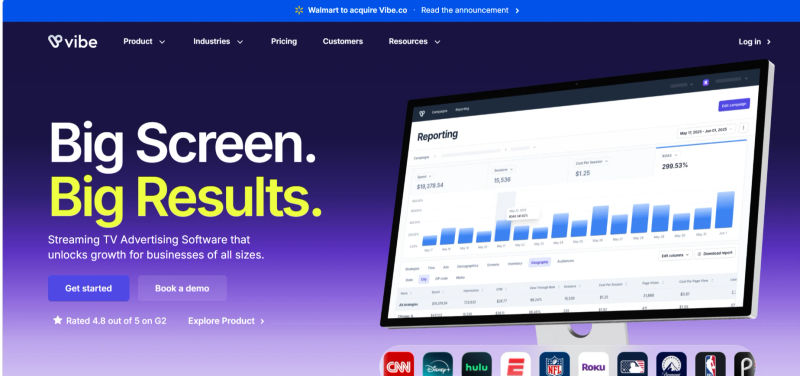
Treat CTV not just as a branding play but as a retargeting and incremental reach layer. The automation should be set to optimize for downstream events, such as site visits or app installs, ensuring that the TV spend is accountable to the same ROAS targets as your digital channels.
Niche Contextual Optimization
For specific verticals or unique inventory needs, generalist automation tools may lack the nuance required. In scenarios where broad programmatic algorithms struggle—such as highly regulated industries or specific language targeting—niche tools like Befruch can be deployed. While less universally known than the giants, Befruch specializes in contextual optimization where standard behavioral signals might be weak or restricted.
The key to successful integration here is ensuring that these specialized tools communicate with your central data warehouse. You must avoid creating "data silos" where niche performance data is locked away from the broader marketing view. Use API connectors to pull performance data from tools like Befruch and Vibe into a centralized dashboard, allowing you to monitor the holistic impact of your automated ecosystem.
Phase 5: The 'Human-in-the-Loop' Protocol
Automation is not a "set-and-forget" solution. The most sophisticated implementations rely on a "Human-in-the-Loop" protocol where strategic oversight complements algorithmic execution. The danger of full automation is algorithmic drift, where the system slowly deviates from business goals due to anomalies in data or changes in market conditions.
Defining Ownership Roles and Review Cadence
To mitigate drift, you must establish a rigorous review cadence with clearly defined ownership roles. Automation changes the job description, it doesn't eliminate the job.
The Pilot (Media Buyer) - Daily: Responsible for health checks. Has spend spiked unexpectedly? Have conversion pixels stopped firing? This role monitors the "circuit breakers" and ensures the system is operational.
The Mechanic (Data Analyst) - Weekly: Reviews the "learning phase" status and creative performance. Are ad sets stuck in learning? Is the API connection to the CRM stable? This role ensures the machine is well-oiled.
The Navigator (Strategist) - Monthly: Conducts high-level strategic analysis. Are the ROAS targets still aligned with business margins? Do we need to adjust the logic rules based on seasonality? This role sets the destination for the automation.
Anomaly Detection and Intervention
Part of this protocol involves setting up automated alerts for significant deviations. If your CPA increases by 50% overnight, the system should alert a human operator rather than just trying to bid its way out of the problem. This "circuit breaker" approach prevents the algorithm from spiraling during periods of platform instability or external market shocks. The human role is to diagnose why the anomaly occurred—was it a broken landing page, a competitor sale, or a tracking error?—and then guide the automation back on course.
Find Perfect Software for Your Business
The Economics of Automation: Cost vs. Efficiency
Implementing an advanced ad automation stack is an investment, not just in time but in capital. Most enterprise-grade automation platforms charge a licensing fee, typically ranging from 1% to 5% of total ad spend, or a flat monthly SaaS fee. For the implementation to be deemed a success, the efficiency gains must significantly outpace these costs.
When building your business case, calculate the "Efficiency Lift" required to break even. If a tool charges 3% of spend, it must deliver at least a 3% improvement in ROAS or a commensurate reduction in man-hours to be cost-neutral. However, the true value usually lies in scalability. A manual team might hit a ceiling managing $50k/month effectively; an automated stack can scale that same team to manage $500k/month.
The economic argument should therefore focus on the reduced marginal cost of scaling. By automating the heavy lifting of bid management and reporting, you decouple revenue growth from headcount growth, allowing for a much healthier P&L as you scale.
After mastering implementation best practices, find the perfect ad automation software to put them into action. AuthenCIO offers free, vendor-neutral comparisons to simplify your choice.
Comparative Analysis: Resource Allocation
The implementation of ad automation fundamentally reshapes how your team spends its time. The following table illustrates the shift in resource allocation required for a successful rollout. Note the drastic reduction in manual execution and the corresponding increase in strategic analysis and technical maintenance.
Functions | Manual Ad Ops Allocation | Automated Ad Ops Allocation | Impact of Shift |
Bid Management | 40% (Daily manual adjustments) | 5% (Monitoring guardrails) | Eliminates repetitive tasks; reduces human error. |
Reporting & Aggregation | 20% (Spreadsheet consolidation) | 10% (Automated dashboards) | Real-time visibility replaces lagged reporting. |
Creative Strategy | 15% (Ad hoc ideation) | 40% (Data-driven iteration) | Creative becomes the primary performance lever. |
Technical Maintenance | 5% (Pixel setup) | 20% (API/Feed/Rule maintenance) | Requires higher technical aptitude for data hygiene. |
Strategic Planning | 10% (Quarterly reviews) | 25% (Continuous optimization) | Focus shifts to long-term growth and cross-channel scale. |
The 30-Day Implementation Checklist
To move from theory to practice, this 30-day checklist serves as the definitive guide to automation implementation best practices. Following a disciplined, phased rollout prevents algorithmic volatility and ensures a smooth transition.
Days 1-7 (The Audit): Conduct a full audit of pixel health, server-side tracking (CAPI), and product feed attributes. Fixing all critical data errors before connecting any tools is a foundational automation implementation best practice.
Days 8-14 (The Setup): Define your logic strings and guardrails. Map out your "If-Then" rules to check for overlap and prevent conflicting bids. Set up your "Creative Sandbox" campaigns.
Days 15-21 (The Pilot): Launch the automation software on a single channel or a subset of campaigns (allocating approximately 20% of your budget). Monitor daily for anomalies rather than making immediate manual adjustments.
Days 22-28 (The Calibration): Review the initial performance data. Check if the algorithms are successfully exiting the learning phase. Adjust CPA caps or ROAS floors based on actual delivery data rather than theoretical targets.
Day 30 (The Review): Conduct the first monthly strategic review. Compare your pilot performance against historical manual benchmarks. If the data is positive, begin scaling the automation to 50% of your total budget.
Try AuthenCIO
Move to faster, smarter software evaluation with AI
Conclusion: Future-Proofing Your Advertising Strategy
Implementing ad automation is a journey of operational transformation. It requires a disciplined approach to data hygiene, a willingness to restructure team roles, and a commitment to continuous testing. By following the "Crawl-Walk-Run" framework, you mitigate the risks of the transition while positioning your organization to capitalize on the efficiency of machine learning.
The tools mentioned—Quartile for marketplace velocity, Motion and Creative Score for creative intelligence, and Vibe and Befruch for channel and context expansion—are powerful engines for growth, but they require a skilled pilot. The future of advertising belongs to those who can blend the processing power of algorithms with the strategic intuition of human marketers. As you roll out these solutions, remember that the goal is not just to automate tasks, but to elevate your entire marketing operation to a higher level of strategic execution.