Introduction
Finding the right social media management software is critical for scaling your brand without draining your runway. In 2026, the best social media management tools for startups go far beyond basic scheduling—they are intelligent systems designed to protect a founder's most valuable asset: time. Manual posting is a direct threat to your burn rate, which is why modern SMM software relies heavily on AI agents capable of drafting, scheduling, and analyzing content with minimal human oversight.
Streamline your software evaluation process
For early-stage decision-makers, the goal is to eliminate the prohibitive cost of context switching. Every hour a founder spends formatting a TikTok Reel or tweaking an AI voiceover is an hour stolen from product development, fundraising, or strategic growth. Startups need tools that leverage advanced generative AI to enhance creativity and streamline workflows without sacrificing the genuine, authentic voice that early adopters connect with.
Key Takeaways
Top Overall Pick: Vista Social offers the best balance of advanced automation and scalability for fast-growing startups, with plans starting at $15/month.
Best for Bootstrapped Startups: Buffer and Metricool provide generous free tiers and low-cost entry points (starting at $6/month) with essential scheduling and analytics.
Best for Visual Brands: Later and Iconosquare lead the pack for Instagram and TikTok management, featuring intuitive visual planners starting around $16/month.
Core Features to Prioritize: Maximize your 2026 ROI by choosing platforms that offer AI-driven content repurposing, seamless data portability, and pricing structures that don't penalize you for adding new team members.
🏆 Top Software Picks
If you need to make a rapid decision on what is the best social media management tool for small business, here are the top three platforms that consistently deliver the highest return on effort. For founders seeking affordable social media management tools for startups, these options lead the pack:
Vista Social — Best for all-in-one management and AI automation.
Buffer — Best for affordable, easy-to-use scheduling.
Iconosquare — Best for advanced analytics and reporting.
Metricool — Best for cross-channel analytics and ad tracking.
Later — Best for Instagram, TikTok, and visual content planning.
SocialBee — Best for evergreen content scheduling and recycling.
Zoho Social — Best for CRM integration and sales alignment.
Publer — Best for bulk scheduling and high-volume publishing.
Pallyy — Best for visual planning and team collaboration.
MeetEdgar — Best for automated content recycling.
Tailwind — Best for Pinterest and visual marketing.
Software Covered in this Article
To help you understand Social Media Management Software in the right context, this article refers to a carefully curated set of key players:










The State of Social Media Automation for Startups in 2026
The landscape of social media has shifted dramatically. Platforms have evolved into complex search engines, social commerce hubs, and AI-powered engagement ecosystems. Startups are expected to maintain an active, highly responsive presence across multiple channels simultaneously, all while managing tight budgets and limited human resources.
To compete with established enterprise brands, startups must adopt software that acts as a literal extension of their team. Identifying the best tools for organizing and managing digital content at scale 2026 means looking beyond basic schedulers to find comprehensive asset libraries and automated workflows. The right software stack eliminates manual publishing, centralizes digital asset management, provides predictive trend analysis, and proves a direct return on effort.
Achieving scalable social media management for startups requires platforms that handle increasing content volumes without exponential cost increases. With hundreds of tools on the market, selecting the right platform requires a strategic approach focused entirely on the unique constraints and growth trajectories of early-stage companies. Founders must prioritize software that offers transparent pricing, bulk content organization, and robust customer support—because when a tool breaks during a critical product launch, you need a human on the phone, not a chatbot.
Scaling your startup? Find the SMM tools that grow with you using AuthenCIO.
Key Features Startups Need in SMM Software
Selecting a platform in 2026 goes beyond simply finding a tool that can push a text update to LinkedIn. Startup founders must evaluate startup social media marketing software based on four non-negotiable pillars. Ignoring these criteria often leads to painful, time-consuming data migrations just as the company begins to experience critical growth.
1. Scalability Without Hidden Penalties
As your startup moves from the bootstrapped phase to Seed and Series A, your software must seamlessly adapt. Many legacy platforms penalize growth through aggressive per-seat pricing models or restrictive API limits.
Founders must look for tools that allow for easy addition of team members and support increasing volumes of scheduled content without forcing an immediate upgrade to an enterprise tier.
2. Advanced, Authentic Automation
Automation in 2026 is far more sophisticated than simple queue management. Startups require AI-driven automation that handles evergreen content recycling and automated variations of a single post.
Furthermore, robust support for TikTok and Instagram Reels automation, including the handling of AI-generated video and voiceovers, is mandatory for modern audience capture.
3. Data Portability
Startups pivot, and their software stacks change. Founders need absolute assurance that their historical analytics, audience data, and content libraries can be easily exported. High data portability ensures you are never locked into a platform that no longer serves your scaling business model.
4. True Cost-Effectiveness and ROI
Cost-effectiveness is not synonymous with the cheapest available monthly subscription. For a startup, true value is measured by the "Return on Effort." A tool that costs $40 a month but saves a founder ten hours a week is vastly superior to a $10 tool that requires constant manual intervention.
2026 Startup SMM Software Comparison Table
To help you make a rapid, informed decision, we have compiled the critical data for the most startup-friendly plans of each platform. This table strips away the marketing jargon to give you the exact pricing and core features you need to evaluate cost-effectiveness and scalability.
Tool | Price | Best For | Features |
Iconosquare | Starts from $13/month | Early-stage analytics | 3 profiles, 2 team members, 14-day free trial, Promoted post analytics, Custom dashboards, Automated reporting, Slack integration |
Vista Social | Starts from $99/month | New ventures | 5 profiles, 1 user, 14-day free trial, AI assistant, Review management, Unified inbox, HubSpot integration |
Later | Starts from $25/month | Visual storytelling | 3 social sets, 3 users, 14-day free trial, Visual Instagram planner, Linkin.bio tool, AI caption writer, Shopify integration |
SocialBee | Starts from $29/month | Evergreen automation | 5 profiles, 1 user, 14-day free trial, Category scheduling, Evergreen recycling, AI post generation, Bitly integration |
Buffer | Starts from $6/month | Simplified scheduling | 1 channel, 1 user, Free tier available, Planning and publishing, Analytics dashboard, AI assistant, Canva integration |
Zoho Social | Starts from $15/month | CRM integration | 7 channels, 1 team member, 15-day free trial, Publishing calendar, Summary reports, Drafts and approvals, Zoho CRM integration |
Metricool | Starts from $25/month | Cross-channel analytics | 5 brands, 2000 posts/month, Free tier available, Looker Studio integration, Competitor analysis, Ad campaign management, Hashtag tracker |
MeetEdgar | Starts from $30/month | Hands-off management | 5 accounts, Unlimited scheduled posts, 7-day free trial, 10 weekly automations, A/B testing, Auto-variations, Zapier integration |
Tailwind | $30/month | Pinterest & IG growth | 1 Pinterest, 1 Instagram, 100 posts/month, Free tier available, 200 Ghostwriter AI credits, SmartSchedule, Advanced analytics |
Publer | Starts from $5/month | High-volume posting | 3 accounts, 1 workspace, 7-day free trial, Unlimited scheduling, Bulk uploading, AI assist, Native photo editor |
Pallyy | Starts from $25/month | Visual planning | 1 social set, Unlimited team members, 14-day free trial, Custom analytics reports, Bulk scheduling, Feed preview, Comment management |
*Note: All prices shown reflect typical monthly billing. Vendors often offer lower pricing for annual commitments, but those discounts are excluded here for easier comparison. Actual costs may vary depending on your requirements, usage volumes, and negotiated terms.
12 Best SMM Software for Startups in 2026
Finding the best social media management tools for startups 2026 means prioritizing ROI, scalability, and AI capabilities. We evaluated the SMM landscape to highlight the top 11 platforms tailored to startup requirements.
These best social media management tools for startups streamline workflows, offer robust support, and eliminate hidden penalties.
1. Iconosquare
Iconosquare has cemented its position in 2026 as the premier choice for data-driven startup founders who need deep, actionable insights rather than just basic scheduling. For startups where every marketing dollar must be justified, Iconosquare provides the granular data necessary to prove ROI to investors. Their premium customer support ensures data discrepancies are handled rapidly by human agents.

Core Strengths:
Advanced Analytics: Highly customizable dashboards track nuanced engagement metrics and competitor performance in real-time.
Automated Reporting: Generates presentation-ready reports automatically, saving hours before investor meetings.
Industry Benchmarking: Compares your performance directly against industry standards.
Startup Fit: While not the cheapest entry-level tool, its value lies in replacing a dedicated data analyst. The insights gained directly inform better ad spend, justifying the cost.
Startup Use Case: Best for a Series A SaaS company that needs rigorous, board-ready reporting on social acquisition metrics.
2. Vista Social
Vista Social represents the new wave of tools designed with modern workflows in mind. It is rapidly becoming the go-to all-in-one platform due to its aggressive feature set and highly competitive pricing. Vista Social is built for founders who want enterprise-grade AI capabilities without the enterprise price tag.

Core Strengths:
Unified Inbox: Consolidates messages, comments, and reviews from all platforms, drastically reducing context switching.
Native AI Agents: Deeply integrates generative AI to draft captions, respond to comments, and suggest trends instantly.
Review Management: Uniquely includes tools to monitor local business reviews on Google and Yelp.
Startup Fit: Offers an unmatched feature-to-price ratio. By including advanced AI in its standard tiers, it eliminates the need for expensive third-party add-ons.
Startup Use Case: Best for a 3-person hybrid startup (e-commerce and local retail) needing to manage social feeds and local reviews simultaneously.
3. Later
For startups in the consumer goods, fashion, or lifestyle sectors, visual storytelling is paramount. Later remains the undisputed leader in visual-first management, particularly for TikTok and Instagram Reels. It is designed for founders who need their brand to look impeccable and leverage AI-generated video trends without spending hours manually curating feeds.

Core Capabilities Evaluated:
Social Media Scheduling: Later excels with its Visual Planner, offering a drag-and-drop grid preview to curate aesthetics before publishing. It provides elite scheduling capabilities for short-form video, including trending audio suggestions and direct auto-publishing.
Social Media Automation: Beyond basic auto-posting, Later automates link-in-bio management via Linkin.bio, transforming standard profiles into shoppable, trackable landing pages. It also features AI caption writing and hashtag generation to streamline workflows.
Social Media Engagement: The platform handles engagement through a unified inbox, allowing teams to moderate and reply to Instagram and TikTok comments efficiently from a single dashboard.
Social Media CRM: Later's social media CRM features are lightweight. While it excels at collecting and crediting user-generated content (UGC) and tracking basic interactions, it lacks the deep customer lifecycle management and detailed profile histories found in enterprise CRM tools.
Startup Fit: The return on investment is immediate for visually driven brands, directly correlating beautiful feed curation with increased click-through rates.
Startup Use Case: Best for a Seed-stage direct-to-consumer (DTC) fashion brand scaling heavily through TikTok and Instagram Reels.
4. SocialBee
SocialBee is the ultimate "set it and forget it" platform, making it a favorite among bootstrapped founders. Its entire architecture is built around maximizing the lifespan of content through intelligent, automated recycling. When you are too busy building your product to post, SocialBee's AI agents keep your feeds active.

Core Strengths:
Evergreen Content Recycling: Automatically republishes top-performing content based on predefined rules.
Category-Based Scheduling: Organizes posts by content type to maintain a balanced and engaging feed.
AI Post Generation: Built-in AI instantly generates dozens of captions from a single startup blog post URL.
Startup Fit: By maximizing the utility of every piece of content created, SocialBee provides an incredible return on effort, saving thousands on content creation.
Startup Use Case: Best for a lean B2B SaaS startup looking to continuously recycle its library of whitepapers and blog posts across LinkedIn and X.
Find Perfect Software For Your Business
5. Buffer
Buffer is the quintessential SMM tool for startups prioritizing simplicity and clean design. When evaluating the SaaS company Buffer on product releases, they stand out for their transparent, "build in public" roadmap. Rather than rushing buggy updates, Buffer takes a deliberate approach to product releases. This prevents feature bloat and ensures the platform remains stable, allowing busy founders to schedule content in minutes without navigating disruptive interface changes.

Core Strengths:
Intuitive UI/UX: Famously easy to use, requiring zero onboarding time for founders.
Transparent Product Releases: Deliberate, stable feature rollouts guided by a public roadmap.
Start Page: A simple, mobile-friendly landing page builder to consolidate links.
Clear Analytics: Provides essential performance metrics without overwhelming users.
Startup Fit: Buffer's free tier is legendary. Even on paid plans, its straightforward a la carte pricing ensures founders never face unexpected billing surprises.
Startup Use Case: Best for a solo bootstrapped founder who needs to establish a basic social presence with absolutely zero learning curve.

6. Zoho Social
For startups in the Zoho ecosystem or focused on B2B lead generation, Zoho Social is a powerhouse. It is the best software for scaling LinkedIn content across employees, seamlessly bridging social media management and customer relationship management (CRM) to track interactions as business opportunities.

Core Strengths:
Deep CRM Integration: Connects directly with Zoho CRM, turning social engagements into trackable sales leads.
LinkedIn Employee Scaling: Empowers startups to scale LinkedIn content across employees, amplifying brand reach through team advocacy.
Team Collaboration: Robust draft and approval workflows simplify reviewing content created by staff.
SmartQ Predictions: Uses historical data to predict the absolute best times to post.
Startup Fit: Unmatched integration value for startups already using Zoho products, providing clear ROI through CRM alignment and employee advocacy.
Startup Use Case: Best for a B2B startup relying on LinkedIn outreach that needs to scale content via employee networks and pipe interactions directly into a sales CRM.
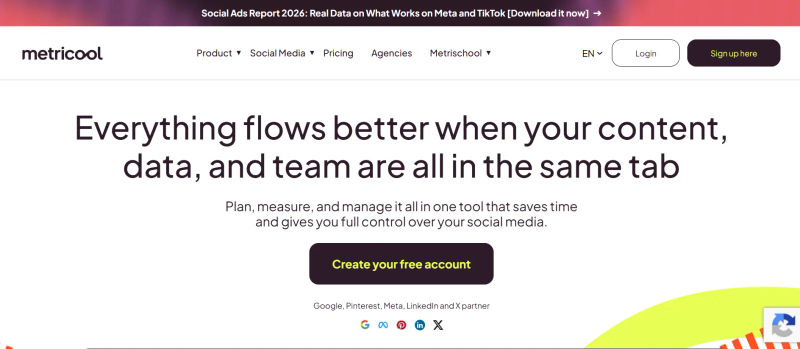
7. Metricool
Metricool is the hidden gem for startups that run cross-channel campaigns and manage paid advertising alongside organic social media. In 2026, the line between paid and organic is blurred, and Metricool provides a single, unified dashboard to track the performance of everything simultaneously.
Core Strengths:
Unified Dashboard: Displays metrics from organic posts, website traffic, and paid ad campaigns in one view.
Competitor Tracking: Monitors competitor growth and top-performing content to reverse-engineer successful strategies.
Looker Studio Integration: Exports seamlessly to advanced data visualization tools for custom reporting.
Startup Fit: Eliminates the need for separate ad management and organic scheduling tools, significantly reducing monthly software subscription costs.
Startup Use Case: Best for a high-growth startup running concurrent Google Ads, Facebook Ads, and organic TikTok campaigns that needs unified attribution.
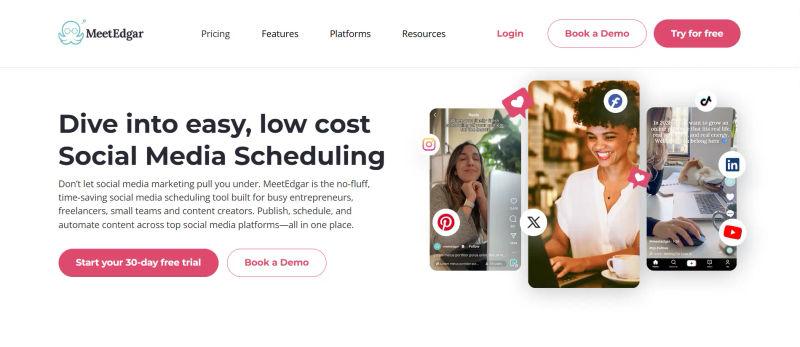
8. MeetEdgar
MeetEdgar is the pioneer of automated content recycling and remains a top choice for founders who want a truly hands-off presence. It is designed to build a vast library of your best content and continuously share it over time, ensuring your startup's message reaches new followers regardless of when they discover you.
Core Strengths:
Continuous Posting: If the queue is empty, MeetEdgar automatically pulls from past successful posts.
Auto-Variations: Uses advanced AI to automatically write multiple different status updates for a single link.
A/B Testing: Automatically tests different variations of your messages to determine which phrasing drives the most clicks.
Startup Fit: Provides the ultimate peace of mind. The time saved by never having to manually refill a queue is invaluable for a busy founder.
Startup Use Case: Best for a founder building a personal brand on LinkedIn and X who wants their core philosophies tweeted automatically on a loop.
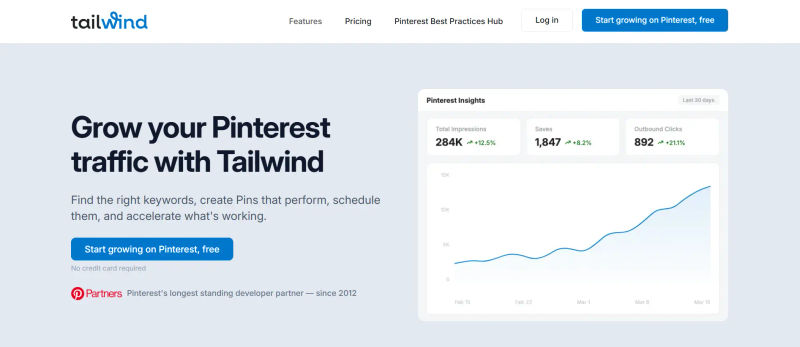
9. Tailwind
Tailwind is the undisputed champion for startups leveraging Pinterest and Instagram for traffic and sales. If your startup relies on visual discovery, DIY tutorials, or lifestyle content, Tailwind's specialized algorithms provide a massive competitive advantage over generic scheduling tools.
Core Strengths:
Ghostwriter AI: A highly specialized AI tool trained to write engaging, conversion-focused Pinterest descriptions.
SmartSchedule: Analyzes audience behavior to pinpoint the exact moments they are most active.
Tailwind Communities: Allows startups to join niche groups to amplify reach through reciprocal sharing.
Startup Fit: Built for virality. Its ability to optimize visual discovery channels provides a direct, measurable impact on sustainable website traffic.
Startup Use Case: Best for a bootstrapped home decor or DIY startup relying entirely on Pinterest for organic website traffic and product sales.
10. Publer
Publer is widely recognized as one of the best social media management tools for multi-platform posting in 2026. Known as the "social media superhero," it is the top choice for startups that need to manage a massive amount of content across a wide array of networks, including niche platforms like Telegram and Google Business Profiles, alongside standard giants like LinkedIn, X, and Meta.

Core Strengths:
Bulk Scheduling: Allows founders to upload and schedule up to 500 posts at once via a simple CSV file.
Workspace Management: Offers incredibly clean workspace separations for managing multiple products.
Built-in Photo Editor: Integrates directly with Canva, allowing quick visual tweaks without leaving the platform.
Startup Fit: Offers an incredibly generous feature set at a very accessible price point, handling high volume without requiring enterprise-level subscriptions.
Startup Use Case: Best for a startup managing massive, localized product launches across dozens of different regional social media accounts simultaneously.
11. Pallyy
Pallyy has emerged as a powerful, affordable alternative for visual planning and team collaboration. It is widely regarded as the best owned media for creators prioritizing pricing that scales with audience growth software, making it perfectly suited for startups that collaborate heavily with external freelancers, creators, or early-stage investors on their brand messaging.

Core Strengths:
Client Feedback Links: Send a secure link to external stakeholders to review and approve content without an account.
Visual Grid Preview: A seamless, drag-and-drop interface for planning Instagram and TikTok feeds with pixel-perfect accuracy.
Comment Management: Provides a clean, threaded inbox for managing replies efficiently.
Startup Fit: Pallyy's unlimited team member approach on its premium tier is a massive advantage, allowing you to add freelancers and scale your owned media presence without incurring per-seat costs.
Startup Use Case: Best for a growing startup that relies heavily on a rotating roster of freelance content creators and external PR agencies for their social output.
Best Social Media API Integrations for Startups
For startups building a custom tech stack, the best social media API integrations for startups depend entirely on your primary growth channels. Instead of relying solely on off-the-shelf SMM software, leveraging direct network APIs allows for deeper data extraction, custom automation, and seamless syncing with proprietary CRMs.
When looking at a social media API comparison for startups, four major networks stand out for custom development:
Meta Graph API (Facebook & Instagram): Widely considered the best social network API for startups focused on B2C e-commerce and paid social. It offers robust endpoints for publishing, reading insights, and managing ad campaigns, though its strict rate limits and frequent version updates require dedicated engineering oversight.
X (Twitter) API v2: Ideal for real-time engagement and B2B SaaS startups. While the free tier remains highly restricted in 2026, the paid tiers provide essential access to conversational data, social listening, and automated thread publishing.
LinkedIn API: The top choice for B2B lead generation. Startups use the Marketing Developer Platform to automate company page posts, pull detailed demographic analytics, and route lead gen forms directly into their sales pipelines.
TikTok API for Business: Crucial for consumer-facing brands. It allows startups to automate video publishing, track trending sounds, and pull granular campaign metrics directly into custom analytics dashboards.
If maintaining direct network connections drains your engineering resources, utilizing a unified API aggregator like Ayrshare or leveraging SMM platforms with their own robust developer APIs (such as Buffer) can bridge the gap between a fully custom build and out-of-the-box software.
Optimize your social operations on a budget. Find the right software at AuthenCIO today.
How to Choose the Right SMM Tool for Your Growth Stage
Selecting the right software is about finding the exact match for your startup's current operational reality and budget. A mismatch here leads to wasted capital and frustrated teams. Here is how to align your choice with your specific growth stage in 2026.
1. Bootstrapped and Pre-Seed Startups
At this stage, cash preservation is your primary directive. You do not need complex approval workflows because the founder is likely the only person touching the accounts. Focus on extreme cost-effectiveness and time-saving simplicity. Tools like Buffer is ideal. They allow you to maintain a professional presence while dedicating 95% of your energy to building your minimum viable product (MVP).
Time to Switch Warning Sign: You are spending more time manually organizing your content queue than you are engaging with early beta testers.
2. Seed Stage Startups
Once you have secured seed funding, your focus shifts to establishing product-market fit and driving consistent traffic. You likely have a small team or a dedicated freelance marketer. Automation and scalable content strategies become critical. SocialBee and MeetEdgar are perfect for this stage, ensuring your growing library of content works tirelessly for you. If your growth relies on visual platforms, Later or Vista Social provides the AI tools necessary to compete with larger brands.
Time to Switch Warning Sign: Your content queue constantly runs dry because your small team cannot manually create original posts fast enough to feed the algorithm.
3. Series A and High-Growth Startups
At Series A, rapid scaling demands the best social media management for funded startups. Focus shifts entirely to team collaboration, cross-channel ROI attribution, and deep analytics.
Scalable social media management for funded startups must handle high volumes flawlessly. Iconosquare is invaluable for granular board reporting, Zoho Social aligns marketing with sales pipelines, and Metricool unifies organic and paid data. To ensure reliable social media management for funded startups, the software must provide undeniable proof of revenue generation. Upgrading to premium social media management for startups guarantees enterprise-grade security.
Time to Switch Warning Sign: You cannot accurately attribute engagement to pipeline growth or direct revenue, signaling an immediate need for premium social media management for funded startups.
Try AuthenCIO
Move to faster, smarter software evaluation with AI
Conclusion: Automate to Accelerate
In the hyper-competitive landscape of 2026, social media is no longer just a marketing channel for startups; it is a critical touchpoint for customer acquisition, brand trust, and investor visibility. However, the manual execution of a multi-platform strategy is a fast track to founder burnout.
The 11 SMM software options detailed above represent the best tools available to solve this exact problem, offering the perfect blend of scalability, advanced AI agents, and strict cost-effectiveness.
The key takeaway for decision-makers is to stop viewing social media management as a daily chore and start treating it as an automated growth engine. By carefully matching a platform's core strengths to your startup's current funding stage and operational bottlenecks, you can reclaim countless hours each week.
Evaluate the tools, leverage the comparison data, and implement a system that works tirelessly in the background. Automate your social operations today, so you can focus entirely on accelerating your startup's growth and scaling your vision.