
Introduction
In the rapidly evolving digital landscape of 2026, business leaders face an undeniable reality: the era of cheap, limitless customer acquisition is officially over. For years, companies operated under a growth-at-all-costs mindset, pouring massive budgets into digital advertising, aggressive promotional campaigns, and top-of-funnel marketing strategies. However, shifting data privacy regulations, the saturation of AI-generated content, and an increasingly fragmented media ecosystem have fundamentally altered the economics of business growth. Today, the cost of acquiring a single new customer has skyrocketed, forcing Chief Marketing Officers (CMOs) and Customer Success Executives to reevaluate their core financial strategies.
Streamline your software evaluation process
While most experienced leaders already understand that retention is vital, the real challenge lies in the "how." Transitioning from an acquisition-heavy model to a retention-first strategy requires overcoming cross-departmental silos, managing complex technical executions, and proving the financial value of customer satisfaction to stakeholders. It is no longer enough to simply offer good customer service; businesses must operationalize loyalty.
The paradigm has shifted from a relentless pursuit of net-new logos to a sustainable, profitability-driven focus on customer retention. Forward-thinking organizations realize their most valuable assets are the customers they have already acquired. By extending the customer lifecycle, increasing repeat purchase rates, and transforming satisfied buyers into vocal brand advocates, businesses can unlock compounding revenue that traditional acquisition models simply cannot match.
This article explores the deep financial impact of the ROI of customer retention. We will dive into the hard data comparing the cost of retention versus acquisition, outline strategic frameworks for calculating Customer Lifetime Value (CLV), and examine how modern reputation management software serves as the technological backbone for long-term loyalty. By prioritizing retention, businesses can insulate themselves against rising advertising costs and build a foundation for resilient, highly profitable growth.
Software Covered in this Article
To help you understand Customer Retention & Reputation Management Software in the right context, this article refers to a carefully curated set of key players:










The Escalating Cost of Customer Acquisition
The financial drain of focusing exclusively on net-new customers has reached a tipping point across both B2B and B2C sectors. The traditional "leaky bucket" strategy—where companies constantly pour resources into acquiring new users to replace the ones churning out—is no longer financially viable. As digital advertising platforms increase their cost-per-click (CPC) and cost-per-acquisition (CPA) metrics, the margins on newly acquired customers are shrinking to unprecedented lows.
1. Customer Retention vs Acquisition Cost
To understand the severity of this issue, we must look at the underlying data driving the current market, specifically breaking down the nuances between different business models.
SaaS vs. E-commerce Acquisition Realities:
In the SaaS sector, customer acquisition costs have surged due to longer sales cycles, the need for extensive product demonstrations, and high technical integration hurdles. The CAC payback period for many SaaS companies has extended from 12 months to over 18 months, meaning a customer must be retained for at least a year and a half just to break even.
In the E-commerce sector, the rising costs are driven by advertising saturation and stringent data privacy changes (such as the ongoing evolution of iOS tracking transparency). E-commerce brands are paying premium CPCs to reach audiences that are increasingly blind to traditional digital ads, severely eroding initial profit margins.
2. The Hidden Costs of Constant Acquisition
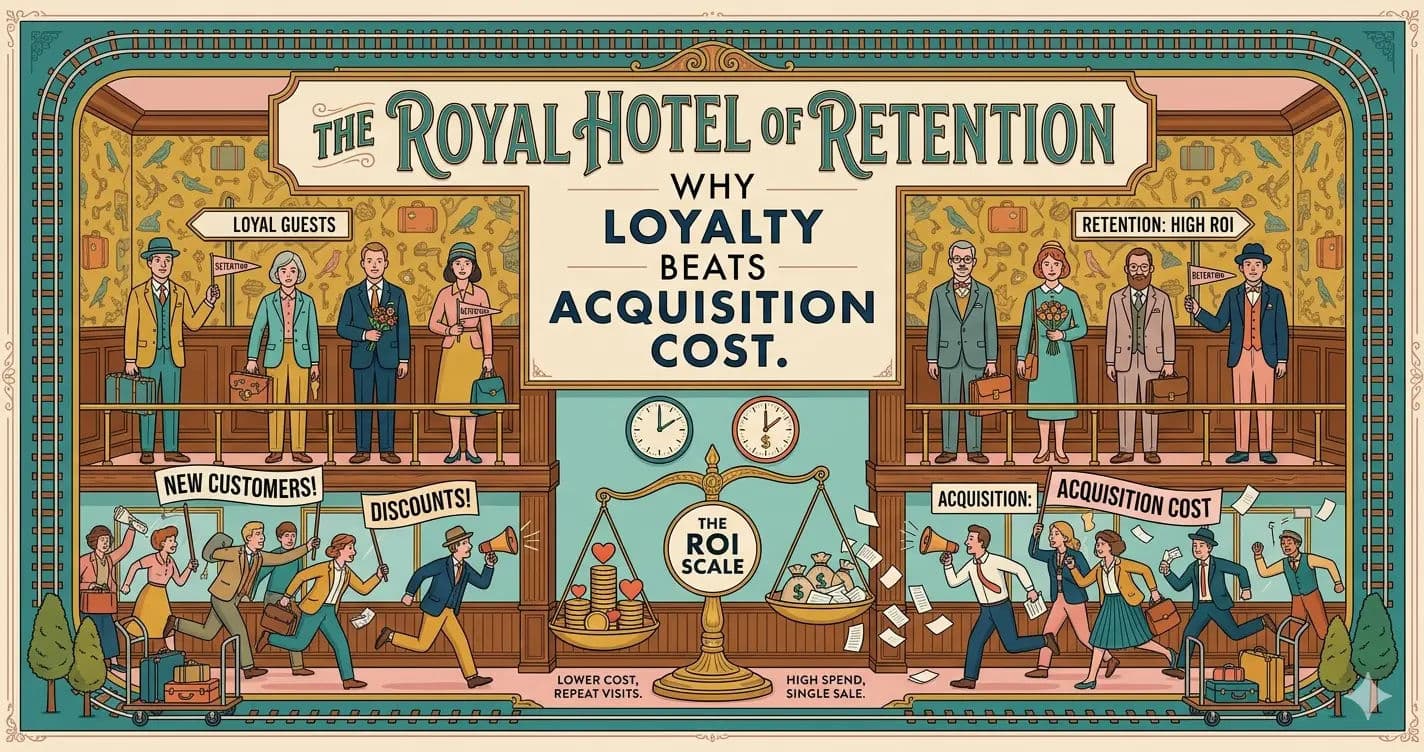
Research consistently shows that acquiring a new customer costs 5 to 25 times more than retaining an existing one. Furthermore, retention initiatives cost approximately five times less to execute than equivalent acquisition campaigns. When a business loses a customer, it does not just lose future revenue; it loses the sunk costs associated with marketing, sales, and onboarding.
The Trust Deficit: New prospects require extensive nurturing. The probability of selling to a brand-new prospect hovers between 5% and 20%. In stark contrast, the probability of successfully selling to an existing, satisfied customer is between 60% and 70%.
Passive Churn: Many businesses suffer from passive churn, where customers simply stop using a product or service without formally canceling. When companies focus solely on acquisition, they lack the resources to identify and re-engage these at-risk accounts before they disappear entirely.
By ignoring the escalating costs of acquisition, companies risk entering a cycle of negative ROI, where the cost to acquire a customer exceeds the revenue generated during their brief lifespan. Shifting budget toward retention is an aggressive maneuver to protect profit margins and ensure long-term viability.
Ready to maximize your ROI? Use AuthenCIO's vendor-neutral platform to compare the top customer retention tools and find the perfect fit for your business for free.
Calculating the True ROI of Customer Retention
To truly understand the financial superiority of retention, organizations must move beyond surface-level metrics and examine the precise mathematical impact of keeping customers engaged over time. The cornerstone of this analysis is Customer Lifetime Value (CLV), a metric that projects the total net profit a company can expect from a single customer relationship.
Implementing customer lifetime value strategies 2026 requires a nuanced approach that factors in repeat purchase frequency, average order value (AOV), and the compounding nature of long-term loyalty.
Measuring the Profitability of Customer Loyalty
To maximize the ROI of retention, businesses must segment their customer base based on CLV and churn risk levels. Not all customers are worth retaining. In some "Negative ROI" scenarios, it is actually more profitable to let highly demanding, low-value customers churn. By utilizing predictive analytics, companies can identify high-CLV cohorts and direct their retention budgets toward the accounts that will generate the highest long-term returns.
Metric Category | Acquisition-Focused Model | Retention-Focused Model | Financial Impact |
Primary Cost Driver | Digital advertising, sales outreach | Customer success, loyalty programs | Retention costs 5x to 25x less than acquisition |
Conversion Probability | 5% to 20% | 60% to 70% | Higher predictability in revenue forecasting |
Average Order Value | Baseline initial purchase | Up to 67% higher than baseline | Increased gross margins per transaction |
Time to Positive ROI | Often 12-18 months due to high CAC | Often 6-12 months | Faster payback periods and improved cash flow |
Implementation Effort | High (constant campaign creation) | Moderate to High (requires tech integration) | Requires upfront effort but yields compounding returns |
Required Human Capital | Large sales and ad-buying teams | Dedicated Customer Success Managers | Shifts headcount from acquisition to relationship management |
The most compelling argument for a retention-first strategy lies in the disproportionate impact of small improvements. A widely cited industry benchmark reveals that a mere 5% increase in customer retention can boost overall profits by 25% to 95%. This staggering return on investment occurs because retained customers are inherently more profitable. They require less hand-holding, are less sensitive to price changes, and are significantly more likely to explore cross-sell and upsell opportunities.
How Reputation Management Software Drives Loyalty
In the modern digital economy, brand reputation and customer retention are inextricably linked. Proving reputation management software ROI within the first 100 days of implementation is entirely possible when companies realize that a customer's decision to stay is heavily influenced by public perception and the transparency with which a brand handles feedback. Reputation management software has evolved from a simple review-monitoring utility into a comprehensive retention engine that directly impacts the bottom line.
Building Trust and Mitigating Churn
When a customer encounters an issue, their next step often dictates whether they will churn or remain loyal. If their feedback is ignored, they leave. If their feedback is acknowledged and resolved swiftly, their loyalty actually increases—a psychological phenomenon known as the Service Recovery Paradox.
However, it is crucial to acknowledge the human element: software alone does not fix retention. These tools require a dedicated manager and a broader company culture shift to be truly effective. Reputation management platforms facilitate this process at scale, ensuring that no customer concern falls through the cracks.
Find Perfect Software For Your Business
Several leading platforms exemplify how technology drives retention through reputation management:
Trustpilot (Best for B2C & B2B Trust Building | Integrates with Shopify, Magento): As one of the most recognized review platforms globally, Trustpilot allows businesses to scale trust by showcasing verified customer experiences. By actively inviting feedback and responding to reviews publicly, companies demonstrate a commitment to customer satisfaction, significantly reducing the likelihood of churn.
Birdeye (Best for Multi-Location SMBs | Integrates with Salesforce, HubSpot): For businesses operating across multiple locations, centralized feedback is critical. Birdeye aggregates reviews, survey responses, and social mentions into a single dashboard. This allows customer success teams to identify macro-trends in customer sentiment and address systemic issues before they cause widespread dissatisfaction.
ReviewTrackers (Best for Enterprise Sentiment Analysis | Integrates with Hootsuite, Zendesk): Geared toward enterprise-level operations, ReviewTrackers utilizes advanced sentiment analysis to decode the emotional tone behind customer feedback. By identifying specific keywords associated with frustration or delight, businesses can proactively adjust their product roadmaps.
Bazaarvoice (Best for Enterprise Retail & Social Commerce | Integrates with BigCommerce, Salesforce Commerce Cloud): Operating at the intersection of reputation and social commerce, Bazaarvoice helps brands syndicate user-generated content across retail networks. Seeing a brand actively engage with community feedback reinforces existing customers' purchasing decisions.
Leveraging Reviews and UGC for Compounding Revenue
The intersection of customer retention and organic acquisition is found in the strategic use of User-Generated Content (UGC) and customer reviews. When a business successfully retains a customer, that individual becomes a prime candidate for advocacy. This creates a highly profitable referral loop, where retained customers lower the overall blended Customer Acquisition Cost (CAC) by serving as organic marketers for the brand.
The Psychology of Loyalty and Loss Aversion
The psychology of loyalty is deeply tied to the concept of loss aversion. Customers are naturally hesitant to abandon a brand where they have accumulated status, loyalty points, or a recognized voice within the community. Loyalty ecosystems tap into this psychology, making the switching costs—both emotional and financial—too high for the customer to justify leaving for a cheaper alternative.
Several specialized platforms excel at turning satisfied customers into vocal advocates, thereby driving compounding revenue:
Stamped (Best for E-commerce Loyalty Loops | Integrates with Shopify, Klaviyo): Known for its robust integration of reviews and loyalty programs, Stamped helps brands create highly customized reward structures. By incentivizing customers to leave detailed reviews and refer friends, Stamped effectively turns the existing customer base into a decentralized marketing team.
Yotpo (Best for Comprehensive D2C Retention | Integrates with Shopify Plus, SMSBump): Yotpo takes a comprehensive approach to E-commerce retention by unifying SMS marketing, loyalty programs, and visual UGC. By creating seamless, personalized post-purchase journeys, Yotpo ensures that customers remain engaged long after their initial transaction.
Okendo (Best for Zero-Party Data Collection | Integrates with Shopify, Attentive): Focused heavily on optimizing the review capture process, Okendo allows brands to collect rich, zero-party data alongside standard product reviews. By asking customers specific questions about their demographics and usage habits, brands can build highly detailed customer profiles to personalize future retention campaigns.
Feefo (Best for Verified Authenticity | Integrates with Magento, WooCommerce): Operating on an invite-only, verified review model, Feefo ensures that all feedback comes from genuine, paying customers. This high standard of authenticity is crucial for B2B and high-ticket B2C brands where trust is the primary currency.
Streamlining Communication to Prevent Churn
One of the most insidious threats to profitability is passive churn. Unlike active churn, where a customer formally cancels a subscription or voices a complaint, passive churn occurs in silence. Customers simply stop logging in, stop repurchasing, and slowly fade away. Preventing this requires a proactive approach to customer communication and the establishment of automated feedback loops that detect the early warning signs of disengagement.
Automated Feedback Loops and Proactive Engagement
Relying solely on annual Net Promoter Score (NPS) surveys is insufficient. Businesses must operationalize feedback by monitoring customer sentiment, support ticket volume, and product usage data in real-time. When a customer's engagement drops below a certain threshold, automated systems should trigger re-engagement sequences or alert customer success managers to intervene.
Effective communication tools bridge the gap between the brand and the consumer, ensuring that support is always accessible and that feedback is immediately actionable:
NiceJob (Best for Local SEO & Service Businesses | Integrates with QuickBooks, Jobber): Particularly effective for local and service-based businesses, NiceJob automates the process of requesting reviews and referrals immediately after a service is completed. The platform's integration with local SEO efforts means that retained, happy customers directly contribute to the brand's local search visibility.
Podium (Best for SMS & Frictionless Communication | Integrates with Salesforce, Shopify): Podium revolutionizes customer engagement by centralizing communication through SMS and text-based messaging. Podium allows businesses to handle support queries, request reviews, and facilitate payments all within a single text thread, drastically reducing customer frustration and improving retention rates.
Try AuthenCIO
Move to faster, smarter software evaluation with AI
Conclusion: Building a Profitable Tech Stack
The financial evidence is clear: transitioning from an acquisition-heavy strategy to a retention-first growth model is the most profitable decision a company can make. With customer acquisition costs continuing to climb and digital advertising yields diminishing, the true path to sustainable revenue lies in maximizing the Lifetime Value of the customers you already have. A mere 5% increase in retention can nearly double your profit margins, proving that the profitability of customer loyalty is a hard financial imperative.
To execute this strategy effectively, businesses must invest in the right technological infrastructure. Reputation management software, automated review platforms, and streamlined communication tools are the critical engines that drive long-term customer success.
Your 90-Day Retention Roadmap
To move from theory to execution, follow this actionable 90-day roadmap to audit and upgrade your retention strategy:
Days 1-30: Audit Churn Data & Identify Leaky Buckets. Analyze your current customer journey to find exactly where and why users are dropping off. Differentiate between active cancellations and passive churn.
Days 31-60: Evaluate the Human Element & Tool Gaps. Assess your internal team's capacity. Do you have dedicated Customer Success Managers? Identify which software categories (UGC, SMS communication, sentiment analysis) are missing from your current tech stack.
Days 61-90: Request Demos & Integrate Systems. Shortlist vendors based on their integration capabilities with your existing CRM or E-commerce platform (e.g., Salesforce, Shopify). Ensure the chosen tools align with your specific industry needs.
By prioritizing the ROI of customer retention and selecting the right tools to support your strategy, you can build a resilient, highly profitable business that thrives regardless of the rising costs of customer acquisition. Reducing customer churn rate is no longer just a defensive tactic; it is the ultimate growth engine.