
Introduction
The best donor management software for nonprofits in 2026 includes tools like Keela, Zeffy, Aplos, Bloomerang, and DonorPerfect—each designed to help organizations streamline fundraising, track donor relationships, and improve retention.
But choosing the right platform isn’t straightforward.
Streamline your software evaluation process
Today’s nonprofit leaders aren’t struggling to find options—they’re overwhelmed by them. With dozens of platforms promising better automation, deeper insights, and higher donor retention, the real challenge is identifying which solution actually fits your organization’s size, budget, and technical capacity.
At the same time, switching systems comes with real risk. Concerns around data migration, staff training, and potential downtime often prevent teams from upgrading—even when their current setup is holding them back.
This guide simplifies that decision.
We compare 11 of the best donor management software platforms for nonprofits in 2026, evaluating each based on pricing, features, ease of use, and scalability—so you can confidently choose a CRM that supports long-term donor relationships and sustainable growth.
Whether you're a small organization looking for a cost-effective solution or a growing nonprofit that needs advanced reporting and fund accounting capabilities, this guide will help you navigate the selection process with confidence.
Software covered in this article
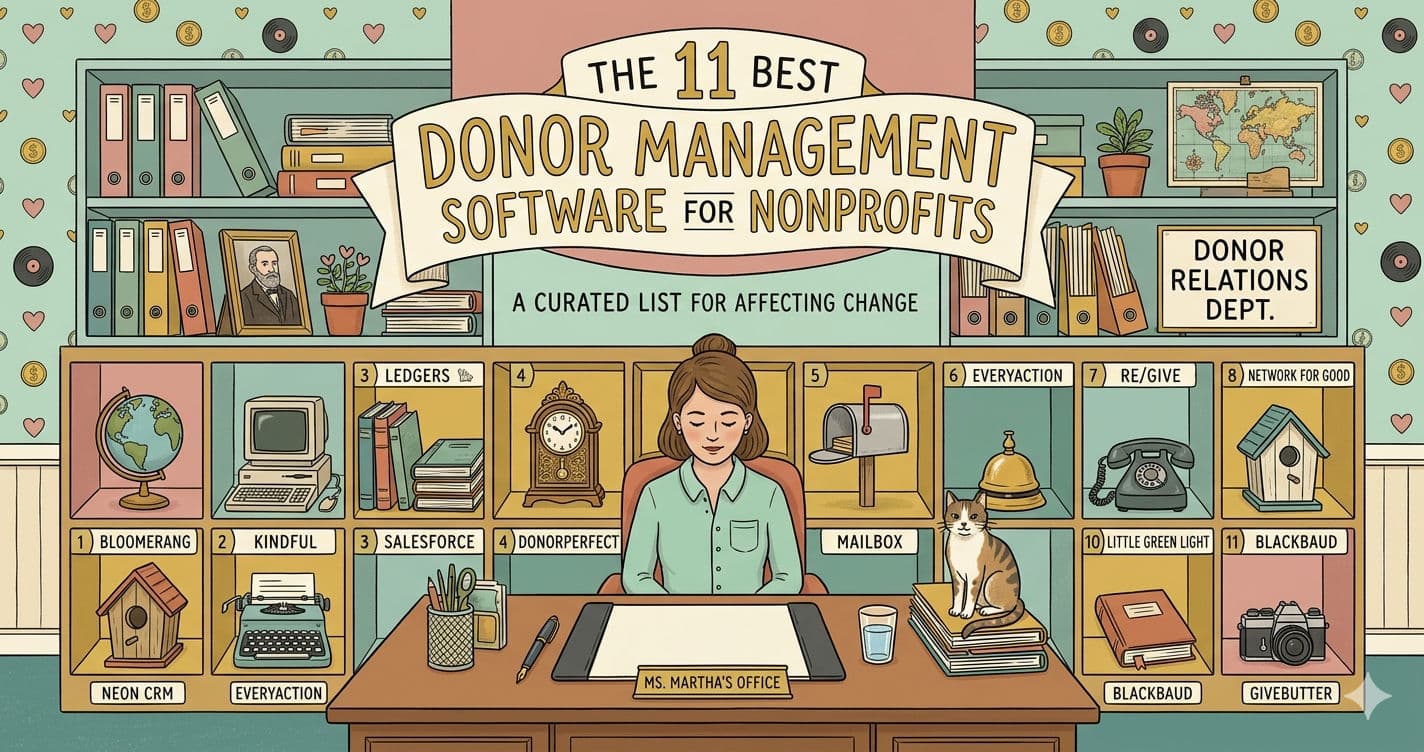
For learning and reference, this listicle presents a comprehensive overview of the best donor management software for nonprofits:






The State of Donor Management in 2026: Why Retention Matters
As we navigate 2026, the nonprofit sector is placing a heavier emphasis on retention than ever before. The cost of acquiring a new donor has risen significantly compared to previous years, making the stewardship of existing supporters the most financially viable strategy for growth. Modern donor management software is no longer just a digital Rolodex; it is a relationship engine designed to predict donor behavior and automate stewardship.
1. The Rise of Predictive AI and Clean Data
Today's most effective platforms utilize Artificial Intelligence (AI) and machine learning to analyze giving patterns. They can tell you not just who gave, but when they are likely to give again and how much you should ask for. However, it is crucial to understand that these AI tools are not magic wands. They rely heavily on "clean data." If your historical data is fragmented or inaccurate, the predictive insights will be flawed. The best nonprofit CRM for fundraising managers in 2026 is one that not only predicts behavior but also helps you maintain data hygiene automatically.
2. Security and Global Compliance
In an era of increasing cyber threats, security is no longer an IT concern—it is a donor trust concern. For international NGOs or nonprofits handling data from EU citizens, compliance with GDPR (General Data Protection Regulation) and CCPA (California Consumer Privacy Act) is non-negotiable. Modern platforms must adhere to PCI DSS (Payment Card Industry Data Security Standard) to ensure every transaction is encrypted and secure. Donors in 2026 are tech-savvy; they expect their data to be handled with the same rigor as a bank handles their finances. A breach doesn't just cost money; it costs reputation.
In-Depth Reviews of the Best Donor Management Tools
To help you make an informed decision, we have analyzed eleven of the most robust platforms available in 2026. Each review focuses on the software's capability to streamline donor tracking, manage data migration, and, crucially, how it supports your goal of increasing donor retention.
1. Keela CRM: Best for Intelligent Donor Insights
Keela CRM continues to lead the pack in 2026 as one of the most intelligent platforms for nonprofits that want to leverage data without needing a degree in data science. Keela’s philosophy is built around the idea that data should drive decisions, and their platform is engineered to surface actionable insights that directly impact fundraising revenue.
Key Features for Relationship Building
At the heart of Keela’s retention strategy is its AI-powered "Donor Score." This feature analyzes a contact’s interaction history—email opens, event attendance, and donation frequency—to assign a score indicating their engagement level. For a Fundraising Manager, this is invaluable. It allows you to segment your audience instantly, identifying who is ready for an upgrade and who is at risk of churning.
Furthermore, Keela’s "Smart Ask" technology removes the guesswork from solicitation. By calculating the optimal ask amount for each specific donor based on their giving history, Keela helps you avoid leaving money on the table or offending a donor with an ask that is too high.
Migration and Integrations
Keela understands the pain of switching systems. They offer robust import tools that allow you to map fields from CSV files easily, reducing the downtime associated with migration. On the integration front, Keela pairs exceptionally well with finance tools like QuickBooks Online and Xero, ensuring that your development and finance teams are looking at the same numbers. It also integrates with Mailchimp, though its internal email marketing tool is powerful enough that many organizations drop their external email provider entirely to consolidate costs.
2026 Pricing and Value
Keela operates on a tiered pricing model based on the number of contacts. For 2026, their "Growth" plan starts at approximately $160 per month for up to 1,000 contacts. While this investment is higher than some entry-level tools, the ROI generated through Smart Asks and increased retention often offsets the cost within the first few campaigns.
2. Zeffy: Best for 100% Free Fundraising and Management
Zeffy remains a unique disruptor in the nonprofit software space. As the only 100% free fundraising platform for nonprofits, Zeffy covers all platform and transaction fees by asking donors for a voluntary contribution. For small to mid-sized nonprofits operating on tight budgets in 2026, Zeffy eliminates the overhead that typically eats into fundraising totals.
How Zeffy Supports Long-Term Retention
While "free" is the headline, Zeffy’s value for retention lies in its friction-free donor experience. By removing transaction fees, nonprofits can honestly tell their donors that 100% of their gift goes to the mission. This transparency builds immense trust, a foundational element of long-term relationships. The platform includes a surprisingly robust CRM that tracks donor history, issues automated tax receipts immediately (a key compliance pain point), and manages event ticketing.
For retention, Zeffy excels in its simplicity. It allows fundraising managers to set up recurring donation campaigns easily. The intuitive interface means that even non-technical volunteers can manage donor data effectively, ensuring that no donor interaction gets lost due to software complexity.
Addressing "Donor Fatigue"
One potential friction point with Zeffy is the voluntary contribution model. Some donors may feel pressured to tip the platform on top of their donation. To mitigate "donor fatigue," successful nonprofits using Zeffy in 2026 are proactive in their communication. They explicitly state on their donation pages: "Zeffy allows us to receive 100% of your donation by relying on optional tips. You are free to set this to zero." This transparency preserves the donor relationship while explaining the platform's economic model.
2026 Pricing and Plans
Zeffy’s pricing model is simple: $0. There are no monthly fees, no platform fees, and no credit card processing fees. This model has proven sustainable and popular, making it a top choice for organizations prioritizing maximum net revenue from their campaigns.
3. Aplos: Best for Integrated Accounting and Donor Tracking
Aplos distinguishes itself by combining true fund accounting with donor management. For many Nonprofit Directors, the disconnect between the fundraising team (CRM) and the finance team (Accounting Software) is a major source of friction. Aplos solves this by housing both in one ecosystem, ensuring that financial reporting is as accurate as donor tracking.
Streamlining Financial Transparency
Retention is often tied to trust, and trust is built on financial transparency. Aplos allows organizations to produce granular reports on exactly how funds are being used, which can be shared with donors to demonstrate impact. The system handles complex fund accounting requirements, such as tracking restricted vs. unrestricted grants, automatically. This makes preparing the IRS Form 990 significantly less stressful.
From a relationship management perspective, Aplos offers a dedicated donor portal. In 2026, donors expect self-service options. Through the portal, donors can manage their recurring gifts, view their giving history, and download their own tax statements. This empowers the donor and reduces the administrative burden on your staff.
Migration and Security
Moving to Aplos often involves migrating both donor data and financial history. Aplos provides dedicated implementation specialists to assist with this dual migration, which is critical for maintaining audit trails. Security-wise, they offer bank-level encryption, which is essential given that the platform houses sensitive financial data alongside donor contact information.
2026 Pricing and Plans
The "Core" plan for Aplos is priced at $79 per month in 2026. This includes the fund accounting suite and the donor management system. For organizations that would otherwise pay for QuickBooks plus a separate CRM, Aplos represents a significant cost consolidation and operational streamlining.
4. Bloomerang: Best for Donor Retention Focus
Bloomerang has long been the champion of donor retention, and in 2026, their platform continues to prioritize this metric above all others. The user interface and feature set are specifically designed to discourage "churn and burn" fundraising tactics and encourage thoughtful stewardship.
Interactive Tools for Fundraising Managers
The standout feature of Bloomerang is the "Engagement Meter." Every constituent in the database is visually ranked based on their level of interaction with the organization. This isn't just about money; it includes email clicks, volunteer hours, and event attendance. This allows a Fundraising Manager to instantly spot a "cold" donor and intervene before they lapse completely.
Bloomerang also emphasizes the "Generosity Score," which screens your database for capacity to give. Combined with their built-in letter-writing tool (which includes templates based on fundraising psychology research), Bloomerang makes it easy to send personalized, high-touch communications.
Mobile Accessibility and Data Hygiene
In 2026, fundraising often happens away from the desk. Bloomerang’s mobile app is highly rated, allowing fundraisers to update donor notes immediately after a coffee meeting. This real-time data entry prevents the loss of critical relationship details. Additionally, Bloomerang includes automatic NCOA (National Change of Address) updates. This feature ensures that when a donor moves, their address is updated in your system automatically, preventing wasted postage and ensuring your direct mail appeals actually reach their destination.
2026 Pricing and Plans
Bloomerang uses a tiered pricing structure based on the number of records. For a standard plan accommodating up to 1,000 records, the price sits around $139 per month. While not the cheapest option, the platform’s obsessive focus on retention metrics provides a clear path to ROI by reducing the attrition rate of your donor base.
5. DonorPerfect: Best for Scalable Campaign Management
For growing nonprofits that need a system capable of scaling with them, DonorPerfect is a powerhouse. It is highly customizable, allowing organizations to tailor the interface and data fields to their specific operational workflows. In 2026, DonorPerfect remains a top choice for organizations that have outgrown basic tools and need enterprise-level capability.
Advanced Tracking for Growing Nonprofits
DonorPerfect excels in managing complex data. If your organization runs auctions, manages large volunteer corps, and processes thousands of transactions monthly, DonorPerfect’s robust infrastructure handles the load seamlessly.
For retention, DonorPerfect offers the "SmartActions" workflow automation. This allows you to set up complex triggers—for example, if a donor gives over $500, an alert is immediately sent to the Executive Director to make a personal thank-you call. This immediacy is crucial for retaining major donors.
Customization vs. Usability
It is important to note that DonorPerfect's greatest strength—customization—can also be a challenge. While it offers limitless flexibility, setting up these complex workflows often requires a higher level of technical proficiency than simpler tools like Zeffy. Organizations without a dedicated database administrator may find the learning curve steeper.
However, for those who master it, the integration with Constant Contact is deep, allowing for sophisticated email segmentation based on precise donor criteria that few other platforms can match.
2026 Pricing and Plans
DonorPerfect’s "Lite" package starts around $100 per month, with prices scaling up based on the number of records and advanced feature modules required. Its modular nature means you only pay for the features you need, but it has the capacity to expand as your fundraising strategy becomes more complex.
Find Perfect Software For Your Business
6. Salesforce Nonprofit Cloud: Best for Large, Complex Nonprofits
For large nonprofits managing complex programs, multiple stakeholders, and high donor volumes, Salesforce Nonprofit Cloud remains the gold standard in 2026. Built on the world’s leading CRM platform, it offers unmatched customization and scalability for organizations with advanced operational needs.
Enterprise-Level Donor Management
Salesforce excels in unifying donor data across fundraising, program management, and marketing. Its Nonprofit Success Pack (NPSP) allows organizations to track relationships beyond individual donors—including households, foundations, and corporate sponsors. This holistic view is critical for large nonprofits running multi-channel campaigns.
The platform’s automation capabilities are particularly powerful. With tools like Flow Builder, you can create complex workflows—such as triggering follow-ups for major gifts or automating grant tracking pipelines.
Customization vs. Complexity
However, this flexibility comes with a trade-off. Salesforce is not plug-and-play. Implementation often requires a dedicated administrator or external consultant, especially for customizing data models and workflows.
For organizations with the resources, this investment pays off in long-term scalability. But for smaller teams, the learning curve can be steep.
2026 Pricing and Considerations
Salesforce offers discounted or free licenses for nonprofits through its Power of Us program. However, costs can quickly increase with add-ons, integrations, and implementation services. It is best suited for organizations that need enterprise-grade infrastructure and have the capacity to manage it.
7. Donorbox: Best for Simple Online Donations
Donorbox has become one of the most widely adopted tools for nonprofits looking to simplify online fundraising. In 2026, it continues to stand out for its ease of use and rapid deployment, making it ideal for organizations that want to start accepting donations quickly without heavy setup.
Optimized for Conversion
Donorbox’s strength lies in its donation forms. These are highly customizable, mobile-friendly, and optimized for recurring giving. Features like suggested donation amounts, donor-covered fees, and one-click recurring options help increase average donation value and retention.
The platform integrates seamlessly with websites via embedded forms and supports multiple payment processors, including Stripe and PayPal.
Lightweight CRM Capabilities
While Donorbox includes basic donor management features—such as tracking donation history and generating reports—it is not a full-fledged CRM. Many organizations use it alongside tools like Salesforce or Bloomerang for deeper relationship management.
2026 Pricing and Plans
Donorbox operates on a freemium model. The core platform is free, but it charges a platform fee (typically around 1.75%) in addition to standard payment processing fees. For nonprofits focused on maximizing online donations quickly, the trade-off is often worth it.
8. Givebutter: Best for Modern Fundraising Campaigns
Givebutter has rapidly gained popularity as an all-in-one fundraising platform designed for modern, digital-first nonprofits. In 2026, it stands out for combining donor management, event fundraising, and engagement tools into a single, user-friendly platform.
Engagement-First Fundraising
Unlike traditional CRMs, Givebutter focuses heavily on donor experience. It offers features like live campaign pages, peer-to-peer fundraising, text-to-give, and integrated video storytelling. These tools make it particularly effective for organizations running events, social campaigns, or community-driven initiatives.
Its built-in communication tools—email, SMS, and donor updates—help maintain consistent engagement without needing separate marketing software.
Balancing Simplicity and Power
Givebutter is designed to be intuitive, making it accessible for small teams and volunteers. However, it may lack some of the advanced reporting and customization capabilities found in enterprise systems like Salesforce or DonorPerfect.
For many nonprofits, this trade-off is acceptable given its ease of use and strong engagement features.
2026 Pricing Model
Givebutter is free to use, with optional tips from donors helping to fund the platform. Standard payment processing fees still apply. This makes it an attractive option for nonprofits looking to minimize upfront costs while maximizing engagement.
9. Neon CRM: Best for Growing Nonprofits
Neon CRM is a well-rounded platform designed for growing nonprofits that need more structure and reporting than entry-level tools can provide. In 2026, it continues to be a strong choice for organizations transitioning from basic systems to more sophisticated donor management.
Balanced Feature Set
Neon CRM offers a comprehensive suite of tools, including donor tracking, event management, email marketing, and reporting. Its flexibility allows organizations to manage multiple fundraising channels within a single system.
The platform’s reporting capabilities are particularly valuable for leadership teams that need clear insights into campaign performance and donor behavior.
Scalability Without Overhead
Unlike enterprise systems, Neon CRM strikes a balance between functionality and usability. It does not require the same level of technical expertise as Salesforce, making it more accessible for mid-sized teams.
At the same time, it provides enough depth to support growth, including integrations with popular tools and customizable workflows.
2026 Pricing and Plans
Neon CRM uses a tiered pricing model based on features and database size. While not the cheapest option, it offers strong value for nonprofits that need a scalable solution without the complexity of enterprise platforms.
10. Little Green Light: Best for Small Nonprofits
Little Green Light has built a loyal following among small nonprofits thanks to its simplicity, affordability, and reliability. In 2026, it remains one of the most practical choices for organizations that need a straightforward donor management system without unnecessary complexity.
Simplicity That Works
The platform focuses on core functionality: tracking donors, managing campaigns, and generating reports. Its clean interface makes it easy for staff and volunteers to learn quickly, reducing the need for extensive training.
Despite its simplicity, Little Green Light includes essential features like email integration, event tracking, and customizable reports.
Cost-Effective Operations
For nonprofits operating on tight budgets, affordability is a major advantage. Little Green Light offers predictable pricing without hidden fees, making it easier to plan long-term.
However, it may lack some advanced automation and AI-driven insights found in newer platforms.
2026 Pricing and Value
Pricing is based on the number of constituent records, with plans starting at a relatively low monthly cost. For small organizations prioritizing ease of use and cost control, it delivers excellent value.
11. Raisely: Best for Campaign-Driven Fundraising
Raisely is a modern fundraising platform designed for nonprofits that rely heavily on campaigns, storytelling, and digital engagement. In 2026, it stands out for its ability to create visually compelling donation experiences that resonate with donors.
Campaign-Centric Design
Raisely allows organizations to build fully branded donation pages, peer-to-peer fundraising campaigns, and event microsites. Its design flexibility makes it ideal for nonprofits that prioritize storytelling as part of their fundraising strategy.
The platform also supports recurring donations, team fundraising, and integrations with CRM systems for deeper data management.
Focus on Donor Experience
Raisely places a strong emphasis on user experience. Donation flows are optimized for conversion, and the platform provides tools to personalize communication and engagement.
However, like Donorbox, it is often used alongside a dedicated CRM for more advanced donor management.
2026 Pricing Model
Raisely operates on a subscription model with platform fees, in addition to payment processing costs. While it may be more expensive than some alternatives, its focus on campaign performance and branding makes it a strong choice for organizations running large-scale fundraising initiatives.
Key Features to Look for in 2026 Fundraising Software
When evaluating nonprofit relationship management software in the current year, standard features like "contact storage" are no longer sufficient. To truly drive retention and efficiency, look for these advanced capabilities:
Predictive Analytics: Does the software suggest who to ask and how much? Tools like Keela and Bloomerang are leading the way here, moving beyond reporting into forecasting. Remember, these tools need clean historical data to function effectively.
Automated Stewardship Workflows: Can the system automatically send a welcome series to new donors or a "we miss you" email to lapsed donors? Automation ensures no donor falls through the cracks, regardless of your staff capacity.
Integrated Multi-Channel Communication: The ability to send emails, track direct mail, and log phone calls in one record is essential for a 360-degree view of the donor.
Self-Service Donor Portals: In 2026, donors expect to be able to update their credit card info and download receipts without calling your office. This reduces administrative friction and churn due to expired cards.
Mobile Accessibility: Your fundraisers are not always at their desks. A robust mobile app allows for real-time data entry and lookup during events or donor meetings.
Quick Comparison: Best Donor Management Software for Nonprofits (2026)
Software | Best For | Pricing | Key Features |
Keela | Data-driven fundraising teams | Paid (tiered) | AI Donor Score, Smart Ask, automated workflows, integrations |
Zeffy | Budget-conscious nonprofits | Free (0% fees) | Zero fees, unlimited donors, automated receipts, event tools |
Aplos | Nonprofits needing accounting + CRM | Paid (subscription) | Fund accounting, donor portal, IRS compliance tools |
Bloomerang | Donor retention & engagement | Paid (tiered) | Engagement Meter, Generosity Score, reporting tools |
DonorPerfect | Scaling fundraising operations | Paid (custom pricing) | SmartActions automation, reporting, integrations |
Salesforce Nonprofit Cloud | Large, complex nonprofits | Paid (custom pricing) | Highly customizable CRM, automation, integrations |
Donorbox | Easy online donations & forms | Free + transaction fees | Recurring giving, embeddable forms, Stripe/PayPal |
Givebutter | Events & modern fundraising campaigns | Free + optional fees | Peer-to-peer, events, SMS/email engagement |
Neon CRM | Growing nonprofits | Paid (tiered) | Reporting, event management, integrations |
Little Green Light | Small nonprofits | Paid (affordable tiers) | Simple CRM, reporting, affordability |
Raisely | Campaign-driven fundraising | Paid + platform fees | Branded pages, peer fundraising, integrations |
How to Choose the Right Tool for Your Organization
Selecting the right software is a high-stakes decision. To minimize risk and ensure you choose a platform that your team will actually use, follow this comprehensive evaluation framework.
Data Migration Checklist
Before you sign a contract, you must have a plan for your data. The fear of data loss is the primary reason nonprofits stay with outdated systems. Use this checklist to prepare:
Audit Your Current Data: Remove duplicates and archive inactive records (older than 5-7 years) before migration.
Map Your Fields: Ensure your unique data points (e.g., "Gala 2024 Table Number") have a corresponding home in the new system.
Test the Import: Never import your entire database at once. Run a test batch of 50 records to verify that donation history and contact details transfer correctly.
Verify Recurring Gifts: This is the most critical step. Ensure that credit card tokens transfer securely so you don't lose monthly revenue.
Questions to Ask During a Demo
Don't let the sales team control the conversation. Ask these specific questions to gauge the tool's fit for your reality:
"Can you show me the exact steps to pull a 'LYBUNT' (Last Year But Unfortunately Not This Year) report?"
"What is the cost of your data migration service, and does it include cleaning the data?"
"How does your system handle soft credits for family foundations or donor-advised funds?"
"Is your support team available via phone, or is it chat-only? What are the support hours in my time zone?"
"Can I restrict user permissions so volunteers can see donor names but not total giving amounts?"
Calculating Total Cost of Ownership (TCO)
Don’t just look at the monthly subscription. To get the true price, calculate:
Implementation Fees: One-time setup and training costs.
Payment Processing Fees: What percentage is taken from every donation? (e.g., 2.2% + $0.30).
Staff Time: If the software is hard to use, how many hours will be wasted on manual work?
Add-on Modules: Do you have to pay extra for email marketing, auctions, or text-to-give features?
Try AuthenCIO
Move to faster, smarter software evaluation with AI
Conclusion: Streamline Your Impact
In 2026, the technology available to nonprofits is more powerful than ever. Whether you choose the AI-driven insights of Keela, the cost-efficiency of Zeffy, the financial integration of Aplos, the retention focus of Bloomerang, or the scalability of DonorPerfect, the goal remains the same: building authentic, lasting relationships with the people who power your mission.
The right software will not only save you time on administrative tasks but will also provide the intelligence needed to keep your donors engaged and feeling valued. By moving from manual tracking to automated, data-informed management, you secure the financial future of your organization. Don't let the fear of migration hold you back—the cost of inaction is far higher than the cost of transition.