
Introduction
Is Thinkific Still the King of Course Platforms in 2026?
Scaling a digital learning business in 2026 requires far more than just a place to host your video files. As a solo course creator transitioning into a high-volume business, your learning management system (LMS) is the operational heartbeat of your revenue engine. Choose the right platform, and you build a scalable asset. Choose the wrong one, and you will inevitably face the nightmare of fragmented student data, low conversion rates, and a costly, agonizing migration process. Avoiding technical debt from day one is the single most important decision a scaling creator can make.
Streamline your software evaluation process
Thinkific remains one of the most recognized names in the creator economy. The company recently reported a robust Q1 2026 revenue of $18.7 million. But rather than just being an investor metric, this financial trajectory directly impacts creators: it guarantees platform stability during high-traffic launches, funds faster feature rollouts, and ensures a mature customer support infrastructure that will not disappear overnight.
But does Thinkific actually deliver the return on investment (ROI) required for a solo creator scaling to six or seven figures? The landscape has shifted dramatically. AI is now a baseline expectation, demand for low-friction downloadable products is surging, and students are abandoning open social platforms in favor of private, secure learning communities. You need to know if Thinkific's architecture can support these 2026 market demands.
This review strips away the marketing hype to provide a brutally honest, data-backed verdict on Thinkific. We will evaluate its core infrastructure, dissect its pricing structure, and pit it directly against its top competitors to help you make a definitive, revenue-focused decision.
2026 Course Platform Summary Table
Tool | Best For | Pricing (USD $) | Transaction Fees | Key Features | Use Cases |
Thinkific | Scaling solo creators needing a robust, customizable LMS | Starts at $49/mo | 0% | Advanced course builder, App Store, Communities | High-volume course sales, diversified digital product catalogs |
LearnWorlds | Deep educational experiences and B2B training | Starts at $29/mo | 0% (on Pro+) | Interactive video, SCORM compliance, advanced white-labeling | Corporate training, accredited certification programs |
Kajabi | All-in-one marketing and sales automation | Starts at $179/mo | 0% | Built-in email CRM, complex funnels, native landing pages | High-ticket coaching, consolidated software stacks |
Teachable | Creators who want hands-off tax and payment handling | Starts at $39/month | 0% (on Pro+) | Native tax compliance (VAT/GST), integrated affiliate payouts | Rapid course launches, creators avoiding administrative overhead |
Podia | Beginners and creators selling simple digital products | Starts at $49/mo | 0% (on Mover+) | Unified storefront, simple email marketing, digital downloads | Selling templates, basic webinars, and simple memberships |
Eurekaa.io | Course topic validation and market research | Starts at $14/mo | N/A | Trend analysis, competitor course tracking, content ideation | Pre-launch market validation, curriculum planning |
FlexiQuiz | Advanced assessments and complex testing | Starts at $25/month | N/A | Timed exams, custom grading logic, secure testing environments | Compliance training, rigorous academic assessments |
Note: Pricing reflects base platform costs and does not include the estimated $50–$150/month for necessary third-party marketing and CRM tools.
Software Covered in this Article
To help you understand Education Software in the right context, this article refers to a carefully curated set of key players:





Deep Dive: Evaluating Thinkifics Core Features for Solo Creators
To determine if Thinkific is the right vehicle for your growth, we must look past the generic feature lists and analyze how its core tools perform under the pressure of scale. When you are managing thousands of active students, minor interface friction translates into massive customer support headaches.
1. AI-Driven Course Creation vs. The Human Touch
In 2026, AI is positioned as a productivity layer rather than a replacement for human instruction. Thinkific has integrated AI course outlining and content generation tools directly into its builder.
Rapid Deployment: These tools drastically reduce the time it takes to structure a curriculum, allowing you to bypass the blank-page syndrome.
The Human Element: Thinkific’s 2026 edtech trends research found that while 49% of people would consume AI-created content, respondents still strongly prefer content with a human touch.
Customization: Thinkific’s builder excels because it allows you to rapidly deploy an AI-generated framework, which you can then easily overwrite with your proprietary video content, personalized assessments, and unique brand voice.
The platform's drag-and-drop interface remains one of the most stable in the industry, rarely suffering from the lag or crashing issues seen in newer, less mature platforms during heavy use.
2. Monetizing Downloadables and Micro-Learning
The creator economy has seen a massive shift toward low-friction digital products. According to recent industry data, 48% of surveyed consumers have paid, or are willing to pay, for downloadable content such as templates, eBooks, or PDFs from a creator they trust. Thinkific has recognized this trend by streamlining how creators can sell standalone digital downloads without forcing the customer through a clunky, course-specific checkout flow. For a scaling solo creator, this means you can build a highly profitable top-of-funnel strategy, selling $19 templates that seamlessly upsell into your $499 flagship courses.
3. The App Store Ecosystem: Safeguard or Technical Debt?
Thinkific’s philosophy is fundamentally different from all-in-one platforms. Instead of trying to build a mediocre email marketing tool or a basic CRM, Thinkific focuses on being a best-in-class LMS and relies on its App Store for everything else. For scaling creators, this is generally a massive advantage.
When your business grows, you will inevitably outgrow native marketing tools. You will need the advanced tagging of ActiveCampaign, the conversion tracking of a dedicated analytics suite, or the sophisticated affiliate management of Rewardful. Thinkific’s App Store allows you to plug these enterprise-grade tools directly into your LMS. To truly unlock this ecosystem, automation tools like Zapier or Make become the essential glue, seamlessly passing student data between Thinkific and your external marketing stack. While this modular approach requires a higher level of technical competence to set up, it prevents the technical debt of being locked into an inflexible all-in-one system.
4. Thinkific Communities: Moving Beyond Static Content
Static video courses suffer from notoriously low completion rates. To combat this, learning businesses are shifting toward cohort-based models and private communities. Thinkific Communities allow you to host discussions, live events, and peer-to-peer networking directly alongside your course material. While it is a massive step up from a chaotic Facebook Group, it still lacks some of the hyper-engaging, gamified features found in dedicated community platforms like Skool or Circle. If your business model is 90% community and 10% curriculum, Thinkific might feel restrictive. But if you are a curriculum-first creator who wants a secure, integrated space for student Q&A, Thinkific Communities provides a highly stable environment.
5. The 2026 Student Experience: Mobile App and UX
As a scaling creator, your students expect a frictionless mobile learning environment. Thinkific addresses this with its white-labeled mobile app capabilities. The platform allows students to consume content, participate in community discussions, and purchase upsells directly from their iOS or Android devices.
From a UX perspective, the no-code builder offers excellent baseline customization, allowing you to match brand colors, logos, and typography easily. It is important to note the distinction between no-code limits and developer-required tasks: you do not need a developer to create a beautiful, highly functional storefront. However, if you require a completely bespoke, non-standard user interface with complex animations, you will hit the limits of the no-code editor and require custom CSS/HTML.
Pricing and Value for Money: Does Thinkific Deliver ROI?
Evaluating Thinkific pricing 2026 requires looking beyond the monthly subscription fee and calculating your Total Cost of Ownership (TCO). In 2026, Thinkific continues to offer a tiered pricing model designed to capture creators at every stage of their journey, but the real ROI is found in the mid-to-high tiers.
1. The Pricing Tiers Breakdown
Thinkific’s Free Plan is strictly a sandbox. It allows you to build a single course and test the interface, but it lacks the customized branding and integration capabilities required for a professional launch.
The Basic Plan (typically around $49/month) unlocks unlimited courses and custom domains, making it the absolute minimum entry point for a serious creator. However, it still restricts access to vital scaling tools like advanced pricing options (payment plans and subscriptions) and the full App Store ecosystem.
The Start/Grow Plans (ranging from $99 to $199/month) are the sweet spot for scaling solo creators. These tiers unlock the API, priority support, bulk student enrollments, and advanced community features. More importantly, they remove Thinkific's branding, allowing you to establish a fully white-labeled learning environment.
2. Thinkific Payments vs. External Gateways
A common point of confusion for scaling creators is the difference between platform transaction fees and payment processing fees. Thinkific charges zero platform transaction fees on its paid plans. However, you will still pay standard credit card processing fees (typically around 2.9% + $0.30 per transaction). Thinkific strongly encourages users to adopt "Thinkific Payments," its native, white-labeled payment gateway powered by Stripe. Using Thinkific Payments unlocks crucial scaling features like order bumps, subscriptions, and integrated refund management directly within your dashboard, saving you from toggling between external Stripe or PayPal accounts.
3. Total Cost of Ownership (TCO) Analysis
The most critical financial factor to consider with Thinkific is its zero-transaction-fee policy. Unlike platforms that take a percentage of your sales on top of the monthly fee, Thinkific allows you to keep 100% of your revenue (excluding the standard processing fees mentioned above). If you are processing $10,000 a month in course sales, a platform charging a 5% transaction fee is costing you an additional $500 monthly. In this scenario, Thinkific’s $199/month plan pays for itself several times over.
However, you must factor in the cost of your external tech stack. Because Thinkific’s native email marketing is incredibly basic—designed primarily for transactional student notifications rather than complex marketing automations—you will need a third-party tool. Adding a robust CRM like ConvertKit or ActiveCampaign will add $50 to $150+ to your monthly overhead. When evaluating ROI, you must weigh Thinkific's zero transaction fees against the cost of the third-party apps required to run a high-converting marketing funnel.
Join 10,000+ creators who trust AuthenCIO for data-driven software decisions without the sales bias.
Thinkific vs. The Competition: A Head-to-Head 2026 Deep Dive
To make an informed decision, you cannot view Thinkific in a vacuum. The 2026 market is highly competitive, and the best platform for you depends entirely on your specific operational bottlenecks. Let’s look at how Thinkific stacks up against the industry heavyweights.
1. Thinkific vs. LearnWorlds 2026: Best for Educational Depth?
If your primary goal is to deliver rigorous, accredited educational programs, LearnWorlds is a formidable competitor. LearnWorlds excels in instructional design features, offering native interactive video (where quizzes pop up mid-video), advanced SCORM compliance, and highly customizable certification engines. Thinkific, by contrast, is far more user-friendly and faster to deploy. Thinkific wins for entrepreneurial creators focused on speed-to-market and sales, while LearnWorlds wins for B2B trainers and institutions that require deep, complex academic features.
Migration Effort: High. Moving from LearnWorlds to Thinkific requires manual content transfer and re-building complex SCORM files or interactive video quizzes.
2. Thinkific vs. Kajabi 2026: All-in-One vs. Specialized Power
This is the most common dilemma for scaling creators. Kajabi is a premium, all-in-one platform. For a higher monthly fee, Kajabi provides your LMS, your email marketing CRM, your landing page builder, and your sales funnel software natively. It is designed to eliminate the need for third-party tools.
The downside to Kajabi is that you are locked into their ecosystem. If their native email tool lacks a specific automation trigger you need, you are stuck. Thinkific takes the opposite approach. It provides a superior, more flexible course builder than Kajabi, but forces you to connect external tools for marketing. Choose Kajabi if you want the simplicity of a single login and a unified tech stack. Choose Thinkific if you want a best-in-breed learning environment and prefer to build your own custom marketing stack via integrations.
Migration Effort: Moderate to High. Moving away from Kajabi means you must not only migrate your courses but also rebuild your entire email list, landing pages, and sales funnels in third-party tools.
3. Thinkific vs. Teachable 2026: Which Scales More Efficiently?
When conducting a Thinkific vs Teachable comparison, the most glaring difference in 2026 comes down to administrative control versus hands-off convenience. Teachable’s biggest advantage is its native handling of complex tax compliance (VAT/GST) and automatic affiliate payouts. Teachable acts as the merchant of record, meaning they handle the legal headache of calculating and remitting digital taxes globally.
Thinkific requires you to integrate a third-party tool like Quaderno or Stripe Tax to manage these obligations. However, Teachable’s checkout pages are notoriously rigid, and their pricing structure often includes transaction fees on lower tiers. Thinkific offers vastly superior site customization, a more robust App Store, and zero transaction fees. For creators scaling high-volume sales who want total control over their brand and checkout experience, Thinkific is the superior choice.
Migration Effort: Low to Moderate. Both platforms have similar course structuring, and bulk student import tools make transitioning relatively straightforward, though checkout pages will need to be redesigned.
4. Niche Alternatives 2026: Podia, Eurekaa.io, and FlexiQuiz
Not every creator needs an enterprise-grade LMS.
Podia is an excellent alternative if you are a beginner or if your business model relies heavily on simple digital downloads and basic memberships. It is incredibly easy to use but lacks the advanced curriculum structuring and API access required for complex scaling.
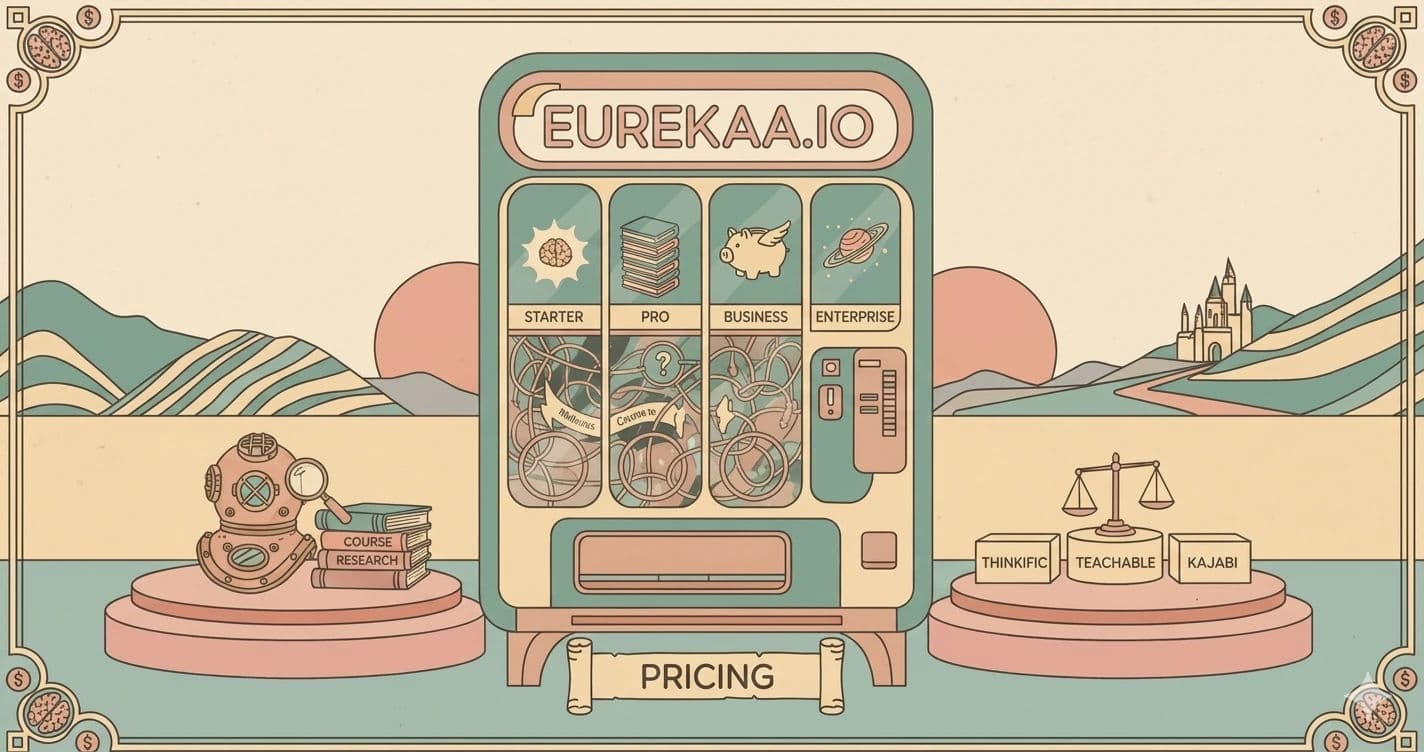
Eurekaa.io is not a direct competitor to Thinkific, but rather an essential complementary tool. Before you spend hundreds of hours building a course on Thinkific, Eurekaa.io allows you to conduct deep market research, validate your course topic, and analyze competitor curriculums to ensure market demand.
FlexiQuiz is a specialized assessment tool. While Thinkific has native quizzes, they are relatively standard. If you are running compliance training or high-stakes academic courses that require timed exams, complex grading logic, and secure testing environments, you will want to integrate FlexiQuiz into your Thinkific architecture.
Find Perfect Software for Your Business
The Honest Verdict: Pros and Cons of Thinkific
Before committing your business to Thinkific, you must clearly understand where the platform excels and where its architectural limitations will cause friction.
Where Thinkific Excels (The Pros):
Zero Transaction Fees: Across all paid plans, Thinkific allows you to keep 100% of your revenue, making it highly cost-effective for high-volume creators.
The App Store Ecosystem: The ability to seamlessly integrate with industry-leading tools (ActiveCampaign, Shopify, Zapier) prevents technical debt and allows your tech stack to grow with your business.
Platform Stability: During high-traffic launch periods, Thinkific’s infrastructure is incredibly reliable. Load-speed tests consistently show fast course player performance across global regions.
Advanced Course Customization: The ability to mix various content types (video, text, downloads, surveys) and easily update curriculums without breaking existing student progress is top-tier.
Digital Product Flexibility: Superior handling of standalone downloadable products compared to legacy competitors.
Where Thinkific Falls Short (The Cons):
Weak Native Marketing Tools: The built-in email features are inadequate for sophisticated marketing funnels. You are practically forced to pay for a third-party CRM.
Template-Based Site Builder Limitations: While functional, the native website builder can feel rigid. Creating a truly unique, bespoke brand identity often requires hiring a developer to write custom CSS/HTML.
Tax Compliance Overhead: Unlike Teachable, Thinkific does not act as the merchant of record. Managing complex global VAT/GST requirements requires integrating and paying for external tax software.
Community Depth: While Thinkific Communities are good for basic Q&A, they lack the deep gamification and algorithmic engagement features found in dedicated community platforms.
Try AuthenCIO
Move to faster, smarter software evaluation with AI
Final Decision: Should You Build Your Business on Thinkific?
In 2026, Thinkific remains one of the most powerful, reliable, and scalable course platforms on the market, but it is not a one-size-fits-all solution.
If you are a solo creator looking for an "all-in-one" magic bullet that handles your email marketing, sales funnels, and course hosting in one simple dashboard, Thinkific will frustrate you. You will be better served by the consolidated ecosystem of Kajabi.
However, if you are a decision-maker treating your digital products like a serious software business, Thinkific is an exceptional foundation. It provides a rock-solid, highly customizable learning environment that integrates flawlessly with the best marketing and analytics tools on the internet. By leveraging Thinkific’s App Store and zero-transaction-fee model, you can build a bespoke, high-converting tech stack that scales infinitely without eating into your profit margins.
Key Takeaways
Thinkific is best for creators who want a specialized, highly customizable LMS and are willing to integrate third-party marketing tools.
The zero-transaction-fee model makes it incredibly cost-effective for high-volume sellers.
To maximize the platform, you will need to leverage tools like Zapier or Make to connect your external tech stack.
Migration Readiness Checklist
If you are ready to make the switch to Thinkific, ensure you have the following prepared:
Exported Student Data: Download your current student list as a CSV file, ensuring you capture first names, last names, and email addresses.
Tech Stack Audit: Identify which third-party email CRM (e.g., ActiveCampaign) and analytics tools you will connect via the App Store.
Payment Gateway Setup: Have your business details ready to configure Thinkific Payments for seamless checkout flows.
Content Inventory: Organize your raw video files, PDFs, and assessments in a cloud drive for rapid uploading into the drag-and-drop builder.
Domain Configuration: Secure access to your DNS settings to point your custom domain to Thinkific's servers.
For the scaling creator who values flexibility, ownership of data, and best-in-breed integrations, Thinkific is still a premier investment.