.webp&w=64&q=75)
Introduction
The demands of virtual events have shifted dramatically. As an event planner managing large-scale virtual summits—defined in today's landscape as complex events hosting anywhere from 5,000 to 20,000+ concurrent attendees—you know the stakes are incredibly high. Furthermore, 2026 summits frequently incorporate hybrid components, requiring a seamless, synchronized bridge between your physical event hub and your massive online audience. Finding the best virtual summit software 2026 has to offer is no longer just about stable video streaming; it is about orchestrating a multi-layered, interactive attendee journey that delivers measurable value to sponsors.
Key Takeaways:
Accessibility: Livestorm excels in frictionless, browser-based access, significantly reducing technical onboarding issues for high-profile speakers.
Marketing Alignment: Deep CRM integrations and automated workflows make it a powerhouse for post-summit lead generation.
Scale Limitations: While highly polished, its native multi-track agenda management requires workarounds compared to specialized summit platforms.
Budget Impact: Enterprise pricing scales rapidly at high attendee counts, requiring careful analysis of bandwidth overages.
Streamline your software evaluation process
Planning a massive online event requires a platform that balances technical resilience with an exceptional user experience. If your platform crashes during a peak keynote, or if it creates high friction for non-technical speakers trying to join the virtual stage, your summit's reputation is immediately on the line. Known historically for its sleek interface and strong marketing integrations, Livestorm has evolved significantly to capture the enterprise summit market.
In this comprehensive Livestorm review 2026, we will dissect its capabilities, evaluate its pricing structures, and compare it directly against top competitors to help you make a confident, data-backed purchasing decision.
Tool | Best For | Pricing ($) | Key Features | Use Cases |
Livestorm | Browser-based mid-to-large events | Free, Starts from $1200/year | Automated workflows, deep CRM integration | High-end B2B summits, hybrid events |
WebinarJam | High-capacity broadcasts | Starts from $49/month | Up to 5000 attendees, panic button | Massive live sales, global broadcasts |
Zoom Webinars | Familiarity & stability | Free, Starts from $17/month | High reliability, massive scale | Corporate town halls, massive global summits |
GoToWebinar | Legacy corporate events | Free, Starts from $69/month | Robust security, simulated live | Traditional corporate training |
Demio | Marketing-focused ease of use | Free, Starts from $63/month | Engagement tools, seamless UI | Marketing events, product demos |
WebinarGeek | GDPR-compliant EU events | Free, Starts from $69/month | EU hosting, easy setup | European audience events |
BigMarker | Massive interactive summits | Custom | No-download 10k+ capacity, multi-track | Large-scale multi-day virtual summits |
Note: All prices shown reflect typical monthly billing. Vendors often offer lower pricing for annual commitments, but those discounts are excluded here for easier comparison. Actual costs may vary depending on your requirements, usage volumes, and negotiated terms.
Software covered in this article
To help you understand Webinar & Virtual Event Platforms in the right context, this article refers to a carefully curated set of key players:


Livestorm Core Features: Built for Large-Scale Events?
When evaluating a platform for a large-scale virtual summit, surface-level features are not enough. Event organizers need to know how the software performs under the hood, especially when thousands of attendees log in simultaneously and sponsors demand visibility.
1. Seamless Browser-Based Access for Global Audiences
One of Livestorm's most significant advantages is its frictionless, 100% browser-based architecture. In 2026, forcing attendees or speakers to download bulky desktop applications is a surefire way to decrease attendance rates and increase technical support tickets. Livestorm utilizes advanced WebRTC technology, allowing users to join high-definition streams directly from Chrome, Safari, or Edge without any plugins.
For event planners, this means significantly lower friction for non-technical speakers when joining the virtual stage. However, it is vital to note that browser-based stability for high-definition 4K streaming relies heavily on the user's local hardware memory. While Livestorm has optimized its video routing, stress-test data indicates that concurrent stream stability can occasionally dip for users on older machines when attendee counts surpass 5,000 in a highly interactive session.
2. Advanced Engagement Tools and AI Matchmaking
Screen fatigue is a critical pain point for long-form, multi-day summits. Livestorm combats this with a robust suite of engagement tools. Beyond the standard polls, Q&A, and upvoting features, Livestorm has introduced enhanced interactive elements designed to keep audiences active.
Furthermore, their integration of AI-driven networking and automated matchmaking features allows attendees to connect with peers based on shared interests and professional backgrounds. While not quite as immersive as emerging 3D or VR-enabled event platforms, these engagement tools are highly effective for professional B2B summits. Interactive features are paramount for modern event planners, making engagement a direct driver of lead qualification and attendee retention.
3. Sponsor Visibility and ROI Tools
For large-scale summits, sponsor revenue is the lifeblood of the event. Event planners must be able to prove ROI to stakeholders, which requires sophisticated sponsor visibility tools. Livestorm allows for deep white-label branding customization, enabling you to prominently feature sponsor logos across registration pages, email cadences, and the live stream environment itself.
While Livestorm does not offer a native, 3D-navigable "Virtual Exhibit Hall," it compensates by allowing organizers to create dedicated sponsor sessions, inject in-stream banner ads, and utilize custom CTA buttons that drive traffic directly to sponsor landing pages. Crucially, Livestorm's lead attribution tracking ensures that if an attendee clicks a sponsor link or attends a sponsored breakout room, that data is captured and easily exportable.
4. Global Accessibility and Interpretation
As summits scale globally, accessibility is no longer optional; it is a strict 2026 requirement. Livestorm has made significant strides in global accessibility, offering robust screen reader compatibility and high-contrast UI options.
More importantly for international summits, Livestorm supports integrations for live captioning and simultaneous interpretation. Event planners can route multiple audio tracks, allowing attendees to select their preferred language in real-time without leaving the primary browser window. This seamless multi-lingual support is a massive advantage for global enterprise events.
5. Enterprise-Grade Analytics and CRM Integration
Extracting granular, real-time attendee engagement data is essential. Livestorm tracks everything from attendance duration to specific poll responses and chat participation.
Livestorm's API flexibility and native integrations with modern CRM and marketing automation stacks (like HubSpot, Salesforce, and Marketo) are practically unmatched in the virtual event platform reviews space. You can build custom attendee portals and dashboards, ensuring that every piece of behavioral data flows seamlessly into your marketing ecosystem. Livestorm's automated workflow capabilities are incredibly valuable for extending the lifespan of your summit content, turning live sessions into gated, on-demand lead generation assets.
2026 Pricing Breakdown: How Much Will Livestorm Actually Cost You?
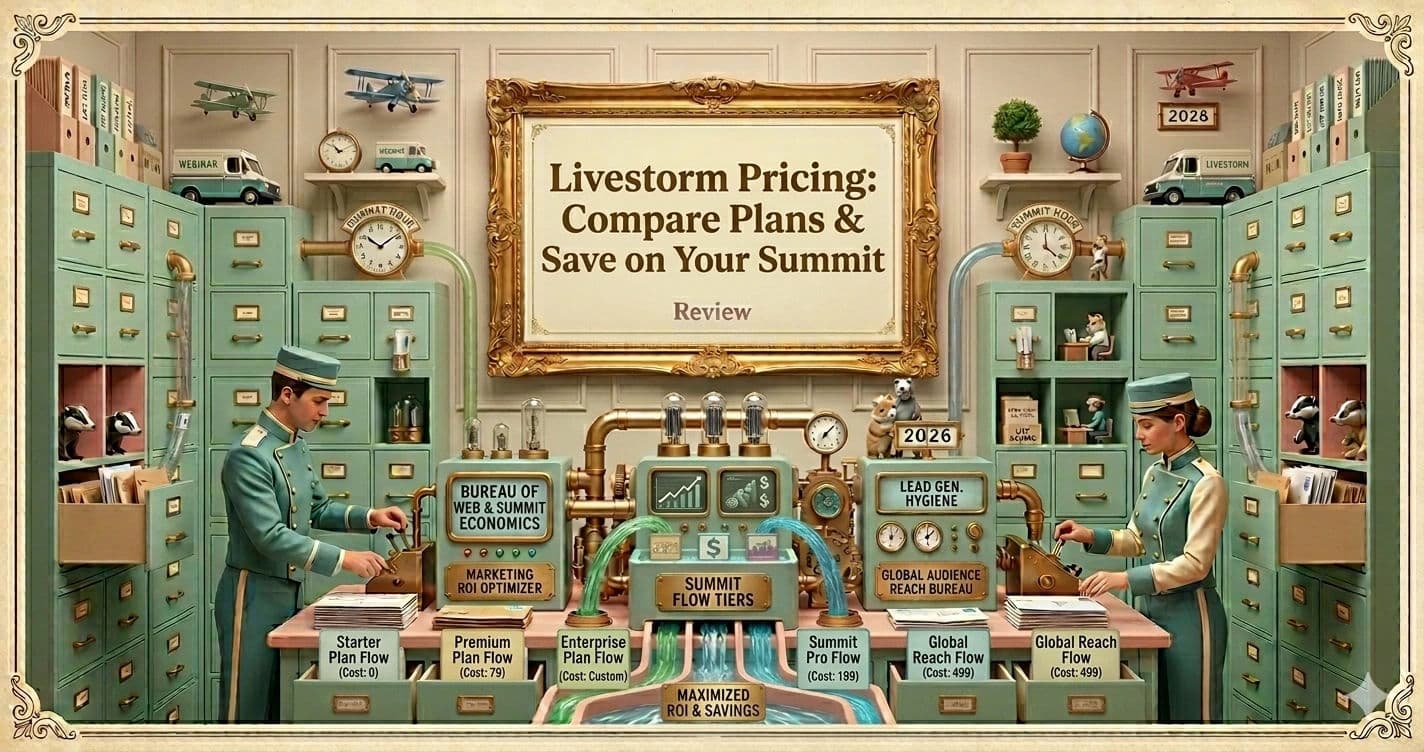
Understanding Livestorm pricing 2026 is crucial, as costs can escalate quickly for massive audiences. Livestorm operates on a freemium model for basic use, but large-scale summit planners will immediately need to look at the Custom Enterprise tiers.
1. The Base Costs versus Enterprise Reality
The Pro plan starts around $99 per month, while the Business plan hovers closer to $299 per month. However, these plans come with strict active contact and concurrent attendee limits (often capped at 500 or 1,000 attendees).
For an influencer or event planner hosting a summit with 5,000 to 20,000+ concurrent users, you will require a Custom Enterprise plan. This is where unbiased analysis of hidden costs becomes critical. Enterprise pricing is quote-based and heavily dependent on your expected bandwidth, registration volume, and required integrations.
2. Hidden Costs, Overages, and Registration Fees
When budgeting for Livestorm, you must account for potential bandwidth overage fees. If your summit goes viral and attendance spikes beyond your contracted limit, you may be hit with premium overage charges. Additionally, while basic support is included, access to premium, dedicated event support tiers—which are highly recommended for global summits to manage live-streaming latency issues—will add a significant premium to your annual contract.
Another critical factor for summit planners is ticketing. While Livestorm integrates seamlessly with payment gateways like Stripe, you must account for third-party transaction fees. Fortunately, Livestorm does not natively take an additional percentage cut of your ticket sales, but the cost of maintaining the enterprise software alongside your payment processor must be factored into your overall event budget.
Livestorm Alternatives: Comparing the Legacy Giants
When choosing a platform, many event planners default to the legacy giants due to brand recognition. However, comparing Livestorm vs competitors directly reveals stark differences in user experience and modern capabilities.
1. Livestorm vs. Zoom Webinars 2026: UX vs. AI and Legacy Stability
Zoom Webinars remains a dominant force for raw stability. If you are hosting a massive global event with over 50,000 concurrent users, Zoom's app-based infrastructure is incredibly resilient. User sentiment surveys from event planners note that Zoom rarely crashes under extreme load. Furthermore, Zoom has aggressively rolled out 2026 AI features, including advanced AI companions and automated session summaries, narrowing Livestorm's technological edge.
However, Zoom's user experience still feels distinctly corporate. It requires attendees to download an application or deal with a heavily restricted browser version. Livestorm, by contrast, offers a beautiful, modern, and fully branded browser experience. Livestorm allows for deep white-label branding customization for multi-track virtual summits, whereas Zoom's branding options remain somewhat rigid. If your priority is a frictionless, aesthetically pleasing experience that feels like a premium summit, Livestorm wins. If absolute stream stability for 50,000+ people is your sole metric, Zoom Webinars holds the edge.
2. Livestorm vs. GoToWebinar 2026: The Modern Shift
GoToWebinar has been a staple in the corporate training world for over a decade. It offers robust security and a familiar interface for older demographics. However, in 2026, GoToWebinar feels outdated compared to modern enterprise webinar solutions.
Livestorm's engagement tools, automated summit capabilities, and CRM integrations run circles around GoToWebinar's legacy framework. Furthermore, Livestorm's analytics are far more actionable for modern event marketing teams. Unless you are locked into a legacy enterprise contract with GoTo, Livestorm provides a vastly superior experience for both the organizer and the summit attendee.
Livestorm Alternatives: The Modern Contenders
To make a fully informed decision, we must evaluate Livestorm against other modern, browser-based platforms that are actively competing for the virtual summit market in 2026.
3. Livestorm vs. BigMarker 2026: Scaling for Summits
If there is one platform that directly challenges Livestorm for the large-scale virtual summit crown, it is BigMarker. BigMarker is explicitly designed for massive interactive summits. Like Livestorm, it is entirely browser-based and requires no downloads.
The critical differentiator—and potential dealbreaker for a complex 3-day summit—is multi-track agenda management. BigMarker natively supports complex, multi-day, multi-track agendas straight out of the box. Attendees can seamlessly navigate a virtual lobby and choose between five concurrent stages. Livestorm, while capable of hosting concurrent sessions, requires more workflow workarounds and manual routing to achieve a true multi-stage feel.
BigMarker also comfortably handles 10,000+ attendees with excellent browser-based stability. While Livestorm has superior native CRM integrations and a slightly more intuitive UI for single-track events, BigMarker often provides better specialized features specifically for complex, multi-stage virtual conferences.
4. Livestorm vs. WebinarJam 2026: The Broadcast Powerhouse
WebinarJam is built for high-capacity broadcasts and live sales environments. It is famous for its direct-response marketing features, such as limited-time offers, sticky announcements, and a 'panic button' that instantly boots all attendees into a new live room if technical issues occur.
For a professional B2B virtual summit, WebinarJam's interface can feel a bit too focused on aggressive sales tactics. Livestorm offers a much cleaner, more professional environment suitable for high-level corporate sponsors and thought-leadership keynotes. Additionally, Livestorm's automated and on-demand capabilities are far more refined, making it better suited for long-term summit content repurposing.
5. Livestorm vs. Demio and WebinarGeek 2026: The Marketing Focus
Demio and WebinarGeek are excellent platforms, but they are generally better suited for smaller, marketing-focused events rather than massive virtual summits. Demio shares Livestorm's passion for a beautiful, frictionless user interface and excellent engagement tools. However, Demio's maximum attendee limits are lower, making it a risky choice for a large-scale summit with thousands of concurrent users.
WebinarGeek is a strong contender if your primary concern is strict European hosting and GDPR compliance, as it is built from the ground up for the EU market. Yet, Livestorm also maintains rigorous GDPR compliance and offers a much broader feature set for complex event routing and API flexibility. For a large-scale event planner, Livestorm is the more robust, enterprise-ready choice.
Find Perfect Software for Your Business
Pros and Cons: Where Livestorm Shines and Where It Falls Short
To help you finalize your platform evaluation, here is an objective, scannable breakdown of Livestorm's strengths and weaknesses for large-scale event planners in 2026.
Where Livestorm Shines:
Zero-Friction Access: The 100% browser-based architecture eliminates download barriers, ensuring high attendance rates and easy onboarding for non-technical speakers.
Exceptional UI/UX: The platform is incredibly polished, offering white-label branding customization that elevates the perceived value of your virtual summit.
Deep Marketing Integrations: Native, seamless syncs with HubSpot, Salesforce, and Marketo make extracting real-time attendee engagement data effortless for sponsor reporting.
Global Accessibility: Strong support for live captioning and simultaneous interpretation routing.
Robust Compliance: Current SOC2 Type II and GDPR compliance statuses provide peace of mind for global, enterprise-grade events.
Where Livestorm Falls Short:
Multi-Track Complexity: Setting up complex, simultaneous multi-track agendas is not as natively intuitive as it is on specialized summit platforms like BigMarker.
Lack of a Native Virtual Exhibit Hall: Planners looking for a 3D-style networking floor or immersive sponsor exhibit hall will find Livestorm's 2D interface lacking compared to specialized virtual environment platforms.
Hardware Dependency: High-definition 4K streaming without plugins relies heavily on the attendee's local computer memory, which can cause varied experiences across your audience.
Premium Pricing: Enterprise-level plans are expensive, and hidden costs like bandwidth overage fees can impact your summit's overall ROI.
Try AuthenCIO
Move to faster, smarter software evaluation with AI
Final Verdict: Should You Choose Livestorm for Your Next Virtual Summit?
Choosing the right virtual event platform in 2026 comes down to balancing your technical requirements with your logistical summit goals.
If your primary goal is to host a massive, 50,000-person global broadcast where absolute stream stability is the only metric that matters, you may still need to rely on the app-based infrastructure of Zoom Webinars. If you are building a highly complex, 3-day, multi-track virtual conference, BigMarker might offer a more specialized toolset for your specific routing needs.
However, if you are an event planner managing a large-scale virtual summit (ranging from 5,000 to 20,000 attendees) and your priorities are a flawless, frictionless attendee experience, premium white-label branding, and deep CRM integrations to prove ROI to your sponsors, Livestorm is an exceptional choice. It bridges the gap between powerful marketing automation and professional broadcast quality better than almost any other platform on the market today.
Pre-Purchase Stress Test Checklist
Before signing an enterprise contract, we highly recommend event planners run through this technical checklist:
Run a Simulated Load Test: Push 1,000+ concurrent simulated users into a test room to evaluate browser latency.
Test Speaker Onboarding: Have a non-technical user join the virtual stage from a low-end, older laptop to verify hardware dependency limits.
Verify CRM Data Sync: Ensure custom registration fields map perfectly to your specific Salesforce or HubSpot instance.
Audit Sponsor Visibility: Check how in-stream banner ads and sponsor logos render on mobile devices.
Test Interpretation Latency: If using simultaneous translation, measure the audio delay on secondary language tracks.
Take the time to assess your specific attendee capacity limits, your speaker technical capabilities, and your sponsor data requirements. By aligning these factors with the insights provided in this review, you can confidently select the platform that will make your 2026 virtual summit a resounding success.